

Home & Decor Blogs: DIY, Interior Design & Lifestyle Ideas
Your Patio Has A Warm Chair And A Cold Chair, And The Changing Sun Angle Is A Big Part Of It

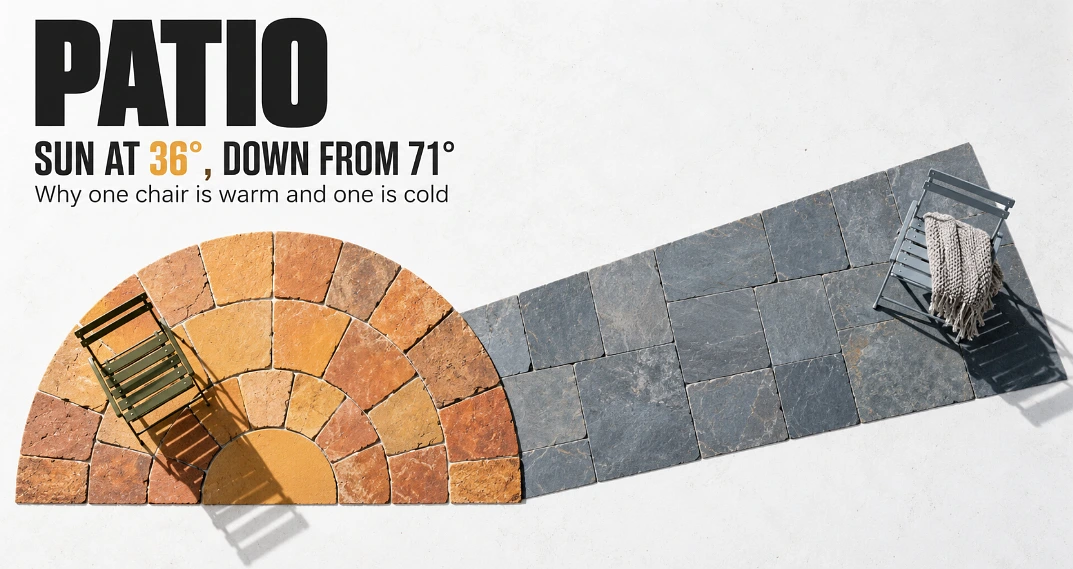
Sit out on the patio around lunchtime this week and you’ll probably notice the chair by the back door has the sun right in your eyes while the one over by the fence is in shade and feels cold enough for a jacket. In July it was more or less the other way round. Nothing in the yard moved. The sun’s a lot lower now, and that’s a big part of it.
A patio packs a lot into a small space, a slab of concrete, the back wall, a glass slider, a fence, maybe a tree, all within 20 feet or so. Each one changes how hot or cold or windy it feels in the spot next to it, and people call that a microclimate. We went through the EPA’s heat island pages, a University of Nebraska guide on windbreaks and a paper from the Vinyl Siding Institute, and did the sun math for southern Michigan. Between them they explain most of what goes wrong on a patio.
How high the sun gets over your patio
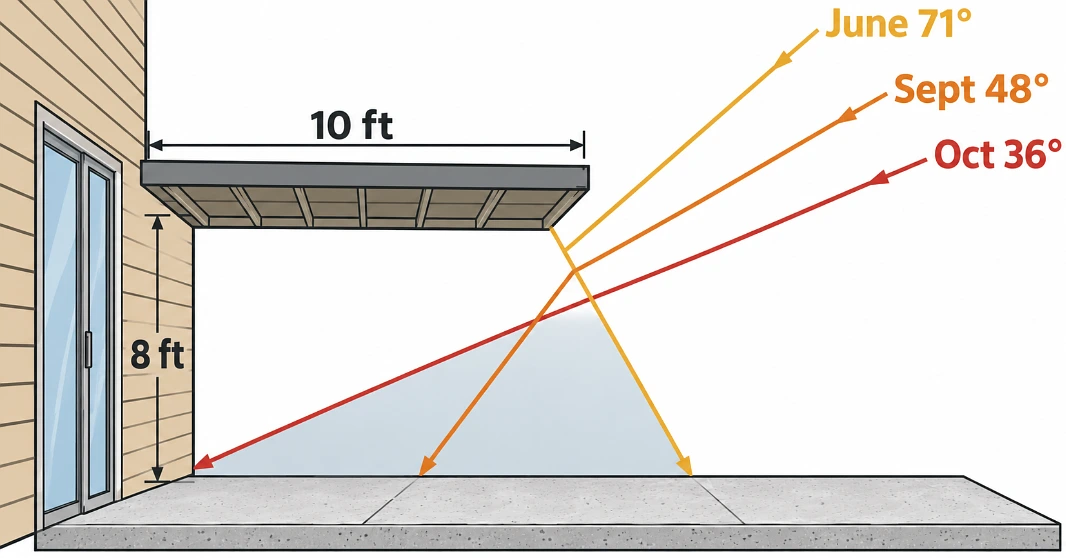
Around Detroit you’re at about 42 degrees north. Work it out and the sun at solar noon (closer to 1 in the afternoon on the clock) is about 71 degrees up in late June, about 48 in March and September, about 36 right now in late October, and down to about 24 the week before Christmas. In summer it’s nearly overhead and the shadows are short and tucked in close to the house. In winter it comes in so low across the yard that the shadow off the fence goes halfway to the neighbor’s.
The shade you had over the patio in June was set up for a sun 35 degrees higher than it is today. The umbrella, the pergola, the overhang on the roof were all doing their job at 71, and now the sun’s getting in under them at 36.
| Date | Sun height at noon |
|---|---|
| March 20 | about 48° |
| June 21 | about 71° |
| September 22 | about 48° |
| October 22 | about 36° |
| December 21 | about 24° |
Say you’ve got an awning 8 feet up the back wall sticking out 10 feet over a south-facing patio. At solar noon in late June it shades the ground from the wall out to about 7 feet. Come September that’s down to under 3 feet, and by now the solar noon sun comes in under the front edge and lands on the slab right up to the bottom of the wall, though the slider itself is still mostly in shade. In October you want that. It’s just not what most people expect from an awning.
It moves side to side too. In June the sun goes down well over in the northwest, so if your patio faces west you’re getting it low and hot in your face at 7 in the evening when you’re trying to eat. By December it sets in the southwest around 5 and you’re barely home.
The slab keeps cooking after the sun goes
The EPA says regular paving can get to somewhere between 120 and 150°F on a summer afternoon. The app on your phone says 85, you walk out barefoot to the grill, and the concrete under you can be a whole lot hotter, up toward 150 on the worst days. Everybody’s done it once.
Then the sun goes down and you figure it’s cooled off, so you bring dinner out, and there’s still warmth coming up off the ground at 9 o’clock. Concrete and stone hold the heat all day and let it go slowly through the evening. A patio that felt fine under the umbrella at lunch can feel stuffy after dark for exactly that reason.
Color has a lot to do with how much it takes in. Caltrans put out a summary on cool pavements with figures from the American Concrete Pavement Association for how much sunlight different surfaces bounce back:
- new asphalt, about 5 to 10 percent
- older asphalt, about 10 to 15 percent
- new gray concrete, about 35 to 40 percent
- older gray concrete, about 20 to 30 percent
A light new concrete patio throws back a lot more sun than a blacktop driveway, and it slowly gets worse at it as it ages and gets dirty. Dark pavers and dark stained concrete look nice and hold a lot of heat. A light colored outdoor rug where your feet go under the table can make that part feel cooler, though it depends a lot on what the rug’s made of and how thick it is.
Shade yourself now, and shade the slab early for a cooler evening
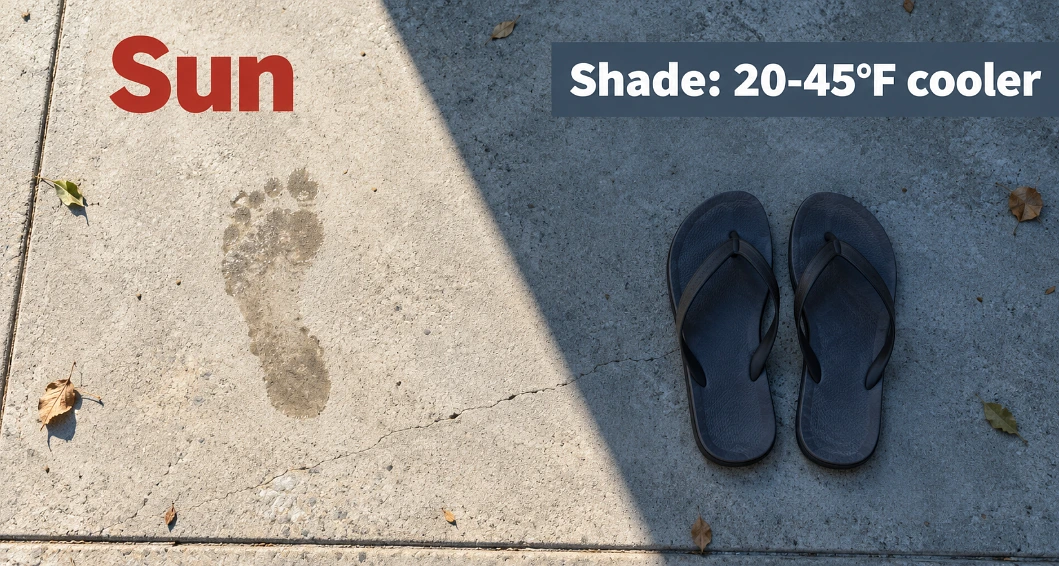
The EPA’s page on trees says shaded surfaces can run 20 to 45°F cooler than the identical material sitting in full sun. Think about what that means for an umbrella. It keeps the sun off you, and that matters a lot, but the concrete all around the table has been out in it since 11 and it’s giving all of that back up at you.
Get shade onto the slab early in the day and it never stores the heat in the first place, so the evening’s cooler too.
A tree does that well, and the leaves cool the air on top of it. The EPA puts that at 2 to 9°F off peak summer temperatures. Only it takes years to get big enough, and you can’t move it when you figure out it’s in the wrong spot.
An awning gets you shade a lot sooner than waiting on a tree. We spoke with someone at Marygrove, who put up patio awnings around Michigan, about how they work out what a yard needs. The first thing they ask is which way the patio faces and when people use it, because a family eating at 6 on a west-facing deck has a totally different problem from somebody drinking coffee out back at 8 in the morning. They said plenty of people like one they can roll back in spring and fall, when you want that low sun on the patio and coming in through the back door.
Green Newton, an environmental group in Massachusetts, passes on Department of Energy numbers saying an awning can cut the summer solar heat coming in through windows by up to 65 percent on the south side and 77 percent on the west. Light colored fabric bounces more of it. They also say if you leave it out all winter you can end up spending more on heat, so up here the roll-back kind makes more sense.
Fall is when the low sun is on your side
Right now the stuff that bugs you in July comes in handy. That slab that held heat all evening in August is soaking up what it can from a 36 degree sun and giving it back around 4 or 5 when it starts getting chilly, so the chairs closest to the concrete and the house wall are the warm ones. Pull them in there. A south-facing brick or stone wall soaks it up too and it’s nice to sit against in the late afternoon. If you’ve got an awning that rolls back, roll it back now and leave it until May. The sun gets onto the slab and in through the slider, and you get a few more weeks out of the patio before it’s too cold.
When the sliding door is throwing sun at you
Most people have one chair near the slider that gets weirdly hot for where it is. It’s the glass. Some sun bounces off it and lands on whatever’s in front of it.
The Vinyl Siding Institute wrote a paper on this because it’s been warping siding. Low-E glass, the energy saving coating on most newer windows and patio doors, bounces back more sunlight than plain glass. Pressure differences across a sealed double pane unit can make the glass bow in a little, and the paper says that turns it into a slightly curved mirror that focuses the beam. They do say it usually takes other things going on too before it damages anything, so plenty of houses never see it. But if a plastic chair by your door has gone wavy, or the neighbor’s siding has, reflected sun off the glass is one thing worth checking. See if the warped bit lines up with where the reflection falls in the afternoon.
On the patio you mostly notice it as a hot spot that turns up at one time of day, usually afternoon when the sun hits the door at the right angle. Shade the glass from outside and it stops. Moving the chair a few feet out of the line of it works too.
A fence with gaps blocks the wind better than a solid one
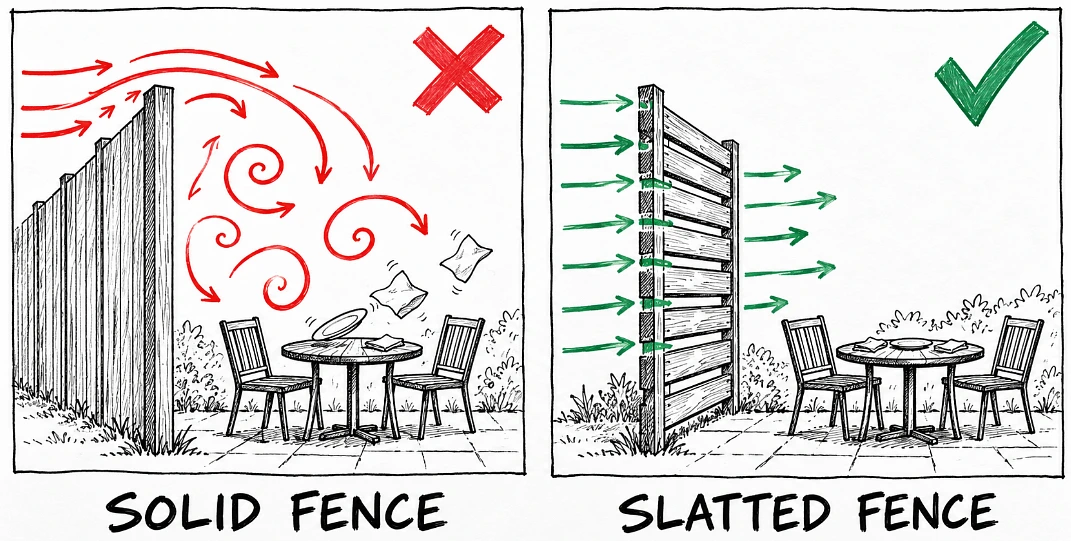
You’d think a solid privacy fence or a block wall would kill the wind on the patio, and then you put it up and the napkins still go flying off the table. It’s the wall doing it.
The University of Nebraska has an extension guide on windbreaks. It’s written for tree windbreaks on farms, but the basic idea carries over to a backyard. It says a really solid barrier pulls the wind down behind it and stirs it up, so you get turbulence right where you’re sitting. Once a barrier gets past about 60 percent solid the turbulence on the sheltered side goes up, and under about 20 percent it hardly slows the wind at all. Around 40 to 60 percent covers the most ground behind it, and the guide says you can measure some slowing up to 30 times the height of the barrier downwind, though the real shelter is a lot closer in.
Go for a slatted fence, a lattice screen or tall planters with gaps between them and the patio’s usually calmer than behind a solid wall. Most of the calm is in the first few yards behind the screen, so put it fairly close to where you sit.
Summer’s the opposite problem, you want the breeze. Put a solid wall on the side the wind comes from and the air just sits there. Leave a gap between the planters on that side, or put a ceiling fan up if the patio’s covered.
Finding the hot spots on your own patio
Takes one sunny day and your phone. Weekend’s easiest.
- Stand in one spot and take a photo of the patio at around 10, 12, 2, 4 and 6.
- Each time, sit in each chair for a couple of minutes and notice if you’re squinting, sweating or wanting a sweater.
- If you’ve got one of those cheap infrared thermometers for cooking, point it at the slab in sun and in shade and write both down.
- That night, put the photos next to each other and look at where the shade is at the times you’re out there.
Do it once now and once next summer if you can, because the shadows move a long way between the 2. Usually there’s one seat that’s good at the time you use the patio and one that never is.
Move the chairs before you buy anything
Half the time it’s just the furniture. Pull the table out of the afternoon glare and over to wherever the house throws shade around dinnertime. Put the grill where the smoke and heat blow away from people and not across the chairs. If the slider’s bouncing sun onto one seat, move that seat and see. A couple of big planters in the right spot will block a low evening sun and break up the wind too.
After that you’re looking at a tree that’ll take years, an awning that’s up a lot sooner, or a pergola with a cover on it. Figure out which way the patio faces and what time you’re out there before you pick, so you’re not paying to shade the wrong corner at the wrong time of day.
 Decor & Improvement Accessories