

Home & Decor Blogs: DIY, Interior Design & Lifestyle Ideas
5 Expensive Home Decorating Mistakes That Can Lead to Financial Problems

Home decorating is supposed to make you happy. New furniture, fresh paint, a room that finally feels like yours. But somewhere between browsing Pinterest and swiping your credit card at the furniture store, things can go sideways fast.
Americans spent over $600 billion on home renovations in 2024 alone. That’s 50% higher than before the pandemic. And a chunk of that spending happens on credit cards, where the average household now carries $9,326 in balances.
The home decor industry knows exactly how to make you feel like your couch is outdated or your kitchen is somehow wrong. Instagram and TikTok accelerate this feeling. One scroll through your feed and suddenly your perfectly fine living room looks shabby compared to some influencer’s professionally staged space. Understanding where the financial traps actually are can help you decorate without destroying your budget.
1: Furniture Financing That Looks Free But Isn’t
Walk into any furniture store, and someone will offer you a store credit card within five minutes. Zero percent interest for 12 months on that $3,000 sectional sounds like a smart way to spread out payments. The math seems simple. Pay $250 a month, and you’re done before interest kicks in.
Here’s where people get burned. Most furniture store promotions use something called deferred interest. This is completely different from a true 0% APR offer. With deferred interest, you’re not actually getting interest-free financing. The interest is silently accumulating in the background from day one. Pay off the full balance before the promotional period ends, and you dodge it. Miss that deadline by even a single day or leave even $50 on the balance? You get hit with all the interest that’s been building up since you bought the furniture.
The numbers are brutal. Store credit cards now average 30.14% APR, according to Bankrate’s 2025 Retail Cards Study. That’s nearly 1.5 times higher than regular credit cards. And 80% of store cards with promotional rates use deferred interest.
A CFPB study found that over 40% of consumers with subprime credit scores couldn’t pay off the balance before the promotional period ended. They got slammed with lump-sum retroactive charges. One furniture retailer’s terms spell it out clearly: fail to pay off a $6,800 purchase in 61 months, and you owe interest on the full amount at 35.99% going back to day one. The interest alone on that purchase could exceed $7,400.
People stack multiple furniture financing arrangements without thinking about it. One card for the living room. Another for the bedroom set. A third for that dining table. Suddenly, you’re juggling multiple payment dates and promotional deadlines. When something unexpected hits your finances, these payments become impossible to maintain.
2: Chasing Whatever Style is Trending This Month
Farmhouse everything was inescapable a few years back. Shiplap walls, rustic signs with inspirational quotes, distressed wood, everything. Then minimalism took over. Now warmer tones and vintage pieces are cycling back. Social media compresses these style cycles into weeks instead of years. Short-form video and influencer content can popularize micro-styles almost overnight.
The financial hit from constantly updating your home to match whatever’s trending right now goes beyond the obvious purchase costs. You’re discarding perfectly functional furniture and decor that could have served you for years. The median household spent $20,000 on renovations in 2024. Doing this repeatedly because your style feels dated every 18 months compounds into serious money.
Younger shoppers are most vulnerable here. Gen Z and millennial households allocate more discretionary spending to decorative items and show higher rates of replacing decor after viral trends emerge. About 61% of Americans regret impulse purchases made because of social media influence, and 70% of Gen Z and millennials report buyer’s remorse within six months of trend-driven purchases.
A couple renovates their living room for $15,000 to match the minimalist look dominating their feeds. Eighteen months later, warmer maximalist styles are everywhere, and their space feels cold and sterile. The furniture works perfectly fine. Nothing is broken. But it feels wrong because it no longer matches what they’re seeing online.
3: Renovations for Looks Instead of Function
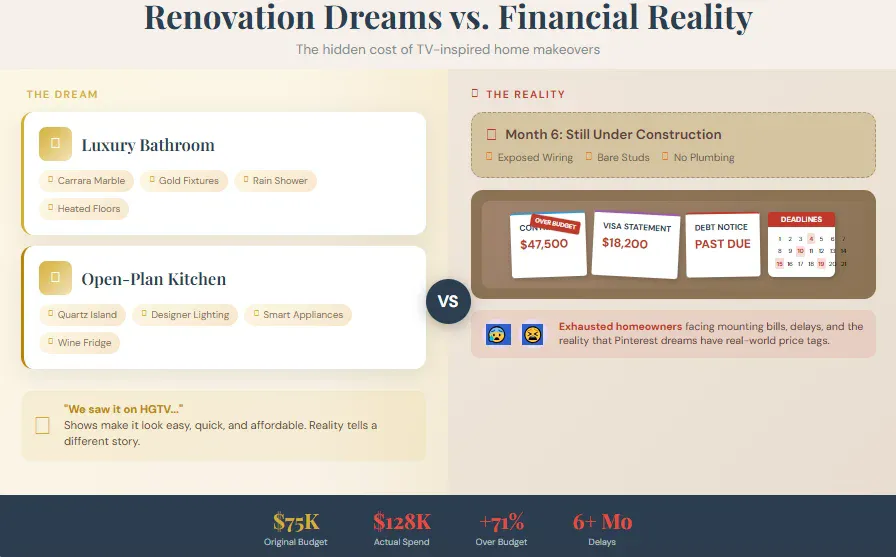
The line between necessary renovation and expensive indulgence gets blurry when you’re convinced your bathroom needs to look like a spa or your kitchen requires an open floor plan because that’s what everyone has on renovation shows.
Here’s the reality check: 78% of homeowners went over budget on their last project. Among them, 44% exceeded their budget by at least $5,000, and 35% went over by $10,000 or more. Nearly two-thirds of homeowners have gone into debt to pay for renovations.
Purely decorative renovations rarely return their cost if you sell. A mid-range kitchen remodel averaging $79,982 recovers only about 49.5% of that cost at resale. Bathroom renovations averaging $25,251 recoup around 73.7%. So that $80,000 kitchen upgrade might add $40,000 to your home’s value. The rest is money you’re not getting back.
Renovation timelines slip constantly. You’re living through disruption, eating out more because your kitchen is gutted, maybe paying for temporary housing. Every week the project runs over costs money beyond what’s in the contractor’s invoice.
Some homeowners end up in serious financial trouble when decorative renovations spiral. When the debt becomes unmanageable, selling might be the only practical option. Services like The Best Cash Home Buyer work with homeowners facing bankruptcy or severe financial challenges, buying properties quickly even when they’re burdened by incomplete renovations or over-personalized spaces that traditional buyers won’t touch.
4: Small Purchases That Add Up to Big Problems
That $25 throw pillow seems harmless. So does the $40 candle, the $60 vase, and the seasonal wreath for the front door. Home goods stores design their layouts to encourage exactly this kind of impulse buying. The “it’s only $25” thinking obscures what’s actually happening to your bank account.
Americans spend an average of $1,598 annually on home decor, according to Opendoor’s 2024 data. That’s separate from renovation spending. The average consumer makes about 6 impulse purchases per month, and those purchases average $282 monthly or $3,381 annually.
Seasonal decorating is particularly expensive. Fall decor, winter decor, holiday decor, spring refresh, summer update. Retailers have successfully sold the idea that your home should transform with the calendar. Storage units fill up with bins of seasonal items that get displayed for a few weeks, then packed away. That’s significant money invested in things that serve no practical purpose most of the year.
Americans discard over 12 million tons of furniture annually. More than 80% ends up in landfills, with only 0.3% recovered for recycling. The amount of furniture discarded has grown 450% since 1960. This isn’t just an environmental problem. It represents massive amounts of money thrown away on items that didn’t last or fell out of favor.
5: Decorating to Impress People Instead of Yourself
Social media creates a curated fantasy where everyone else’s home looks perfect. You’re comparing your actual living space to professionally photographed, edited, and staged rooms. The pressure to create something Instagram-worthy drives spending that has nothing to do with whether you actually like living in your home.
About 33% of consumers in surveys admit their decorating decisions are based on wanting a social media-worthy aesthetic. Neighborhood dynamics add physical world pressure on top of the digital comparison. When houses around you get major upgrades, the subtle competition can push you toward spending your budget that you can’t support.
This comparison-driven approach never ends. Someone always has nicer furniture. A bigger kitchen. Better taste. Trying to match external standards means permanent dissatisfaction with what you have and constant pressure to upgrade. The decorating becomes about validation instead of comfort.
The Financial Damage at a Glance
| Problem | Typical Cost Impact |
|---|---|
| Store credit card deferred interest trap | 30%+ APR charged retroactively on full purchase |
| Trend-chasing redecoration cycles | $15,000-$24,000 per major room refresh |
| Cosmetic renovation budget overruns | 44% of homeowners exceed budget by $5,000+ |
| Impulse home decor spending | ~$3,400 annually (average consumer) |
| Kitchen remodel value loss at resale | Recover ~74% of the $25,000 average cost |
| Bathroom remodel value loss at resale | 30%+ APR charged retroactively on the full purchase |
Decorating Without Destroying Your Finances
None of this means you should live in bare rooms with nothing on the walls. The point is buying with intention instead of impulse, setting realistic limits, and understanding that your home exists to support your life rather than impress strangers on the internet.
Buy quality pieces you genuinely love and can actually afford. Skip the store credit card and its deferred interest trap. Choose styles that feel right for you rather than whatever’s trending this month. Track what you’re actually spending on decor purchases because the small stuff adds up faster than you think.
If you’re already in financial trouble because of renovation debt or other housing costs, options exist. Working with cash buyers like The Best Cash Home Buyer can provide a path out when traditional selling isn’t viable.
The most expensive decorating mistake is letting your home become a source of financial stress instead of comfort. A modest space you can afford beats a showpiece that’s pushing you toward bankruptcy.
 Decor & Improvement Accessories