

Home & Decor Blogs: DIY, Interior Design & Lifestyle Ideas
5 Things to Think About Before Installing Bi-Folding Speed Gates
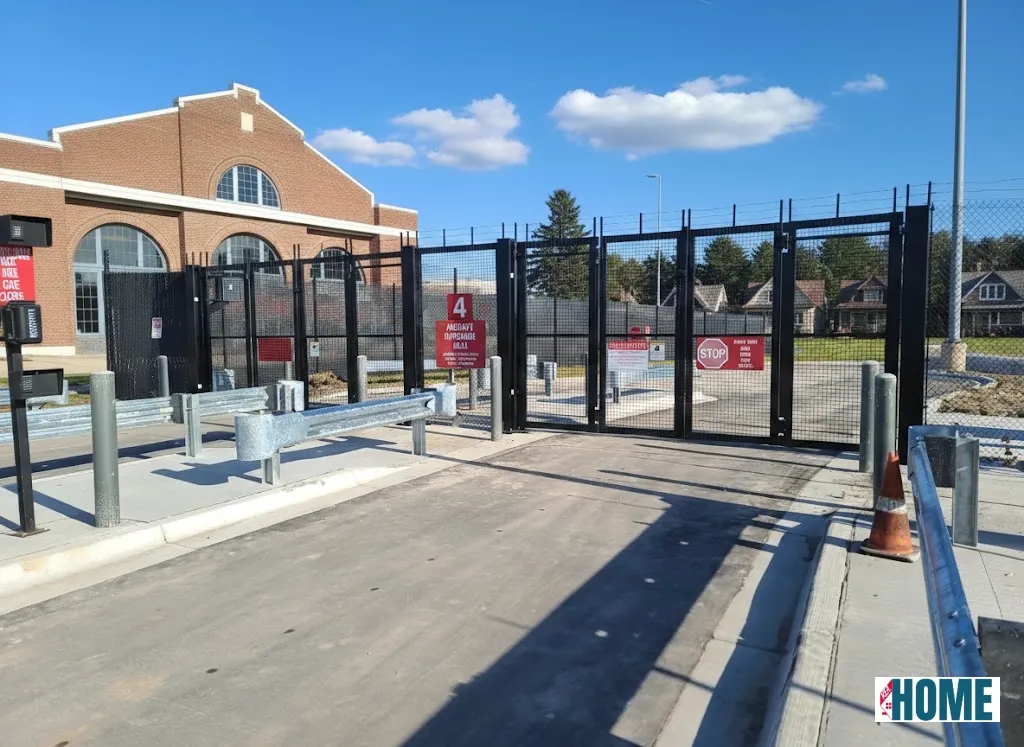
Most bi-folding speed gates open in about 3 to 8 seconds roughly twice as fast as a standard swing gate. That speed is the whole point. On a busy site where vehicles are queuing up and the entrance is a potential weak spot, you want the gate open and closed again as quickly as possible. Less time open means less time exposed.
They’re common on corporate campuses, logistics yards, data centres, government sites basically anywhere that needs proper access control without creating a traffic jam at the entrance. But the gate itself is only part of it. Where you put it, what it’s made of, how it connects to the rest of your security setup, and whether it actually meets safety regulations all of that determines whether the thing works properly or becomes a headache.
| Factor | Key Specs | What to Watch For |
|---|---|---|
| Space | Up to 30ft wide, 10ft high | Folding clearance, level ground, sturdy posts |
| Materials | Steel, aluminium, or wood | Corrosion resistance, weight on motors, security rating |
| Power | 115–230V, battery backup | Manual override, integration with access control |
| Safety | UL 325, BS EN 12453 | Sensors, emergency release, risk assessment |
| Speed | 3–8 second cycle | Reduced vulnerability window, smoother traffic flow |
1. Where the Gate Goes
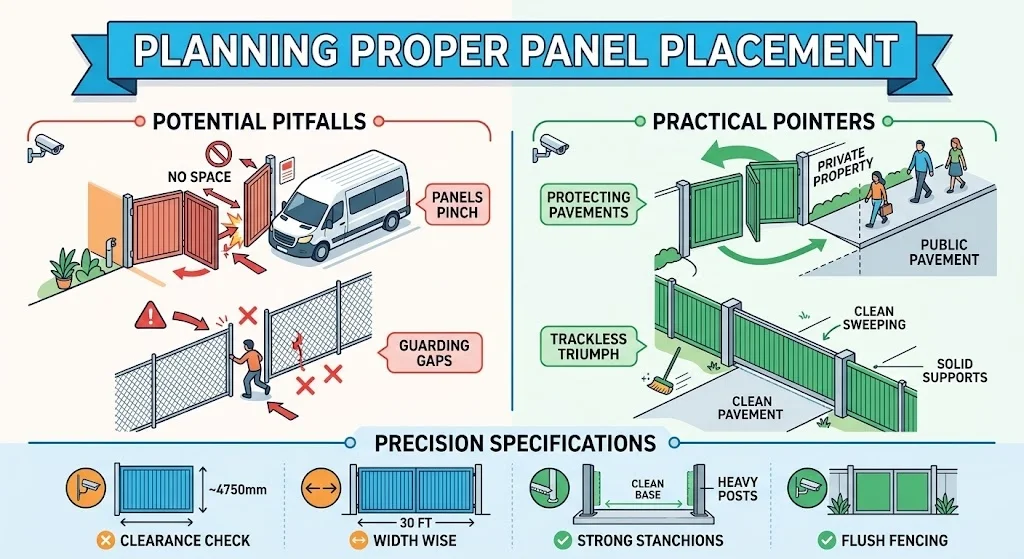
Sounds basic, but a surprising number of installations hit problems because someone didn’t measure properly or didn’t think about how vehicles and people actually move through the area. Bi-folding gates need space to fold. The panels swing inward or outward, and if there’s a wall, a post, or someone’s parked transit van in the way, it jams. Then you’ve got a queue building up and a security gap sitting wide open.
Single-leaf gates need around 4,750mm of clearance. Double-leaf setups can cover openings up to 30 feet wide and 10 feet high, which handles most commercial entrances. Trackless designs skip the ground rails entirely no grooves collecting rainwater and grit, no tracks to maintain but they do need flat ground and heavy-duty posts (200x400mm RHS steel is typical) to stay properly aligned over thousands of cycles.
Panels should always fold toward private property. You don’t want them swinging out onto a pavement where a pedestrian catches the edge. And if your site already has perimeter security fencing, the gate needs to sit flush within that fence line. A gap between the fence and the gate is exactly the kind of oversight that makes the whole perimeter pointless. The gate should be a continuation of the fence, not an afterthought bolted on next to it.
2. Connecting It to Everything Else
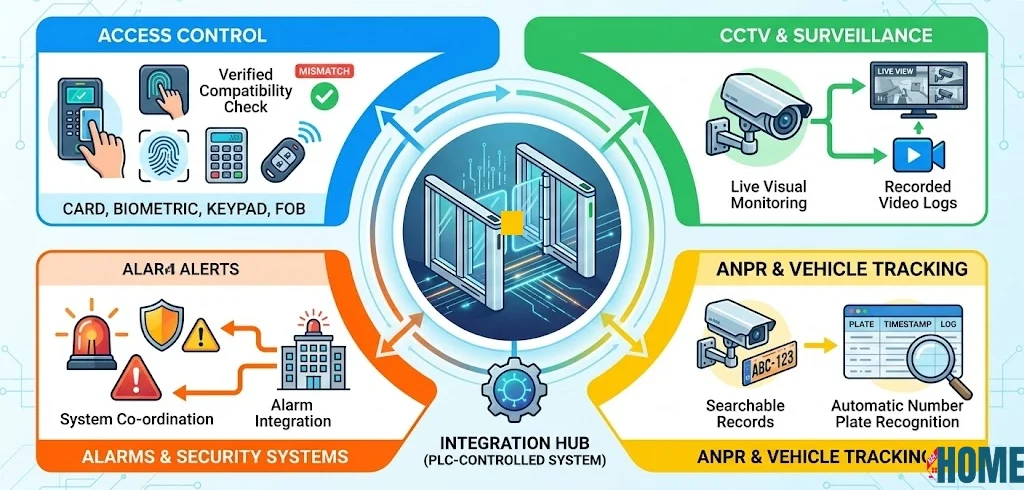
A gate that opens and closes is fine. A gate that’s wired into your CCTV, access control, ANPR cameras, and alarm system is actually useful. The difference is whether you’re just controlling a barrier or controlling who comes and goes with a record of every movement.
Your bi folding speed gates need to be compatible with whatever platform you’re already using for access control. Card readers, biometric scanners, fobs, keypads, remote operation most modern gates handle all of these through PLC-controlled systems, but you need to verify compatibility before the gate’s installed. Discovering a mismatch after installation means either expensive workarounds or ripping something out and starting again.
Linking CCTV to the gate is straightforward and worth doing. Security staff get a live view of every entry and exit without having to physically be at the gate. Add automatic number plate recognition and you’ve got a searchable log of every vehicle that’s passed through, timestamped and stored. If something happens on site, you can trace movements back in minutes rather than spending hours scrubbing through footage trying to find the right clip.
3. What It’s Made Of
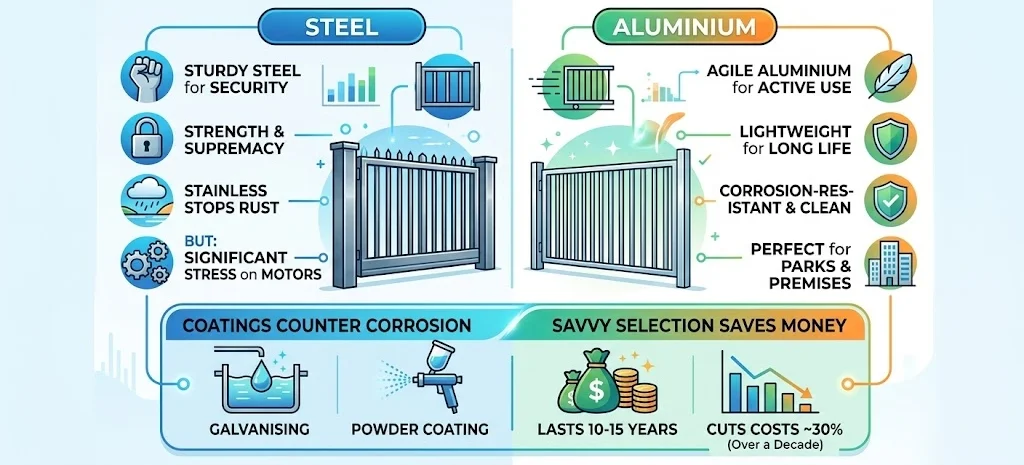
Material choice comes down to three things: how secure the site needs to be, what the weather’s like, and how much ongoing maintenance you’re willing to deal with.
Steel is the toughest and comes standard with high-security applications. Stainless steel, in particular, won’t rust on rainy days or in humid or coastal air, all of which can be factors when the gate may be outside 365 days a year. It is heavy, however, and extra weight takes a toll on motors and hinges more quickly.
The fact that Aluminium is lighter means that it does not stress the moving parts as much and the gate can cycle faster. It’s naturally more resistant to corrosion and requires less treatment. For the majority of commercial sites offices, car parks, distribution centres aluminium does the job as well without all the weight and associated drawbacks of steel.
Coatings help either way. The frame adds strength to the design, and the hot-dip galvanising/powder coating combination protects it from water damage, so you can feel like a maths operation owner not melted-down metal merchant. The last thing you want to do is send the wrong message about how serious you are about security, but the gate works fine except for looking corroded and un-cared-for.
With the right materials and regular maintenance, a quality installation lasts 10 to 15 years. Getting the material choice right upfront can also cut maintenance costs by around 30% over a decade, which adds up when you factor in engineer callouts and replacement parts.
4. Safety
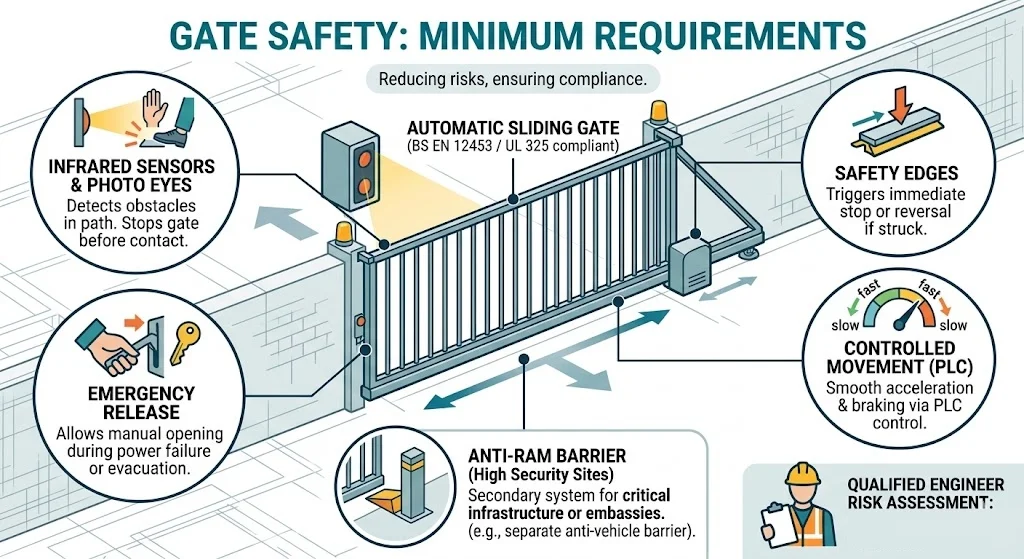
A gate that weighs several hundred kilos and moves at a metre per second can seriously hurt someone. That’s not a theoretical risk it’s why safety standards like BS EN 12453 and UL 325 exist, and why cutting corners on this bit is genuinely dangerous.
What every installation should have as a minimum:
- Infrared sensors and photo eyes these detect anything in the gate’s path and stop it before contact
- Safety edges pressure-sensitive strips on the leading panels that trigger an immediate stop or reversal if they hit something
- Emergency release a manual mechanism that lets someone open the gate by hand during a power cut, system crash, or evacuation
- Controlled acceleration and braking PLC-managed slowdown so the gate doesn’t lurch open or slam shut, which reduces both injury risk and mechanical wear
On sites with a higher threat level embassies, military facilities, critical infrastructure anti-ram barriers can sit behind or alongside the gate. The gate handles everyday access control; the barrier is there for the worst-case scenario where a vehicle tries to force its way through. They’re separate systems that work together rather than one replacing the other.
Every installation needs a proper risk assessment from a qualified engineer. Not a generic checklist an actual assessment of the specific hazards at your site. Certified installers (DHF level 2 or equivalent) handle alignment, grounding, sensor testing, and calibration before the gate goes live. Skipping this step to save time or money is how accidents happen.
5. Regulations and Standards
Nobody enjoys reading about compliance, but ignoring it creates two problems: the installation might not be safe, and if something goes wrong, the lack of documentation makes the liability situation far worse.
The main standards worth knowing:
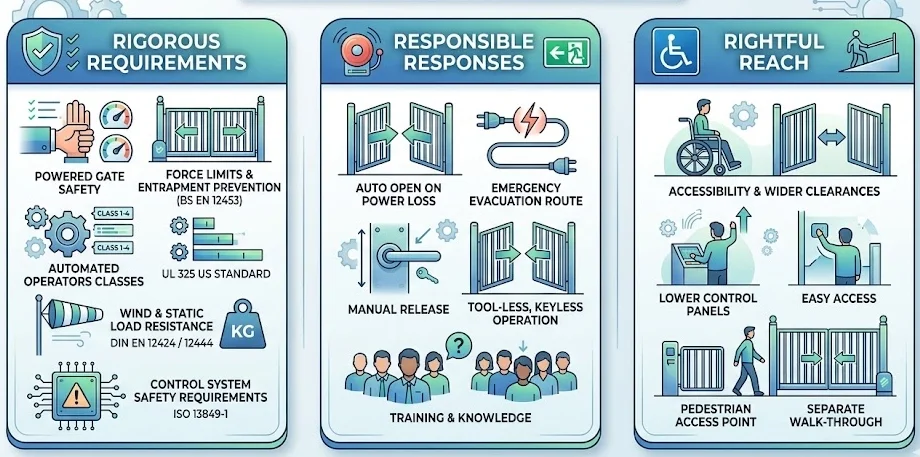
- BS EN 12453 powered gate safety, covering force limits and how to prevent entrapment
- UL 325 US standard for automated gate operators, split into four classes based on the type of use
- DIN EN 12424/12444 wind load resistance and static load capacity
- ISO 13849-1 safety requirements for the gate’s control system
- Local building codes fire safety, accessibility, structural requirements (these vary by area, so check with your local authority)
Fire regulations trip people up more than anything else. If the gate sits on an evacuation route, it has to open automatically when power is lost or there needs to be a manual release that anyone can operate without tools, keys, or training. During a fire evacuation is not the moment to discover that nobody knows how to open the gate manually.
Accessibility is the other one. If the public or employees with limited mobility need to pass through, the installation has to account for that wider clearances, lower control panels, maybe a separate pedestrian access point next to the vehicle gate. This isn’t just good practice; it’s a legal requirement in most jurisdictions.
A Note on Power
That’s not one of the five huge factors, but it intersects with several and elegant enough to be worth a quick walk-through. The motor wants to be hooked up to its own dedicated single-phase circuit at maybe 115–230 V, 50/60Hz (in your case), probably 15A or whatever. If you have larger or heavier gates, they might use three-phase.
It must have battery backup, not just be nice to have. When the power goes out, you want inaccessibility, and the gate needs to fail open (if it’s located along a fire escape route) or keep operating at least some of the time on available backup until someone responds to take charge. There should always be a key operated manual release as a final last resort.
Hydraulic drives are more expensive to buy than electromechanical ones, but are generally faster, quieter and cheaper to maintain over the long term. If the gate is cycling dozens or hundreds of times per day which is a normal rate for a busy commercial site hydraulic usually ends up being cheaper over the life of the system, even if it costs more than electromechanical initially.

 Decor & Improvement Accessories