

Home & Decor Blogs: DIY, Interior Design & Lifestyle Ideas
Create the Perfect Outdoor Space with a Pergola – Helpful Tips For You

Pamela Anderson put up a photo of herself not long ago sitting on the tiered wooden walkway that runs up to the pergola in her garden, dressed in white, and captioned it with something about how she thinks of life as a garden, you get to replant and start again and make it yours. Behind her the arched pergola is framing a little dining set, four green wire chairs and a table, herb and flower beds running up either side of the gravel path with small lamps tucked among them.
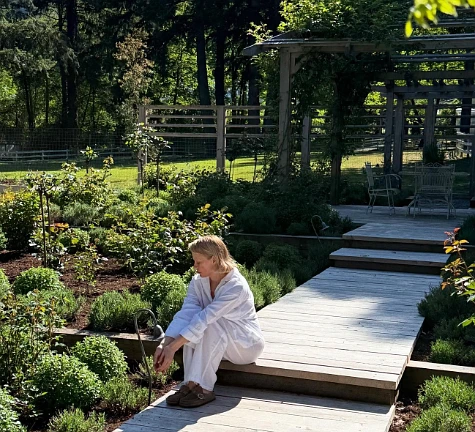
The thing is, it wasn’t styled to look expensive. It looked like somewhere she actually goes and sits.
And that’s the whole gap between a pergola that works and one that just stands there being decorative, and it comes down to a handful of decisions most people never think to make on purpose. Her estate’s on Vancouver Island, the place she spent years restoring, so she’s had the time and the reason to get it right. You don’t need the estate. You just need to make the same calls she did.
What a Pergola Actually Is
Got a terrace or garden that’s basically unusable half the year because the sun turns it into an oven? You’re not alone. Outdoor spaces have become prime real estate in homes – everyone wants that extra “room” where you can have people over, eat dinner outside, or sit with a book without melting.
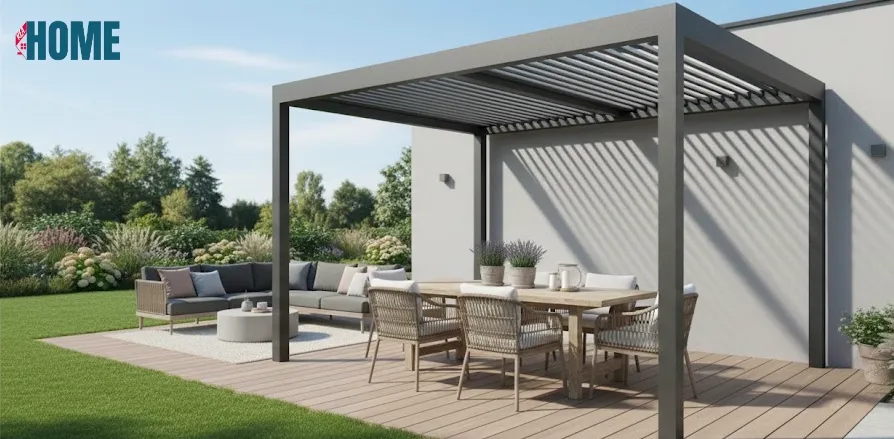
A pergola fixes that problem. Good ones, anyway. Something like this motorized pergola gives you proper shade and protection from whatever the weather throws at you – heat, rain, wind. But before you buy anything, you should understand what you’re actually getting.
Pretty simple: it’s an open structure with vertical pillars holding up horizontal beams on top. The main job is shade. That’s it.
The beams on top can be left open (more decorative than functional), covered with climbing plants, or fitted with fabric canopies that you can adjust. The fabric option makes way more sense for most homes – you can open it up when you want sun, close it when you don’t. Plants look nice, but they’re fussy about temperature and take years to fill in properly.
What You’re Actually Building?
The top can go three ways. Leave the beams open, which is really more about the look than any actual cover, grow climbing plants over it, or fit an adjustable fabric canopy you can pull across when you want. And the fabric’s the one that makes sense for most homes, because you’re opening it up when you want the sun and closing it when you don’t, on the day, based on what the sky’s doing. Plants look wonderful, no argument, but they’re fussy about temperature, they take years to really fill in, and by the time they’ve finally done it you’ve half the time changed your mind about where you wanted the shade falling in the first place.
A Pergola Only Works If You Get These Few Decisions Right:
Which Way the Beams Run Decides Everything
This is the call almost everyone walks straight past, and it’s the one that quietly decides whether the whole thing gets used or not.
And it’s not which way the structure faces. It’s which way the beams are running across the top.
Run them north to south and they’re blocking the low sun, the morning and the evening, which is exactly the stretch most people are actually outside wanting to sit. Run them east to west instead and you’re getting the reverse, shade at midday when the sun’s straight overhead, and not much either side of it. So a pergola pointed the wrong way is shading the yard through the hours nobody’s out in it, and people give up on those inside a season without ever quite working out why it never felt right.
Then there’s the spacing between the beams, which is doing a completely separate job.
A traditional pergola, beams about six inches apart at the usual two-inch thickness, is only covering around a quarter of the sky. That’s why an open-lattice one always feels light and airy and casts almost no real shade, it’s roughly a quarter material to three-quarters open. Tighten that gap down to about three inches and the whole ratio flips, closer to sixty percent blocked. So if it’s genuine shade you’re after rather than the look of the thing, the spacing is pulling more weight than the wood you pick ever will.
Pick the Wood for How Long You Want It Standing
Every species is handling the weather differently, and the gap between the right one and the wrong one isn’t small.
Western red cedar is where most people should land, and it’s not just about how it looks. It’s carrying natural oils and tannins that fight off decay, rot and insects on their own, no chemical treatment involved, and it stays light enough to actually work with by hand while you’re building. Douglas fir gives up a little of that natural rot resistance for raw strength, which is why it’s the one you’re reaching for when a beam has to span a wide gap without a post breaking up the middle. Pressure-treated pine costs less at the till, and it earns its place if the budget’s the thing deciding this, but you’re generally looking at ten to fifteen years out of it against twenty-five to fifty for cedar or fir that’s been built and cared for properly.
The fastener detail nobody warns you about
Here’s one I only really clocked after seeing it go wrong. Cedar and redwood both carry a natural acidity that reacts with ordinary nails and screws, and within a year or two you’ve got black streaks bleeding down the wood from every fixing. Stainless steel or hot-dipped galvanized fasteners just don’t do it. Costs almost nothing extra at the hardware store, and it gets skipped constantly because nobody thinks to mention it before the build starts.
One more on the pine, while we’re here. If budget’s winning over longevity, pressure-treated pine still makes sense, especially if you’re going to paint the thing anyway rather than leave the grain showing, because paint hides most of what pine does badly when it’s left bare.
Size It to the Yard You’ve Got, Not the One in the Photo
A pergola that’s too small for its patio is reading as an afterthought, and one that’s too big is swallowing the whole yard around it.
The beams have real limits worth knowing before you fall for a Pinterest picture and design around it. Slats generally shouldn’t run much longer than about four and a half metres without a perpendicular support somewhere in there, and anything you’re putting on top needs a slope to it, roughly a sixteenth of an inch per foot at the very least, or it’s not shedding water, it’s holding it. And skip that slope and you’ve got standing water sitting up there after every rain, which for wood is speeding up the exact rot the right species was meant to hold off.
What Goes on Top, and Why It’s Really a Shade Question
The open-beam look, the plants, the fabric canopy, each one’s solving a different problem, and choosing between them isn’t really about style. It’s about how much say you want over the shade itself.
- Open beams give you the lightest, airiest look, and about a quarter shade at normal spacing, so it’s more a decorative frame than actual cover
- Climbing plants get you there eventually, dense and genuinely beautiful, but you’re waiting real years for it and most of them want particular sun and temperature to properly thrive up there rather than just cling on
- An adjustable fabric canopy is the only one of the three that’s answering the weather you’re actually getting that afternoon, open on a grey day, shut through the peak, instead of committing you to one fixed amount of shade forever
For most homes the fabric ends up doing the most work day to day, because it’s the only one adapting instead of locking you in.
None of this is complicated once you’ve made the real calls in the right order. Which way the beams run before you fuss over spacing, wood matched honestly to how long you want it standing rather than what looked best under the showroom lights, a top chosen for how you’ll actually use the space and not how it photographs the first afternoon. Get those right and it turns into the spot you keep going back to, the way Pamela clearly does, instead of the handsome thing standing empty in the corner.
Attached vs. Freestanding:
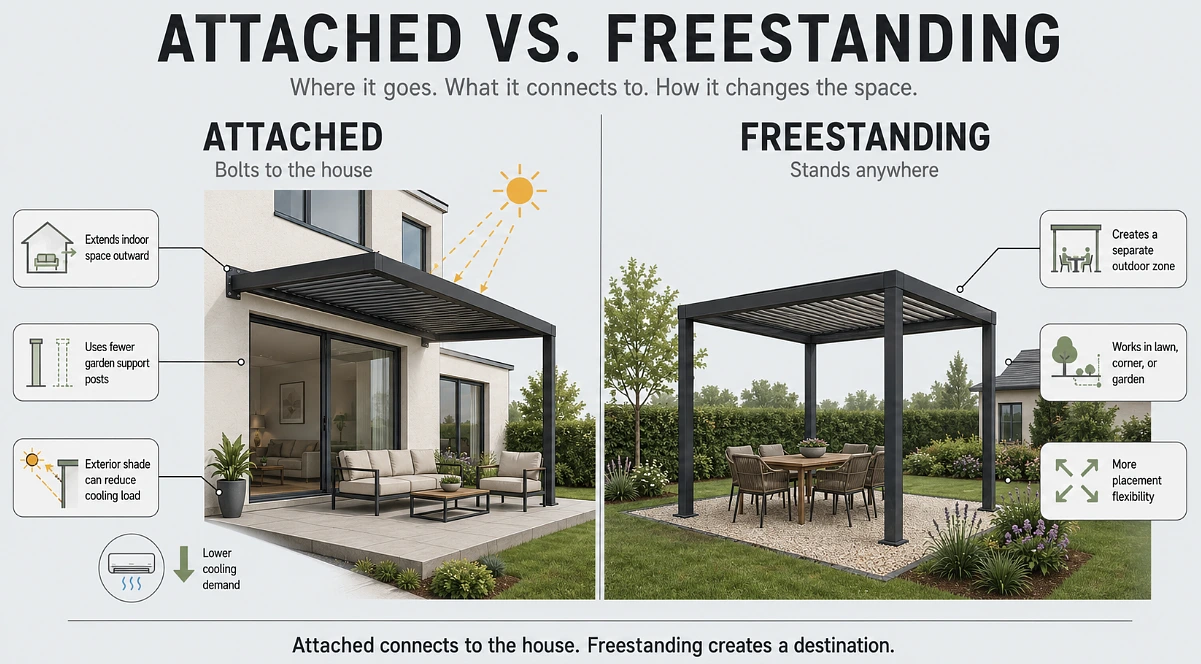
This is the big decision. Where’s it going and what’s it connecting to?
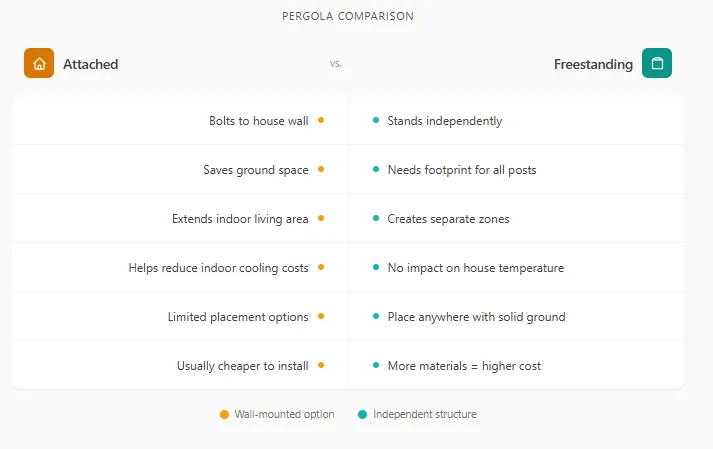
- Attached pergolas bolt directly to your house wall. A wall-mounted pergola basically extends your indoor space outward – your living room flows onto your terrace without a hard break. These work brilliantly for smaller spaces because you’re not losing garden area to extra support posts. The canopy materials these days handle sun, humidity, and wind without falling apart after one season.
- Bonus: Attached pergolas actually help with your energy bills. They block direct sunlight from hitting your windows and walls, so your AC isn’t working overtime. The U.S. Department of Energy recommends exterior shading as one of the most effective ways to reduce cooling costs.
- Freestanding pergolas stand on their own four (or more) legs anywhere you want them. Middle of the lawn, corner of the garden, wherever. You need more space for this setup, obviously, but you get flexibility. Want a dedicated outdoor dining area away from the house? Freestanding. Creating a separate lounge zone? Freestanding.
One situation the brochures skip is a pergola going up over a deck you already have, which is where most of these end up. Deck framing was sized to hold people and furniture, not four posts catching wind like a sail, so the posts need to land over beams or blocking rather than on the boards, and older decks sometimes need reinforcing underneath before anything gets bolted down. A deck builder like Olympic Decks can tell you in one visit whether your framing takes it, which is a cheaper conversation than finding out later.
Materials That Actually Last
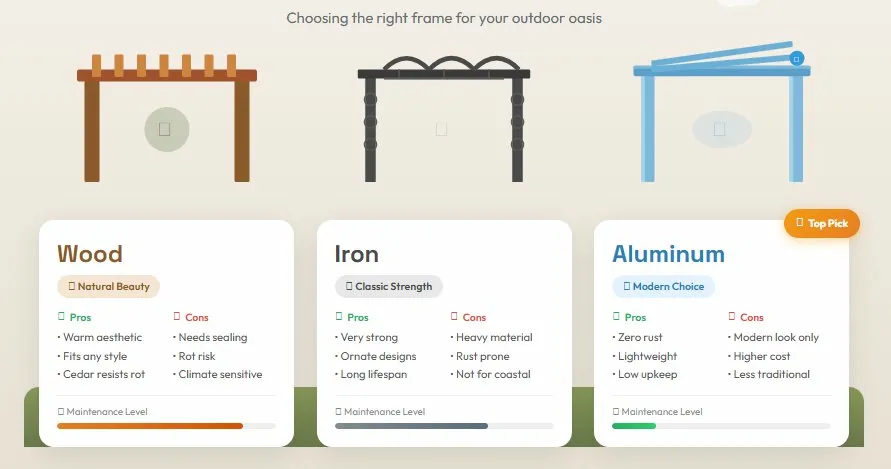
Three main options: wood, iron, and aluminum.
Wood looks fantastic. Natural, warm, fits traditional and modern designs. But it needs maintenance – sealing, staining, checking for rot, depending on your climate. Cedar and redwood hold up better than cheaper softwoods.
Iron is strong and can be shaped into ornate designs if that’s your thing. Heavy though, and rust is a problem unless you keep up with protective coatings. Not ideal for coastal areas or anywhere with serious humidity.
Aluminum is where most people end up landing. Lightweight, doesn’t rust, barely needs maintenance. Modern aluminum pergolas, like the motorized pergola systems, use powder-coated finishes that hold their color for years. You lose some of that traditional aesthetic, but you gain a structure that pretty much takes care of itself.
Who Actually Uses These Things
Homes, obviously. But pergolas show up everywhere once you start noticing them – restaurant patios, hotel pool areas, park entrances, building facades. Any large outdoor area that needs defined shade without full walls benefits from one.
For residential use, the sweet spot is usually a wall-mounted pergola for the main terrace (keeps things connected to the house, maximizes your usable space) and maybe a freestanding setup in the garden if you’ve got room for a secondary hangout spot.
Before You Buy
Measure twice. Seriously. Know exactly how much space you’re working with and how much coverage you actually need. Think about sun direction throughout the day – that matters more than people realize when positioning a freestanding unit.
Check your local building codes, too. Some areas require permits for structures over a certain size or height. Better to find out before the thing shows up on a truck.
And if you’re going motorized – with adjustable louvers you can control with a remote or app – make sure you’ve got outdoor electrical access sorted, or budget for having it installed. Worth it for the convenience, but plan.
 Decor & Improvement Accessories