

Home & Decor Blogs: DIY, Interior Design & Lifestyle Ideas
Kitchen Renovation Budget Planning for Smarter Remodels

Kitchens eat money. They’re the most renovated interior room in Australian homes, and the most expensive one to get wrong. The Houzz 2023 Australia study put the median kitchen renovation spend at $30,000, but that number hides a massive range — from a basic $10,000 facelift right through to $75,000+ custom builds with all the trimmings.
I’ve seen plenty of homeowners start a kitchen reno buzzing with excitement and finish it staring at invoices they never planned for. The difference between a renovation that works and one that spirals almost always comes down to what happened before the first wall got touched. This guide walks through the full budget framework — setting a hard ceiling, understanding where the money actually goes, avoiding compliance surprises, and locking your contract down so your builder can’t nickel-and-dime you mid-project.
Define Your Goal and Hard Budget Ceiling
Pick a number you genuinely cannot exceed. Not a number you’d prefer not to exceed — one that would actually cause you financial stress if you went past it. That’s your ceiling.
From that ceiling, subtract 10–15% and put it aside as contingency. If your home was built before 1990, push that contingency toward 20%. Older homes love hiding nasty surprises behind walls — asbestos in the splashback sheeting, water damage under the vinyl, wiring that hasn’t been touched since the Hawke era.
What’s left after contingency is your working budget. That’s the number you plan around, quote against, and refuse to move on.
A couple of things worth doing right now:
- Write down your must-haves and your nice-to-haves as two separate lists
- Any upgrade that creeps in later has to be offset by a downgrade somewhere else — dollar for dollar
- If a quote comes back over your ceiling, you walk
Having that rule decided in advance, before you’re emotionally invested in a particular benchtop or tap fitting, makes it dramatically easier to stick to.
Funding and Cash-Flow Planning
Sort out how you’re paying before you start comparing stone samples. If you’re financing, model the repayments properly including interest — an extra $8,000 on your renovation can quietly turn into $12,000 by the time you’ve paid it off.
If you’re staging the project (appliances now, flooring later, for example), document the scope split carefully so you’re not doubling up on trades or paying for the same demolition twice. And budget for temporary cooking. Three weeks of takeaway because your kitchen is a construction zone adds up faster than most people expect.
Price Your Renovation Tier
Australian kitchen renovations in 2026 fall into three rough bands. Knowing which one you’re in saves you from quote shock and stops you spec’ing a luxury kitchen on a mid-range budget.
Budget refresh ($10,000 to $20,000): You are maintaining the current layout and service locations. A modular/flat-pack suite of cabinetry, laminate bench tops, a very basic tile splashback and if you’re lucky a new line-up of mid-range appliances. A kitchen to look and feel new, but nothing structural needs changing.
Basic replacement ($20,000–$45,000): The most common level you can expect for the better half of your kitchen renovation budget. You could do a combination of custom and modular cabinetry, spring for porcelain or natural stone counter tops, install mid-range appliances and boost internal storage with drawer-heavy designs. Some minor layout tweaks are available here, but you’re not moving plumbing or blowing through walls.
Luxury custom ($35,000–$75,000+): Customised joinery with high-end stone or porcelain benchtops and splash backs, integrated appliances and possible structural changes such as moving existing power points, new island benches and/or removing a wall to open the kitchen into an adjoining room. This is the tier on which budgets blow past the fastest, since decisions multiply and each one costs more.
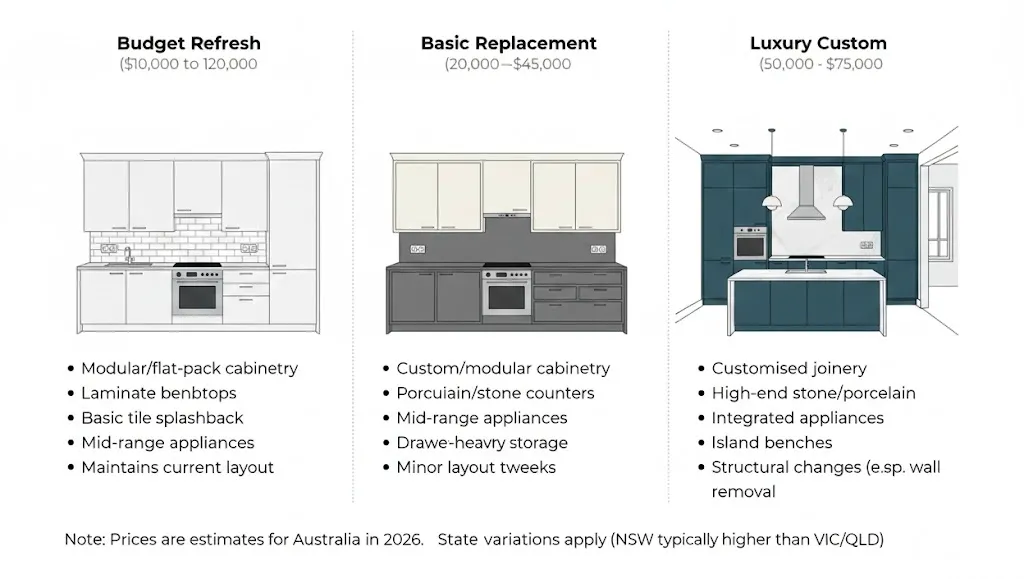
State variations shift these numbers around too. NSW projects tend to run higher than Victorian or Queensland ones thanks to differences in labour costs and supplier networks. For a Melbourne-specific breakdown you can benchmark against your own quotes, see the kitchen renovation cost guide from Mint Kitchen Group, then adjust for your exact scope and inclusions.
Get three comparable, itemised quotes. Demand they price cabinetry, benchtops, splashback, appliances, electrical, plumbing and demolition as separate line items. Specifically request brand and model numbers of appliances and hardware — unclear “allowances” are how budget issues get pushed until midway through the build when it’s too late to change course.
Where the Money Actually Goes
Pre-allocating spend to categories forces the hard trade-offs to happen on paper, not on-site when your builder’s waiting for an answer and the clock’s running.
| Category | % of Budget |
|---|---|
| Cabinetry and joinery | 35–45% |
| Appliances | 15–25% |
| Benchtops | 10–20% |
| Trades (electrical, plumbing, tiling) | 15–20% |
| Splashback and flooring | 5–10% |
| Contingency | 10–15% |
These ranges flex depending on your tier. Budget renovations skew heavily toward modular cabinetry (lower percentage but lower total cost), while luxury customs push the joinery and materials allocation higher. If you’re switching from gas to induction, factor induction ready cookware into your appliance allocation — test your existing pots with a fridge magnet first, and budget $200–$800 for replacements if they don’t stick.
The rule that makes all of this work: convert every PC (Prime Cost) allowance to an actual selection with a confirmed price before you sign a contract. PC items are where the biggest blowouts happen because nobody pins them down early enough.
Map Scope Versus Cost Drivers
Keeping your existing footprint and service locations is the single biggest money-saver in any kitchen renovation. The moment you start moving things — sinks, cooktops, ventilation — costs jump because you’re paying for new plumbing rough-ins, electrical circuits, patching, and sometimes structural work.
- Moving a sink means new plumbing and waste lines plus patching where the old ones were
- Relocating a cooktop might mean capping a gas line or running a dedicated 32–40A electrical circuit for induction
- Islands need power, waste planning, and in apartments potentially slab penetration — which brings strata approval into the picture
- Ventilation ducting changes are invasive and expensive; recirculating rangehoods cost less to install but don’t perform as well as ducted ones
Cabinetry swallows the biggest single chunk of most budgets. A few things worth knowing here:
- Flat-pack and modular systems cut labour and fabrication time significantly — you can get a genuinely good-looking kitchen from modular components these days
- Custom joinery gives you precision fits and special finishes, but the cost difference is substantial
- Drawer-heavy layouts are better for ergonomics and daily use, though they push up hardware costs because quality drawer runners aren’t cheap
- Two-pack polyurethane and timber veneer cabinet fronts cost more to fabricate than melamine
- Porcelain and natural stone benchtops sit above laminate
Every one of these choices is a lever — pull one toward the premium end and you need to push another toward the budget end, or your allocation falls apart.
Compliance Costs That Catch People Out
Rework for compliance is more budget-wrecking than all but the most destructive things. Having those requirements mapped out before you start means they are now in your budget, rather than dealing with them as one-off out-of-pocket payments halfway through the project.
Electrical work. The only people who are permitted to do electrical installation work in Australia are licensed electricians — DIY electrical is illegal and unsafe, end of story. If you are installing an induction cooktop or more circuits, get the capacity of your switchboard checked early on. Older boards may require an upgrade, and that can get costly — $1,500 to $3,000 depending on what you need. Final sub-circuits in new domestic installations or alterations are required to have RCD protection as per AS/NZS 3000.
Gas installations. Whenever you use gas, it has to be in compliance with AS/NZS 5601. In NSW, Amendment 2 to AS/NZS 5601.1:20221 became effective on and from 6 March 2025. If you are capping gas as part of an induction switch, ensure your gasfitter is across the latest iteration of the standard.
Engineered stone ban. This one trips people up who haven’t renovated recently. Engineered stone benchtops are banned nationally — production, supply, processing and installation since 1 July 2024 (import as of 1 January 2025). The ban was in response to a recommendation by Safe Work Australia, prompted by increasing cases of silicosis among workers processing engineered stone. Your choices of worktop are now porcelain, stone, solid surface, laminate or timber. Factor the alternatives into your dispensary plans and prices from the outset.
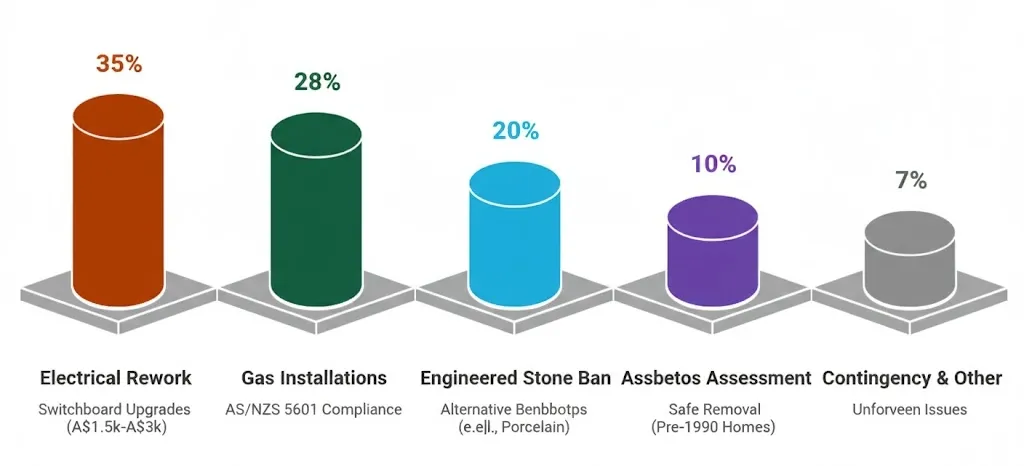
Asbestos. Eaves, vinyl floor tiles and splashback sheeting in houses built before 1990 could contain asbestos. When disturbed, as it is during demolition, it releases dangerous fibres. Schedule a licensed asbestos assessment before any demolition work starts and add building removal to your contingency.
Lock Your Contract Down
Your contract is the most potent budget-protection mechanism available to you, assuming that it is designed correctly. So everything from how much builders can ask for as a deposit, to what happens if insurance is called on or when progress payments are due will vary by state. The contravention of any of these exposes both parties to legal and financial liabilities.
in NSW: the highest deposit a builder may ask for under the Home Building Act 1989, is 10% of the contract price. All residential building work over $5,000 (including labour and materials) must have a written contract. InsuranceMust have Home Building Compensation cover for works over $20,000Requires the builder to provide you with a certificate of cover before they start work or accept any money (including a deposit).
In Victoria: no more than 5% of the purchase price as a deposit will be payable subject to those where deposits are limited to $20,000 or less under provisions of section 11 of the Domestic Building Contracts Act 1995. DBI is compulsory for works over $16,000 you should receive the insurance certificate before paying any deposit. Check licence and registration details of all builders and trades with the Victorian Building Authority.
Structure progress payments around completed milestones, not time elapsed. A sensible schedule looks something like:
- Demolition complete
- Rough-in complete
- Cabinets installed
- Benchtops installed
- Fit-off complete
Each payment maps to work you can physically see and inspect.
Track every variation formally, in writing, with agreed costs before the work happens. Untracked field changes — the builder asks if you want to move that powerpoint, you say yes on the spot, nobody writes it down — are one of the primary causes of budget overruns. They seem small individually. They stack up fast.
Your Next Three Moves
One. Set your ceiling today. Calculate the absolute maximum you can spend, subtract your contingency percentage, and write down your working budget. Pin it somewhere you’ll see it throughout the project.
Two. Allocate your categories. Use the percentage framework above to assign actual dollar amounts to cabinetry, appliances, benchtops, trades, and contingency before you talk to a single supplier or builder.
Three. Get three itemised quotes. Require brand and model specifics on every line item. Verify deposit compliance for your state before signing anything. Confirm insurance certificates are in your hand before any money changes hands.
The gap between a kitchen renovation that stays on budget and one that blows out by 30% isn’t luck. It’s planning — boring, detailed, unsexy planning that happens before anyone picks up a hammer.

 Decor & Improvement Accessories