

Home & Decor Blogs: DIY, Interior Design & Lifestyle Ideas
How AI Takeoff Construction Tools Reduce Errors Before Bidding Even Starts

The most expensive mistakes in construction aren’t made on the job site; they are made weeks before a shovel ever hits the dirt. In the high-stakes world of commercial bidding, a single miscalculated load-bearing beam or a missed structural addendum can obliterate project margins before the contract is even signed.
For years, the industry accepted a certain percentage of human error as a “cost of doing business.” But the margins for error have vanished. General contractors and specialty trades are pivoting to ai takeoff construction tools not just to bid faster, but to build an impenetrable defense line against pre-bid miscalculations.
If you are still relying on tired legacy digitizers and basic spreadsheets, you aren’t just losing time—you are carrying massive, unseen financial risks into every proposal. Here is the contrarian truth about how artificial intelligence is fundamentally neutralizing bidding errors before the clock runs out.
The Anatomy of a Pre-Bid Error
Before we examine the technological cure, we must dissect the disease. Why do experienced, highly paid estimating teams make catastrophic errors? It rarely comes down to incompetence; it comes down to a fundamental mismatch between human cognitive limits and modern blueprint complexity.
The “Screen Fatigue” Epidemic
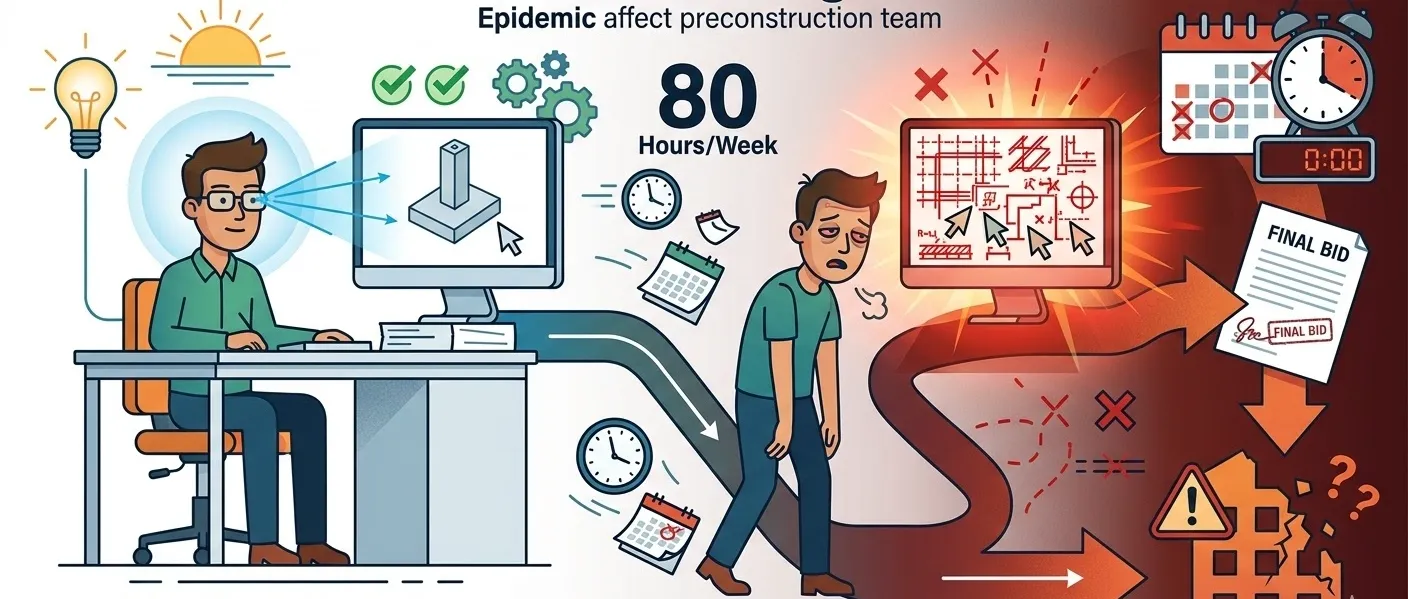
Estimating is a game of extreme visual endurance. When a preconstruction team is forced to spend eighty hours a week staring at a glowing monitor, meticulously clicking and dragging a mouse over hundreds of overlapping lines on a dense PDF, cognitive fatigue is inevitable.
- The Law of Diminishing Accuracy: The 500th concrete footing traced on a Friday afternoon will never be as accurate as the first footing traced on a Monday morning.
- Symbol Blindness: In complex schematics, essential details like a specific grade of high-tension rebar or an obscure fire-stopping requirement blend into the visual noise.
- The Rush to the Deadline: As the bid deadline approaches, the pressure to simply “get the numbers out” overrides the meticulous double-checking process, leading to severe oversight.
Shifting from Reactive to Proactive with AI Takeoff Construction
This is the exact vulnerability that modern platforms were engineered to eliminate. By shifting the burden of raw data extraction from the human eye to machine learning algorithms, the software neutralizes the root causes of pre-bid errors.
How Algorithms “Read” Blueprints Differently
Legacy tools are passive; they only measure what you tell them to measure. AI is active. It doesn’t just see a flat PDF file; it interprets geometric relationships, standard architectural symbols, and text callouts simultaneously.
The Power of Contextual Detection
When an algorithm scans a plan set, it isn’t just counting lines. It cross-references elements. If it detects a specific type of steel column on the structural plans, it cross-checks the schedule to pull the exact unit weight, tonnage, and connection details. This multi-layered scanning means the software catches the obscure, deeply buried specifications that a fatigued human estimator is highly likely to skip over.
Deep Dive: The Structural Steel Bottleneck
To truly understand the risk-mitigation power of AI, we must look at one of the most unforgiving trades in the industry: structural steel. In steel, a missed detail isn’t just a minor cost variance; it can halt an entire project schedule due to massive fabrication lead times.
Why Legacy Structural Steel Estimating Software is Failing
For years, estimators relied on traditional structural steel estimating software that required manual data entry. You had to manually input every beam length, joist total, and brace quantity from the drawings into the interface.
- The Calculation Trap: Even if you counted the beams correctly, calculating the exact tonnage, accounting for waste, and factoring in the complex connection plates required intricate, error-prone manual math.
- Siloed Workflows: The takeoff was disconnected from the actual pricing model. A change in the drawing required completely restarting the manual count and re-entering the data.
The AI-Driven Steel Revolution
Modern AI platforms have completely overhauled this workflow. The algorithm automatically reads the structural sheets, schedules, and callouts. It instantly extracts exact beam lengths, joist totals, stud counts, and brace quantities directly from the drawings.
More importantly, it pulls the unit weights and calculates the exact tonnage instantly. By removing the manual keystrokes from the structural steel estimating software workflow, you effectively eliminate the risk of a “fat-finger” data entry error that could result in underbidding a project by tens of thousands of dollars.
The Secret Weapon: Eradicating Errors During Addenda
If there is one thing that causes more estimating errors than initial complexity, it is the dreaded last-minute addendum.
The Chaos of Revised Drawings
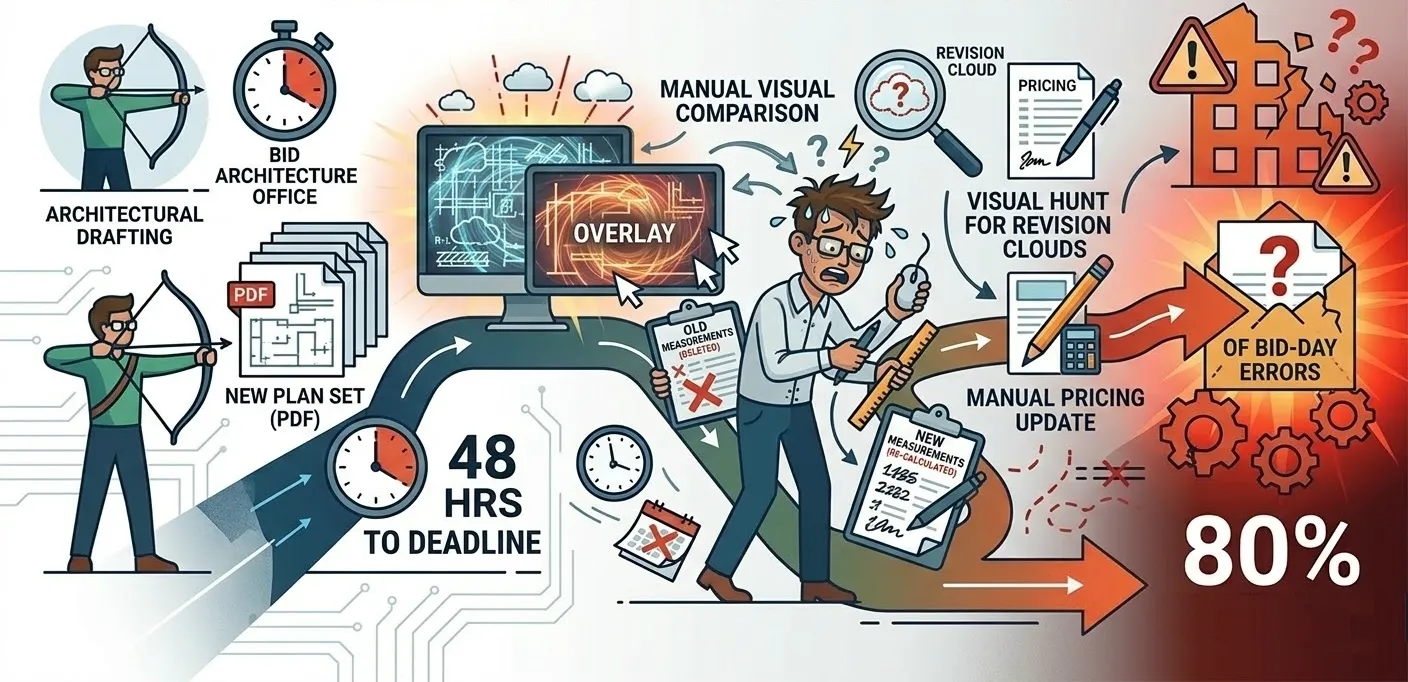
Historically, when an architect issued a revised plan set 48 hours before the bid deadline, it caused pure chaos in the estimating department.
- Estimators had to visually overlay the new PDFs over the old ones.
- They had to manually hunt for the microscopic clouding indicating a change.
- They had to delete old measurements, re-measure the new elements, and manually update their pricing sheets.
This chaotic rush is where 80% of bid-day errors occur.
Automated Variance Reporting
AI takeoff construction software neutralizes the addendum threat instantly. When a revised plan is uploaded, the system utilizes pixel-by-pixel comparison to automatically generate a Variance Report.
This report instantly highlights exactly what was added, what was deleted, and what was modified. The AI adjusts the material quantities automatically, allowing the estimator to instantly see the delta in materials and adjust their final pricing without the panicked rush. The software acts as an unblinking auditor, ensuring that not a single revised connection plate or extra linear foot of piping is missed.
Conclusion: Building an Impenetrable Bid Strategy
The narrative that artificial intelligence is merely a “speed tool” is a dangerous underestimation of its true value. While it certainly allows contractors to bid on twice as many projects, its most profound impact lies in its ability to act as a flawless, tireless QA auditor.
By adopting advanced ai takeoff construction platforms and integrating them with specialized tools like structural steel estimating software, you are no longer relying on human visual endurance to protect your profit margins. You are leveraging machine learning to build an impenetrable, mathematically verified foundation before the bidding even begins.
In today’s hyper-competitive market, the contractor who eliminates the most errors wins the most profitable work.

 Decor & Improvement Accessories