

Home & Decor Blogs: DIY, Interior Design & Lifestyle Ideas
How to Create a Study Space in a Small Student Bedroom

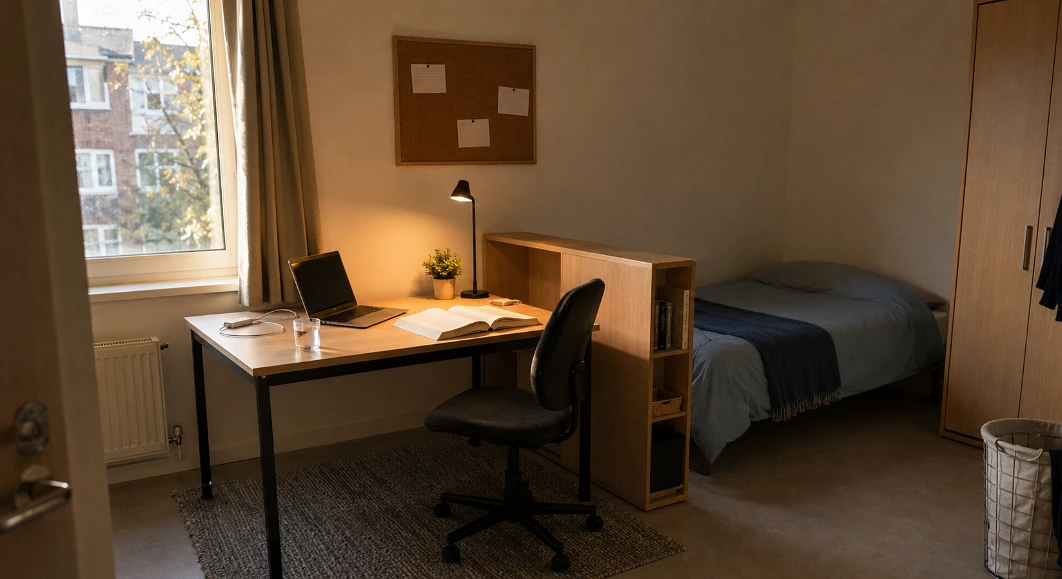
A small bedroom asks a lot of one room, somewhere to sleep, somewhere to keep clothes, somewhere to unwind, and somewhere to actually get coursework done, all in the same twelve square metres. The good news for both the student living in it and the parent or guardian who’s usually the one helping set it up is that the fix isn’t more space, it’s a handful of specific changes that turn one corner of an ordinary bedroom into somewhere the brain actually recognises as work mode.
Pick The Spot Before You Buy Anything
Most people do this backward, buying a desk or a lamp before they know exactly where they’re going to go. The better first move is to decide where, which is why context dependent memory, the phenomenon in which the context of learning influences recall, was first described by Godden and Baddeley and rediscovered in decades of cognitive psychology later. (This pattern of recall was observed underwater for participants who’d learned word lists underwater.) The short version, your brain files away the physical surroundings alongside whatever you were learning at the time, so a consistent, dedicated spot slowly builds a set of retrieval cues that make recall easier later, and it also builds a conditioning effect where just sitting there starts priming focus before a single book is open.
Hence the place is more important than the furniture in it, and that place had reasons for such a position.
- Corners near a window with a solid socket nearby tend to work well, as long as the window glass is not causing glare on the screen.
- Thus the real distance from the bed is more important than the rest of the furniture, because at nine at night, in the heat of a hard reading session, a pillow two feet away wins that argument more often than not.
- Anyone who’s tried to study propped against their own headboard knows exactly how that ends.
Cut The Visual Noise On The Desk Itself
In addition, neuroscience by McMains and Kastner at the Princeton Neuroscience Institute shows that visual clutter in an observer’s field of view occupies space in the visual cortex, competing for limited attention. The brain keeps registering and half processing every object sitting there even when none of it is the actual task, the way a phone left face up on the desk keeps stealing a glance even when it never once buzzes. That takes some of the very limited attention and working memory the student needs for the coursework. The cost amasses over the course of a session, which is probably why an hour at a messy desk leaves someone more drained than an hour at a clear one, even when the actual work doesn’t change.
For me, it’s laptop, whatever the current course material happens to be, a charger, water, and maybe one personal item, all visible and everything else gone. An art or engineering student will obviously require more surface area for a sketchbook or materials than someone working purely off a screen, so this isn’t a fixed list to copy exactly, it’s a habit, ruthlessly clear off whatever isn’t today’s actual work before starting.
Get The Lighting Timing Right, Not Just The Brightness
Most study advice stops at buy a bright lamp, and that’s actually only half of what the research says, sometimes the wrong half depending on the hour. A study in the Journal of Environmental Psychology compared blue enriched white light to standard lighting in real classrooms, and subjects processed information more quickly and focused better, but only to a point. It’s the same wavelength doing two opposite jobs depending what time you catch it in, sharpening focus like a second coffee by day and quietly working against sleep like one drunk at nine at night, which is why a student can be genuinely focused at four in the afternoon under cool white light and then wired and unable to sleep at eleven under that same bulb.
What that actually means in practice:
- Cooler, brighter lighting is best for daytime use and evening study sessions requiring greater focus.
- Otherwise, consider switching to a warmer, dimmer lamp once it gets late, especially if the goal is winding down to sleep.
- And place the lamp on the opposite side to that of your writing hand, lest your writing hand cast a shadow on the page.
It’s a five pound difference in lightbulb choice that brochures never mention, because it is genuinely much more complicated than one number printed on a box.
Protect The Routine, Not Just The Furniture
This bit didn’t come from a study at all. I just asked Belinda, one of the tutors over at EduBirdie, something related to that one day, almost as a side comment, expecting her to say the hard part was the coursework itself, and she was brutally honest with me instead, that’s not really it, most students spend more energy dreading the first minute of a session than they ever spend once they’re actually inside it. She said it like it genuinely got to her a little, watching capable students talk themselves out of starting over and over again.
Her real advice and the routine she says works:
- Clear the desk before starting.
- Fill a glass of water.
- Only open the file or files actually needed for that session.
- Write down a specific goal to be achieved.
- Only commit to ten minutes, not the whole session.
In other words, the hardest part of this job is not the whole thing, but the first ten minutes. This is not an arbitrary number. It’s simply the point that habit and behaviour research both tell us is where the most willpower is used, and past which, continuing is much less of a challenge. Doing the same short sequence over and over becomes another kind of cue, the same job the physical spot is doing, so the brain learns to associate that ritual with focus rather than procrastination.
Draw A Boundary Around It When The Session Ends
Were we to take the context memory research to its logical conclusion, one of the reasons to pick a single consistent point would be that that point had some edge to it, and wasn’t just mixed in with the detritus of the bedroom. A few ways to actually draw that line:
- A rug under the desk and chair.
- A pinboard showing the zone, or a different coloured desk mat signifying it instead.
- And even a narrow shelf acting as a physical divider between the bed and the desk.
Skip all of that and a bedroom that’s also meant to be a study corner slowly becomes one open space in which the laundry is growing onto the desk and the desk is growing onto the bed, and the cue that made either of those spaces useful in the first place becomes weaker each week it is violated.
At the end of each session: protect it small. Save what you need, put away the supplies, write down a first step for the next day. Let the desk actually go quiet. So, if the bedroom still has to work as somewhere to switch off and sleep, a study corner that’s visibly closed for the night is what keeps that possible in a room already doing four jobs at once.
The Room Doesn’t Need To Be Bigger, It Needs To Be Cued Properly
None of this takes much space or much money, and that’s really the point of writing it down at all. A bedroom asked to be four rooms at once, a place to sleep, a wardrobe, a lounge, and an office, will always feel smaller than it actually is until each job gets its own corner and its own signal. A tiny desk with the light timed right, a clear surface, a real boundary, and a routine repeated enough times to become automatic will beat an expensive, styled setup that’s missing even one of those pieces. Work on the one that feels the most broken in the room right now, fix that one properly, and then, once that change has actually stuck, deal with the rest.
 Decor & Improvement Accessories