

Home & Decor Blogs: DIY, Interior Design & Lifestyle Ideas
The AC Keeping Your House Cool Is Sometimes Growing the Mold Inside It

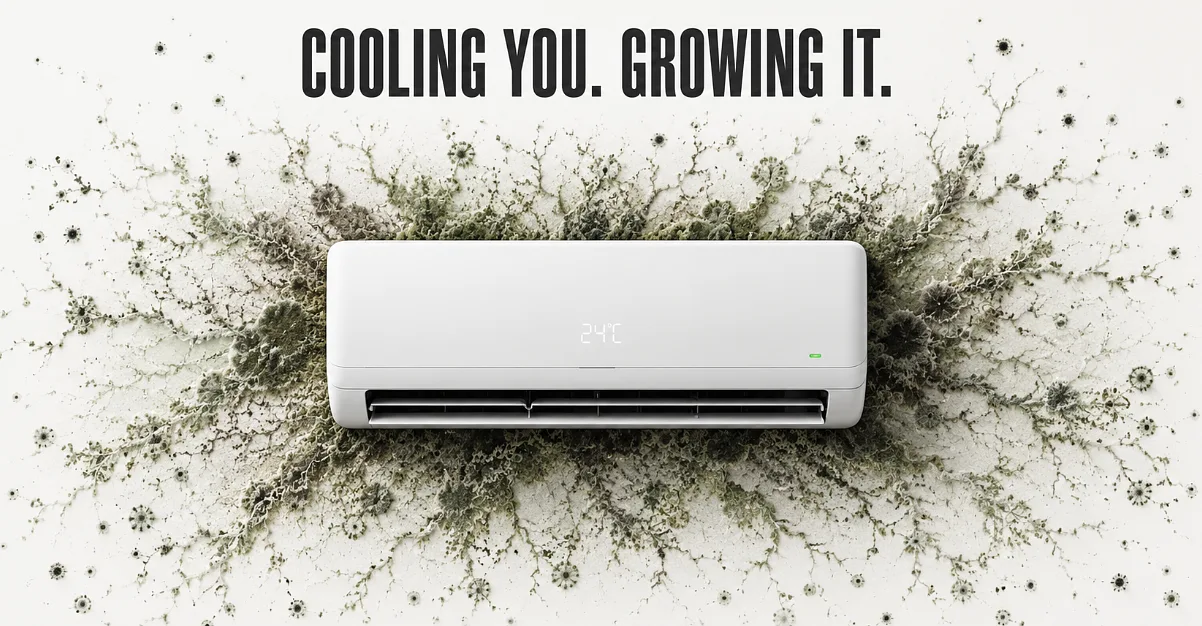
It’s the mold season.
Yes, from July through September they hit their full peak, the actual measured peak, not just a feeling people get because summer’s sticky. You can’t erase them off the globe, spores are in the air everywhere, always have been, they were floating around before your house existed and they’ll keep floating around after. What you get a real say in is whether they wake up.
Does the air conditioner running in the next room actually stop that from happening?
Mostly, and that’s the whole reason people stop worrying once the AC’s on. EPA and AIHA both track airborne spore counts, and both show them climbing through August into a genuine September peak across most US regions, not because the calendar says so but because relative humidity crosses roughly 60 percent for long stretches once summer air holds this much water in it. Warm air just holds more moisture than cool air, physically, that’s the whole mechanism, and a working AC pulls a good share of that moisture out along with the heat.
What’s Sitting Inside the Unit Itself
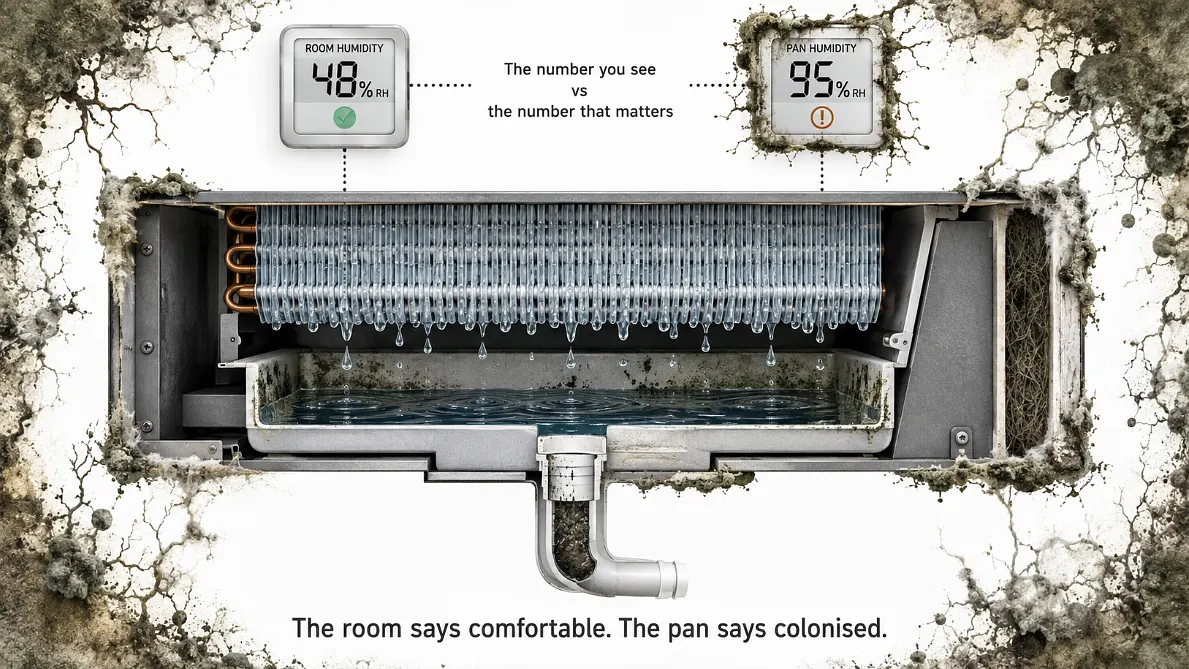
Every central AC has a drip pan under the evaporator coil, catching whatever condensation the system pulls out of the air as it cools everything down. Call it the little pond no one in the house has ever looked at, because once that drain gets even slightly blocked, standing water sits in a dark, sealed, consistently warm cavity for weeks. That combination, dark, warm, wet, undisturbed, is close to the exact recipe mold actually wants.
Why This Stays Invisible for So Long
The unit’s inside a metal box mounted somewhere nobody has a reason to open. It’s running, it’s cooling the house, it sounds fine. A homeowner checks the thermostat, sees the temperature’s on target, and moves on. Meanwhile the drain that’s supposed to carry that water outside can sit partially clogged for an entire season before anyone’s reason to look inside the unit even comes up.
I want to be honest about the numbers here rather than just gesture at them. Ambient humidity readings, the kind your thermostat shows, measure the room. A cold duct surface or the inside of that drip pan cavity can sit at a completely different figure, closer to saturation, while the room reading stays a perfectly reasonable 48 percent. The average number and the actual problem spot rarely match, and the reading you can see is the one that lies.
Windows Do This Differently, Worth Knowing the Split
There’s a second, entirely separate condensation problem worth naming here because people often lump it in with the AC issue and it isn’t the same thing. Cold window glass in a warm humid room condenses simply because glass conducts heat fast and drops below the dew point long before the air around it does. Any surface cooler than the dew point sweats, full stop, and once dew point climbs past 60°F the air itself starts feeling humid even before anything visibly beads up.
The AC drip pan problem and the window condensation problem share a root cause, warm humid air meeting something colder than it, but they need genuinely different fixes. One’s about a drain. The other’s about insulation and airflow across glass. Confusing the two usually means treating the wrong thing.
Once conditions are right, germination on a wet organic surface can start in 24 to 48 hours. That’s not a lot of runway if a drip pan’s been backing up quietly through a whole humid stretch.
Where a Spray Bottle Stops Working
Wiping visible growth off a bathroom tile with a bleach spray genuinely handles a small, contained, easy to reach patch. What it can’t do is get behind drywall, inside a wall cavity, or into ductwork a rag will never physically reach. Surface bleach kills what’s visible and leaves whatever’s rooted underneath exactly where it was, growing back within days like nothing happened.
That’s usually the actual point where a homeowner needs more than what’s under the kitchen sink. Mold removal services exist specifically for the parts of a house that can’t be opened up with a screwdriver and a bottle of bleach, behind drywall, deep inside ductwork, wherever an overflowing drip pan has been quietly feeding a problem for longer than anyone realized it was there.
The Cheap Things That Actually Change This
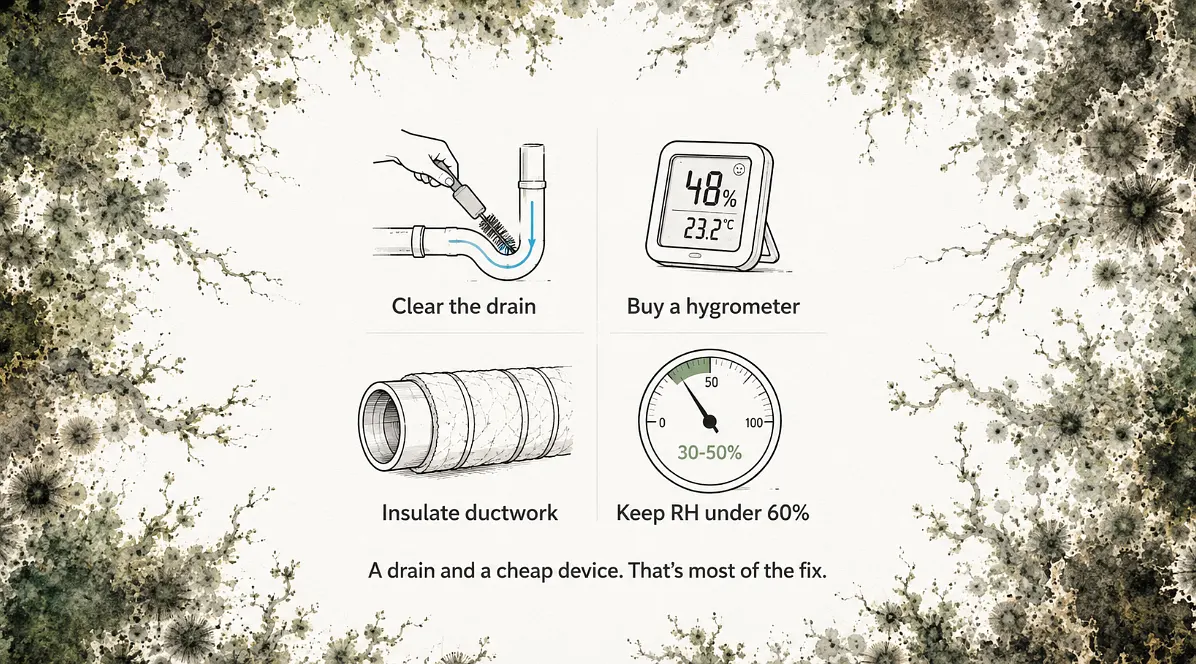
- Check the AC drip pan and drain line at least once a season, ideally before peak summer humidity sets in properly. A clear drain fixes most of this on its own.
- Buy an actual hygrometer, the kind that costs somewhere between ten and fifty dollars, and check more than one room with it, since a single living room reading tells you almost nothing about a duct running through a hot attic.
- Insulate ductwork passing through an attic or crawlspace, since uninsulated ducts sweat exactly the way cold glass does, and that moisture has to land somewhere eventually.
- Keep indoor humidity somewhere in the 30 to 50 percent range where it’s realistic to manage, EPA’s own preferred target, well under the 60 percent line where things start waking up.
A house doesn’t need to be sealed against every spore in the air, that fight was never winnable to begin with. It needs the two conditions mold actually depends on taken away, and most of the time that comes down to a drain nobody’s checked and a number on a cheap little device most people never bought.
 Decor & Improvement Accessories