

Home & Decor Blogs: DIY, Interior Design & Lifestyle Ideas
Fire Damage Restoration: What Happens in the First 48 Hours and What It Costs

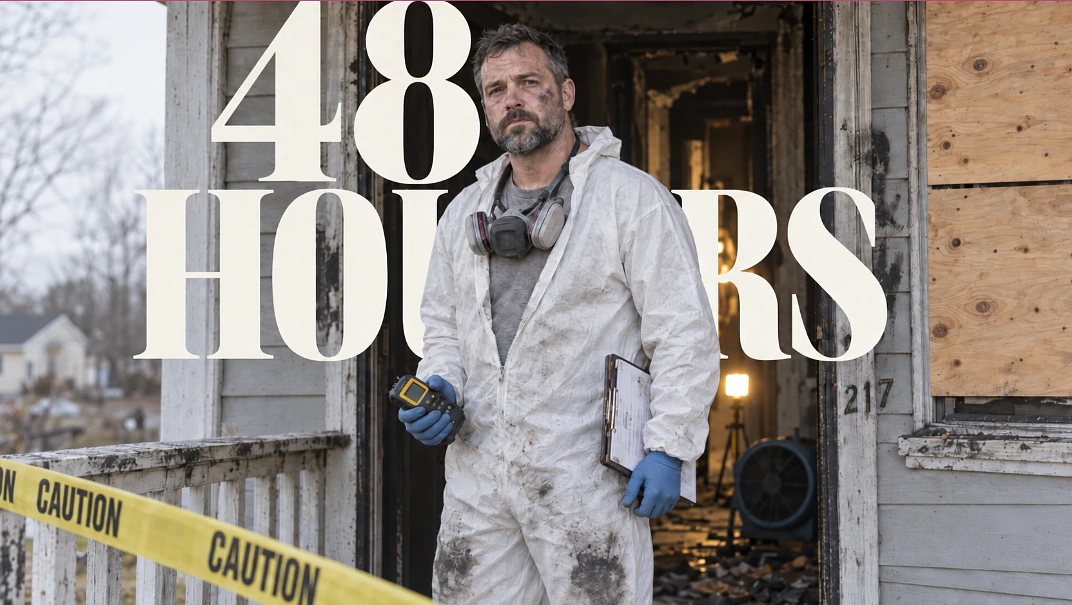
God forbid anyone ever has to face the day a fire breaks out in their home. Take care of yourself and your family, be careful with the things in the house that start fires, and may God protect us all from every kind of accident and keep our homes and the people in them safe.
If you are reading this because it has already happened, I am sorry. What follows is the practical part, and I have tried to make it useful rather than comforting, because at this stage the useful thing is knowing what to do in the next two days.
A fire is over in minutes. The damage it leaves behind keeps working for days, and most of what makes a restoration expensive happens after the fire is out.
Soot is acidic. Once it settles on a warm surface it starts reacting with metal, plastics and grout, and by 24 to 48 hours that reaction leaves permanent yellow brown staining on walls and ceilings. Meanwhile the water the fire service used is soaking into drywall and framing, and mould can begin in the same 24 to 48 hour window.
So the timeline is the thing. A house handled on day one and a house handled in week two are two different jobs at two different prices.
What the First Two Days Look Like
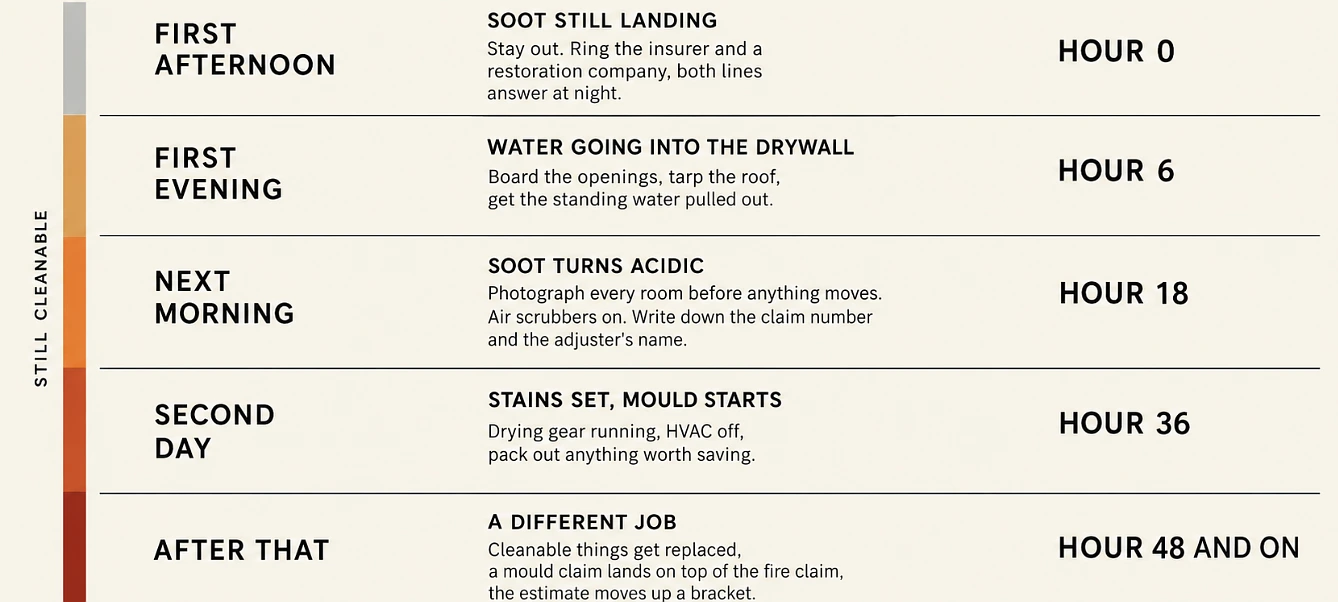
The house is doing things to itself in this window, and what you do has to keep up with it.
On the first afternoon the smoke is still cooling and the soot has not finished landing. You cannot go in yet. What you can do is make two phone calls, one to the insurer and one to a restoration company, and both of those lines are staffed through the night.
By the evening the water the fire service put in is already down in the drywall and the carpet, and the soot is sticking to anything that was warm when it landed. Boarding up and tarping happen here. So does pulling the standing water out. Leave it overnight and you have added days of drying at the other end.
Somewhere in the next morning the soot turns acidic and starts eating at metal, plastic, grout, anything electronic. This is the day for air scrubbers, for photographing the rooms exactly as they are, and for getting a claim number and an adjuster’s name written down. Nothing gets moved until it has been photographed.
By the second day the staining stops being removable and the wet materials are old enough for mould. Drying gear should be running. The HVAC stays off. Anything worth saving starts getting packed out.
Miss those two days and it becomes a different job. Things that could have been cleaned get replaced instead, a fire claim collects a mould claim on top of it, and the estimate moves up a bracket.
What to Do on Day One
- Stay out until the fire service says you can go in
- Ring the insurer and a restoration company, both answer at night
- Get the openings boarded and the roof tarped
- Photograph and film everything before you touch it
- Get the water pulled out
- Leave the HVAC switched off
- Keep every receipt from the first night onward
- Throw nothing away
Do Not Go Back In Until the Fire Service Clears It
Wait for official clearance. Fire weakens floors, staircases and beams in ways that are not visible from a doorway, and hot spots can sit inside a wall for hours.
When you do go in:
- Gloves, boots, long sleeves and an N95 mask
- Keep children and pets off the property entirely
- Do not touch soot covered surfaces with bare hands
- Leave utilities alone unless the fire service or an electrician says otherwise
Secure the Property Before Anything Else
Most policies require you to prevent further damage, and failing to do it can reduce what they pay.
That means boarding up openings and tarping a damaged roof, usually the first thing a restoration crew does on arrival. Board up runs $150 to $500 per opening, and roof tarping runs $400 to $1,500.
An open house takes rain, animals and anyone who wanders in, and all of that lands on your claim as further damage rather than fire damage.
Smoke, Soot and Water Cause More Damage Than Flames
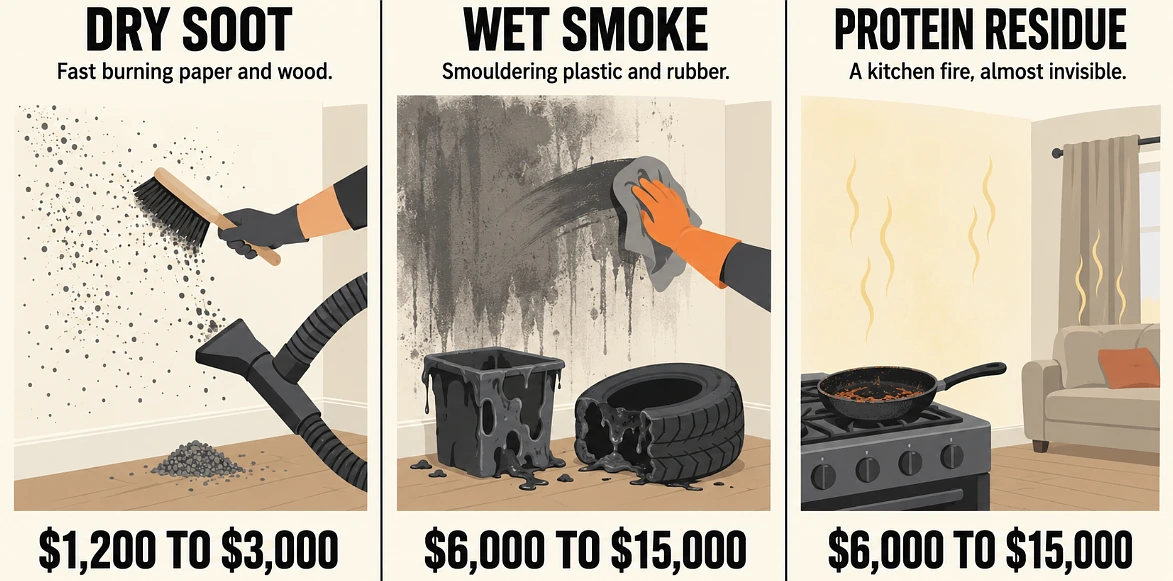
Flames are rarely the biggest line on the estimate. Smoke, soot and firefighting water usually are.
Smoke travels through the whole house. It gets into insulation, ductwork, upholstery and behind trim, which is why a fire contained to one room leaves odour in bedrooms two floors up.
Soot type decides the price. Dry soot from fast burning paper and wood brushes and vacuums off relatively easily. Wet smoke from smouldering plastics and rubber is sticky and smears. Protein residue from a kitchen fire is almost invisible and carries a strong odour that sits in every porous surface in the room.
That difference is real money. Light residue cleanup runs $1,200 to $3,000, while heavy wet smoke or protein residue runs $6,000 to $15,000 on the same size of house.
Water is the other half. Extraction and structural drying runs $1,000 to $6,000, and skipping it turns a fire claim into a mould claim.
Because those three problems feed each other, they are handled as one job rather than three. A crew doing fire damage restoration sequences the drying, the soot removal and the deodorising in a set order, since cleaning soot off a wall that is still wet just drives it in.
Photograph Everything Before You Throw Anything Away
Do not dispose of damaged items before the adjuster has seen them. This is the most expensive mistake people make, because an item with no photograph and no receipt is an item that was never damaged as far as the claim is concerned.
Photograph and film every room from several angles, covering burnt structure, smoke staining, water damage, appliances, electronics and personal belongings.
Then keep a running list of what was lost with rough values. Receipts help, and bank statements, warranty emails and old photographs of the room work too.
Know What You Should Not Clean Yourself
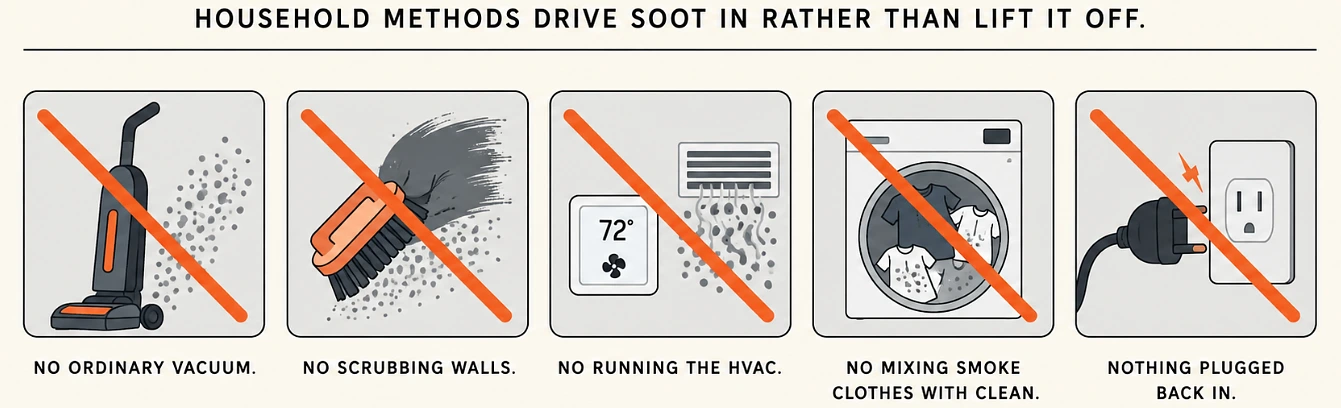
Household methods make soot worse, because the wrong approach pushes it further into the surface rather than lifting it off.
- No standard vacuum on soot. A domestic filter passes the fine particles straight back into the air. Restoration uses HEPA.
- No scrubbing walls. Dry soot smears into the paint and the mark becomes permanent.
- No running the HVAC. It distributes soot through every room that was clean.
- No washing smoke damaged clothing with clean items. The odour transfers.
- Nothing plugged back in. Soot is conductive and corrosive inside electronics.
Porous items are the hard category. Mattresses, rugs, insulation and upholstery absorb smoke all the way through, so they can look fine and keep releasing odour for months.
What Restoration Costs
The national average sits around $27,000, with most projects between $3,100 and $51,000, or roughly $4 to $7 per square foot for cleanup scope.
| Line item | Typical cost |
|---|---|
| Emergency board up | $150 to $500 per opening |
| Roof tarping | $400 to $1,500 |
| Soot removal | $2,000 to $6,000 |
| Smoke deodorisation | $200 to $1,200 |
| Water extraction and drying | $1,000 to $6,000 |
| HVAC duct cleaning | $250 to $500 |
| Thermal fogging or ozone | $200 to $1,000 per treatment |
| Structural repair | $15,000 to $25,000 |
By severity, a single room with light smoke runs under $10,000 and takes days. A multi room fire with soot and water runs $8,000 to $25,000 and takes one to four weeks. Anything structural climbs past $30,000 and runs months.
Claim Your Additional Living Expenses From Day One
Standard policies cover hotel, food and the extra costs of living elsewhere while the house is unliveable, and it is the coverage people most often underclaim.
Keep every receipt from the first night onwards. Hotel, meals out, laundry, pet boarding, the extra fuel from a longer commute.
Alongside that, track claim numbers and adjuster contacts, dates of every inspection and call, contractor estimates, and what has been approved or denied in writing.
Most restoration firms bill the insurer directly, which is worth confirming before work starts so you are not fronting the money.
Check the Air Before You Call It Finished
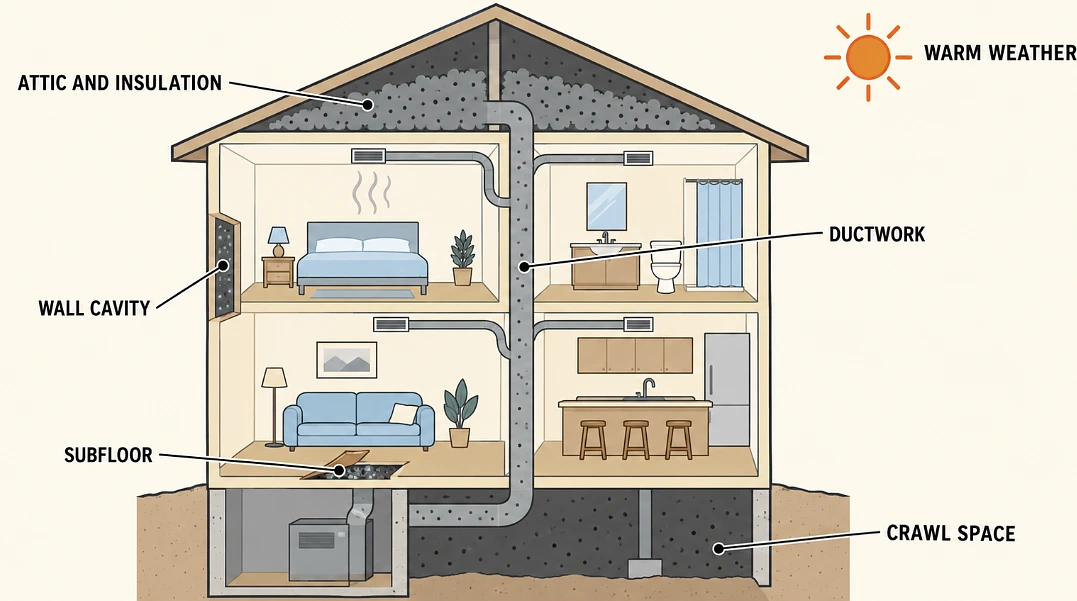
A house can look restored and still be holding smoke.
Ask for inspection of the HVAC system and ductwork, the attic and crawl spaces, subfloors and wall cavities, and the insulation. Those are where residue and moisture survive a surface clean.
Odour returning in warm weather is the usual sign something was sealed in rather than removed, and it means going back into the cavity rather than repainting again.
Use the Rebuild to Fix What the Fire Found
While the walls are open, some things cost very little to add.
- Interconnected smoke alarms on every level
- Fire rated materials in the repaired areas
- Rewiring if the system is old, particularly if the cause was electrical
- Proper storage for paint, fuel and batteries
- Two exits planned from every room
None of it is exciting, and the walls are never going to be this open again.
 Decor & Improvement Accessories