

Home & Decor Blogs: DIY, Interior Design & Lifestyle Ideas
How to Make Moving Day Easier Before the Truck Arrives


A moving day can start going wrong by 11 in the morning. The crew has been working for 2 hours, somebody is still wrapping plates in the kitchen, and the hallway is blocked with boxes that have no labels on them. None of that was decided on the day. It was decided 3 weeks earlier, when the packing kept getting put off.
In the US, many local moves are billed by the hour, so cutting the time a crew spends waiting, packing or working around obstacles can bring the final bill down as well. A rough national range for 2 movers and a truck is around $80 to $200 an hour, although rates vary a great deal by city, crew size and company. Many movers also set a minimum booking period or charge for travel time, so check exactly when billing starts and when it stops.
As a rough example, a packed 1 bedroom apartment may take a 2 person crew around 3 to 5 hours, while a 3 bedroom home can take 7 hours or more, depending on how much is being moved, how easy the access is and how big the crew is.
The pricing and rules in this article are based on moves within the US. Other countries handle movers, pricing and liability differently.
Plan Backward From The Moving Date
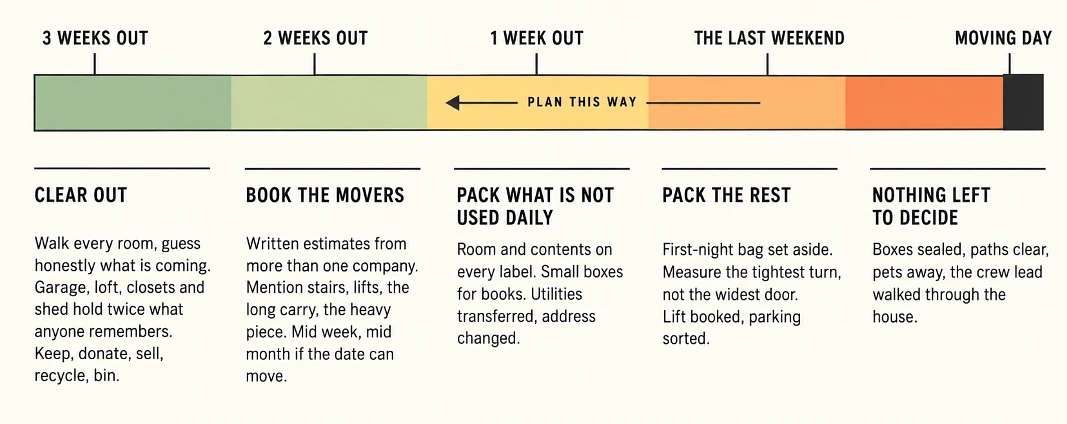
A colour coded spreadsheet is not needed, but a rough plan is. Start from the moving date and work backward, picking out the jobs that cannot be squeezed into the last weekend.
Walk every room first and make an honest guess at what is coming with you. Garages, lofts, closets and garden sheds deserve a closer look than the rest, since those are the spaces that hold far more than anybody remembers putting there.
Then work through the main jobs in roughly this order.
- Walk the home and decide roughly what is moving.
- Start clearing out the things that are not.
- Get estimates and book the mover.
- Carry on selling and donating what you do not want.
- Pack everything that is not used day to day.
- Transfer utilities and change the address.
- Finish packing, clean, and do the final walkthrough.
Book the mover early rather than after the packing is done, particularly if the date falls in summer or at the end of a month, because those are the busiest periods and crews fill up first. A weekday in the middle of the month is usually easier to get and can be cheaper as well.
Choose The Level Of Help The Move Needs
Households need very different amounts of help. Some only want a truck and 2 people to load it. Others want packing, furniture taken apart and rebuilt, and everything placed in the right room at the other end.
When you arrange local moving, compare what each company includes for the size and difficulty of your particular move rather than going straight to the lowest hourly rate, since a cheaper crew that takes 2 hours longer is not cheaper.
Professional packing is normally an extra service on top of that. Some companies charge by the hour per packer, while others use a flat rate or price it per box, and packing materials may be included or charged separately. Hourly packing rates can range from roughly $25 to $80 or more per packer depending on the area and what is included, so ask for the packing labour and the materials to be itemised before you book.
Be specific when you ask for estimates. Mention stairs, lifts, a long walk from where the truck can park, unusually heavy furniture, and anything fragile or awkward. Leaving important details out of the estimate can lead to extra charges or a revised estimate later.
Declutter Before You Pay To Move Everything
Every box that goes on the truck is more time for the crew, so the cheapest box is the one that never gets packed.
Work one room at a time rather than attacking the whole house. Split things into keep, donate, sell, recycle and throw away. Clothes that have not been worn in years and furniture that will not fit the new rooms do not earn a place on the truck just because they were already there.
A smaller load also makes the estimate more accurate, because the movers can see exactly what they are taking. When you compare companies, get the details in writing. The Federal Motor Carrier Safety Administration advises getting written estimates from several movers for interstate moves rather than choosing on price alone, and the same habit is worth keeping on a short local move, where comparing exactly what each quote covers takes 10 minutes and saves arguments later.
Pack In The Order You Will Unpack
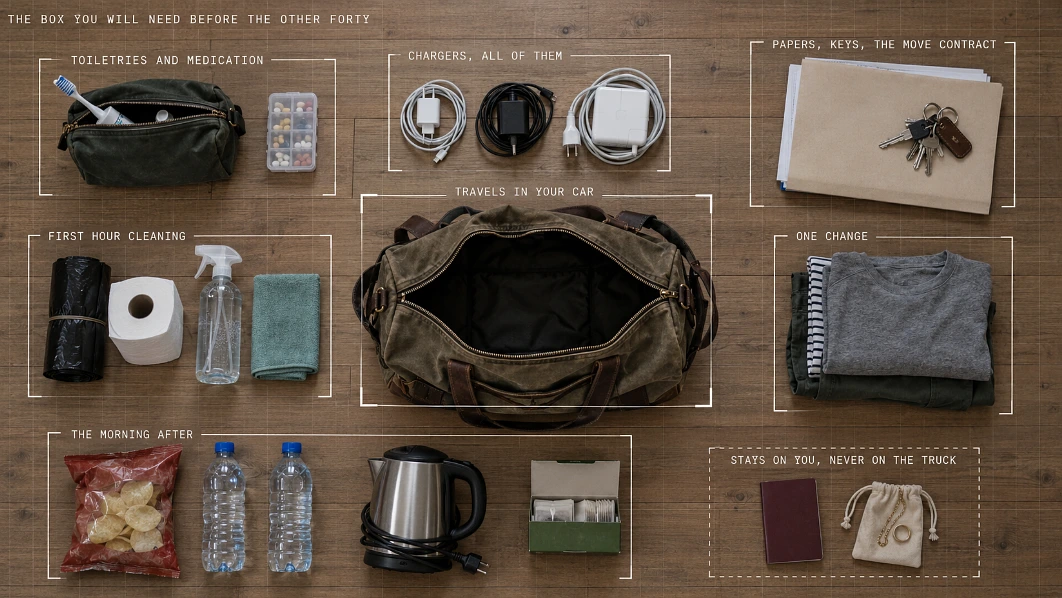
Packing fast feels productive right up until the first night in the new place, when the phone charger, the medication and the kettle are somewhere in 40 identical boxes.
Label every box with the room it is going to and a short note of what is inside. “Kitchen, everyday plates” is far more use than “Kitchen 6”. Mark fragile boxes clearly, and keep book boxes small, since a large carton full of books quickly becomes too heavy to lift safely.
Keep a separate bag or box for the first day and night, and make sure it travels with you rather than on the truck.
- Toiletries and any medication.
- Phone chargers and a laptop charger.
- Important papers, keys and the paperwork for the move.
- A change of clothes.
- Basic cleaning things, a roll of bin bags and toilet paper.
- Snacks, water and a kettle or whatever gets the morning started.
Anything valuable or impossible to replace should stay with you rather than go deep into the truck. That includes jewellery, passports and documents, and anything with sentimental value.
Check Parking, Lifts And Doorways At Both Homes
The distance between the 2 addresses is only part of the job. The truck needs somewhere it can legally park close to the door, and the furniture needs a clear route through doorways, hallways, lifts and stairwells.
For an apartment or condo, ask the building management about lift bookings, loading bays, the hours moves are allowed, and whether the moving company needs to send a certificate of insurance first. Some buildings only allow moves during set times. If the crew cannot start because the building requirements were not arranged in advance, you may still be charged a minimum, travel or waiting time fee, depending on the mover’s contract.
Measure large furniture against doorways, stair turns and lift doors before the day. A sofa that clears the doorway can still get stuck on the turn of a staircase, so measure the tightest corner as well as the widest door.
Clear the paths before the crew arrives. Move small things out of the way, keep pets shut in one room or away for the day, and take up loose rugs or anything else people could trip over while carrying heavy loads.
Understand How Your Quote Is Worked Out
A low estimate is only useful if you know what it includes. Ask how the price is calculated and what could add to it.
Find out whether packing materials, stairs, long carries, taking furniture apart, storage or a second truck cost extra, and ask when the clock starts and stops, since that varies more between companies than the hourly rate does. Ask as well what happens if you end up with more to move than was on the estimate.
Ask about the mover’s liability options too. On interstate moves, the Released Value Protection option, which comes at no extra charge, limits the mover’s liability to 60 cents per pound per item, so a 10 pound item would be worth only $6 under it however much it cost. Full Value Protection covers more and normally carries an extra charge. Neither is the same thing as separate moving insurance. Moves that stay within one state are governed by that state’s rules rather than federal ones, so ask a local mover exactly what their standard liability pays out.
For interstate moves, the Federal Trade Commission advises getting written estimates, making sure your belongings are properly listed, and asking about protection for anything damaged. It also warns against movers who want a large deposit up front or ask you to sign papers with blank spaces in them. Those warning signs are worth watching for on a move across town as well, so do not sign anything that is not filled in.
What To Do On Moving Day Itself
By the morning of the move, most of the decisions should already be made. Boxes sealed, paths clear, and everything you are taking yourself kept apart from what goes on the truck.
Before loading starts, walk the house with the crew lead and point out anything fragile or that needs special care. Keep your phone on you, and make sure the movers have your number in case you end up in separate vehicles.
At the new place, tell the crew which room each piece of furniture and each box goes in rather than letting it all pile up in the lounge. Good labels make that quick.
Before the truck leaves the old home, check every cupboard, closet, bathroom, garden and storage space one last time. Once everything is unloaded, look over your belongings for damage or anything missing while the day is still fresh.
Tipping is optional. If the service was good, one commonly suggested guide is around $5 to $10 per mover per hour, adjusted for how hard the job was and how well it was done.
By the end of the day there is a sealed box of plates in the right kitchen, a bag with the chargers and the kettle on the counter, and a crew that finished on time because nothing was left for them to wait on.
 Decor & Improvement Accessories