

Home & Decor Blogs: DIY, Interior Design & Lifestyle Ideas
Daylight Saving Time Ends November 1, So Get The Porch Light Pointing The Right Way
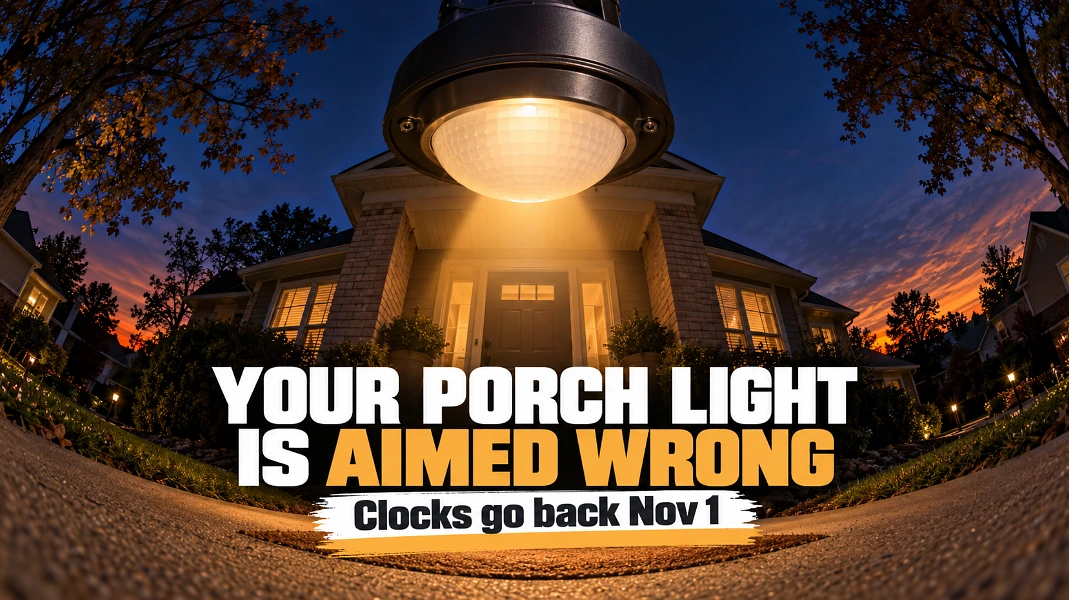
After November 1 you’ll be walking up the front walk in the dark again, probably with groceries, and if you put a motion light up over the door last year there’s a fair chance it comes on about the time you’re standing on the mat looking for your keys. That doesn’t necessarily mean it’s broken. Often it’s pointed straight down the walk at you, and that’s about the hardest angle you can give one of these sensors.
We went through the instructions for 2 kinds you’ll see at hardware stores. One is the Defiant DF-5716, which Home Depot sells as a replacement motion sensor you fit to an outdoor light you already have. The other is the Heath Zenith HZ-4132, a complete porch light with the sensor built in. We also read DarkSky International’s advice on keeping outdoor light off the neighbors, and between the manuals you get the explanation for several of the setup problems people run into.
Where the sensor can see you from
The Defiant covers up to 270 degrees and up to 100 feet, and that’s under good conditions, since the manual says the range shifts with the outdoor temperature so it won’t always catch you way out at 100. The Heath Zenith is narrower at 150 degrees and reaches about 30 feet. Defiant wants it around 8 feet off the ground, and if you go higher you end up tilting it down and losing some coverage.
Right there in the Defiant manual it says the sensor is more sensitive to motion moving across the front of it and less sensitive to motion coming straight toward it. That one line explains plenty of porch lights that come on late, and it’s in a booklet most people toss in the recycling with the box.
Walking straight at it is the problem

The little dome on the front is a lens, and it splits the area in front into a bunch of detection zones. Your body heat moving from one zone into the next is what the sensor picks up. Cut across in front of it and you’re passing through zones the whole way, so it reacts quick. Walk straight at it and you cross them much more slowly, so on a lot of ordinary sensors the light comes on later than you’d expect. Designs differ, and some are built to pick up people coming head on, but a light over the end of a straight walk is the classic late one.
Aim the sensor at the stretch of walk where you want the light to come on, then walk it. Put it on TEST, give it a minute to warm up, and come up toward the door from a couple of different spots. If it’s still late, turn the sensitivity up a bit. Sometimes the angle from above the door is just wrong, and a side wall that looks across the walk works better because you’re moving across its view and not into it. When you’re comparing motion sensor wall lights, look for a sensor head you can adjust separately from the lamp, so the sensor can look across the walk and the light can point down at the step.
The switches underneath that stay where the installer left them

Flip it over and there’s usually a little panel of switches under the sensor that hardly anyone touches again after the day it went up.
The ON-TIME one on the Defiant goes TEST, 1, 5 or 20 minutes, and the Heath Zenith does TEST, 1, 5 or 10. TEST keeps the light on about 5 seconds after you stop moving. It’s meant for setting up, and plenty of lights get left on it because that’s where it was when the ladder came down. You walk up, stop at the door, put a bag down to dig out the key, and 5 seconds of standing still can be enough for it to go dark on you. Defiant also warns that leaving it on TEST flicks the bulb on and off so often it can shorten the bulb’s life. If yours keeps cutting out, check it isn’t still on TEST, move it to 1 minute and see if that’s long enough for your door.
The Defiant has a DualBrite switch too, with OFF, 3 hours, 6 hours or dusk to dawn, and it keeps the light at a low glow then jumps to full brightness when it sees you. It’s nice if you hate a dark porch, though you’re lighting the place all evening for nobody, and leaving it on motion only keeps that down.
When the light goes into the neighbor’s bedroom
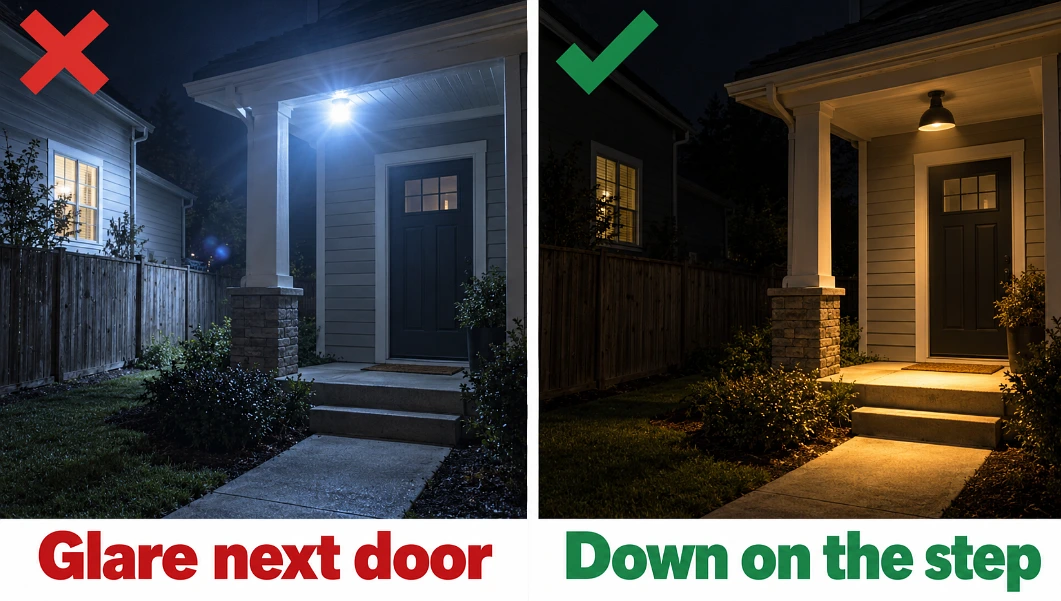
Rules on light spilling onto someone else’s property depend on where you live. Some states have their own, Arizona for one has a state law on shielding outdoor fixtures, and then you’ve got city or county ordinances, HOA rules and nuisance rules on top of that. Check what applies where you are before you put up something really bright.
DarkSky International keeps its advice pretty simple. Light only what you need, point it down, shield it so the bulb can’t be seen from next door, and go for a warmer color, 3000K or lower, instead of that harsh blue-white. Talking to the neighbor is usually a sensible first step anyway, which, to be fair, is how most things with neighbors get sorted.
A properly shielded fixture, or a shade or hood the maker sells for that light, sends the light down onto your step and keeps it on your side. Don’t rig something up yourself that covers the vents or blocks the sensor. A brighter bulb won’t fix it either. You just get a brighter wall and the glare in your face on the way up.
Solar ones and the December problem
Solar saves you running a wire but the panel needs real direct sun on it, and the wall next to your door is often in the shade of the porch roof even when the rest of the yard is bright. Go and stand there in the morning and again later in the afternoon and see where the sun gets to. Then think about December, with short days and the sun so low it barely clears the neighbors’ roof, so the battery gets a lot less charge. If you set it to glow all evening between triggers it’ll drain the battery faster than one that stays dark until someone walks up.
If you’re putting in or swapping a hardwired one, go by the maker’s wiring instructions, turn the power off at the breaker and check it’s dead before you touch a wire, and know that some places require a qualified electrician to do it. After that, tell everyone in the house which wall switch feeds it and to leave it on, because a motion light with its switch flipped off won’t ever come on and people call thinking it’s faulty.
Getting a late light sorted, in order
- Check it’s got power and the bulb works.
- Set it to TEST, let the sensor warm up, and walk toward the door from a few spots.
- Adjust where the sensor points and the sensitivity until it picks you up where you want on the walk.
- Move ON-TIME to 1 minute, or whatever suits your door.
- Go out after dark and look at where the light lands and whether it’s going over the fence.
Before you buy one
- whether it’s a full light or a replacement sensor for one you’ve already got
- how wide it sees and how far
- what height it’s meant to go at
- whether the sensor head adjusts separately from the lamp
- whether it has a sensitivity control
- what bulbs it takes
- wired, battery or solar
- whether the light itself can point down
If it still comes on late after all that, go back up the walk and nudge the sensor a little at a time toward the part you want covered. Small turns usually do it.

 Decor & Improvement Accessories