

Home & Decor Blogs: DIY, Interior Design & Lifestyle Ideas
Enhancing Your Property Value Through Proper Tree Management in Sydney

The right tree in the right spot adds tens of thousands of dollars to a Sydney property. The wrong one in the wrong spot takes even more away.
Sydney homeowners thinking about property value usually focus on kitchens, bathrooms, or a fresh coat of paint. Trees rarely come up — and that’s a gap worth closing. AECOM’s analysis of five years of Sydney house price data found that every 10% increase in street canopy coverage increased property values by an average of $50,000. In Annandale, that uplift reached $60,761. In Blacktown, $55,000. The numbers are real, and the pattern is consistent across the city.
But there’s a harder truth sitting alongside that. Research published in the international Cities journal, which matched more than 1,500 Sydney house sales from 2021 to 2024 with data on nearly 50,000 public trees, found that a single street tree within 10 metres of a property’s centre reduced its sale price by $70,290. That same tree, positioned further away, added $30,000.
The difference between a $30,000 gain and a $70,000 loss is placement and management.
What a well-placed tree actually does to a sale price
Trees at a useful distance — beyond 10 metres from the property centre — consistently lift Sydney sale prices, not just aesthetics.
The AECOM research tracked this through aerial photography, Landsat thermal imagery, and RP Data house prices across Blacktown, Willoughby, and Annandale. The pattern held across suburbs with very different canopy levels and price points. It wasn’t about one leafy street in one wealthy area — the value connection showed up wherever canopy existed in meaningful proportions.
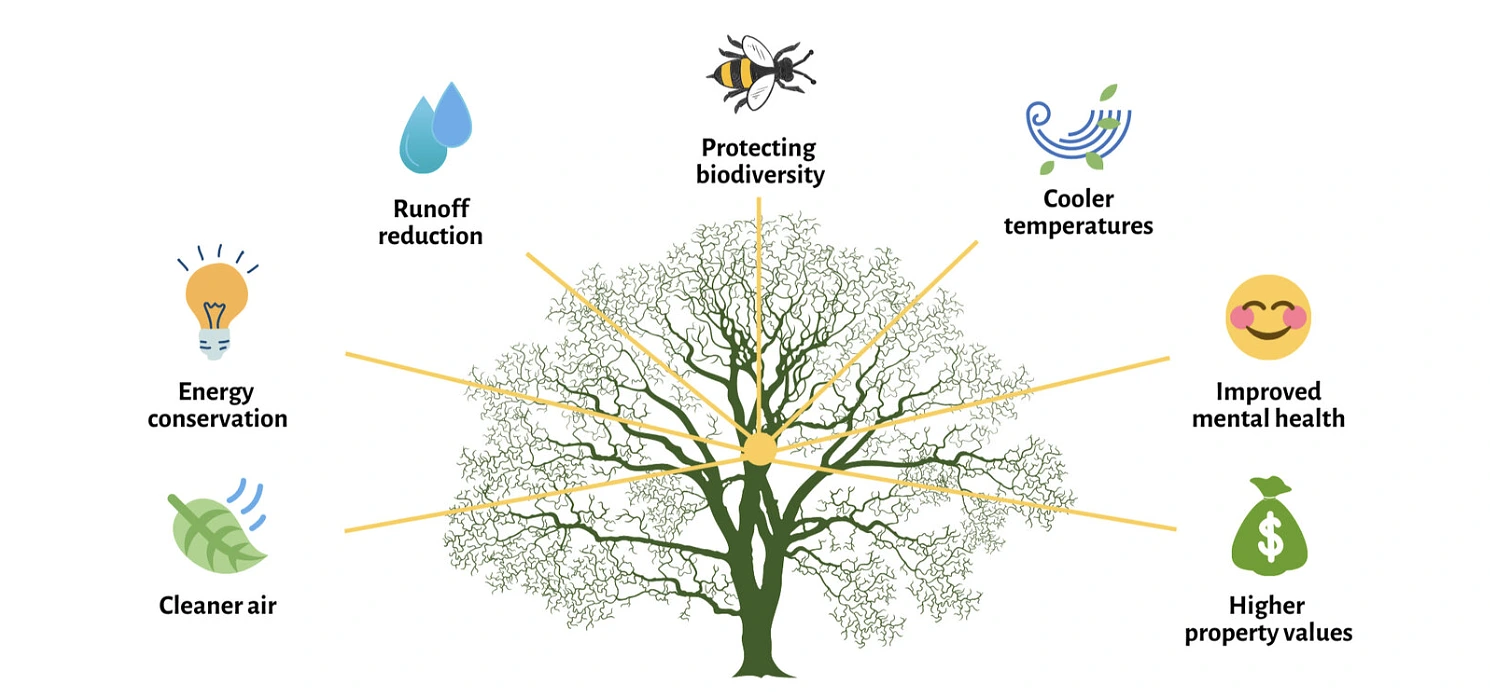
Part of what buyers are responding to is temperature. Streets in Annandale with 28% canopy cover recorded air temperatures 4°C cooler than streets with 20% coverage. In a Sydney summer, that’s not a small detail. It feeds directly into how a property feels during an inspection, how much buyers perceive they’ll spend on cooling, and whether the street itself feels liveable.
The problem with trees that are too close
A tree within 10 metres of your property centre doesn’t behave like an asset — Sydney sale data shows it behaves like a liability.
Most roots extend two to three times the width of the tree’s canopy. In Sydney’s varied soil conditions — from sandy coastal ground to clay-heavy inland areas — the root spread behaves differently depending on where the tree is. Aggressive species like some eucalypts, willows, and poplars are known to infiltrate sewer lines, lift foundations, crack paving, and displace soil under structures.
The NSW Land and Environment Court regularly handles disputes that stem from exactly this. In one documented Sydney case, a property owner on the lower north shore was fined $83,000 for arranging the removal of two neighbouring trees without council consent. Tree disputes in NSW aren’t informal — they’re litigated, and costs fall on whoever acted without proper process.
Most councils in NSW allow removal without a permit only when a tree sits within 3 metres of home foundations. Beyond that, a council application is required. Getting the placement right before a tree matures is far less complicated — and far less expensive — than managing it after the fact.
Pruning, maintenance and what buyers actually see
A neglected tree doesn’t just look bad — dead branches, leaning trunks, and sparse canopy are red flags buyers notice before they walk through the door.
The City of Sydney manages 34,500 street trees, 14,000 park trees, and an estimated 40,000 private trees across its local government area. Collectively, those canopies cover 19.8% of the LGA. The council spends up to $5 million each year managing those trees — that budget reflects how seriously tree condition is treated at an institutional level. Privately owned trees showing obvious decline pull against that investment.
Regular pruning removes dead wood, reduces the risk of falling branches, and keeps the tree’s structure sound. An unchecked tree that starts damaging a fence, neighbour’s property, or sewer line shifts from being a value-add to a liability — and under NSW law, the responsibility for that damage sits with the tree’s owner.
Choosing trees that suit Sydney conditions
Species selection determines whether a tree grows into a long-term asset or a future problem.
Sydney’s climate — dry summers, inconsistent rainfall, warm winters — suits native and drought-tolerant species better than many exotic alternatives. Planting a large-canopy species in a tight urban block creates exactly the proximity problem the Cities journal research flagged. Planting something that can’t handle heat stress creates a dying tree that reduces both canopy contribution and street appeal.
The City of Sydney has published a tree species list developed with arboricultural consultants, landscape architects, and urban forest practitioners specifically to guide planting choices in the local area. It exists because species choice isn’t just an aesthetic decision — it affects maintenance costs, root behaviour, canopy contribution, and ultimately how the tree interacts with surrounding structures over decades.
When removal is the right call
Dead, diseased, or dangerously positioned trees reduce property value rather than protect it — and leaving them creates legal exposure.
The same research that found well-placed trees added $30,000 to Sydney sale prices also confirmed that buyers price in risk. A visible hazard tree on a property signals deferred maintenance to any buyer doing due diligence. Where a tree is causing active structural damage or is sitting within the problematic distance threshold, removal done correctly by a qualified arborist is the responsible move.
Professional tree removal Sydney services understand the permit requirements, council regulations, and site conditions involved. Unauthorised removal carries serious consequences under NSW law — the $83,000 fine mentioned earlier came from exactly that situation. Done through proper process, removal can open up light, resolve a structural threat, and clear the way for better-placed planting that actually contributes to the property’s value long term.
What Sydney’s canopy targets mean for homeowners
The City of Sydney is targeting 23% canopy cover by 2030 and 27% by 2050, up from a 15.5% baseline in 2008. Greater Sydney’s target is 40% across the region.
As of 2022, Greater Sydney’s canopy sat at 21.7%, a slight increase from 21% in 2019. Several councils in leafier areas — including Ku-ring-gai, Northern Beaches, and Sutherland Shire — actually saw canopy losses between 2019 and 2022. The NSW Department of Planning and Environment tracks this using aerial imagery at 0.48-metre resolution.
For homeowners, this matters for a simple reason: as Sydney’s canopy targets drive planting across the city, properties in streets that already have established, well-managed canopies sit in a better position. The value research consistently shows that canopy density in the street corridor — not just on a single property — is what moves sale prices. Your own trees are part of that corridor.
 Decor & Improvement Accessories