

Home & Decor Blogs: DIY, Interior Design & Lifestyle Ideas
Everyday HVAC Issues That Impact Comfort in Montana Homes
If your furnace has ever quit on a night when the thermometer reads negative fifteen, you already know what Montana does to heating systems. The Bitterroot Valley gets called the “Banana Belt” because the mountains on either side block the worst of the blizzard winds, and that’s true enough, but January still averages highs around 37°F and lows near 15°F, with sub-zero dips from late November straight through February. Summer brings dry heat that sneaks up on people. And the shoulder seasons? A 40-degree temperature swing inside a single week barely registers as unusual around here.
That kind of climate doesn’t just wear HVAC systems down. It exposes every weakness they have.
Uneven Temperatures Between Rooms
You’ve got one comfortable room and another that feels like nobody bothered to heat it. This drives people crazy, and it happens in a huge number of Bitterroot Valley homes.
Ductwork is almost always the issue. Leaking joints. Sections running through crawl spaces with no insulation. Flex duct patched onto rigid metal from some renovation in the nineties. A lot of homes around the valley have been added onto over the years, and the duct system tends to reflect every one of those changes not always in a coherent way. The original system was designed for a smaller footprint; someone added a master suite or converted a garage, and the existing furnace and ducts were expected to just handle it.
An experienced HVAC contractor can measure airflow room by room, find where conditioned air is leaking out or not reaching, and figure out targeted repairs. Sometimes it’s a damper adjustment. Sometimes a stretch of duct needs replacing or insulating. It doesn’t always mean ripping everything out and starting over, which is what homeowners tend to fear.
Furnace Cycling On and Off Constantly
Short-cycling is the technical term. The furnace fires up, runs a few minutes, shuts off, and fires up again. Over and over. The house never reaches a stable temperature, the equipment takes a beating from all those start-stop cycles, and the energy bill goes up because the system is doing the hardest part of heating — ignition and initial ramp-up — way more often than it should.
Check the air filter first. Always. A clogged filter starves the system of airflow, the heat exchanger overheats, and the safety limit switch shuts things down. People underestimate how much a dirty filter affects performance, especially during Montana winters when the system runs for hours on end every day.
If the filter is clean and the cycling continues, the problem might be a bad thermostat reading or an oversized furnace. Oversized systems blast out heat fast enough to satisfy the thermostat before the rest of the house warms up, so the furnace thinks it’s done. It isn’t.
Elevation complicates things further. The National Fuel Gas Code says gas appliances installed above 2,000 feet need their input de-rated by 4% per 1,000 feet of elevation. The Bitterroot Valley sits between about 3,200 and 3,800 feet. A furnace that hasn’t been adjusted for that altitude runs too rich, too much gas for the available oxygen which causes sooty combustion, rough ignition, and cycling problems. This is the kind of thing a technician from Phoenix wouldn’t think to check. Someone who works in this valley deals with it regularly.
Thermostat Problems
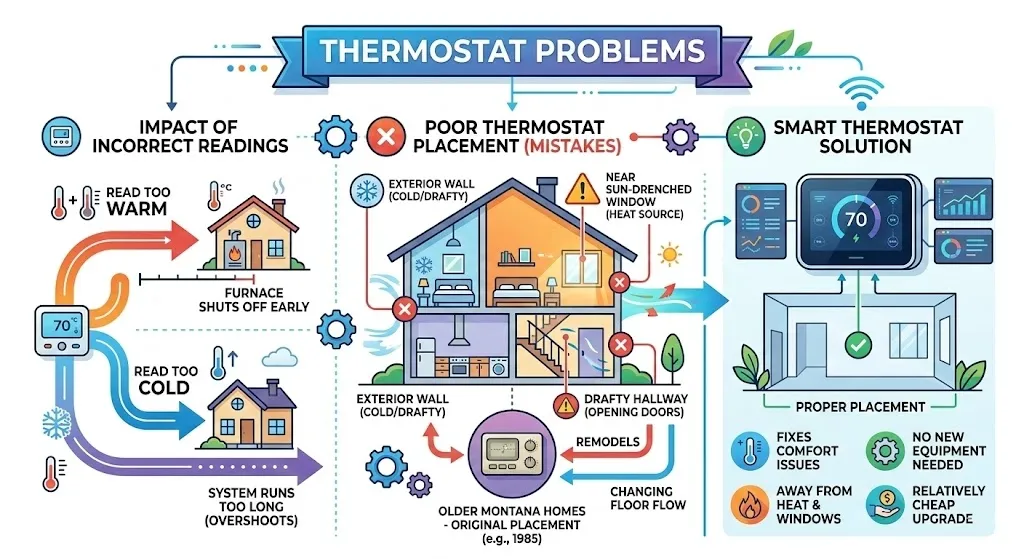
Weird one, because the thermostat seems like such a simple piece of the system. But when it reads the wrong temperature, everything downstream suffers. Reads too warm, the furnace shuts off early. Reads too cold, the system runs longer than it needs to.
Where the thermostat sits on the wall matters more than people think. Next to an exterior wall bad. Near a window that gets afternoon sun bad. In a hallway that gets drafty every time someone opens the front door also bad. Older Montana homes often have thermostats still sitting where a contractor put them in 1985, in a spot that made sense for the original floor plan but doesn’t match how the house flows now after remodels.
A smart thermostat on an interior wall, away from windows and heat sources, can fix comfort issues without changing any actual equipment. Relatively cheap upgrade for what it does.
Dry Air Through Winter
This is the one that affects everyone in Montana, whether they realize the cause or not. Cold air holds almost no moisture. At freezing, a cubic metre of air can absorb about 4 grams of water vapour. Heat that same air to room temperature indoors, and its capacity jumps to around 20 grams but no new moisture gets added in the process. So the relative humidity crashes.
Forced-air furnaces make it worse. They circulate and reheat that already-dry air over and over, and during long cold stretches, indoor humidity can fall below 20%. Cleveland Clinic puts the healthy range at 30% to 50%. Below that, you get dry cracked skin, irritated sinuses, nosebleeds, sore throats, static on everything, and wood floors separating at the seams. Dry air also feels colder than humid air at the same temperature because moisture evaporates off your skin faster. People respond by turning the heat up, which dries the air out further.
Portable humidifiers work fine for a bedroom. They can’t keep up with a whole house when it’s been below zero for two weeks straight. A whole-home humidifier wired into the HVAC system treats the air as it moves through the ductwork — more consistent, covers every room, and you don’t have to fill a tank every day. If you already have one and the dryness won’t quit, there might be air leaks in the building envelope pulling in cold, dry outside air faster than the humidifier can compensate.
Aging Furnaces
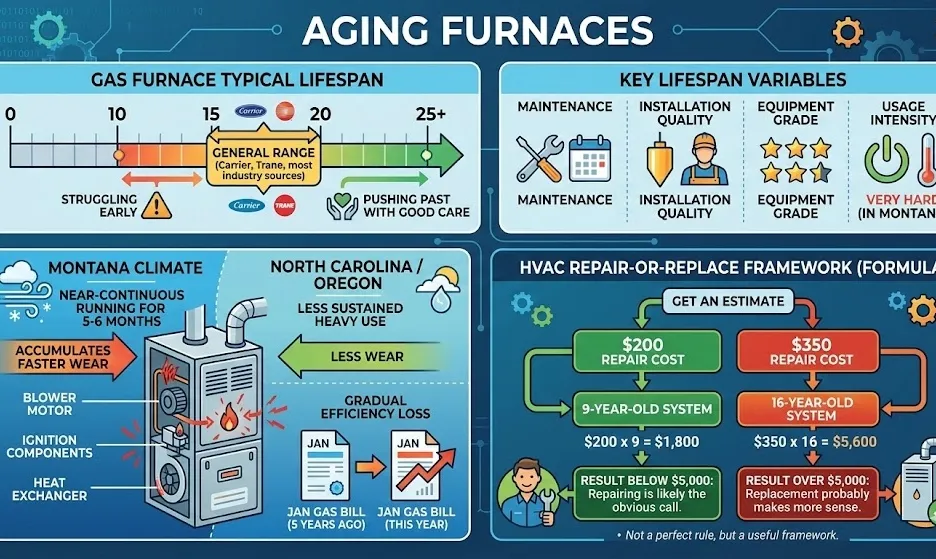
Gas furnaces generally last 15 to 20 years. Carrier says 15 to 20, Trane says the same, and most industry sources land in that range. Some units push past 25 with good care. Others start struggling at 12. The variables are maintenance, installation quality, equipment grade, and how hard the system works, which in Montana means very hard.
A furnace running near-continuously for five or six months accumulates wear that a system in North Carolina or Oregon simply doesn’t. Blower motors, ignition components, heat exchangers — all of it degrades faster under sustained heavy use. Efficiency drops gradually enough that you don’t notice month to month, but if you pull out your January gas bill from five years ago and compare it to this year’s, the difference usually tells the story.
HVAC professionals use a rough formula: multiply the repair cost by the system’s age. Result over $5,000, replacement probably makes more sense. A $350 repair on a 16-year-old furnace hits $5,600 — that’s replacement territory. A $200 fix on a 9-year-old system is $1,800, and repairing is the obvious call. Not a perfect rule. But it gives you a framework when you’re staring at an estimate and trying to decide.
Skipped Maintenance
Most preventable problem on this list. Also, the most common.
Maintenance gets skipped because the furnace seems fine. It ran all last winter without issues, so why spend money having someone come look at it? And then the igniter fails on a Saturday night in January when it’s negative ten outside, and the emergency call costs three times what a tune-up would have.
A filter that hasn’t been changed in four months restricts airflow, overworks the blower motor, and can cause the heat exchanger to overheat. Electrical connections loosen over time from thermal expansion and contraction. Burner assemblies collect dust and debris that affect flame quality. Refrigerant levels in the AC side drift if there’s a slow leak, and compressor strain builds through summer.
Two professional visits a year — fall and spring — catch this stuff before it becomes an emergency. The technician cleans components, checks gas pressure, tests electrical connections, inspects the heat exchanger for cracks, and verifies the system is running within spec. Between those visits, swap your filters every one to two months during heavy-use seasons. Montana’s air is dry and dusty, and filters clog faster here than you’d expect if you’ve moved from somewhere more humid.
When You Need a Professional
Thermostat batteries, dirty filters, furniture blocking a vent — those are homeowner-level fixes. Try those first. But if the problem stays after you’ve handled the basics, or you’re hearing noises that weren’t there before, catching odd smells, or the system just can’t hold temperature on a cold day, that’s when it’s time to get a technician involved.
For homeowners around Victor, Comfort Solutions is at 856 US-93, Victor, MT 59875 — phone is (406) 720-5429. They work specifically in the Bitterroot Valley and deal with the altitude, ductwork, and climate issues that come with this area. That regional familiarity matters more than people assume, especially for altitude de-rating and diagnosing problems in older remodeled valley homes.
Staying Ahead of It All
Montana asks more of your HVAC system than most places in the country. The cold alone would be enough, but add in elevation effects on combustion, rapid temperature swings between seasons, and air dry enough to crack hardwood — and you’ve got conditions that test every part of the system.
The encouraging part is that almost everything on this list is predictable. Regular maintenance catches it early. Paying attention to how your system sounds, how it cycles, which rooms stay cold — that gives you a head start before a small issue becomes a big one.

 Decor & Improvement Accessories