

Home & Decor Blogs: DIY, Interior Design & Lifestyle Ideas
Let’s Talk About Your Fridge (not the biohazard inside)
As women, we always blame men for feeding off us and then moving on. Then we go out, hoping to find the answer in a glass of Margarita. If not, we hex them. We are very modest in our living, to be honest. We cry, drink, and curse. Nothing more complicated than that. Sometimes, we smoke a cigarette, too, between drinking and the moment it’s already 3 a.m., and we scramble in vain to find a place that can sell us an ox’s heart, a dead cuckoo’s head, and the claws of a black hen. Only women who have truly been broken get it. Anyhow, we are still very confused about the reason men do that. How madly thin is the line between starvation and despising, though..
However, if there were an object in this world capable of genuinely understanding us, that must be the fridge. Yep, you heard it right the first time, the fridge. The comparison may seem outrageously brutal at first glance, but so is the world we live in, so you must be tough enough to take it. When did you last consider your fridge? When you were hungry, of course. When was the last time the gentleman whose name you keep murmuring thought about you? When he was hungry, of course. Maybe it is karma. They treat us the way we treat that poor fridge. How utopic would that be, right? To be honest, this is not necessarily a karmic loop. It could be karma, but mostly, the problem is them. (Actually, it is us, because we so deliberately choose to love the same boy, or, if not the same, one who bears enough resemblance to the last to make our hearts erupt in rage.) But it is more comforting to blame them, and we deserve this comfort, at least today. Dear female readers, the miraculous complexity of men is that… There is no miraculous complexity. They typically lose all cognitive functions when asked to relocate the ketchup bottle SITTING IN FRONT OF THEM.
Out of sympathy, however, you should think about that fridge more often than just when you’re hungry. Think of it as a silent witness to the endless tide of female sorrow. That thing knows everything…about the boy who never called back, the one who ghosts your texts like it’s a sport, the fights you replay on loop in your head, and even the heartbreaks you screenshot and scroll through at 2A.M. Maybe you’ve been looking in the wrong place for understanding all along.
What Life Was Like Before The Refrigerator?
A long time ago, to own a refrigerator was quite atypical. People lived with a constant awareness that time, temperature, and biology were always working against them, because, in the truest sense, time, temperature, and biology were working against them. However, food did not simply “go bad”. More specifically, it transformed, depending on the weather, the room’s humidity, and the method of storage at hand. For this reason, most families relied on naturally cool spaces, a striking fact when viewed in the context of modern luxury. So, our beloved refrigerator, the one we so nonchalantly pass by nowadays, was very…let’s say, out of the ordinary, including alternatives such as root cellars dug deep into the ground, pantries positioned on the shaded side of the house, and stone basements that held the night’s chill.
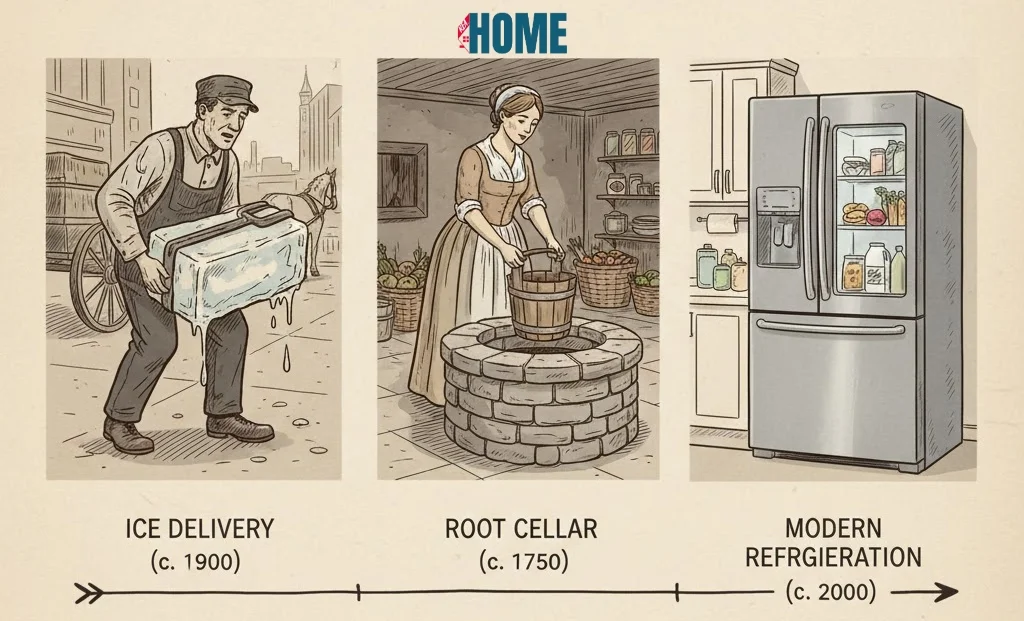
To give you even more context, you should know that people went as far as layering produce in sand or straw, keeping milk in a bucket suspended in a cold well, and often storing butter in a glazed crock submerged in a stream. Thus, every practice we now romanticise as rustic simplicity, pickling, fermenting, smoking, and curing, had no ambience attached to it then. It was unembellished survival. Jars were sealed with genuine concentration because a single improperly sterilised lid could mean losing an entire batch. Meat was heavily salted, not for taste but because it had to endure seasons of scarcity. Even something as modest as keeping leftovers was rare. Once a meal was finished, it was finished.
Urban life, however, offered slightly more comfort through ice delivery, but we shall not mistake it for something remarkable, though. Like, it was extraordinary, of course, but only within the context of that era. Furthermore, a towering block of ice, harvested months earlier from winter lakes and packed in sawdust, would be dropped off by a sweating deliveryman, giving the family’s icebox a brief window of usefulness. However, it required constant draining, scrubbing, and vigilance.
The Coolest Refrigerator Ever
When people attempt to define the “coolest” refrigerator imaginable, they often jump straight to the extravagant. However, it is the function that defines a good appliance, so largely, people are looking for a refrigerator that combines intelligent engineering with practicality. No one says the refrigerator should not be crafted with attention to detail, though. We all love shelves that glide and have good interior lighting. Still, the microclimates that respect the temperaments of different foods are highly important. The reason as to why we insist on that is because if humidity is not thoughtfully managed, vegetables stand no chance of remaining crisp, for example. We don’t want that.
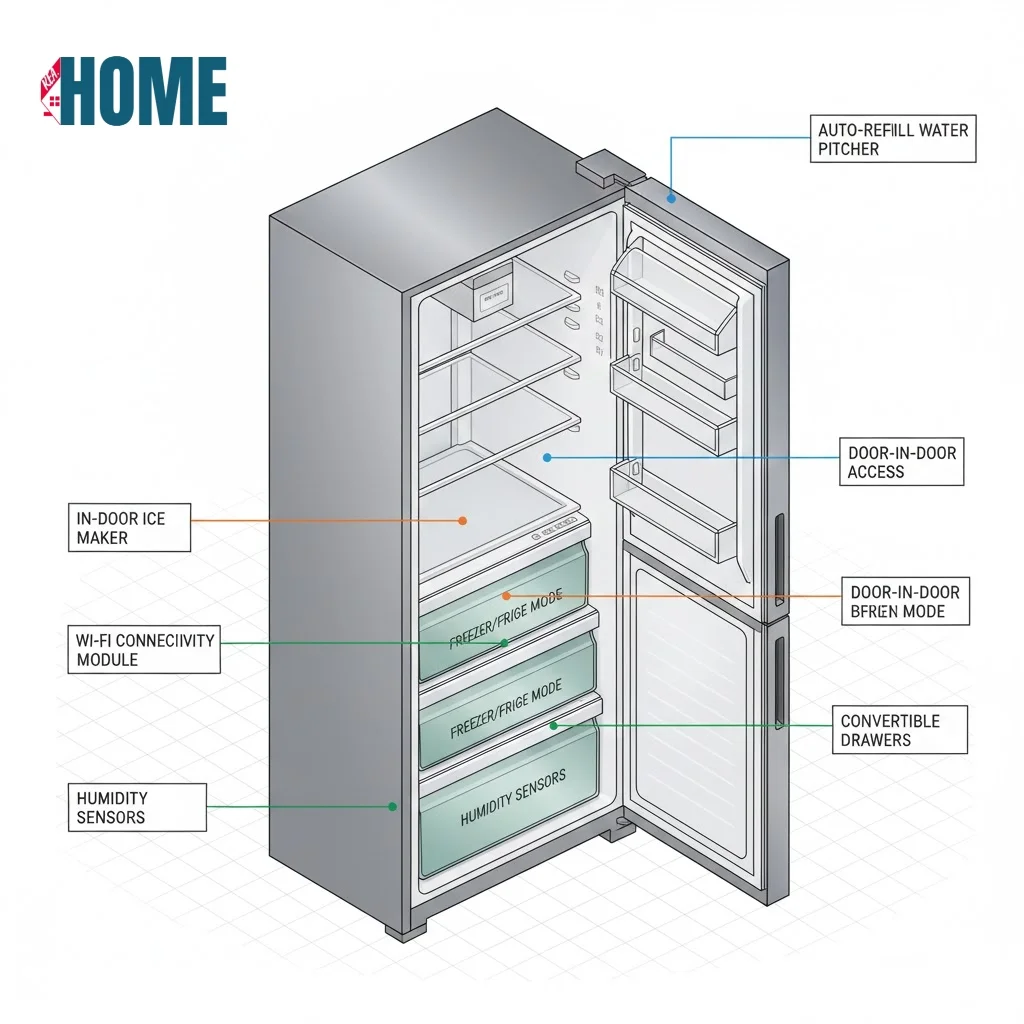
For this reason, it is worth emphasising that some of the most impressive models use internal sensors to observe your habits, so they can further nudge the temperature down after a grocery run, detect when airflow needs recalibrating, or remind you about the horrific moments when produce is approaching its decline. Also, other features you never realised would matter so much, include a built-in pitcher that refills itself and drawers that can shift between freezer and fridge modes, depending, of course, on the week’s needs.
The “coolest” refrigerator, therefore, isn’t the flashiest. It’s the one that manages to disappear into your routine while still improving it. However, if you’d still like to examine how refrigerators have evolved across the decades, here’s a solid start. As for color, it is chosen not to announce itself, but to support the room and align with the overall design of the kitchen. It should, for instance, go well with the cabinet doors. If you choose painted solid wood kitchen doors, the fridge should contrast or enhance the natural warmth of wood. This way, the result will be an appliance that participates in the visual order of the kitchen rather than breaking it.
How Much Is Too Much for a New One?
Deciding how much is reasonable to spend on a new refrigerator is far more nuanced than simply setting a ceiling and refusing to cross it. Now, if we think about the fact that refrigerators sit indeed in a strange category of purchase, we must also mention that they are simultaneously long-term investments, daily companions, and symbols of domestic order. Because of that, the boundary between sensible spending and unnecessary indulgence is surprisingly easy to blur.
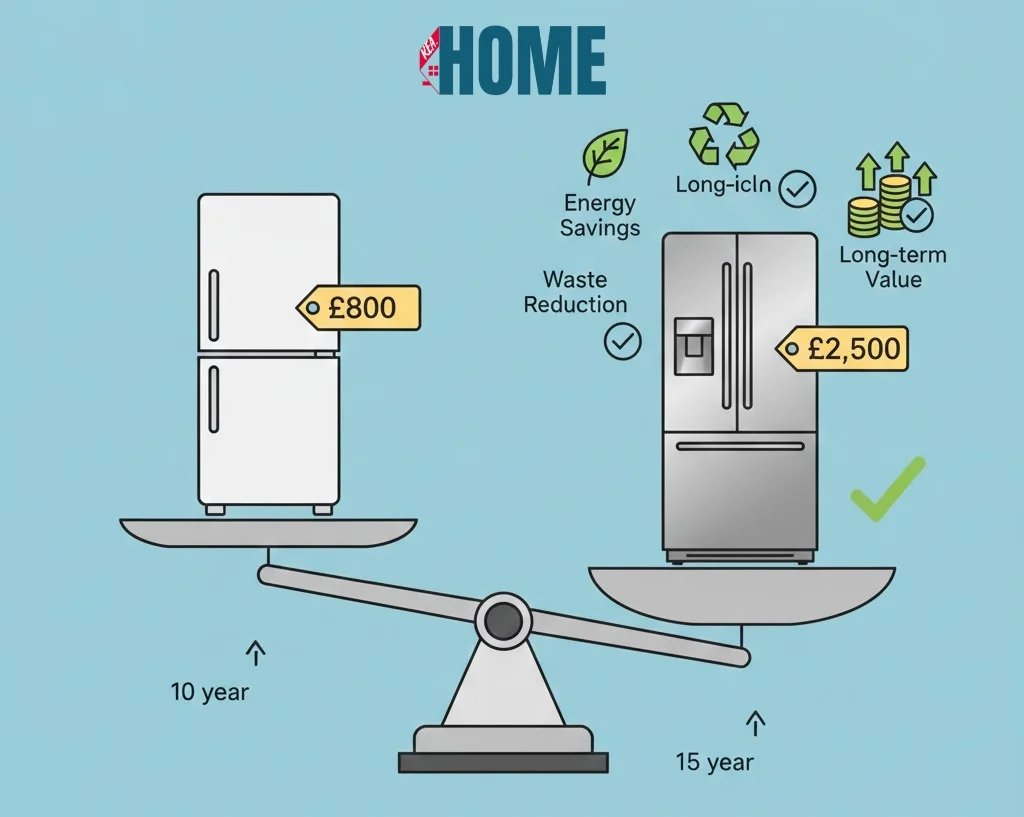
Thus, your household’s habits are the most reliable starting point. For instance, if a family that cooks, entertains, and prefers to buy groceries in bulk, it is only natural that features such as precise temperature zoning, extended storage capacity, and superior insulation are among the best. In that context, paying a higher price shall never be considered outrageous, particularly if we consider the appliance directly reduces waste and energy consumption.
On the other hand, the only logical conclusion is that if your cooking routine is modest and your shopping habits are minimalistic, many premium features, including touchscreens, custom lighting, door-in-door access panels, or ultra-specialised drawers, become pointless. Thus, ultimately, paying thousands for conveniences you rarely use is nothing more than arrogance, or, more certainly, a gesture wholly devoid of real substance, often made by those fully seduced by the consumerist industry.
Lastly, a helpful metric would be to consider whether the refrigerator’s cost aligns with its lifespan. As most models last 10–15 years, the price should never feel disproportionate to the value you’ll extract from it over that period. Otherwise, the purchase may be veering into excess.

 Decor & Improvement Accessories