

Home & Decor Blogs: DIY, Interior Design & Lifestyle Ideas
When Selling Your House Fast Makes More Financial Sense

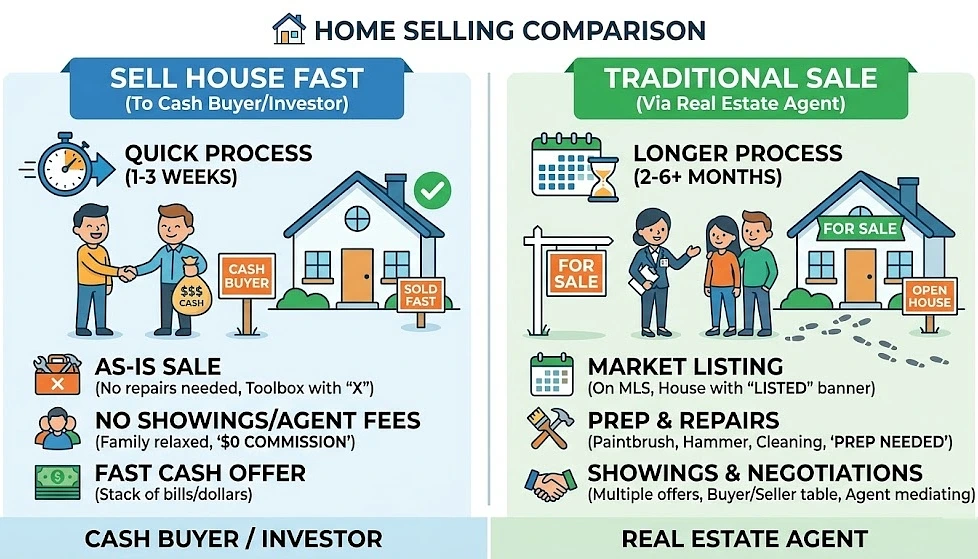
Immediate sale at a lower price may net you more money than a traditional listing once carrying costs, commissions, and time are considered.
The standard advice list in spring, prep the house, wait for the right offer, works when time is on your side. But time costs money. For a specific set of sellers, a drawn-out traditional sale ends up taking more out of their pocket than a quicker, lower offer ever would have. The math changes completely depending on what’s sitting behind the sale.
What a House Costs You While It Sits Unsold
For every month that a property languishes unsold, the seller is paying mortgage, taxes, insurance, utilities, and maintenance whether or not someone lives there.
The U.S. Census Bureau’s 2024 American Community Survey put the median monthly owner cost for mortgaged homeowners at $2,035. A vacant property still requires maintenance, utilities, and vacant home insurance — a separate policy from standard homeowners coverage. Property taxes, which the Census Bureau reports average 1.1% of home value annually nationwide, continue accruing regardless of whether the home is occupied.
Then factor in the sale itself. As of 2025, total real estate commissions average 5.7% of the sale price, according to Clever Real Estate, paid out of proceeds before closing costs or post-inspection repair requests. As of November 2025, the average home spent 64 days on the market before going under contract, with an additional 41-day closing period per ICE Mortgage Technology data. That’s three to four months of carrying costs stacked on top of commissions and closing expenses — and that’s what a “better offer” actually needs to beat.
Selling a House That Needs Repairs
A house that needs major repairs rings alarm bells for most buyers right away, because lenders often won’t finance a property with serious structural problems, roof, or habitability issues.
That leaves cash buyers and investors as the realistic market. The other option — renovating before listing — means carrying costs accumulate every month the work runs, and any surprise discovered mid-project (aging electrical, hidden water damage, foundation issues) turns a calculated budget into an open-ended one. Companies like Fair Deal Home Buyers purchase properties in their current condition, skipping financing contingencies, inspection negotiations, and the renovation risk entirely. For sellers without the cash or time to manage a full renovation, that’s the cleaner financial path.
Selling During a Divorce
When the family home is included in a divorce settlement, divorce often cannot be finalized until the sale closes, meaning every month the sale lingers on, both parties remain financially tethered to each other.
When one spouse won’t cooperate, the other can petition the court to order the sale. If that fails, a partition action forces it through a court-appointed referee — a process that adds $15,000 to $30,000 in legal fees and typically takes 6 to 12 months, according to California real estate attorney Justin Borges. There’s also a tax dimension: married couples filing jointly can exclude up to $500,000 in capital gains from a primary residence sale under IRS Section 121. Once divorced, that drops to $250,000 per individual. Disagreements that push the sale past the divorce filing date can eliminate that difference in exclusion.
Selling in a Falling Market
The price doesn’t get better by waiting in a declining market it gets worse, with each additional month on the market serving to negotiate down from an even worse position.
Existing home sales dropped 8.4% month-over-month in January 2026 to an annualized rate of 3.91 million — the sharpest single-month decline in nearly four years, per the National Association of Realtors. When inventory builds and demand softens, that dynamic compounds. Rising mortgage rates shrink the qualified buyer pool, and deals fall apart at appraisal more often. The NAR’s February 2025 Realtors Confidence Index Survey found 13% of contracts had delayed settlements in the preceding three months, with 7% of those delayed specifically due to appraisal issues. More failed deals mean a longer time on the market, which means more months of carrying costs eating into whatever the eventual sale brings.
How to Compare Your Options
The real comparison isn’t full price versus discounted price, it’s net proceeds from a traditional sale after all costs and time, versus net proceeds from a cash offer today.
Start with a realistic traditional sale figure — not list price, but what buyers in your market are actually paying after negotiation, minus the 5.7% average commission, minus closing costs, minus any post-inspection repair concessions. Then subtract carrying costs for the realistic sale timeline. Compare that against a cash offer. That difference — not the headline price — is the figure that determines which route actually pays more.
 Decor & Improvement Accessories