

Home & Decor Blogs: DIY, Interior Design & Lifestyle Ideas
Why You Should Hire a Pro for Oil Tank Removal and Replacement Instead Of DIY

Oil tank lurking somewhere in the basement? Opposite the steps, rammed against a wall, in a corner behind cartons, of which no one has heard since the Clinton administration. The majority of human beings do not even become aware that it is even present until a home inspector points to it or when they finally get around to clearing out the basement and discover this rusty steel cylinder glaring back at them.
And the instinct is always the same; it is a metal box, I will simply dispose of it. Maybe call a mate with a truck. Not even close, except that it is not that simple. Even the tank, which has not been used for years, has some fuel left, sludge in the bottom, and vapors inside the shell. The corrosion of the steel happens silently over the decades, and what appears to be solid can break the minute you attempt to move it. Oil spills on a basement floor, and it does not sit there until it can be mopped up. It permeates formulas into the cement, and months later, you are still smelling it.
For all these reasons, it is best to let experts remove or replace oil tanks. They recognise the safety rules, and they know every risk that is involved. They can do the job without causing extra problems or costs. The details are important, and the sections below explain why.
How Long Oil Tanks Actually Last
Indoor basement tanks, the most common type around Fairfield County, typically last 15 to 25 years, depending on maintenance and moisture exposure. Some well-maintained ones have stayed functional for 40 or even 60 years, but that’s the exception.
Outdoor above-ground tanks have a shorter life. Roughly 10 to 15 years. Rain, snow, temperature swings, and UV exposure all take their toll. Underground tanks are the worst. They corrode in ways you can’t see, and by the time you notice a problem, the soil may already be contaminated.
If your tank is approaching any of these thresholds, an inspection costs a lot less than dealing with the consequences of waiting.
Hidden Safety Risks
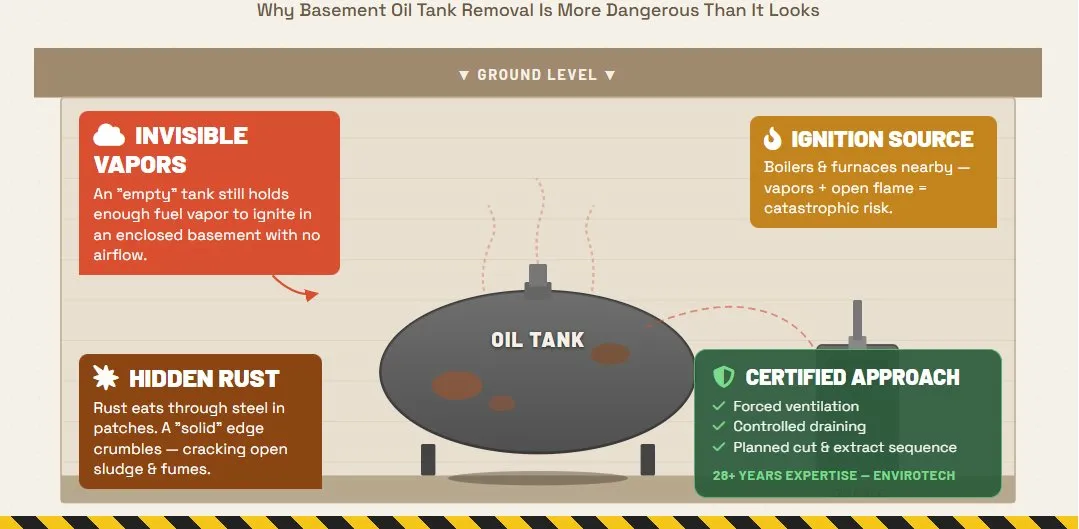
Fuel vapors catch people off guard. A tank can look bone dry and still have enough vapor inside to cause problems in a tight basement with no airflow. You’re working in an enclosed space, probably near a boiler or furnace. That’s not where you want surprises.
Rust doesn’t weaken steel evenly. It eats through in patches, so you’ll grab what seems like a solid edge, and the whole section crumbles. If the tank still has sludge or residual oil in it (and it almost certainly does), any crack during handling puts fuel on the floor and fumes in the air.
Certified contractors working on oil tank in basement jobs, like Envirotech Of Fairfield County Inc, who’ve been doing this for over 28 years, use forced ventilation, protective gear, and controlled draining before they even think about moving the tank. Cutting, lifting, and extraction all happen in a planned sequence that keeps fumes contained and oil off your floor.
You Can’t Just Throw It Away
Old oil tanks aren’t regular waste. Residual fuel counts as hazardous material. The tank needs cleaning before anyone cuts it, and the metal goes to approved recycling. Not your local scrap yard.
In Connecticut, homeowners need a permit before removal starts. The local fire marshal has to know about it, and in many towns, the marshal has to be physically on site during removal and soil sampling. No exceptions.
The contractor needs registration as a Connecticut Home Improvement Contractor with at least $1,000,000 in liability insurance. Piping work requires a licensed plumber. If oil has leaked, a contractor with a hazardous waste license from DEEP handles the remediation.
One thing most people overlook. Make sure your contractor carries pollution liability insurance specifically. General liability and pollution liability are different policies. If something goes wrong during removal and your contractor only carries general coverage, you could end up holding the cleanup bill. Ask to see their pollution liability certificate before you sign anything.
Connecticut law requires sellers of residential property to disclose underground tanks. Location, age, everything. Banks are getting increasingly nervous about mortgages on properties with undocumented tanks. Proper disposal paperwork turns a potential deal-breaker into a non-issue.
Abandonment vs. Removal
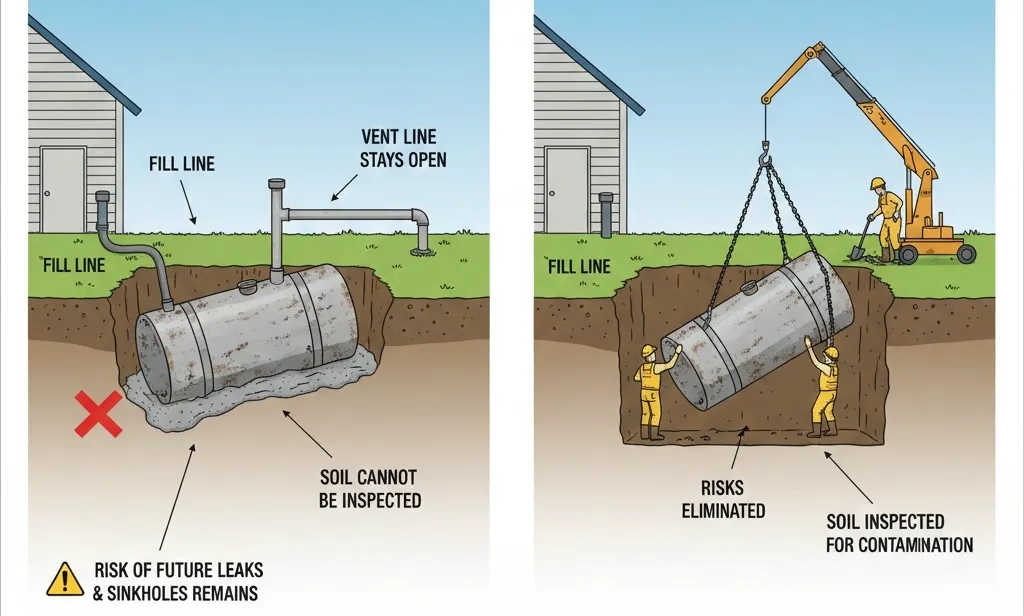
You can abandon a tank in place rather than removing it. That means draining it, cleaning it, and filling the shell with foam, concrete slurry, or sand. Vent lines stay open, fill line gets capped or removed.
It’s usually cheaper, and sometimes it’s the only option when a tank sits under a footing or somewhere excavation would cause more damage than it’s worth.
But removal is almost always the better call. You can’t inspect the soil underneath an abandoned tank. If it was leaking slowly for years, which is common with underground tanks, you won’t know until someone digs it up. That someone is usually the next owner’s inspector during a sale.
New York’s Department of Environmental Conservation puts it plainly. Removal lets you check for contamination and eliminates the risk of future sinkholes if the tank collapses. Abandonment leaves those risks in the ground.
Your Basement Wasn’t Built for This
A standard 275-gallon residential tank weighs around 250 pounds empty. Bigger underground tanks weigh considerably more. And these things are jammed into corners, wedged behind stairs, pressed against beams. The house has spent decades settling around that weight.
Yank it out without planning, and you get cracked concrete floors, damage to a chipped foundation wall that was already borderline, or a shifted load on a staircase. Drag it across the floor, and you’ll gouge a groove into the concrete. Cut it apart without thinking about weight distribution, and the remaining pieces shift unpredictably.
Professional crews measure the exit path first. They protect floors and walls, reinforce weak spots, and section the tank in a controlled sequence if it won’t fit through the whole. When they’re done, you can’t tell anything was there except a clean space.
Insurance Doesn’t Cover What You Think
Standard homeowner’s insurance almost always excludes oil tank leaks and the resulting soil or groundwater contamination. If your tank leaks, whether it’s active or dormant, the cleanup comes out of your pocket.
Some insurers offer a pollution liability rider, but it’s not standard, and not all companies provide it. Others won’t insure a property at all if there’s an underground tank, or they’ll require proof of removal before they write a policy.
During property sales, this creates a chain reaction:
- The buyer’s insurance company won’t write a policy with the tank in place
- The buyer can’t close without insurance
- The sale stalls until someone deals with the tank
- Discovering it during due diligence gives the buyer leverage to renegotiate or walk away
If you still have an active tank, call your insurer and ask what they specifically cover. Find out whether a pollution liability rider exists and what it costs. If you’re planning to sell, sort the removal out before you list.
A planned removal with clean soil results and proper documentation is a one-time expense. An unplanned discovery with contamination, remediation, insurance headaches, and a delayed sale is a financial spiral.
Signs Your Tank Needs Attention
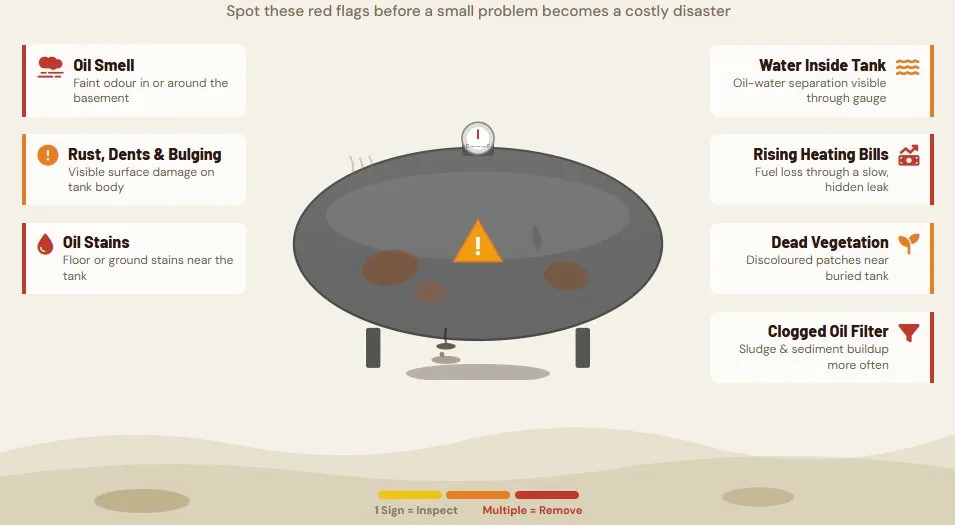
Sometimes the tank decides for you. Any of these should prompt a call to a professional:
- Oil smell in or around the basement, even faintly
- Visible rust, dents, or bulging on the tank surface
- Oil stains on the floor or ground near the tank
- Water pooling inside the tank (oil and water separate, so it’s usually visible through the gauge)
- Rising heating bills without an obvious cause could mean fuel loss through a slow leak
- Dead vegetation or discoloured patches in the yard near a buried tank
- Sludge or sediment clogging the oil filter more often than usual
One of these alone warrants an inspection. Multiple symptoms together mean you’re probably past inspection and into removal territory.
What Happens During Professional Removal
The process is more involved than most people expect. Here’s roughly how it goes.
Oil extraction. They pump out remaining usable oil with an explosion-proof transfer pump. That oil doesn’t go to waste. It can be filtered and reused, and some contractors will credit you for the salvageable fuel or deduct its value from the bill. Worth asking about.
Sludge removal. Water vapor condenses inside oil tanks over time, mixes with rust particles and settles into a thick slurry at the bottom. Crews cut an opening in the tank, scrape the sludge out by hand into buckets, and transfer it to sealed drums. That sludge counts as hazardous material.
Pipe disconnection. They cut fuel lines and vent pipes from the foundation. Holes through concrete get a cement patch. Through wood walls, they seal with silicone and suggest a carpenter replace the siding for a permanent fix.
Tank extraction. The tank either comes out whole if the doorway allows, or they section it into pieces that fit through the exit path. Everything goes to an approved disposal facility. Even after cleaning, the metal still counts as contaminated.
What It Costs
Costs depend on location, size, and whether contamination is involved.
| Job | Typical Cost |
|---|---|
| Above-ground tank removal | $300 – $1,000 |
| Basement or underground tank removal | $1,000 – $3,000+ |
| Soil testing (above-ground) | ~$300 |
| Soil testing (underground) | ~$500 |
| Soil remediation if contamination is found | $500 – $10,000 |
| Permits | $30 – $160 |
| New replacement tank + installation | $2,000 – $4,000 |
National average for a straightforward removal sits around $1,357, but basement jobs in the Northeast with contamination blow past that easily. Get three quotes. Some contractors bundle soil testing, disposal, and documentation into a flat rate. Others itemise everything. Ask what’s included before you compare numbers.
Installing a Replacement
New tanks are built to better standards than whatever’s been rusting since the Ford administration, but installation still matters enormously. Placement, venting, fuel line connections, and spill containment all fall under NFPA codes.
The tank needs clearance for future inspection and servicing. Vent pipes need to ensure proper airflow for safe operation. Shut-off valves have to be accessible. You need spill containment at the fill point. Miss any of these, and you’re looking at a failed inspection or a system that quietly causes problems.
Modern replacement tanks come with features older models didn’t have:
- Double-wall construction for leak containment
- Built-in leak detection systems
- UV-resistant coatings for outdoor installations
- Designs that reduce condensation buildup, which is what causes interior rusting
If you’re replacing, a double-wall tank is worth the extra cost.
Above-ground tanks in Connecticut max out at 660 gallons and need protection from weather and physical damage. Basements, sheds, and enclosed spaces all qualify. If you’ve got an underground tank, every environmental professional in the state will tell you the same thing. Replace it with an above-ground model. Underground tanks corrode invisibly, leaks go undetected for years, and cleanup costs reach tens of thousands.
Timing matters too. Spring and early autumn are the best windows. The heating system needs to stay off for six hours or more during installation. Doing that in January means a cold house, frozen pipe risk, and a miserable experience. Plan if you can.
Professional installers work to local building codes, pressure-test connections, and verify everything before the system goes back online. You get a setup that works, passes inspection, and doesn’t keep you up at night wondering if something’s seeping.
What Happens If They Find a Leak During Removal
Nobody plans for this, but it happens more often than you’d think with underground tanks that have sat for decades.
The crew starts pulling the tank, tests the soil underneath, and the lab results come back showing petroleum contamination. Now what?
In Connecticut, anyone who discovers a leak has to report it to DEEP’s Emergency Response and Spill Prevention Division. If the contamination has reached a drinking water well or surface water, the Remediation Division gets involved, too.
Here’s the typical sequence:
- The contractor excavates contaminated soil and stockpiles it on plastic sheeting on your property
- They cover it with another layer of plastic while the lab processes samples. That takes roughly two weeks
- Once results come back and a disposal facility confirms a date, the contractor returns to load and haul the soil
- Total timeline runs from a few weeks for minor contamination to several months for serious cases
Cost impact is significant. Remediation runs $500 to $10,000 or more, depending on how far the oil spreads. If it reached groundwater, costs escalate dramatically. The EPA has documented underground tank cleanups ranging from $10,000 to well over $100,000 for severe contamination.
This is one of the strongest arguments for not putting off removal. The longer a tank sits, the more likely it is to develop slow leaks, and the more time those leaks have to spread. Getting it out sooner means a smaller contamination footprint and a smaller bill.
Keep It Running: Annual Inspections
Once your new tank is in, don’t forget about it. An annual inspection catches problems while they’re still cheap to fix.
What to check each year:
- Sludge and water at the bottom of the tank (both cause interior rust and feed bacteria that eat through steel)
- Visible corrosion on the exterior and around connection points
- Oil filter cartridge and screen condition. If you’re replacing it more often, that’s an early sign of tank deterioration
- Vent lines and fill pipes for cracks or loosening
If you have an outdoor tank, add weather damage and condensation to the list. Outdoor tanks also run into waxing and gelling in cold weather. The hydrocarbon chains in heating oil form paraffin crystals that clog fuel lines. Wider fuel lines, insulated piping, and heating oil additives all help prevent this. Your installer can advise on what makes sense for your setup.
Having your heating oil technician give the tank a once-over during their annual furnace service is the easiest approach. It adds minutes to a visit you’re already paying for.
Final Thought
Oil tanks are one of those things where doing it right always costs less than doing it wrong. A professional removal runs a few thousand dollars and takes a day or two. A contamination cleanup, a stalled property sale, an insurance dispute, or structural damage from a botched DIY attempt can cost ten times that and drag on for months. If there’s an old tank in your basement or buried in your yard, deal with it on your terms and your timeline. Not on someone else’s.

 Decor & Improvement Accessories