

Home & Decor Blogs: DIY, Interior Design & Lifestyle Ideas
7 Remodeling Mistakes That Start Before the Renovation Does


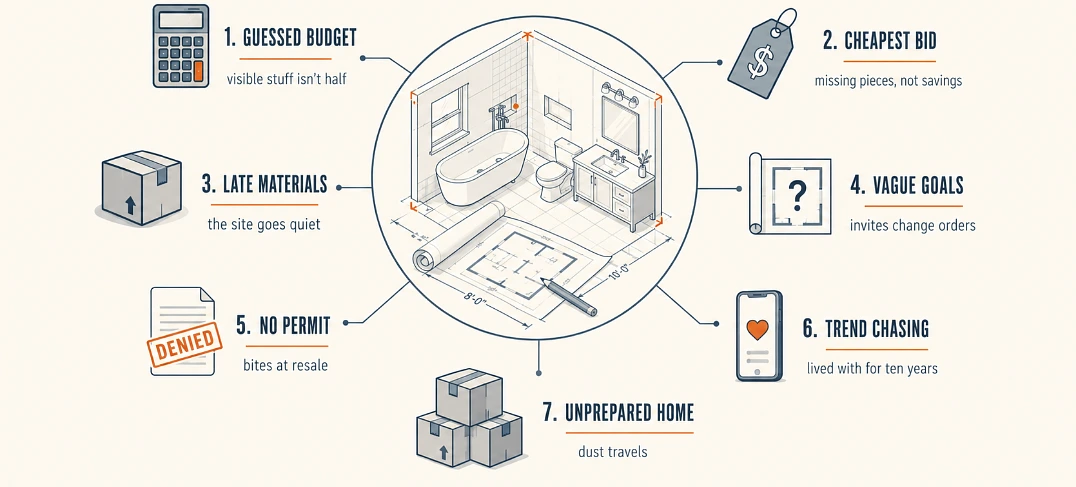
Most renovation problems don’t really start when the sledgehammer comes out, they start weeks before that, back when the whole thing is still a sketch and a spreadsheet and every decision feels too small to matter. Seven of them come up again and again, and it’s the same seven every time: guessing at the budget, chasing the lowest bid, ordering the materials too late, going in without a clear picture of what you actually want, skipping the permit, building for a trend instead of your own family, and never once thinking about the house itself having to survive the job. Some of these bill you during the build and the rest of them just wait, sometimes for years, and hand you the invoice long after the dust has settled.
And the thing is every one of them is still free to fix while it’s sitting on paper, which is the whole reason to read this before you go and call anyone.
The Budget That Doubled
#1 Setting The Budget From What You Can See
Picture how you’d probably go about it. You walk the room, you price the vanity you’ve got your eye on, you add the tile, you pick the fixtures, you total it all up and that number quietly becomes “the budget.” It feels reasonable enough. It’s also wrong, because everything you just priced is the part you can actually see, and the part you can see comes to less than half of what you’re really paying for.
Now the reason for that is labor, which on a bathroom eats up something close to half the total on its own and none of it ever shows up in the showroom. Nationally most of these projects land somewhere between three and a half and twenty-five grand, with the average sitting around ten to fourteen, and where you fall inside that spread has a lot less to do with your taste than with one single question, which is whether the plumbing moves or not. The minute you relocate a toilet or shift a shower drain you’ve added two and a half to five grand, because now you’re paying someone to reroute pipes buried inside walls and floors, so if you can leave the fixtures roughly where they already sit you’ve done more to keep the budget in check than any material swap was ever going to manage.
The Bid You Shouldn’t Have Taken
#2 Taking The Cheapest Bid
If you have got three quotes sitting in front of you and one of them is a thousand dollars under the other two, and your finger is already drifting toward that one. Hold on there a second, because that gap is trying to tell you something.
A remodeler who has opened up enough old bathrooms already knows what tends to be hiding in there, the water that got behind the tile years ago, the wiring that predates the current code, the subfloor gone soft from some leak none ever noticed, and the higher bids usually have all of that priced in. The cheap one very often doesn’t, and that isn’t really a discount, it’s just a bill you haven’t been handed yet, because the rot and the rewiring don’t politely disappear because the quote decided to ignore them. They turn up halfway through the job as change orders, priced at whatever the contractor feels like charging, and by that point the other two bidders you could have compared him against are long gone. So keep back 10 to 20 percent as your contingency, and when one number comes in miles below the rest, don’t go celebrating it, get that contractor to walk you line by line through everything the quote doesn’t actually cover.
The Site That Went Quiet
#3 Choosing And Ordering Materials Too Late
The trades run in a set order, and it goes like this, demo first, then the rough plumbing, then the electrical, then an inspection, then the tile, and the fixtures last, with each one waiting on the one before it, which means the whole schedule only ever moves as fast as whatever hasn’t turned up yet.
Custom and imported tile is running four to twelve weeks at the moment, custom cabinetry piles its own weeks on top of that, so when the vanity isn’t there on the morning the plumber actually needs it, the crew isn’t going to sit around your house waiting for it. They pack up and go start somebody else’s job, and now your project is stuck at the back of their calendar, which is a very different thing from being at the back of yours.
The fix here costs you nothing except doing it early. Before the demolition even starts, get these ordered and, if you can, boxed up and sitting in your garage:
- The tile, especially anything custom or imported, because one cracked box in transit and the replacement takes its own six weeks all over again.
- The vanity and any custom cabinetry.
- The specialty fixtures, the lighting, and the shower glass.
The Plan That Was Never a Plan
#4 Starting Without Clear Goals
There’s an old film, if you guys are from GENZ sorry for landing into such old time, well that has been quietly explaining this exact mistake since 1948. In Mr. Blandings Builds His Dream House, Cary Grant and Myrna Loy get quoted seven thousand dollars to do up their cramped Manhattan apartment, and Grant waves it away, because surely for just a little bit more they could buy themselves a proper place out in the country instead. So they fall for a two-hundred-year-old farmhouse in Connecticut, they convince themselves that renovating it will actually save them money, and by the time the credits roll they’ve spent thirty-eight thousand, which is more than five times the number that started the whole thing off.
And that’s not some quaint period-piece problem, it’s what happens any time you start without knowing exactly what you want, because a vague plan is basically an open invitation for “well, while we’ve got the wall open anyway.” Every one of those mid-build additions is a fresh change order, and every change order drags the whole scheduling headache back through the loop again with a new cost bolted onto it. The people who actually stay on budget aren’t the lucky ones, they’re just the ones who sat down and decided, on paper, exactly what they were and weren’t doing before anybody turned up with tools.
The Remodel That Bites Years Later
#5 Skipping The Permit
A permit will run you anywhere from $150 to $2,500 depending on where you live, and that range is so wide it honestly tells you nothing, so just spend the ten minutes it takes to ring your building department and get the real figure for your own address. What the permit actually buys you is an inspection record, which is official proof that the plumbing and the electrical and the waterproofing were all signed off by someone whose entire job is catching this stuff, and if you skip it there are two problems sitting there waiting for you down the road.
The first one shows up the day you go to sell, because unpermitted work surfaces during disclosure and appraisal, and a buyer does one of two things with it, they either use it to knock your price down or they walk away from the deal altogether. The second one is quieter and frankly worse, because if water damage ever gets traced back to plumbing that was never permitted, your insurer has itself a clean reason to call it a coverage gap and turn down the claim, and then you’re paying for the whole repair out of your own pocket. Set the permit next to either of those and it stops looking like a cost at all.
#6 Remodeling For The Trend Instead Of The Household
Whatever’s all over your feed this season, that’s what you’re stuck living with for the next ten years. The algorithm moves on. You don’t. A house with three small kids gets a porous stone counter that stains if you look at it wrong. A gorgeous sculptural basin becomes the thing you resent wiping down at six every morning. None of it is bad on its own.
The problem is that a photo is styled to be a photo, and your bathroom has to work on an ordinary Tuesday. Pick the finishes for how your household actually lives. Let the trend be somebody else’s regret.
Setting Up a Start Worth Having
#7 Failing To Prepare The Home
This one gets you when you treat day one as purely the contractor’s problem. The house isn’t just a backdrop the crew shows up in front of. Dust travels further than anyone expects. Rooms drop out of use. And a bathroom remodel means you’re living without that bathroom for weeks, not days. So the household needs its own plan, right alongside the construction one. Where does the everyday stuff go? Which bathroom takes the overflow? What does a normal weekday even look like with the work going on around you? Sort that out before it becomes a daily argument.
Look at what all seven of these share. Every one of them gets decided before the first wall opens. And every one is still free to change while it lives on paper.
That’s where the fix is too. Sit down over the layout, the budget, the materials and the timeline with professional bathroom remodeling services before demolition starts. Walk it through once, properly. Let the surprises show up on the page, where changing your mind is still free.
 Decor & Improvement Accessories