

Home & Decor Blogs: DIY, Interior Design & Lifestyle Ideas
Tears on a Withered Flower: A Quiet Story for the Home Garden

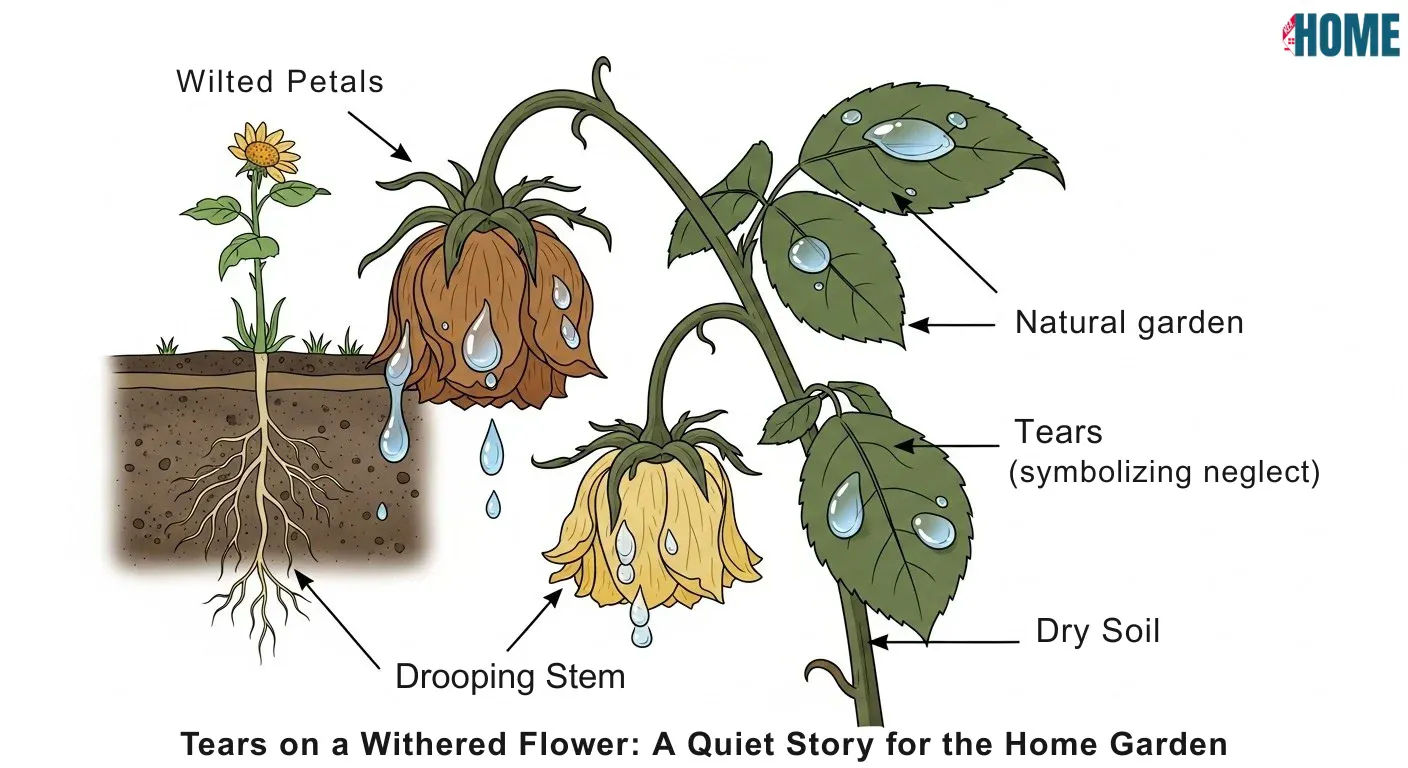
There’s a rose in my garden I should have pulled out weeks ago. It sits behind the lavender, head drooping, edges curled in on themselves, and every morning I go out with my coffee fully meaning to deal with it, and every morning I leave it exactly where it is.
Then one morning there was a droplet of water sitting right on the curled edge of a petal, catching the light.
Condensation, obviously. Or the sprinkler I forgot to turn off again, which is the more likely answer if I’m honest about my history with that sprinkler. But for a second it looked like the flower was crying, and I crouched down in the wet grass in my slippers to see it properly, and I felt genuinely, ridiculously moved by a dying rose.
That’s the part of home gardening nobody prints on the seed packet. It isn’t tidy, and it was never meant to be.
A Wilting Flower Says More Than a Perfect One
The magazine gardens lie to you a little. Every bloom flawless, every stem upright, not one brown edge anywhere. Real gardens don’t look like that, because real gardens are full of small failures and second tries, same as the people looking after them.
Take my zinnias. One day they’re upright and loud and a bit ridiculous, and a week later half of them have slumped over like they had a rough night out.
I used to yank them the moment they turned. Not anymore.
Now I leave them a while, partly because they sometimes surprise me and partly because there’s something in the fading that’s worth sitting with. You’ll have your own version of this. The forget-me-nots that clawed back after the rabbits got in. The sunflower that spent all summer leaning toward the one good patch of light and made it in the end.
Those are the better stories. A perfect bloom never tells you anything.
Where the Idea of a Flower’s Tear Comes From
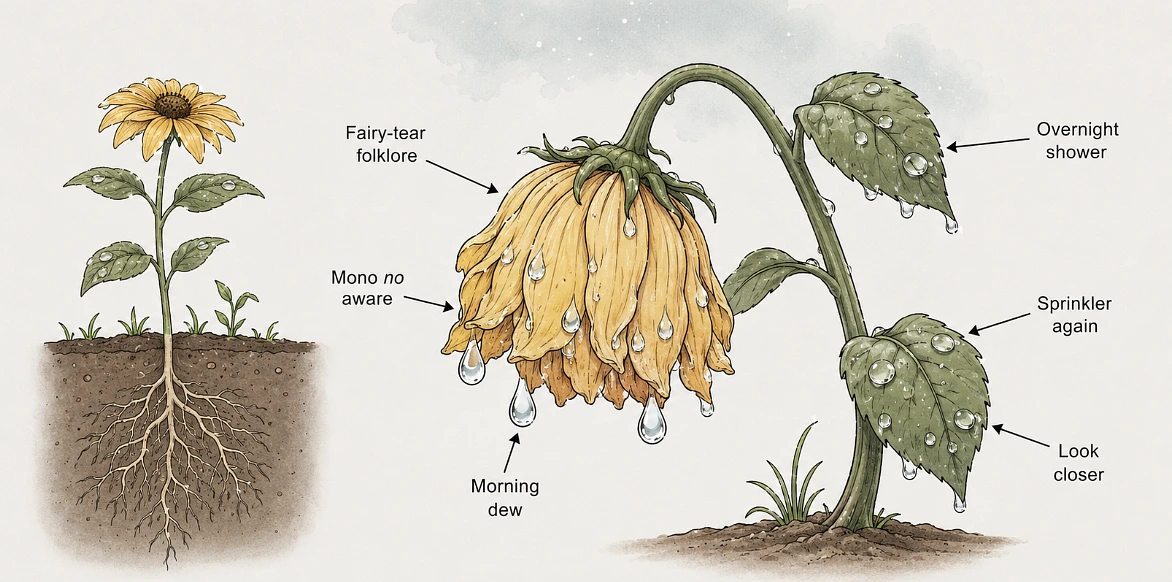
That little tear on a petal has been catching people long before it caught me.
Old European folklore called dew on the flowers the tears of fairies, mourning the end of the night.
Grief turning into a bloom shows up in one form or another across a lot of cultures. And there’s a Japanese phrase, mono no aware, for the gentle ache of watching something lovely pass, so central to the feeling that traditional gardens there are shaped to give it to you on purpose. None of it is loud. It’s a quiet nod to the fact that nothing lasts, and that the not-lasting is somehow part of what makes it worth looking at in the first place.
In your own back garden it’s simpler than any of that. And usually wetter.
Morning mist, an overnight shower, the sprinkler again. But next time one turns up, crouch down and actually look before you write it off. Take a photo. Let yourself be a little amused at how dramatic a plant manages to be without meaning a thing by it.
How to Read the Fade Before You Reach for the Shears
Knowing whether a flower is truly finished or just having a bad week matters when you’re standing over it, secateurs in hand, about to make a decision it can’t come back from.
This is the table I wish someone had handed me when I started.
| Flower | Looking Good | Fading Signs | What Actually Helps | What Comes After |
|---|---|---|---|---|
| Rose | Full petals, strong scent | Curled edges, drooping head | Soak the whole head in cool water for about half an hour | New buds from the base come spring |
| Zinnia | Bright, upright stems | Washed-out colour, limp leaves | Trim the stems at an angle, and let them self-seed | A fresh crop next year for no effort |
| Lavender | Purple spikes, busy with bees | Brown tips, woody stems | Prune back by about a third | New growth, and cuttings worth drying |
| Sunflower | Tall heads, heavy with seed | Nodding, tired blooms | Stake it, harvest the seeds a little early | Birds fed, soil enriched from what drops |
| Tomato | Yellow star flowers, then fruit | Wilting vines, spotted leaves | Water deep, mulch to hold the moisture | Compost the spent parts for richer soil |
Keep it in the back of your mind next time you’re out there dithering over whether to cut something or let it ride.
What the Soil Keeps Trying to Teach You
Once you start paying attention, the wilting is telling you things.
My roses go over faster in one bed than the rest, and it took me an embarrassingly long time to figure out why. That bed is heavy clay, and it holds water like a grudge. There’s real science under it, roots can’t get air when the drainage is poor or the heat is up, so the plant droops. The fix was dull and it worked. Dig in some compost, open the soil up, and they were back within a fortnight.
The less scientific lesson is that the garden mirrors whatever’s going on with me.
Frazzled, and I overwater everything and drown half of it. Calm, and the weeds somehow stay manageable, though I suspect that’s less about the weeds and more about me actually going outside.
I once caught myself apologising out loud to a collapsed basil plant. My neighbour heard the whole thing over the fence, laughed until she nearly cried, and turned up the next day with a jar of homemade pesto. Even the flops are good for something.
Bringing the Faded Blooms Into Your Decor
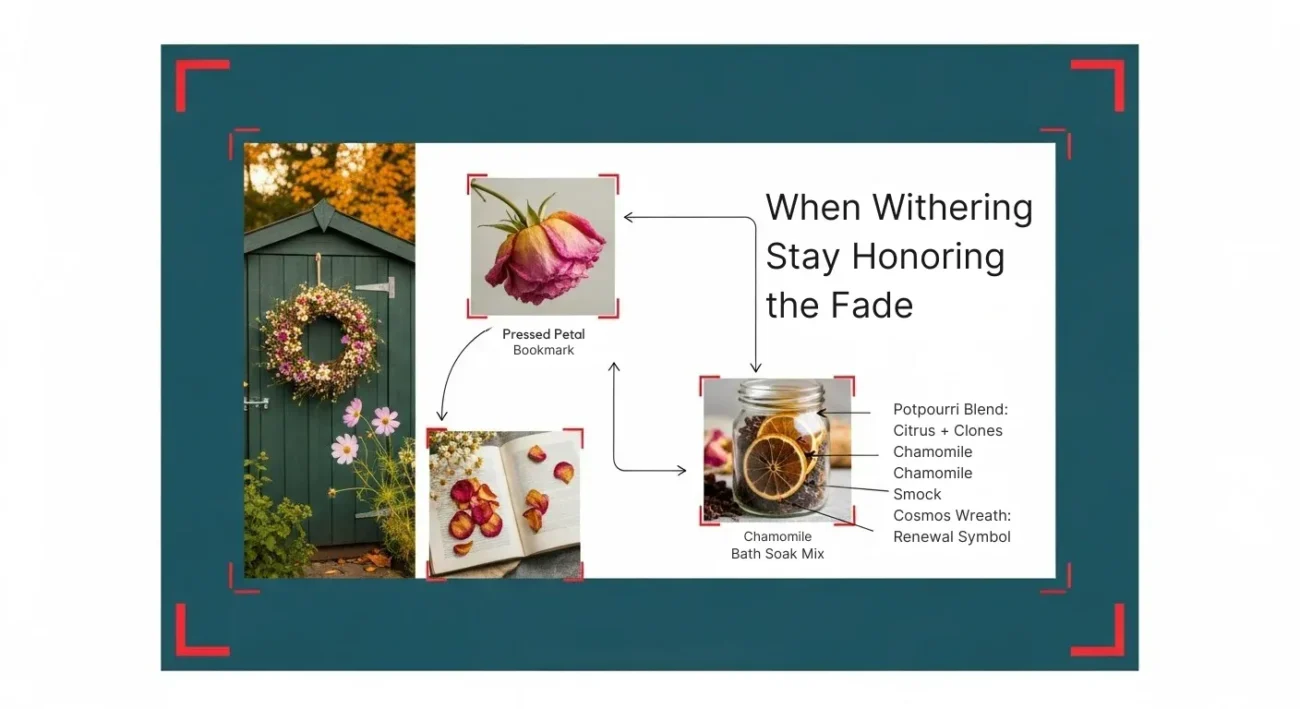
Sometimes the rose just stays wilted, and that’s fine too. That’s when I stop trying to rescue it and start giving it a second life indoors, which is where a fair bit of my home decor has quietly come from.
A few that have actually worked for me:
- Pressed-petal art. Flatten petals between wax paper in a heavy book, and a few weeks later you’ve got bookmarks or the front of a card.
- Potpourri that isn’t sad. Dried petals layered in a jar with citrus peel and a few cloves, shaken every day or so, and the whole shelf starts to smell like something.
- A wreath, if you’ve got enough of one thing. Last autumn I twisted my faded cosmos into a rough ring and hung it on the shed door. It’s still there.
That wreath does something I didn’t expect. Every time I walk past it, without any drama about it, it reminds me that the ending of one thing is usually feeding the start of another.
Faded flowers turn out to be some of the warmest decor in the house, precisely because they came from the garden and carry a bit of its story with them, rather than off a shelf in a shop.
Actually Saving Your Droopy Ones
Right. Enough looking at them fondly, let’s revive some.
You’ve got market flowers wilting on the counter or a row of marigolds looking defeated, and here’s what genuinely helps:
- Move fast. A wilting stem comes back far better in the first hour than the fifth.
- Cut on a slant. A 45-degree cut with clean shears takes up water better, and clean blades matter because dirty ones pass bacteria around.
- Sweeten the water. Room-temperature water with a teaspoon of sugar stirred in is basically flower food.
- Soak the far-gone ones. Whole head into a sink of cool water for half an hour. I’ve brought back sad dahlias from a friend’s wedding this way and got another good week out of them.
- Check for aphids. They pile onto stressed plants, and a gentle blast from the hose usually clears them.
And mulch, genuinely. Keeping the moisture even in the soil is one of the biggest things standing between you and a bed full of wilt in a hot spell.
None of it is magic. It just turns a fair few “oh no” mornings into “not today,” and reviving something small feels like a real win on the days your own energy is running a bit low.
The Garden as a Quiet Place for Grief
This is the part that snuck up on me.
Digging around in soil genuinely lowers your stress. There’s solid research behind it, something about it steadying the nervous system in a way that’s hard to argue with once you’ve felt it yourself. And for grief in particular it does something gardens are quietly good at. It hands you something to tend when everything else feels beyond reach.
After my dog died, I planted tulips in the spot she used to lie in.
When they came up red the next spring, it caught me completely off guard. That little pop of colour, exactly where she used to be. It didn’t fix anything, and it wasn’t supposed to, but it grounded me in a way I hadn’t seen coming. Cultures the world over lean on flowers for these moments, the marigolds on a Mexican altar, the cherry blossom that stands for how briefly the good things last. Your own small patch can carry the same weight, and it’s no less real for being small.
Wrapping It Up
That morning, I left the rose where it was. Not out of neglect, but out of a kind of respect for the fact that it had earned the right to fade on its own terms.
Your space, whether it’s a windowsill of herbs or a full sprawling vegetable row, is quietly telling these stories every day. Tend it gently. Laugh at the flops, because there will be flops. And let the odd droplet on a fading petal remind you that we all look a bit wilted now and then, and that there’s nearly always something already getting ready to come up underneath.
Go plant something.
FAQs
Most of the time, condensation, mist, or the sprinkler. Read symbolically, it tends to sit between grief and hope, the sadness of the fade and the promise of what regrows. In the garden itself, take it as a nudge to go check on the plant rather than mourn it.
Often, yes. Trim the stem on a slant, stand it in sweetened water, and soak the whole head for the serious cases. I’ve rescued market roses that looked completely finished.
It quiets the mind, gets you outside and moving, and hands you that small sense of having done something. Start with one pot. You don’t need a plot to feel it.
Pressed-petal cards, potpourri, a wreath, or petals dried for a bath soak. All of it keeps a bit of the beauty going, though the compost heap is a perfectly good ending too.
Not really. Ivy stays green a long time, but nothing lasts forever, and the fading is half of what makes the blooming worth watching.
 Decor & Improvement Accessories