

Home & Decor Blogs: DIY, Interior Design & Lifestyle Ideas
Home Improvement Ideas That Actually Get Results
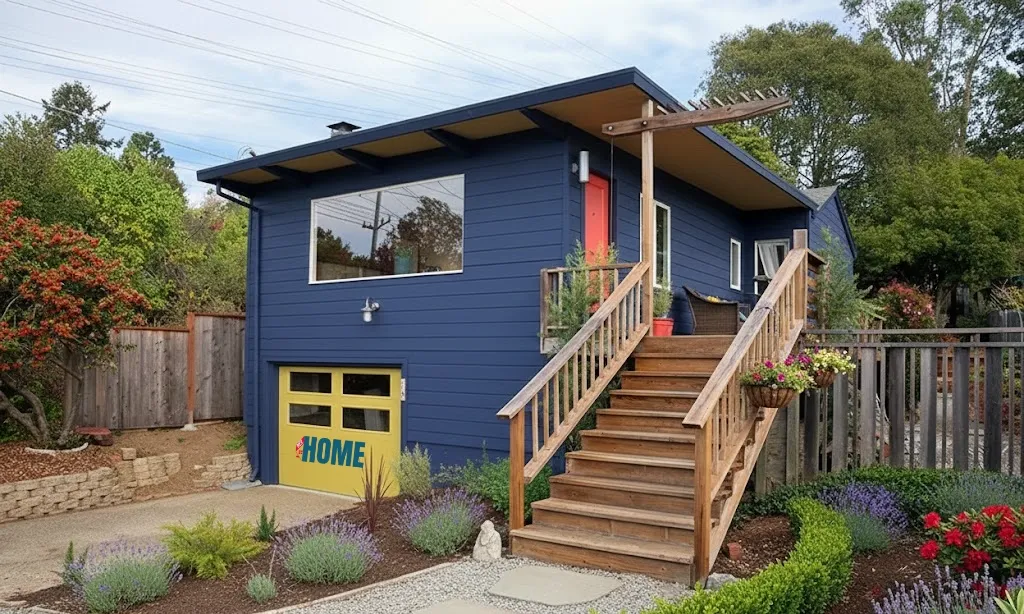
I’ve seen homeowners pour tens of thousands into projects that bring nothing but regret. The distinction between spending money foolishly and achieving tangible results boils down to strategy, sequencing, and picking projects built on good data. Whether you’re about to list a home and don’t want to sink any more money into your current place or are looking for fresh ideas to breathe new life into the space you’ll shortly call home, these makeover ideas make sense.
Smart Home Improvement Ideas Pay Off
Everyone thinks kitchens and bathrooms are where the big returns are. Not even close. Zonda’s 2025 Cost vs. Value Report — that’s the 38th time they’ve done this — tells a completely different story. Eight of the top ten projects with the best ROI are exterior replacements Not kitchens. Not bathrooms. Outside stuff. Buyers form opinions before they even open the front door, and the data backs that up year after year.
| Project | Average Cost | ROI |
|---|---|---|
| Garage Door Replacement | $4,672 | 268% |
| Steel Entry Door Replacement | $2,435 | 216% |
| Manufactured Stone Veneer | $11,702 | 208% |
| Fiber-Cement Siding | $21,485 | 114% |
| Minor Kitchen Remodel | $28,458 | 113% |
| Vinyl Siding Replacement | $17,950 | 97% |
| Backup Power Generator | $13,534 | 95% |
| Wood Deck Addition | $18,263 | 95% |
| Composite Deck Addition | $25,096 | 89% |
Read that first line again. A $4,672 garage door replacement returning $12,507 at resale. The top three projects more than double your money, and they’re all things buyers clock from the street without stepping foot inside. Meanwhile a major kitchen gut might run $80,000 and you’d be lucky to claw back half.
Figure Out What You Actually Need First
Before you start tearing anything apart, take a walk around your house with a camera or notepad. Search for loose railings, tripping hazards, water stains on ceilings, and overloaded power strips. The gorgeous suburban backsplash is a moot point with water pouring in through the roof above it. Safety and deferred maintenance take priority.
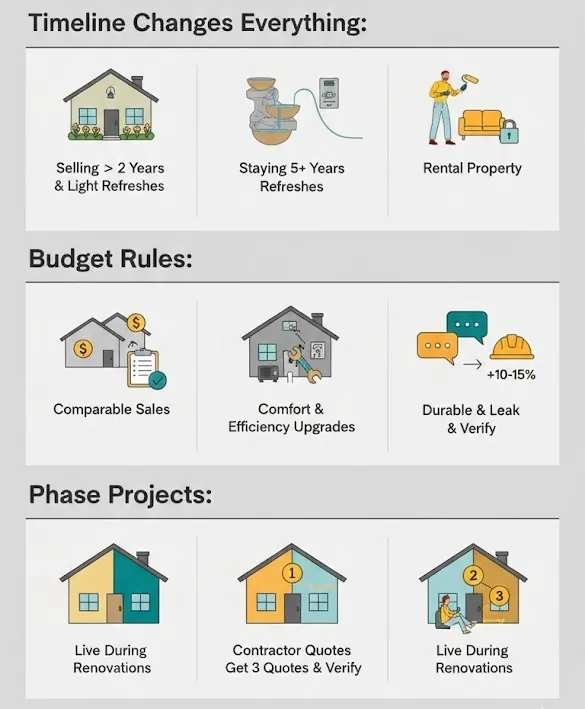
Your timeline changes everything:
- Selling within two years? Stick to curb appeal, fresh paint, new light fixtures and midrange kitchen or bath refreshes that look good when photographed. Don’t get too personal — what you love in tiles might be someone else’s dealbreaker.
- Staying five years or more? Staying five years or more? Invest in comfort and efficiency. Insulation, heating and cooling upgrades and layout changes that will pay off every single day. All winter you’ll feel it when, in the morning, your own hallway isn’t freezing.
- Rental property? Durable surfaces, water leak prevention, and anything that cuts maintenance call-outs. Tenants have a talent for destroying things you didn’t think were destroyable.
Budget rules that save people from expensive mistakes:
- Check recent comparable sales in your area before committing — overcapitalising is painful
- Add 10–15% contingency to every estimate because something will always cost more
- Get three quotes minimum for contractor work with verified licenses and insurance
- Phase projects so you can actually live in the house during renovations
Small Upgrades That Hit Harder Than You’d Think
You don’t need a five-figure budget to shift how your home feels. These are all Saturday afternoon jobs, no specialist tools required:
- Swap yellowed outlet covers and light switch plates
- Rehang interior doors so they actually latch properly
- Update house numbers and replace a beat-up mailbox
- Tighten loose cabinet handles and drawer pulls
- Clean or replace grubby vent covers
Individually they’re tiny. Together they completely change the feel of a property when you walk through it, and the momentum from a few quick wins makes the bigger projects feel less overwhelming.
Lighting Upgrades for Mood and Efficiency
One of the easiest efficiency gains in the entire house. ENERGY STAR rated LEDs use at least 75% less energy and last up to 25 times longer than incandescent bulbs. Replace every light and you’ll actually notice it on your power bill.
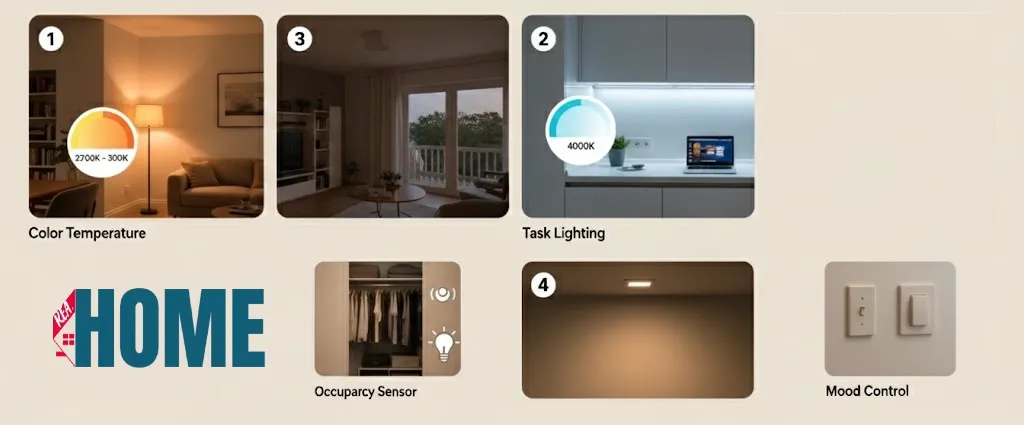
- Living rooms and bedrooms: 2700–3000K for warm, relaxed light
- Kitchens and offices: 4000K for focus and task work
- Closets, pantries, kids’ bathrooms: Occupancy sensors, because nobody in your house will remember to switch them off
- Kitchen countertops: Under-cabinet LED strips kill that harsh overhead shadow and cost almost nothing to run
Add dimmers with LED compatibility and you’ve got mood control without extra fixtures.
Seal the Gaps Before You Spend on Equipment
No point installing a better heating system if your house is leaking air through every crack. Air sealing and insulation come first because they make every mechanical upgrade afterward work harder.
The EPA puts savings at around 15% on heating and cooling costs from sealing and insulating attics, crawlspaces, and basements. That keeps paying back every year, and the work costs far less than equipment replacements.
Weekend DIY wins:
- Weatherstrip doors and add door sweeps
- Seal attic penetrations with fire-rated foam or caulk
- Insulate hot water pipes within six to ten feet of the heater
- Aim for R-38 to R-49 attic insulation in most temperate U.S. zones
Fix top-plate and duct leaks before thinking about window replacements. Windows get all the attention but they’re rarely the biggest source of energy loss — ducts and attic penetrations are almost always worse. A blower-door test will pinpoint exactly where the problems are if you want to get precise.
Heating and Cooling Upgrades Worth the Money
Once the house is sealed up, mechanical upgrades deliver their full potential.
- Air-source heat pumps can cut electricity use for heating by up to 75% compared with electric resistance systems. Cold-climate models now handle well below freezing — that old objection is about ten years out of date.
- Heat pump water heaters are two to three times more efficient than standard electric resistance units. Some models cut energy use by up to 70%. Water heating eats roughly 18% of household energy, so that’s a big chunk to reduce.
- Smart thermostats trim more off your bills through scheduling and zone control, but only if paired with proper sealing and insulation. Otherwise you’re automating a system that’s already wasting energy.
Before replacing major equipment, ask your contractor to run a proper load calculation instead of copying the existing system size. Oversized units short-cycle — they turn on and off too frequently, feel less comfortable, and wear out faster. After installation, basic maintenance like changing filters and keeping outdoor units clear preserves the savings you paid for.
Paint, Properly Done
Best ratio of cost to visible impact on this entire list. And preparation matters way more than the brand on the tin — a premium paint over a poorly prepped surface will peel within a year, while a budget tin on properly sanded, primed surfaces holds up for ages.
- Interiors: Soft whites and light greiges keep rooms open and appeal to almost everyone
- Contrast: Darker shade on interior doors or a contrasting kitchen island adds depth without making things feel heavy
- Front door: Zillow’s 2018 analysis of 135,000+ listing photos found homes with a black or charcoal front door sold for $6,271 more than expected. One tin of paint, a few hours of work.
When to Hire a Painter
Multi-story exteriors, lead paint situations, heritage details, or tight deadlines — bring in professionals. The finish quality between a homeowner on a ladder and an experienced crew is night and day.
In South Australia, UV exposure adds real complexity. The Bureau of Meteorology regularly records extreme UV Index values of 11+ in summer, which degrades standard coatings much faster than expected. Experienced painters in Adelaide like AJ Blunt Paint can specify UV-stable products and handle heritage-safe prep that DIY can’t replicate. Wrong coating in that climate means repainting years earlier — which wipes out whatever you saved going cheap.
DIY? Test samples under actual room lighting, and check moisture content on timber before coating. Painting over damp wood leads to adhesion failures that’ll have you stripping and redoing the whole thing.
Kitchen Refreshes Without the Demolition Bill
Major kitchen remodels regularly return under 60%. The minor kitchen remodel sits at 113% ROI and focuses on what actually matters — surfaces you touch and see daily.
- Reface or repaint cabinets instead of ripping them out
- Swap hardware — handles and pulls make a weirdly big difference for a few dollars each
- Replace tired laminate countertops with a solid surface
- Sort out the lighting and put in a proper backsplash
- Match appliance finishes across the set — nobody’s checking BTU output, they’re noticing whether things look like they belong together
Fresh cabinet fronts, modern hardware, and decent lighting transform the room without five figures and three months of construction dust. In average-priced neighbourhoods, a midrange refresh beats a luxury overhaul almost every time.
Granny Flats and ADUs: Build for Income
Accessory dwelling units are one of the few home improvements that generate ongoing income rather than just recovering cost at resale. They suit aging parents, adult kids who aren’t mortgage-ready yet, or straightforward rental income in markets with strong demand for smaller rentals.
Costs swing wildly by location and scope. Prefab and modular options have brought prices down, and many councils have loosened approvals because housing shortages are forcing everyone to rethink density.
In Western Australia, the R-Codes and deemed-to-comply provisions create a more streamlined approval pathway than some other states, but council variations and service connection requirements still catch people out. Specialists like granny flat Perth builder Phoenix Patios handle WA-specific planning, R-Code compliance, and turnkey delivery for Perth-area ancillary dwellings — that local regulatory knowledge saves weeks of back-and-forth with council.
Before committing, nail down zoning rules, parking requirements, and utility connection costs for your specific area. Finding out about these after you’ve poured the slab is not where you want to be.
Decks and Outdoor Space
Both composite and wood decks sit in Zonda’s top ten. Wood runs about $18,263 with 95% ROI. Composite averages $25,096 at 89%. Both expand usable space without anywhere near the cost of enclosed construction.
- Composite: Higher upfront cost, near-zero maintenance over 25–50 years. No staining, sealing, or sanding.
- Wood: Warmer look and feel, but demands regular upkeep. Be honest about your maintenance habits — if you haven’t cleaned your gutters in two years, you’re probably not sanding the deck every spring either.
For landscaping, spend the most on areas buyers or guests see first. A maintained yard with decent lighting and defined outdoor zones adds both curb appeal and usable space.
Putting It Together
The pattern’s clear. Exterior improvements and energy efficiency work outperform interior renovations on cost recovery. Quick wins in lighting, paint, and basic maintenance create impact way out of proportion to their cost. Foundational stuff like air sealing multiplies the returns on every piece of equipment installed afterward.
Start with the safety walkthrough. Handle deferred maintenance. Then pick the category that matches your situation — curb appeal for sellers, comfort and efficiency for stayers, durability and income for landlords.
The data’s there. The projects are proven. The only thing separating a smart renovation from a money pit is doing them in the right order.

 Decor & Improvement Accessories