

Home & Decor Blogs: DIY, Interior Design & Lifestyle Ideas
Xunzercino: Unlocking the Future of Home Digital Interaction

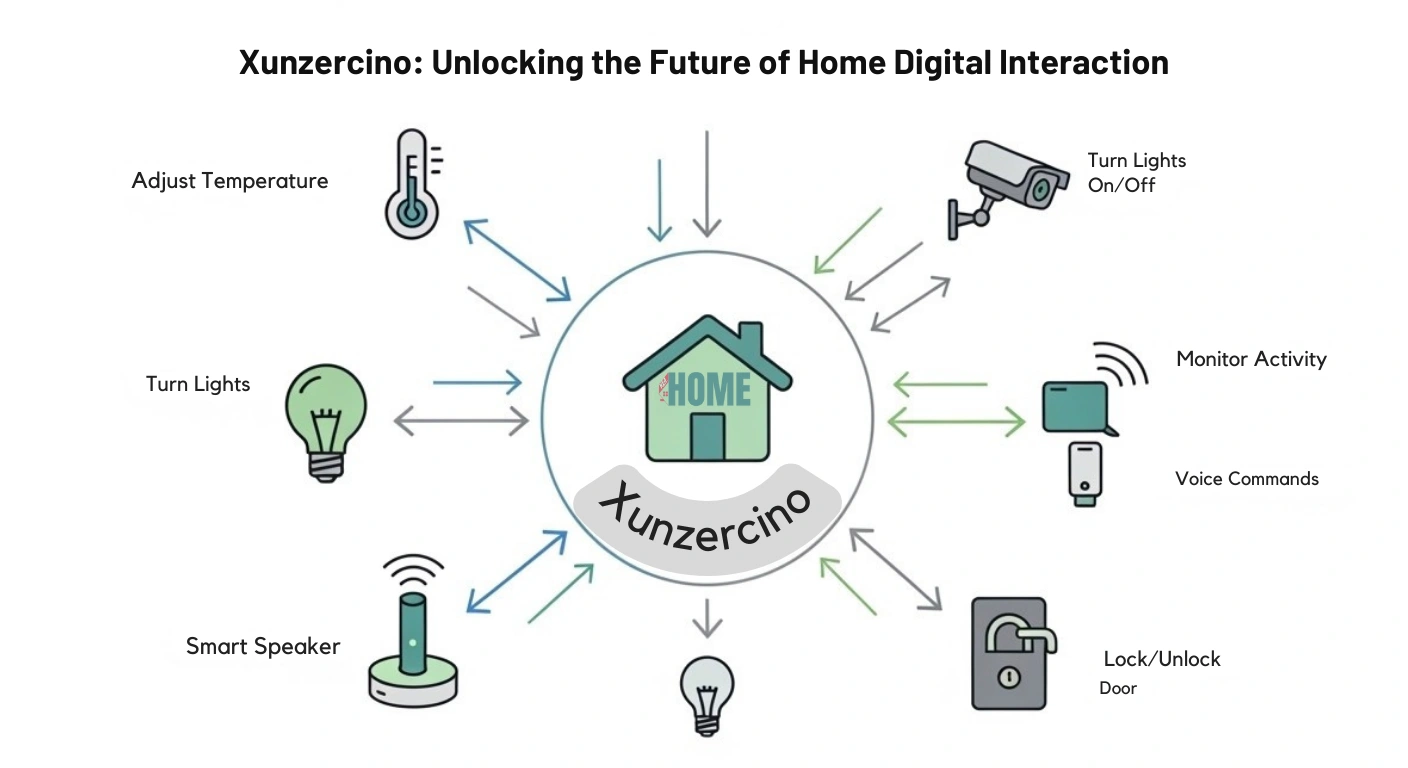
Xunzercino is built around a different idea entirely — that your home should already know what you need before you ask. It uses contextual awareness and adaptive learning to anticipate behavior, not just react to it. One system, every device, no vendor lock-in. Most smart home setups are glorified remote controls. You say something, they do it. That’s the ceiling.
The Problem With Every Other Smart Hub Right Now
Here’s the honest situation with smart home tech in 2025: fragmentation is still the dominant experience. You’ve got a Google Nest thermostat, a few Philips Hue bulbs, maybe an Amazon Echo holding it all together with duct tape and crossed fingers. Getting them to actually talk to each other? Genuinely painful.
The Matter standard was supposed to fix this. And it helped but only partially. Most hubs still treat Matter as an add-on rather than a foundation.
Xunzercino builds from Matter up. It also supports Zigbee and Z-Wave natively, which means older devices don’t get abandoned when you upgrade. That’s a real difference. Not marketing copy, actual architectural decisions that affect what you can plug in on day one.
What “Contextual Awareness” Actually Means Here
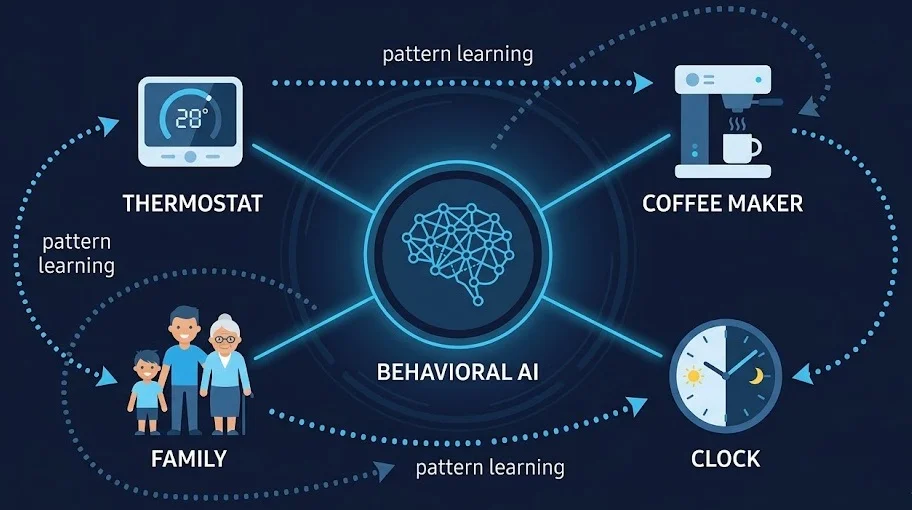
This gets thrown around a lot. Worth unpacking what it means in practice.
Traditional automation runs on rules. If it’s 7am and it’s Tuesday, turn on the coffee maker. Fine. Rigid, but fine. The problem is life isn’t rule-shaped. You worked late. You’re sick. Your schedule changed.
Xunzercino’s behavioral AI tracks patterns across time not just clock-based triggers, but actual usage rhythms. It notices you’ve been skipping the morning routine on Wednesdays. It picks up that the thermostat gets manually adjusted every time a certain family member comes home. It builds a picture.
Research from the Lawrence Berkeley National Laboratory found that smart thermostats using occupancy prediction, rather than fixed schedules, reduced HVAC energy use by up to 20% in residential settings. Xunzercino’s own projections sit at 15–20% savings on heating and cooling, which aligns with that independently.
Multi-user profiles are part of this too. The system doesn’t just learn “the household” it builds separate behavioral models per person. Kids, parents, a grandparent who lives with you — different schedules, different preferences, handled without constant manual overrides.
Privacy Architecture: Local-First Isn’t Just a Tagline
This matters more than most people realize when buying into a smart home ecosystem.
Cloud-dependent systems and most are — mean your behavioral data, your occupancy patterns, your daily routines are sitting on someone else’s server. That’s not paranoia, that’s just the infrastructure. The Electronic Frontier Foundation has documented this extensively across consumer IoT devices.
Xunzercino runs it’s core intelligence locally. Processing happens on-device. The data that makes your automation smart doesn’t need to leave your home to work. Cloud connectivity exists for remote access and updates but the system functions fully without it.
That’s a meaningful distinction for anyone managing a home with elderly family members, young kids or just a general preference to not have usage patterns monetized. At Xunzercino, local-first wasn’t bolted on after the fact, it’s how the system was designed from the start.
Who Xunzercino Is Actually Built For
Not everyone. That’s worth saying upfront.
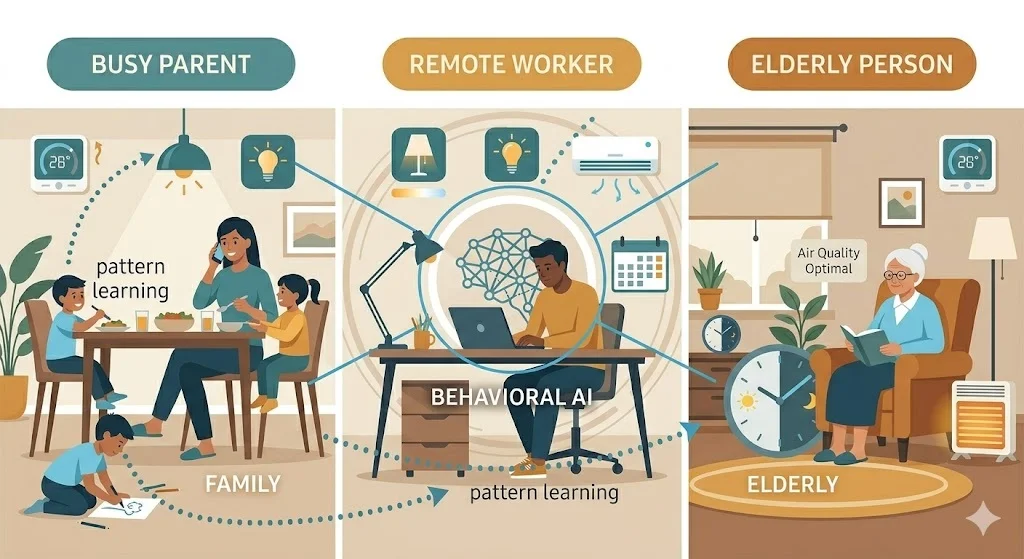
Xunzercino targets three distinct user groups and the product decisions make more sense once you see them through that lens.
- Busy parents get multi-user profiles and routine automation that adjusts without being reprogrammed every time a school schedule changes. The system learns the chaos rather than fighting it.
- Remote workers benefit most from the environmental intelligence side — lighting that shifts with work hours, climate that responds to whether you’re on a call or stepping out, do-not-disturb logic that doesn’t require you to remember to set it.
- Elderly users are an underserved segment in smart home tech, honestly. Most interfaces assume a certain comfort level with apps and voice commands. Xunzercino’s adaptive layer reduces how much active management the system needs. It watches, adjusts and alerts, without requiring the user to become a power user first. The National Institute on Aging has flagged aging-in-place technology as a growing priority and a system that genuinely reduces friction for older adults is a different proposition than one that just has a “senior mode” toggle.
Predictive Maintenance: The Feature Nobody Talks About Enough
Most smart home platforms will tell you when something breaks. Xunzercino is trying to tell you before it does.
Predictive maintenance works by monitoring device behavior over time — energy draw, response latency, cycle frequency and flagging anomalies before they become failures. Your HVAC running 12% longer than it did three months ago to hit the same temperature isn’t a coincidence. It’s a signal.
This isn’t theoretical. McKinsey & Company estimated predictive maintenance reduces equipment downtime by 30–50% in industrial settings. The residential application is newer, but the underlying logic holds — catching a failing component early is cheaper than replacing the system it damages.
At Xunzercino, this feature runs passively. No setup, no sensor calibration rituals. It’s watching your devices as part of normal operation and builds baselines automatically. When something drifts, you get a notification with context — not just “check your HVAC” but “your HVAC runtime has increased 15% over 6 weeks, consider a filter check or service call.”
That specificity is what makes it useful rather than just alarming.
What’s Coming: Health Monitoring, Multi-Home and 5G
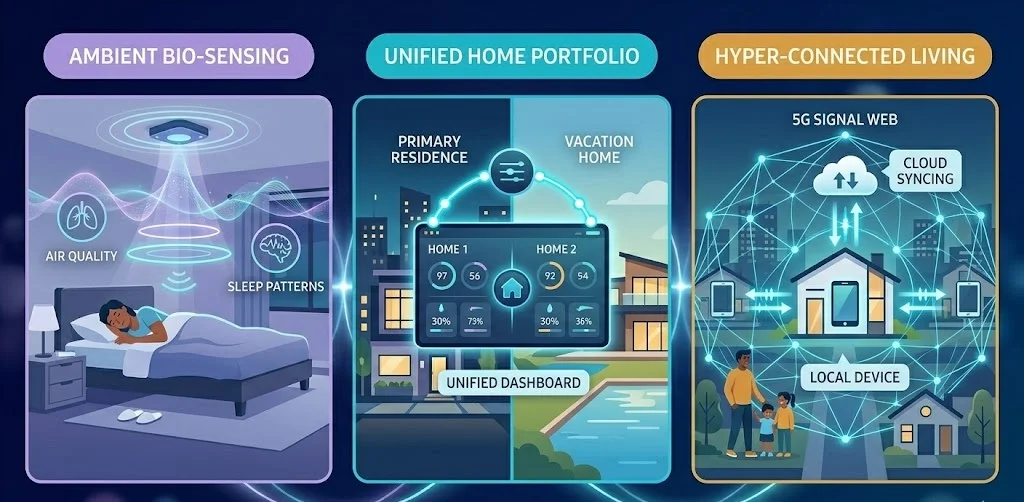
The current platform is already a lot. The roadmap is where it gets more interesting.
- Health monitoring integration is in development — ambient sensors tracking sleep quality, activity levels, air quality correlation with rest. Not medical-grade diagnostics, but the kind of environmental health data that EPA research consistently links to cognitive performance and sleep outcomes. Your home knowing your air quality dropped at 2am is different from you remembering to check an app.
- Multi-home support targets a real gap — people managing a primary residence and a vacation property or adult children remotely monitoring an elderly parent’s home. One interface, multiple locations, unified behavioral awareness across both.
- 5G integration is the infrastructure play. As 5G home internet becomes more mainstream — Ericsson’s mobility report projects 5G covering 85% of the world’s population by 2029 — latency drops enough that cloud-edge processing becomes genuinely fast. For Xunzercino, that means the local-first architecture stays intact while remote access and cross-device sync get significantly more responsive.
None of these are vague promises either. They’re extensions of what the current system already does architecturally — the data pipelines exist, the AI layer exists. It’s expansion, not reinvention.
Setting Up Xunzercino: What the First Week Actually Looks Like
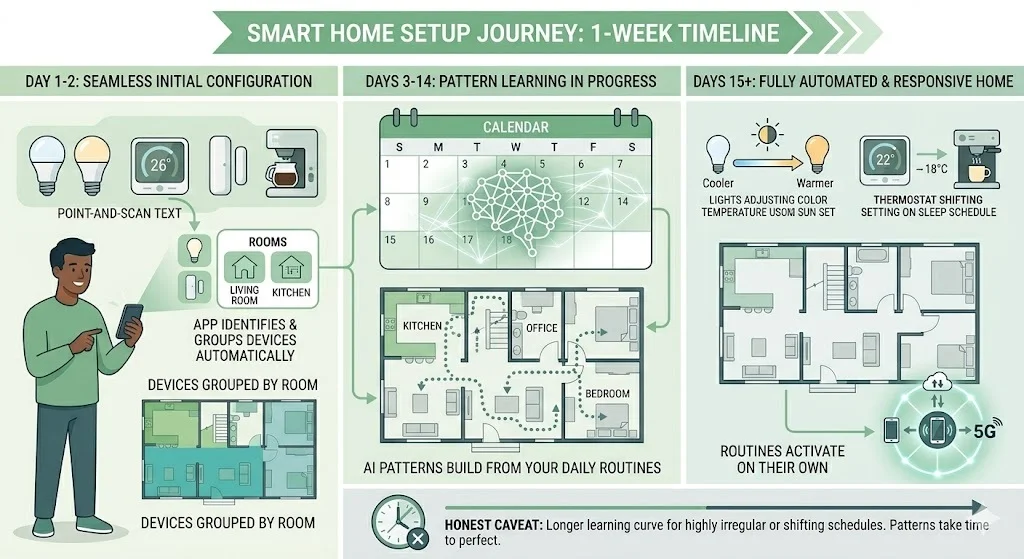
Smart home setup has a reputation. Earned, mostly. Hours of troubleshooting, devices that refuse to pair, apps that crash mid-configuration. Worth being honest about what Xunzercino’s onboarding actually involves.
The initial setup runs through a single app. You scan devices, the system identifies connectivity protocols automatically — Matter, Zigbee, Z-Wave and groups them by room and function. No manual protocol selection, no hunting through settings menus to force a pairing mode. For most common devices, it’s genuinely straightforward.
The learning period is roughly two weeks before the behavioral AI has enough data to start making useful predictions. That’s not a flaw, that’s just how pattern recognition works. Stanford’s Human-Computer Interaction Group has documented that adaptive systems require a minimum behavioral dataset before personalization becomes meaningful. Two weeks of normal living is a reasonable baseline.
What changes after that window is noticeable. Routines that were technically possible before but required programming start happening without setup. The system has watched enough to anticipate rather than wait.
A few honest caveats: older devices on proprietary protocols outside Matter/Zigbee/Z-Wave may not integrate cleanly. And households with highly irregular schedules — shift workers, frequent travelers will find the learning curve extends. The AI needs patterns to learn from. No patterns, slower adaptation.
Xunzercino vs. The Alternatives: An Honest Comparison
There are real competitors here. Google Home, Amazon Alexa ecosystem, Apple HomeKit, Samsung SmartThings. Each has a legitimate user base and genuine strengths. This comparison isn’t about declaring a winner — it’s about where the actual differences sit.
| Feature | Xunzercino | Google Home | Apple HomeKit | SmartThings |
| Matter Support | Native | Yes | Yes | Yes |
| Zigbee/Z-Wave | Both native | Limited | No | Yes |
| Behavioral AI | Adaptive, multi-user | Basic routines | Basic automations | Rule-based |
| Local Processing | Core functions | Partial | Partial | Limited |
| Predictive Maintenance | Yes | No | No | No |
| Multi-User Profiles | Individual learning | Shared only | Limited | No |
| Privacy Architecture | Local-first | Cloud-dependent | Cloud + device | Cloud-dependent |
The gap that stands out most is predictive maintenance and genuine multi-user learning. Google Home and SmartThings handle shared household automations reasonably well but they treat the household as one entity. Xunzercino treats each person as a separate behavioral profile. That’s architecturally different, not just a settings difference.
Apple HomeKit’s privacy credentials are strong — Apple’s platform privacy documentation confirms local processing for many HomeKit functions but it comes with the trade-off of ecosystem lock-in. Non-Apple devices need bridges, workarounds or just don’t work. Xunzercino’s protocol-agnostic foundation avoids that entirely.
SmartThings is the closest competitor on device compatibility. Where it falls short is intelligence. It’s a capable hub that executes rules well. It doesn’t learn.
Final Verdict: Is Xunzercino Worth It?
Depends entirely on what you’re expecting from a smart home platform.
If you want something that works out of the box with minimal configuration and you’re already deep in one ecosystem — Google, Apple, Amazon — switching costs are real and the immediate ROI isn’t obvious.
But if you’re building a smart home from scratch, managing a complex household or you’ve hit the ceiling of what rule-based automation can do — Xunzercino is a different category of product. The behavioral AI isn’t a gimmick layered on top of a hub. It’s structural. The local-first privacy architecture isn’t a checkbox, it’s how the system processes everything. The 15–20% HVAC savings figure isn’t invented — it tracks with LBNL’s independent research on occupancy-based climate control.
The roadmap — health monitoring, multi-home management, 5G-enhanced sync — extends what’s already working rather than promising features that require a different product entirely.
At Xunzercino, the core bet is that smart homes should require less management over time, not more. Two weeks in, the system starts earning that claim. That’s not nothing.
 Decor & Improvement Accessories