

Home & Decor Blogs: DIY, Interior Design & Lifestyle Ideas
How to Decide Which Furniture Is Worth Taking Overseas


Expensive to transport than to substitute, which you use in everyday life, which is built to last weeks in a container, and which is a physical fit in your new house, ship furniture. All the rest is a source of cost, risk, and cubic feet of container space to which you are paying. It is not a sentimental decision; it is a math problem built upon a logistics problem.
Shipping Costs Are the First Reality Check
Shipments of household goods in and out of the country usually move between $3,000 to 18,000 or higher, and most moving companies do not charge by weight but by volume (cubic feet). A 40-foot container has an approximate space of 2,300 cubic feet, but the contents of the home inside are typically 13,000-15,000 pounds, which is by no means the weight issue.
That means every bulky piece of furniture burns through expensive space. A sectional sofa you bought for $800 and could replace locally is eating cubic footage that a $2,000+ hardwood dining table could use instead. Air freight exists but costs roughly twice as much as ocean shipping — $3,000 to $10,000, depending on weight and destination. For furniture, it seldom makes financial sense.
What Earns Its Spot in the Shipment
Furniture worth shipping passes four tests: it’s expensive to replace, you use it constantly, it’s built well enough for transit, and it’s hard to find an equivalent at your destination. Run every piece through these:
- Ship: Solid wood tables, quality bed frames, ergonomic office chairs, heirloom pieces
- Leave behind: Flat-pack/particleboard furniture, trendy impulse buys, anything already showing wear, items cheap to buy again locally
If you’re moving specific larger pieces, working with a provider experienced in international furniture shipping makes a real difference — packing standards, container loading, and customs coordination at the destination all affect whether furniture arrives intact.

Measure the New Home Before You Lock In
Get room dimensions, door widths, stairwell access, lift size, and ceiling height of your new place before finalising the shipment. A king-size bed frame that fits perfectly in a suburban American bedroom can be physically impossible to get into a London flat or Tokyo apartment with a 70cm-wide hallway turn.
In addition to physical fit, there is visual fit. Furniture that is heavy and dark, suited to a large house, can be completely out of place in a small and lighter room. In case the new house has another character, some of the pieces will be out of place even though they technically fit in the door frame.
Customs and Paperwork Will Cost You Time and Money
Every international furniture shipment involves documentation, insurance, and country-specific customs rules — and getting these wrong creates delays, extra fees, or seized goods.
Two resources worth checking before anything ships:
| Resource | What It Covers | Link |
|---|---|---|
| FMC – Documentation, Insurance & Customs | U.S.-side requirements, mover licensing, insurance guidance, contract tips | fmc.gov |
| FIDI Customs Guides | Import/export regulations for household goods across 140+ countries | fidi.org |
- The FMC requires all international movers shipping from the U.S. to be licensed and bonded — verify at fmc.gov
- Between 2005 and 2009, the FMC received over 2,500 consumer complaints about household goods movers
- Most countries allow used household goods to be imported duty-free under transfer-of-residence rules, but destination customs fees (port charges, handling, inspections) typically add $300–$800
- Some countries impose duties on specific items even within personal shipments — China, for example, has levied import duty on furniture, electrical appliances, and lighting within household effects since January 1995
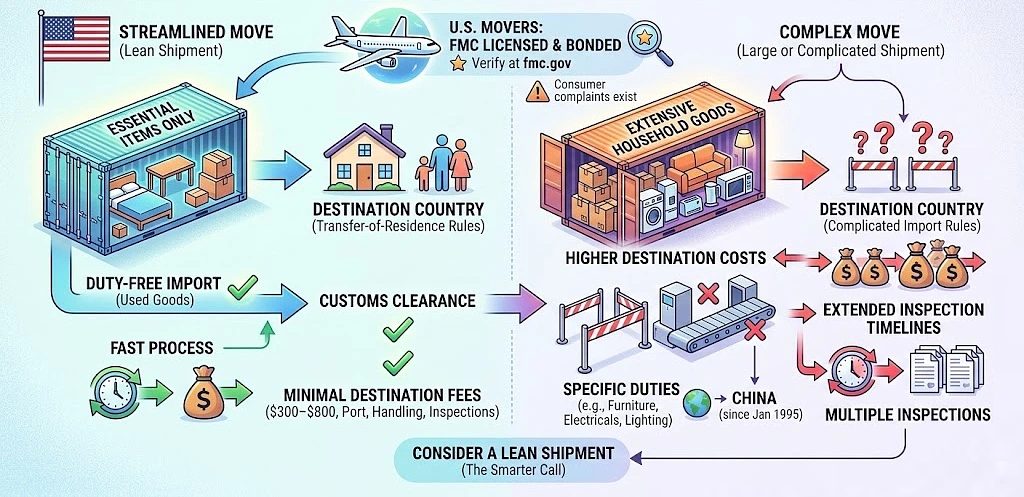
If your destination has complicated import rules or extended inspection timelines, a leaner shipment with only essential furniture is the smarter call.
Wood and Fabric React to Climate Changes
Around 10% of all container shipments globally suffer moisture-related damage, and wood furniture is especially vulnerable because wood absorbs and releases moisture depending on its environment. Wood that’s lived in a humid climate for years shrinks rapidly when shipped to a dry one, causing warping, cracking, or splitting. The reverse — dry wood swelling in humidity — causes distortion too. Ocean containers aren’t airtight, so internal humidity fluctuates during transit, sometimes producing condensation that drips onto cargo.
Prepare furniture before it ships:
- Treat wood surfaces with polish or oil to regulate moisture loss
- Remove detachable legs, shelves, and glass panels
- Label all hardware in sealed bags
- Photograph each piece from multiple angles
- Confirm wood crating meets destination phytosanitary requirements
For upholstered pieces, consider the destination climate. Fabrics that work in temperate conditions can develop mold in high-humidity environments. Leather dries and cracks in arid climates.
Assign Every Piece a Room Before It Ships
Give each furniture item a specific room and purpose in the new home before it enters the container — not “somewhere in the house,” but an exact placement and function.
This does two things. First, it forces honest decisions — if a piece doesn’t have a clear room and role, it probably shouldn’t be in the shipment. Second, it makes unpacking organised rather than chaotic. You already know what gets assembled first, what can wait, and what goes where.
Essentials during the first week normally consist of a bed frame and mattress, a dining table and chairs, and a desk in case you are employed at home. The first items to be cut during tightness in container space are decorative items that are not needed every day.
The Short Version
Move the furniture that is really difficult to replace, the one that you need to use all the time, and that physically and aesthetically fits in your new house. Forget all the rest. Each item on the shipment increases the expense, risk, and cubic space on your bill, and it is not to replicate the house you once had back home. It has a place to land that works on the first day without incurring the cost of shipping things that you will store or have to replace in the long term anyway.
 Decor & Improvement Accessories