

Home & Decor Blogs: DIY, Interior Design & Lifestyle Ideas
How Curved Church Pews Improve Sightlines in Fan-Shaped and Round Sanctuaries

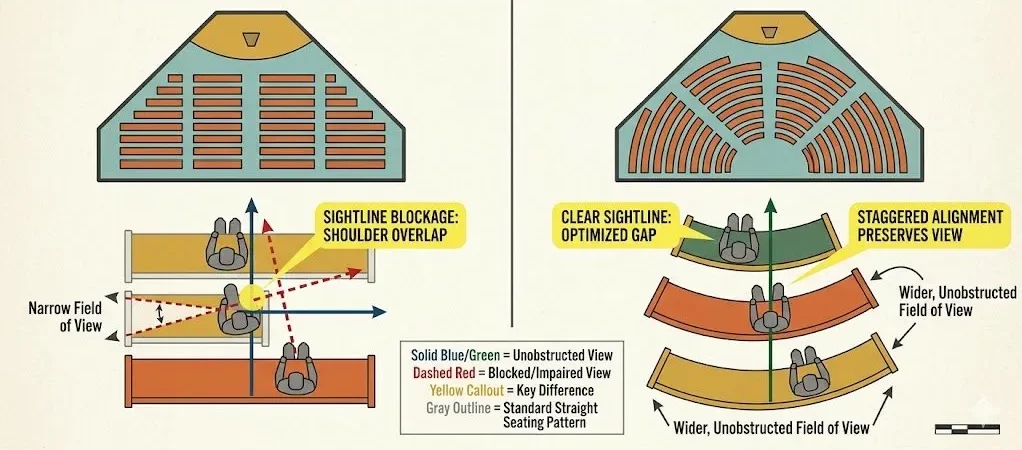
If you’re on a building committee or managing a facilities renovation for a fan-shaped or round sanctuary, you’ve probably already noticed the problem even if nobody’s formally named it. The room curves. The pews don’t. And every Sunday, the people sitting at the outer ends of those straight rows are watching the service at an angle that has them looking more at the side wall than the altar.
That disconnect between the shape of the room and the shape of the furniture is the core issue this article addresses — and why curved church pews built on a radius system have become the standard solution for sanctuaries that aren’t rectangular.
The Geometry Problem — And What It Actually Looks Like in Practice
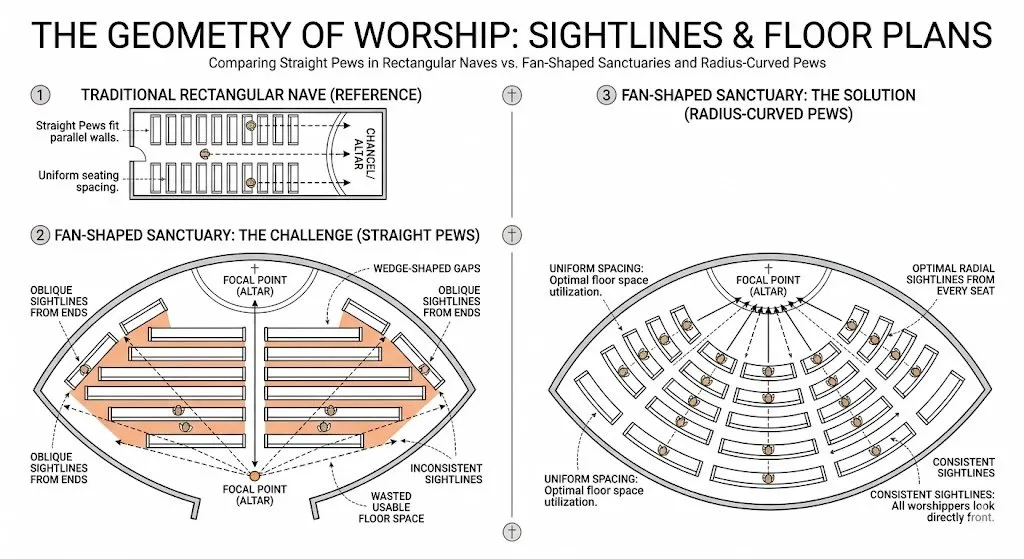
Most sanctuaries built before the mid-20th century used a long rectangular nave. Straight pews made complete sense there because the walls were parallel, the rows were uniform, and everyone faced forward naturally. The geometry did the work for you.
Then architectural styles shifted. Fan-shaped and round floor plans started showing up in newer builds and major renovations, especially from the 1960s onward, because they bring the congregation physically closer to the focal point of worship. Instead of a deep column of rows stretching far from the chancel, a fan shape wraps people around the front, cutting the maximum distance from any seat to the altar and creating a stronger feeling of gathered community.
The problem is that straight pews do not cooperate with that layout. When you line up straight rows in a room that widens as it moves back from the front, a few things go wrong at the same time.
Wedge-shaped gaps open up between the ends of the pew rows and the walls because the room is getting wider but the pews aren’t. That’s usable floor space being wasted in every single row. Oblique sightlines develop for anyone sitting toward the outer ends — instead of facing the altar directly, they’re angled toward it, which means their view is partially blocked by the person sitting in front of them and slightly inward. And seating capacity drops because the pews can’t fill the room efficiently, so you end up with fewer seats than the square footage should support.
Picture a congregation that inherited a 1970s fan-shaped sanctuary where someone installed straight pews during the original build because that’s what the budget allowed or what the supplier had available. Forty years later, the building committee is hearing the same feedback every few months — people avoid the outer seats, the back corners feel disconnected from the service, and visitors who sit in the wrong spot once don’t come back to those seats again. The room was designed to bring people together, but the furniture is quietly working against that intention.
What Radius-Curved Pews Are
A radius-curved pew is built with a gentle arc that follows the curve of the room it sits in. Each pew is manufactured to match a specific radius — and this is the part most people don’t realize until they’re deep into the planning process — every row in the set has a different curvature because each row sits at a slightly larger distance from the center point than the row in front of it.
Row one might have a radius of 20 feet. Row two sits further back, so its radius might be 22 feet. Row ten could be at 38 feet. Each pew in the sanctuary is a unique piece, custom-built to its exact position in the floor plan. This is not a situation where a manufacturer cuts one curve and repeats it across the room. The woodworking is precision work, and the engineering behind the radius calculations needs to account for aisle placement, row spacing, and the specific geometry of the sanctuary’s walls and focal point.
When it’s done correctly, every seat in every row faces the front of the room directly. Not at an angle. Not with a partial view. The person at the far left end of row twelve has essentially the same sightline quality as the person sitting dead center in row three.
What Changes When the Pews Match the Room
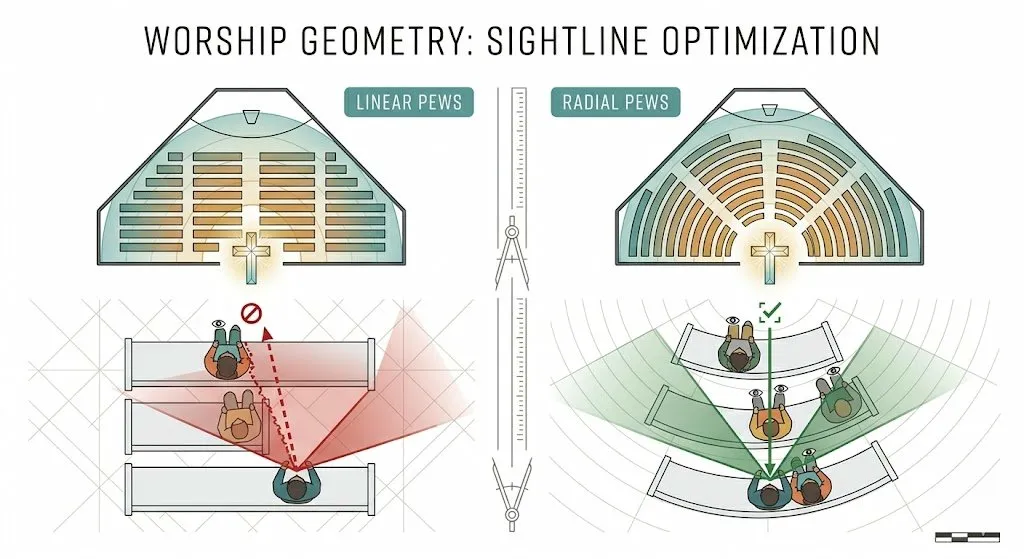
The most obvious change is sightlines, and the difference is not subtle. In a straight-pew fan sanctuary, the person on the outer end is oriented maybe 30 to 45 degrees off-center from the focal point. They’re watching the service at an angle, craning slightly, and their peripheral view is dominated by the backs and shoulders of people in the rows ahead of them. In a radius-curved setup, that same seat faces the altar, pulpit, or bimah directly. The view opens up.
But sightlines are just the entry point. A few other things shift when the pews actually work with the architecture instead of fighting it.
Floor space gets used properly. The wedge gaps disappear because the pews follow the room’s widening geometry. That recovered space translates into more seats within the same footprint, which matters for congregations trying to hit a capacity target without expanding the building. In renovation projects where the budget is tight, gaining 15 or 20 additional seats just by changing the pew geometry can be the difference between the project making financial sense and not.
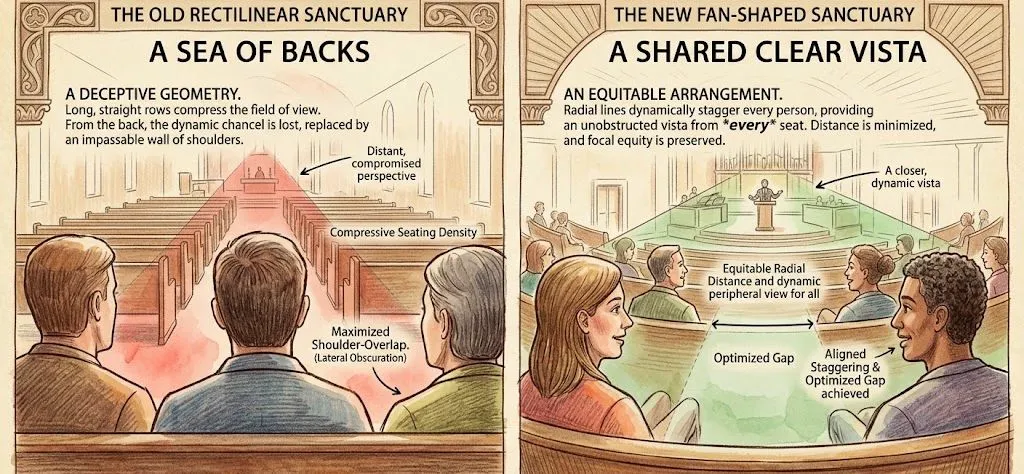
The room feels different. This one’s harder to quantify but easy to notice. When everyone is gently oriented toward a shared center rather than sitting in parallel columns, there’s a sense of being gathered rather than seated. Worshippers can see each other peripherally, which reinforces the communal experience during prayer, singing, and scripture reading. Some congregations describe it as the difference between attending a service and participating in one.
The aesthetics stop fighting. A curved room with straight furniture creates a visual tension that even people with no design background can feel. The architecture says one thing, the seating says another. Curved pews resolve that. They follow the lines of the room, complement any existing millwork or decorative stonework, and make the sanctuary look like it was designed as a complete piece rather than furnished as an afterthought.
A Note on Synagogue Design
Fan-shaped and semicircular layouts are equally common in synagogue architecture, and the sightline benefits apply the same way. In a synagogue setting, the congregation faces the bimah (the raised platform for Torah reading) and the Aron Kodesh (Torah ark), and in many traditional designs seating wraps around the bimah on multiple sides.
Curved benches and radius seating allow every seat to maintain direct orientation toward the bimah throughout the service. This is particularly meaningful during Torah readings and High Holiday services where participation and attentiveness are central to the experience.
One practical consideration specific to synagogue projects — if the layout includes a mechitzah (the partition separating men’s and women’s seating in Orthodox congregations), the curved seating plan needs to account for how that partition integrates with the radius geometry. A manufacturer experienced in synagogue work will understand this requirement from the start rather than discovering it midway through the project.
Planning Considerations for Building Committees
If your committee is at the stage of evaluating curved pews for a renovation or new build, a few things are worth discussing before you’re deep into the manufacturing process.
Accurate radius measurements come first. Everything downstream depends on the floor plan dimensions being correct. The manufacturer needs the exact geometry of the room — not approximate, not estimated from architectural drawings that may have been modified during construction. Some manufacturers provide on-site measurement and layout support, and for a curved pew project that step is worth taking seriously because the cost of getting it wrong is a full re-manufacture of whatever doesn’t fit.
ADA compliance isn’t optional. Wheelchair-accessible spaces need to be integrated into the seating layout as part of the plan, not squeezed in wherever there’s leftover room. In a curved layout, this means planning accessible positions that have the same sightline quality as every other seat — which is achievable but needs to be designed in from the start.
Phased installations are possible. Not every congregation can empty the sanctuary and install all new pews at once. Some manufacturers have experience sequencing the work so sections get replaced while services continue in the remaining area. If you’re considering this approach, raise it early in the conversation because it affects manufacturing scheduling, delivery logistics, and how the installation crew plans their work.
Balconies need their own radius calculations. If your sanctuary has an upper level, those seats have different sightline geometry than the main floor. Each balcony section may require its own set of radius measurements and custom pew specifications. It’s not a problem — it just needs to be scoped into the project from the beginning rather than added on later.
Upholstery choices affect longevity. Curved pews take the same upholstery and finish options as straight pews — wood species, stain colors, foam density, fabric type. For high-use environments, fabrics like polyolefin blends offer stain resistance and durability that hold up over years of weekly use. Worth asking the manufacturer about maintenance expectations before committing to a material.
Drawbacks Worth Being Honest About
No seating solution is perfect, and curved pews carry a few trade-offs that building committees should weigh alongside the benefits.
Cost is higher than straight pews. Every row is a custom piece with its own radius. That means more engineering time, more individualized manufacturing, and no economies of scale from producing identical units. For a congregation comparing quotes, the price difference between a straight pew set and a curved one for the same room can be significant — sometimes 25-40% more depending on the manufacturer, materials, and complexity.
Lead times are longer. Custom radius work takes more time than pulling standard straight pews from production. Depending on the manufacturer’s backlog and the size of the project, lead times can run several months. If your renovation has a hard deadline — say, completing the sanctuary before Easter or High Holidays — that timeline needs to be built in from the start.
Individual pews aren’t interchangeable. Because each row has a unique curvature, you can’t move a pew from row 4 to row 9. If a single pew is damaged — whether from water, an accident, or normal wear over decades — replacing it means ordering a custom piece built to that specific row’s radius. You can’t grab a spare from storage or swap from another location in the sanctuary.
Measurement errors are expensive. If the floor plan measurements are off, pews manufactured to incorrect radii won’t fit the room properly. Unlike straight pews where a few inches of variance can be absorbed, curved pew fit is much less forgiving. Gaps, misalignments, or pews that don’t follow the room’s actual curve become visible and can’t easily be corrected without remanufacturing. This is why the measurement phase matters more for curved projects than for any other type of pew installation.
Resale and reuse is limited. Straight pews have an active secondary market — congregations sell them to other churches, event venues, restaurants, or private buyers. Curved pews are built for one specific room. The chances of another sanctuary having the exact same radius geometry are essentially zero, which means if the congregation ever replaces the pews or closes the facility, resale options are extremely limited.
These drawbacks don’t outweigh the benefits for most fan-shaped and round sanctuaries where sightlines are a genuine problem. But they should be part of the conversation rather than discovered after the contract is signed.
 Decor & Improvement Accessories