

Home & Decor Blogs: DIY, Interior Design & Lifestyle Ideas
6 Beautiful Material Ideas for a Softer, More Inviting Patio or Terrace

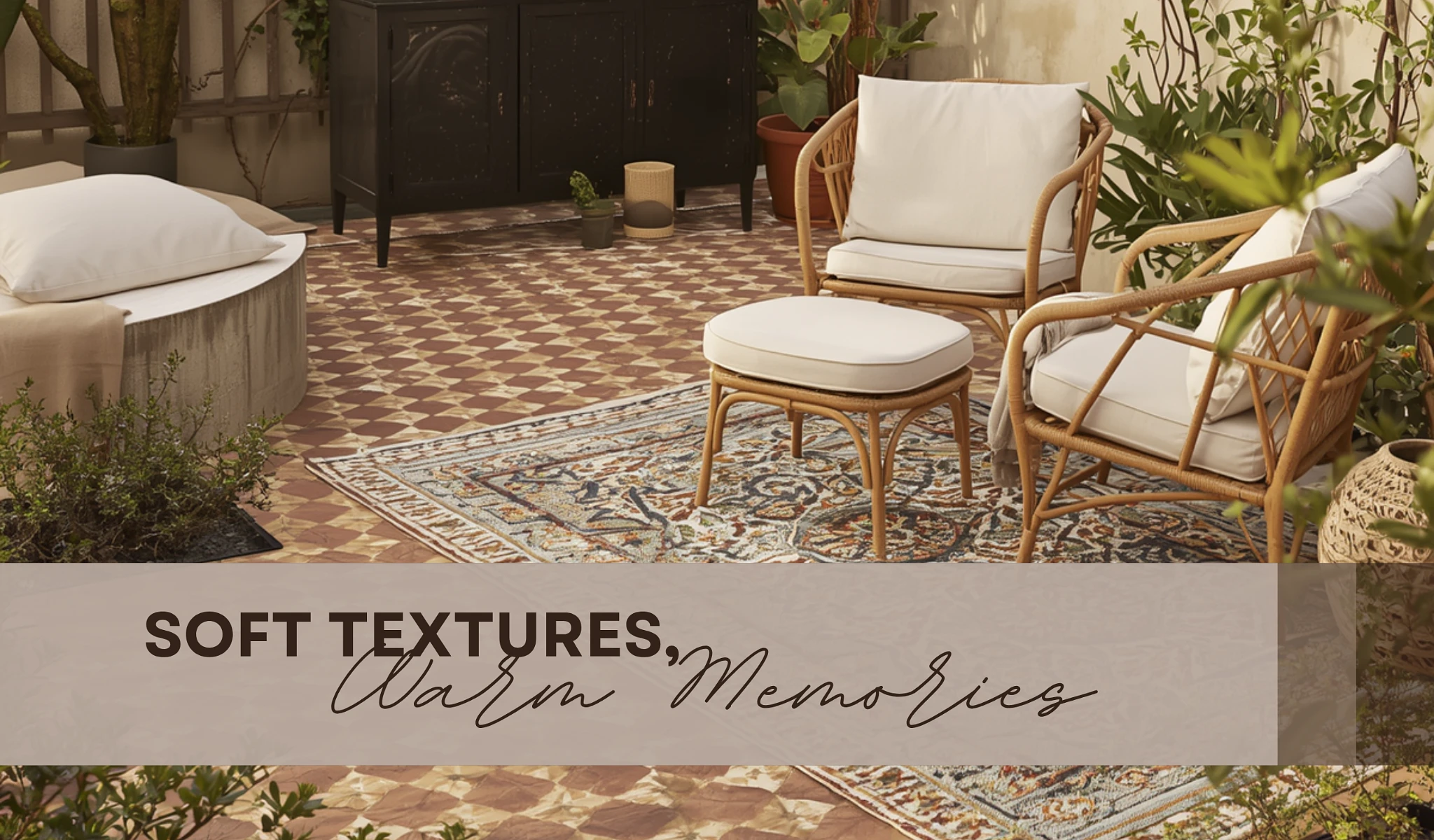
Somewhere between the polished concrete trend of the 2010s and the current desire for outdoor spaces that actually feel like extensions of a home, patios got a reputation for being a little cold. Not temperature cold, design cold.
Flat, hard, grey, and somehow both formal and unfinished at the same time.
The spaces that escape this tend to share one quality: they layer materials rather than commit to a single surface.
A patio that feels genuinely inviting usually combines something warm underfoot with something that catches light differently at the edges, something that grows or softens over time, and something that pulls the colour palette of the interior out into the open air.
That kind of layering starts with material choice. Not furniture, not cushions, though those matter too. The surface itself sets the register for everything that sits on top of it.
These are six materials that bring warmth, texture, and genuine softness to an outdoor gathering space, each suited to the full range of seasonal conditions that patios and terraces face through a year.
01 Artisan porcelain patio tile
Handcrafted character with the performance credentials of through-body porcelain
There is a version of porcelain tile that reads as cold and industrial.
The large-format grey slab that appears in every budget renovation.
And then there is artisan-quality through-body porcelain that draws from centuries of tile-making tradition: rich tonal variation, surface texture that catches low-angle light, geometric and organic patterns that introduce rhythm to a patio floor without competing with the furniture above it.
The difference is in how the tile is produced and specified. The elegant outdoor patio tiles for seasonal climates in OUTERclé’s GATHER collection sit firmly in this second category.
Made from the highest quality porcelain across over 1,000 shapes, textures, forms, and colours, the collection is designed specifically for gathering spaces including outdoor dining terraces, entertaining patios, poolside zones.
These are tiles that look better in dappled late-afternoon light than they do in a product photo, and that still look exactly the same in year five as they did on installation day.
The performance case for through-body porcelain is well established: water absorption rates below 0.5 percent ensure genuine frost resistance, UV-stable colour through the body of the tile means no fading, and a slip-resistant textured surface is appropriate for year-round outdoor use in all weather.
The design case is equally strong; patterned artisan porcelain transforms a patio floor from a background into a considered surface, the kind that draws the eye and invites people to look down as well as around.
| Why it works: Artisan porcelain brings the visual richness of handmade tile with zero maintenance, no sealing, and genuine freeze-thaw performance. It is the outdoor surface most likely to be noticed and remembered. |
02 Warm-tone honed limestone
Natural stone with the tactile warmth of travertine but better outdoor performance
Limestone is one of the most evocative outdoor surface materials available; the aged stone floors of Mediterranean courtyards, the worn steps of French country estates, the pale honey tones of a Provencal terrace that has absorbed decades of summer warmth.
The challenge for contemporary patio applications is that not all limestone is created equal for outdoor use.
Honed limestone in a warm tone including honey, buff, greige, or pale ochre has a surface quality that no manufactured material quite replicates.
The stone absorbs and reflects light differently at different times of day.
At midday it reads pale and clean; at golden hour it glows. That responsiveness to light quality is what gives natural stone its enduring visual appeal.
For outdoor use in climates with seasonal rainfall or temperature variation, dense limestone with a honed or textured finish is considerably more appropriate than polished varieties.
A honed surface reduces the gloss that fades under UV, improves slip resistance, and typically makes the stone’s natural character more visible rather than less.
Apply a breathable impregnating sealer annually and warm-tone honed limestone will hold its colour and surface quality gracefully for decades.
| Why it works: Honed limestone introduces the warmth and colour response of natural stone without the maintenance demands of polished finishes. It reads as genuinely luxurious underfoot and develops a subtle patina that only improves with age. |
03 Weathered or reclaimed timber decking
Organic warmth and barefoot comfort with modern low-maintenance timber options
Wood is warm in a way that no other outdoor material is.
Not just visually warm but actually warm underfoot on a cool morning, soft to touch, resonant underfoot in a way that stone and tile are not.
For a terrace or patio that you want to feel genuinely habitable through the whole year, timber decking introduces a domestic quality that instantly softens the space.
The maintenance question is the one that puts many homeowners off natural timber outdoors, and it is a fair concern for untreated hardwoods that require annual oiling or staining. The solution is timber selection.
Thermally modified timber and naturally durable species like Ipe, Garapa, or Accoya offer the warmth and organic character of wood without the high-cycle maintenance that makes conventional timber frustrating.
Thermally modified timber in particular ages to a characterful silver-grey without any surface treatment; a material that looks as good at year ten as it did at installation.
The combination of timber decking for dining and lounge zones alongside a patterned porcelain tile for transition paths is a pairing that works particularly well: the warmth of the wood and the visual interest of the tile play off each other without competing, and the different surface textures introduce the material layering that makes a patio feel designed rather than default.
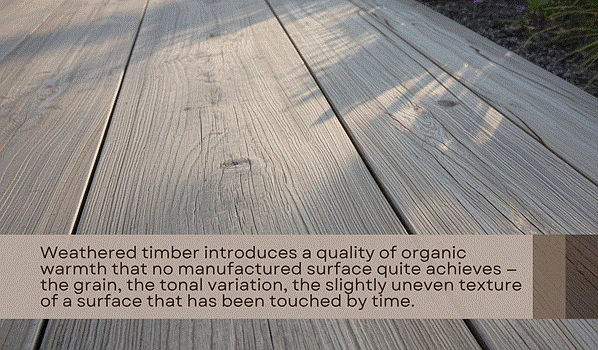
| Why it works: Timber brings barefoot comfort, organic warmth, and a tactile quality no hard surface matches. Correctly specified, it requires minimal maintenance and ages into one of the most characterful outdoor surfaces available. |
04 Planted edges and gravel borders
Softening the boundary between the hard surface and the garden with living material
A patio that meets the garden at a hard, clean line tends to feel cut off from its setting. The spaces that feel most integrated; where indoor and outdoor seem to flow naturally.
Almost always have some degree of planted edge: low-growing perennials, gravel infill between larger paving units, creeping thyme or sedums between stepping stones, or a generous raised planting bed at the perimeter that spills softly over the hard edge below it.
This is about using planting as a material in the design of the patio surface itself, not just as a surrounding landscape element.
A generous gravel-and-planting border between a tiled terrace and a lawn, for example, does several things at once: it softens the visual transition, it introduces colour, movement, and seasonal change, it provides drainage at the edge of the hard surface, and it creates the sense that the patio belongs to the garden rather than being imposed on it.
The broader principle at work here using organic, natural elements to introduce liveliness and warmth into designed outdoor spaces is increasingly central to how the most considered outdoor areas are put together.
Exploring how natural elements bring softness and seasonal variety, from planted edges to contemporary outdoor design approaches, shows consistently that the presence of living material at the boundary of a hard surface is one of the most effective ways to give an outdoor space warmth and character.
For seasonal climates specifically, planted edges that include some evergreen structure such as low box hedging, lavender, rosemary ensure that the patio border reads well through winter as well as summer.
The skeleton of the planting holds the space together when flowering perennials have died back, and returns it to fullness as the season changes.
| Why it works: Planted and gravel borders dissolve the hard line between patio and garden, introduce seasonal change, and give even a small terrace a sense of belonging to its landscape rather than sitting on top of it. |
05 Outdoor textured rugs over hard surfaces
The simplest way to introduce textile warmth to an existing patio floor
A well-chosen outdoor rug does more than look decorative.
On a hard patio surface, it introduces the textile register that makes a space feel like a room: warmth underfoot, visual zoning, an invitation to take shoes off and settle in.
The material separation between a rug-defined dining area and the surrounding paved surface creates the sense of distinct spaces within the same patio, which makes a larger terrace feel more intimate and a smaller one more purposeful.
Outdoor-rated rugs woven from polypropylene or recycled synthetic fibres have improved significantly from the scratchy, faded products that gave outdoor textiles a bad reputation.
Current designs offer genuinely beautiful weave structures, rich colour palettes, and surface textures that read as considered and sophisticated; not as an obviously practical compromise. They handle rain, UV exposure, and foot traffic without deteriorating, and most can be cleaned with a standard garden hose.
The key is choosing a rug that complements the surface beneath it rather than competing with it. A patterned porcelain tile works well under a plain-weave rug in a harmonising tone.
A more neutral stone or timber surface can take a bolder rug pattern. The same instinct that applies when choosing a rug for an interior room proportional to the seating group, grounded in a tone from the surrounding palette is the right one for an outdoor space.
Size matters here as much as pattern. An outdoor rug that is too small for the seating group above it reads as an afterthought rather than a design decision.
Err toward generosity: a rug large enough for all four legs of the furniture to sit on it creates a defined, comfortable, intentional zone.
| Why it works: Outdoor rugs are the most accessible softening material available for any existing patio surface. They zone the space, introduce warmth underfoot, and transform a dining or lounge area from a collection of furniture into an actual outdoor room. |
06 Riven or tumbled sandstone
Natural texture and tonal variation that reads as beautiful in any season
Sandstone has a surface quality that is difficult to replicate artificially: a riven or naturally split face shows the true character of the stone, with slight undulation, variable colour depth, and a texture that catches and distributes light in a way that manufactured surfaces cannot.
In warm tones including honey, buff, York cream, Indian sandstone in autumn brown or Indian sandstone in a caramel tone, it introduces the kind of layered, complex warmth that is immediately apparent to anyone standing on it.
Tumbled sandstone that has been mechanically aged to produce softened edges and a worn, antique character works particularly well in garden settings where a formal paving aesthetic would feel out of place.
The rounded edges, slightly uneven surface, and variation between individual stones give a patio or garden path a quality of natural irregularity that contributes enormously to the sense that the space has been there for a while, that it belongs to its setting.
The practical consideration for sandstone in seasonal climates is surface finish and stone selection.
Riven and textured surfaces resist both UV degradation and moisture far better than polished varieties.
Dense sandstones with low porosity are appropriate for climates with freeze-thaw exposure; more porous varieties suit covered patios or drier climates where moisture ingress is not the primary concern.
Annual sealing with a breathable stone impregnator protects against staining while preserving the natural appearance of the stone’s surface.
| Why it works: Riven and tumbled sandstone introduces natural tonal complexity and irregular texture that reads as inherently warm and considered. It ages into one of the most characterful outdoor surfaces, developing the kind of patina that only time and genuine stone can produce. |
What makes a patio feel soft and inviting rather than cold and finished?
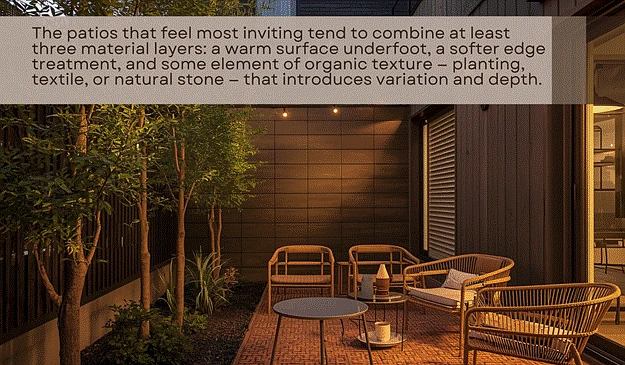
A hard outdoor surface on its own tends to read as functional, not atmospheric.
The shift from functional to beautiful happens when materials are layered in a way that introduces visual complexity: subtle pattern, tonal variation, contrasting textures at the edges, something that changes with light throughout the day.
This is actually the same principle that interior design applies to living spaces. The Lotology approach to interior design, for example, is built on the idea that layered textures and materials, natural alongside manufactured, smooth against rough and create spaces that feel genuinely lived in. The same thinking applies outdoors.
A patio surfaced entirely in one material, however beautiful that material is in isolation, tends to feel static. The most successful outdoor spaces borrow interior design thinking: they layer, they contrast, they let materials speak to each other.
Climate is also part of this equation.
Materials that perform across seasons without constant maintenance are ones that were designed for exterior use from the outset; not adapted, not sealed annually, not replaced every few years.
The six materials below earn their place on both counts: they look beautiful, and they hold their visual quality through everything that outdoor exposure throws at them.
Bringing it together: layering for warmth
The patios and terraces that feel most inviting are rarely the ones that did the most.
They are the ones that made deliberate material choices, layered them thoughtfully, and left room for the space to breathe and develop its own character over time.
Start with a primary surface that sets the visual register — artisan porcelain, warm stone, or timber, and then layer in contrast at the edges: a different material, some planting, a textile zone.
Allow seasonal variation to contribute rather than fighting it. And choose materials that were designed to be outdoors, not adapted from interior applications, so that the performance question never becomes a concern once the space is finished.
The result is a patio that feels genuinely like an outdoor room: soft enough to invite lingering, beautiful enough to look at from inside as well as from within, and durable enough to stay that way through every season that passes over it.
 Decor & Improvement Accessories