

Home & Decor Blogs: DIY, Interior Design & Lifestyle Ideas
7 Walkway Mistakes That Cost More to Fix Than to Prevent


Tearing out a failed walkway and redoing it runs $15 to $25 per square foot installed and sometimes more if the old base has to come out too.
A 200 square foot front walkway done wrong and then redone right is a $3,000 to $5,000 lesson in what should have been handled the first time.
Every one of these seven problems shows up after the walkway looks finished and everyone has already paid.
1. The Walkway Slopes Toward the House Instead of Away From It
Water follows gravity and it does not care about your landscaping plan.
A walkway that sits flat or tilts even slightly toward the foundation becomes a channel that delivers rainwater directly to the base of your house and most people do not notice until they see damp patches on the basement wall or pooling near the front steps after a storm.
The rule is a minimum 1% slope away from the structure. That works out to about one inch of drop for every eight feet of walkway length. Not dramatic enough to feel like you are walking downhill but enough that water moves away instead of sitting.
Why does this get missed so often?
Because most walkways get graded by eye instead of by level.
The contractor eyeballs it, it looks fine when it’s dry, and the first heavy rain reveals the truth. A four-foot spirit level and five minutes of checking during base prep is all it takes but it is genuinely surprising how often that step gets skipped.
The fix after the fact is ugly because you are either lifting and re-grading sections or cutting a channel drain across the walkway to redirect flow, both of which cost more than doing the slope correctly would have.
2. The Base Is Too Thin and the Walkway Will Sink Within Three Years
This is the one that separates a walkway lasting five years from one lasting twenty-five.
And it’s completely invisible once the pavers or stone go on top.
A proper walkway base needs six to eight inches of excavation depth. That means digging out the existing soil, laying three to four inches of compacted crushed gravel (not rounded pea gravel because crushed stone locks together and rounded stone rolls), then an inch of levelling sand on top. The gravel layer needs to be compacted with a plate compactor to 95% density or higher and if you skip any of that the base compresses unevenly under foot traffic and weather cycles.
What does a failed base actually look like?
Pavers start sinking in patches; Joints open up. Water gets underneath and erodes what little base exists and within two or three winters the whole thing looks wavy.
Fixing it means pulling every paver up, excavating properly, rebuilding the base, and relaying everything.
Basically doing the entire job over.
The cost difference is almost nothing
A proper gravel base for a 200 square foot walkway costs maybe $200 to $400 in material. Skipping it saves that amount upfront and costs $3,000 to $5,000 when the redo happens.
The math does not require a calculator.
3. Choosing Material Based on How It Looks Instead of How It Handles Your Climate
A natural slate walkway photographed in southern California sunshine looks incredible.
That same slate in a freeze-thaw climate cracks within two winters because water seeps into the stone’s natural layering and freezes and expands and splits the surface apart. Slate is gorgeous but it is not rated for hard freeze cycles unless you are buying a specific frost-resistant grade and most homeowners do not know there is a difference.
What actually holds up where?
- Concrete pavers ($6 to $12 per square foot material) handle freeze-thaw well because they are dense and uniform. Best all-around choice for most climates and if one cracks you pull it out and drop a replacement in without touching the rest.
- Natural stone ($12 to $50 per square foot installed) varies wildly. Bluestone and granite handle frost. Limestone absorbs water and can spall. Sandstone erodes in wet climates.
- Gravel ($1 to $3 per square foot material) works everywhere because there is nothing to crack but it migrates without edging and it is not ADA compliant if that matters for your property.
- Brick ($10 to $25 per square foot installed) is durable in most conditions but efflorescence, that white salt staining, shows up in wet climates and never fully goes away.
The question is not “what looks best on Pinterest” but “what survives ten winters where I live.”
Ask that first and the material list narrows fast.
4. Planting Trees Near Walkways Without Thinking About What the Roots Do in Ten Years
This one plays out slowly and then all at once.
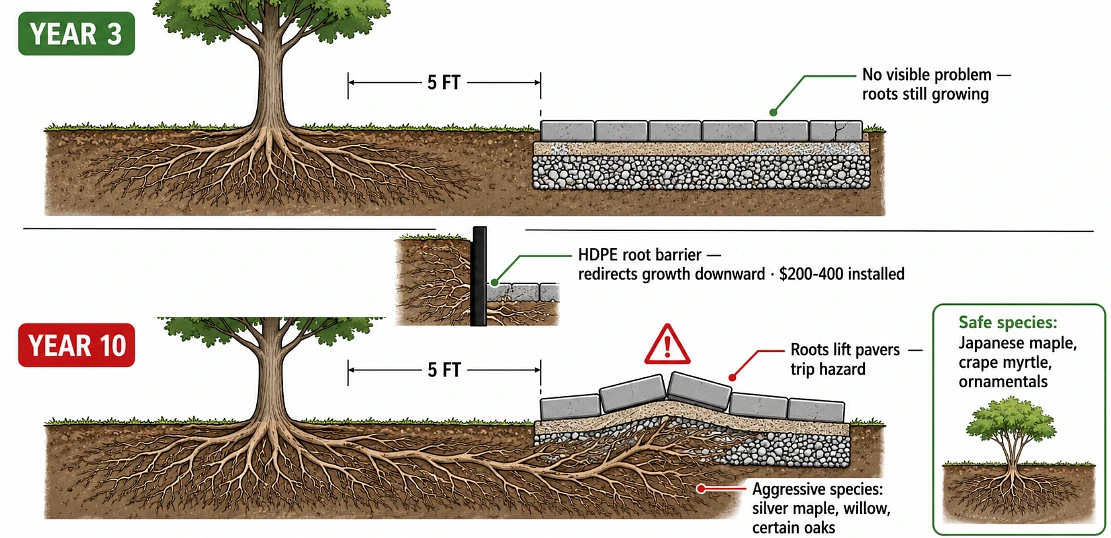
You plant a beautiful tree five feet from the walkway and it grows and the roots spread laterally looking for water and somewhere around year seven or eight the first slab lifts. By year ten you have cracked concrete and trip hazards and a tree you probably do not want to remove because now it is big and established and provides shade for the whole front yard.
The species matters enormously. Silver maples and willows and certain oaks have aggressive shallow root systems that will absolutely destroy any hardscape within their drip line.
Japanese maples, crape myrtles, and most ornamental trees stay relatively contained.
What happens when this goes wrong in a city where you’re liable?
I was curious about this because tree root damage on walkways is not just an aesthetic problem in places where the city holds property owners responsible for the condition of adjacent sidewalks. So I reached out to the FY Sidewalk team in NYC and they deal with this constantly.
Their perspective was that most homeowners do not realise the liability exists until a DOT inspector flags it.
In New York specifically the Department of Transportation can issue a Notice of Violation giving you 75 days to fix the damage and if you don’t handle it the city does the repair and bills you at inflated rates. A straightforward residential repair runs $1,000 to $3,000. If the roots are massive and the damage extends into ADA compliance territory you are looking at $6,000 to $12,000 or more.
How do you prevent it?
Keep large-root-system trees at least 10 to 15 feet from any walkway or sidewalk.
If the tree is already there a root barrier works. That’s a physical sheet of high-density polyethylene buried vertically between the tree and the walkway and it redirects root growth downward instead of laterally.
Costs a few hundred dollars installed. Cheaper than tearing out concrete in a decade.
5. Building the Walkway Too Narrow
Thirty-six inches is the minimum width that feels usable for one person.
Most front walkways should be 48 inches, wide enough for two people to walk side by side without one person stepping off into the grass. Anything under 30 inches feels like a balance beam and people instinctively avoid using it.
Can you widen it later?
You can but it is annoying and expensive because widening means excavating new base on both sides, matching materials that may have weathered differently, and blending the new edges so it does not look like a patch job.
Almost always cheaper to build it wider the first time than to widen it later.
A simple test before you build: stand at the start of where the walkway will go and walk toward the front door with another person beside you. If both of you fit comfortably the width is right. If one of you has to drop behind or step into the lawn it is too narrow.
And it will feel too narrow every single time you have guests over.
6. Skipping the Edging Because It Looks Fine Without It
It does look fine.
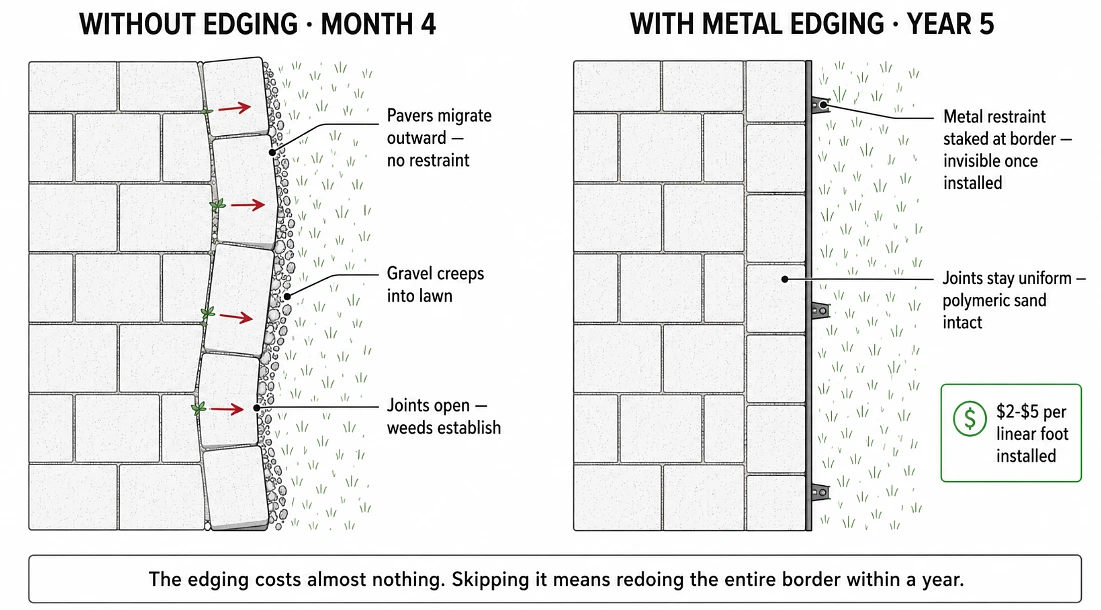
For about four months.
Then the gravel starts creeping into the lawn and the pavers along the edge shift outward because nothing is holding them and the joints open up and weeds take the gaps and the whole border goes soft. Not all at once but slowly enough that you don’t notice until the walkway has no clean edge left.
Can you fix it without redoing the whole walkway?
Not really.
You’re pulling border pavers, trenching for the edging you should have installed initially, and relaying everything. That’s almost the same labour cost as doing it right the first time.
So what type of edging actually works?
Metal, aluminium or steel, staked into the ground along both sides. About $2 to $5 per linear foot installed. Invisible once the walkway materials go in. Holds everything in its lane.
Stone or concrete edging if you want a visible border. Works fine, costs slightly more, same function.
The material doesn’t matter that much. What matters is that something rigid and buried is defining where the walkway ends because gravity and foot traffic and water push everything outward over time and the only thing stopping it is a physical edge at the right depth.
That’s it. That’s the whole fix.
7. Using Regular Sand in the Joints Instead of Polymeric Sand
Regular sand washes out.
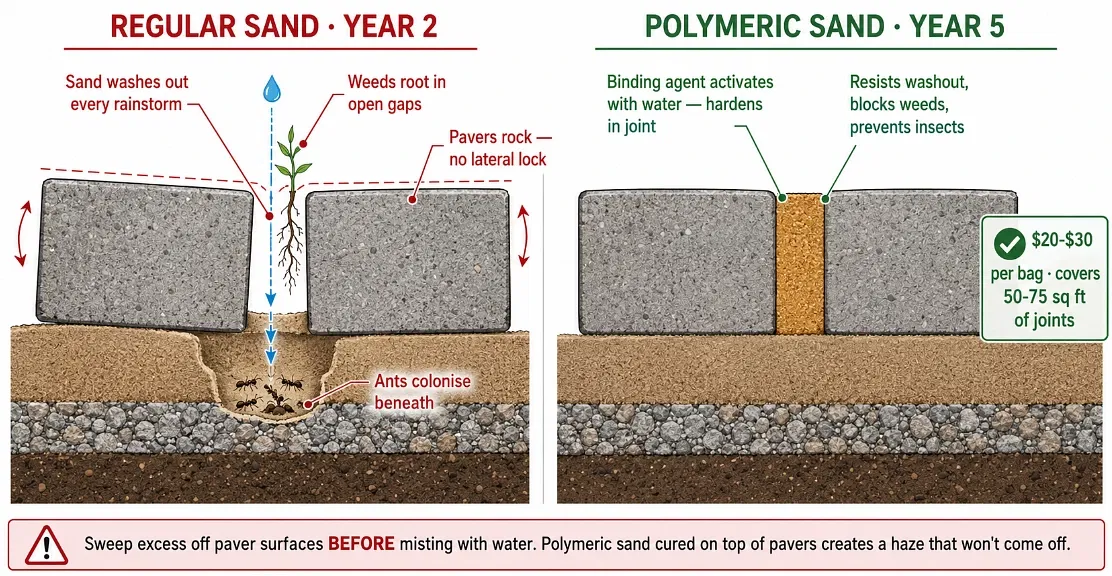
Every rainstorm takes a little more and every time someone hoses off the walkway a little more disappears and within a year the joints between your pavers are empty channels where weeds root and ants build colonies. The pavers start rocking because there is nothing locking them against each other anymore.
Polymeric sand fixes this. It contains a binding agent that activates when you wet it down after installation. It hardens in the joints, resists washout, blocks weed growth, and prevents insect nesting.
A bag costs $20 to $30 and covers about 50 to 75 square feet of joints depending on paver size and gap width.
One thing to get right during application
The sand has to be swept into the joints completely and then the excess cleaned off the paver surfaces before you activate it with water.
Why?
Because if polymeric sand cures on top of the pavers instead of inside the joints you get a haze that is extremely difficult to remove. It bonds to the surface and regular cleaning will not take it off.
Leaf blow the excess aggressively then mist with water. Not a heavy stream, a mist. Heavy water pushes the sand out of the joints before it sets.
The difference between a walkway with polymeric sand and one without is the difference between joints that stay tight for five to eight years versus joints that are empty and weedy by the second spring.
A walkway is one of those projects where the visible part gets all the attention and all the budget and the invisible part determines whether any of it still looks good in five years. Every problem on this list is cheaper to prevent than to repair and none of them are difficult to get right if someone is paying attention during installation rather than after.
 Decor & Improvement Accessories