

Home & Decor Blogs: DIY, Interior Design & Lifestyle Ideas
Your Furnace Is Getting Old – Fix It, Replace It, or Switch to a Heat Pump

The question usually hits when the furnace starts acting up in January, and you’re standing in your kitchen wondering if the repair bill is worth it or if you should just rip the thing out and put in something newer. Maybe the blower motor is making a sound it did not make last winter, or the ignitor failed twice in three months, or the gas bill crept up, and nobody can tell you exactly why.
Here is the short version before we get into any of it. If the repair estimate is under forty percent of what a full replacement would cost and the furnace is under fifteen years old, fix it. Past that threshold — either on age or on repair cost — you are probably better off replacing. With what, though, depends on a few things that are worth going through properly.
When Repairing Still Makes Sense (And When You Are Throwing Money Away)
A gas furnace lasts fifteen to twenty years in most homes. Ignitors, flame sensors, blower motors, draft inducers — these are normal wear items, and all of them are worth replacing on a furnace that is eight or ten years old with no other issues. You fix them, the furnace runs fine for another few years, and nobody thinks about it again.
The calculus changes past the fifteen-year mark, and especially when the expensive stuff starts failing. A cracked heat exchanger runs $1,500 to $3,000 for parts and labor, sometimes more if the unit is an older model and the part has to be sourced. At that price, you are spending a big chunk of what a brand new furnace would cost, except the new one comes with a full warranty and another fifteen to twenty years ahead of it. The old one gives you maybe three more years, maybe five if you’re lucky, before something else goes.
That is roughly where the forty percent number comes from — not some exact science, more of a contractor’s rule of thumb that has held up over enough jobs to be useful. Repair cost under forty percent of replacement, you are buying meaningful remaining life. Over it, and you are putting serious money into a unit that is statistically close to its next failure.
Now, obviously, when the furnace dies at two in the morning on the coldest night of the year, nobody is sitting there doing percentage calculations. You need heat. You call someone who does emergency furnace repair, and they get the system running again. That is the right move in a crisis. But once the house is warm and the panic is over, that is when you sit down and run the numbers honestly instead of just being grateful the thing turned back on.
Going With a New Gas Furnace
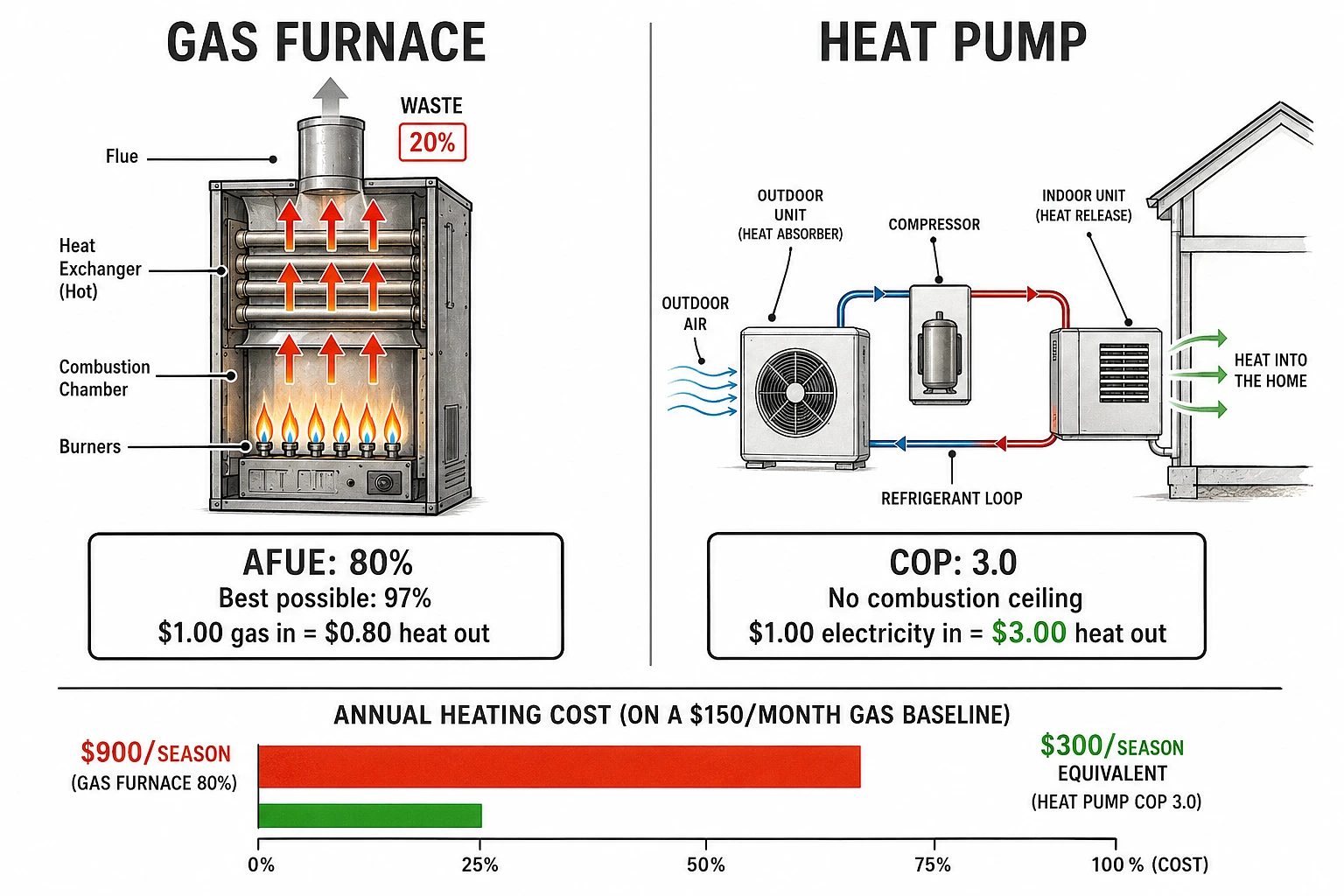
If your home already has gas lines, a flue, and ductwork that is in decent shape — and all you want to do is swap the old box for a new one — this is the simplest path and usually the cheapest upfront.
- Standard efficiency (80% AFUE): $3,800 to $5,500 installed.
- High efficiency (90-96% AFUE): $5,000 to $8,000 installed.
- Premium condensing (97%+ AFUE): $7,500 to $10,000 installed.
AFUE is just the percentage of gas that gets converted into actual heat. An old 80% unit wastes twenty cents of every dollar of gas up the flue. A 96% unit wastes four cents. On a $150 monthly gas bill during winter, that efficiency gap works out to maybe $30 a month, so $120 to $150 over a full heating season.
Whether the high-efficiency model is worth the upfront premium really depends on how long your winters are. In the northern US, where the furnace runs five or six months out of the year, the payback on the premium unit is usually seven to ten years, which is well within the life of the equipment. Down south, where heating season is maybe three months, the math takes a lot longer to break even, and honestly, the standard unit might be the smarter buy. Hard to say that definitively without knowing your specific gas rate and climate, but that is the general direction.
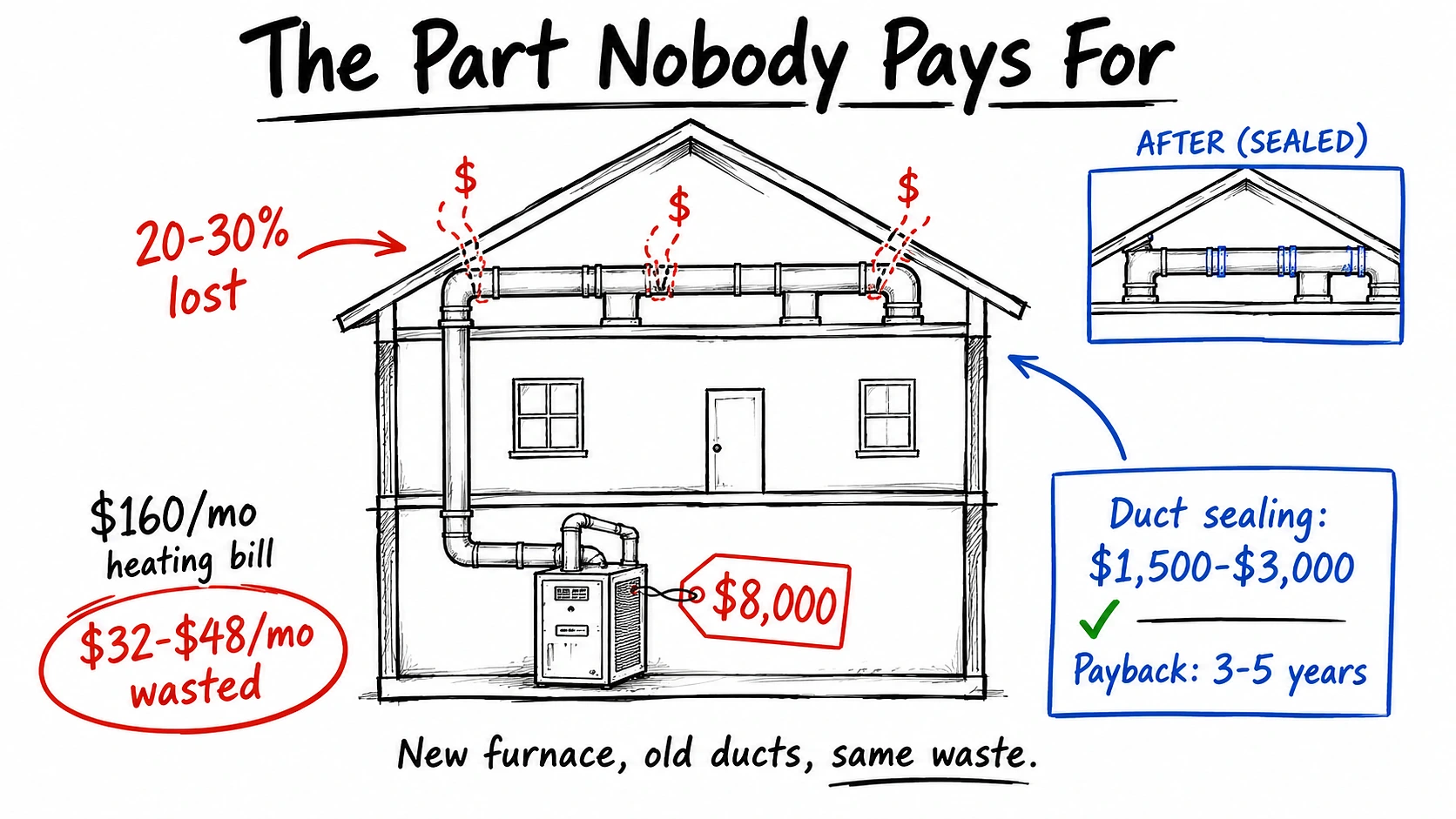
One thing worth mentioning here — your ductwork matters more than most people give it credit for. The US Department of Energy has said repeatedly that leaky ducts waste twenty to thirty percent of conditioned air in a typical home. On a $160 monthly heating bill, that is $32 to $48 per month going into your attic or crawlspace and doing absolutely nothing. Over a five-month season, $160 to $240 per year has just gone. Duct sealing runs $1,500 to $3,000, and the payback in a cold climate is three to five years, but nobody gets excited about paying someone to crawl around with mastic tape, so it gets skipped constantly. If you are dropping eight grand on a new furnace, at least have someone check the ducts before you assume the new unit will perform as the spec sheet says.
What About Heat Pumps — Do They Actually Work in Cold Weather?
So this is the part where a lot of homeowners get confused because they have heard heat pumps are the future, and they have also heard heat pumps do not work when it is cold, and both of those things are sort of true, depending on what you mean by cold and which heat pump you are talking about.
A heat pump moves heat from outside air into your house instead of burning fuel to create it. Modern cold-climate models maintain effective heating output down to minus fifteen or minus twenty Fahrenheit, which covers most of the continental US except the really extreme northern stretches. The efficiency advantage is real — a unit with a COP of 3.0 delivers three dollars of heating for every dollar of electricity it uses. No gas furnace can match that ratio because combustion has a hard ceiling; you cannot extract more than a dollar of heat from a dollar of gas, no matter how good the burner is.
What it costs:
- Central air-source (standard): $3,800 to $8,500 installed.
- Central air-source (premium variable-speed): $10,000 to $15,000.
- Ductless mini-split, single zone: $3,000 to $5,500.
- Geothermal: $15,000 to $35,000+, which is why most people looking at cost savings go air-source.
The federal credit changes the upfront number. The IRA Section 25C credit covers thirty percent of the equipment and installation cost for qualifying heat pumps, up to $2,000 per year, running through 2032. On a $10,000 installation that is $2,000 back at tax time, bringing the effective out-of-pocket to $8,000 — basically the same range as a high-efficiency gas furnace. A lot of homeowners do not realise that credit exists or assume it has expired, but it is very much active.
Where heat pumps genuinely struggle is in extended periods well below zero without a cold-climate rated unit. Below a certain outdoor temperature, the system falls back on electric resistance heating, which runs roughly three times more per hour than the heat pump itself. In places like northern Minnesota or Montana, where it stays below zero for weeks, a standard heat pump is not the right primary heating system. You either need a cold-climate model specifically rated for those temperatures, or a gas furnace is still the practical choice.
But for the rest of the country — the southeast, the mid-Atlantic, the Pacific Northwest, most of Texas, basically anywhere winters are moderate — the heat pump handles winter fine and then reverses in summer to cool the house too. It replaces both your furnace and your AC with one system, which is where the cost comparison really tilts, because you are not just comparing furnace versus heat pump, you are comparing furnace plus AC versus heat pump alone.
How to Think Through the Decision Without Overthinking It
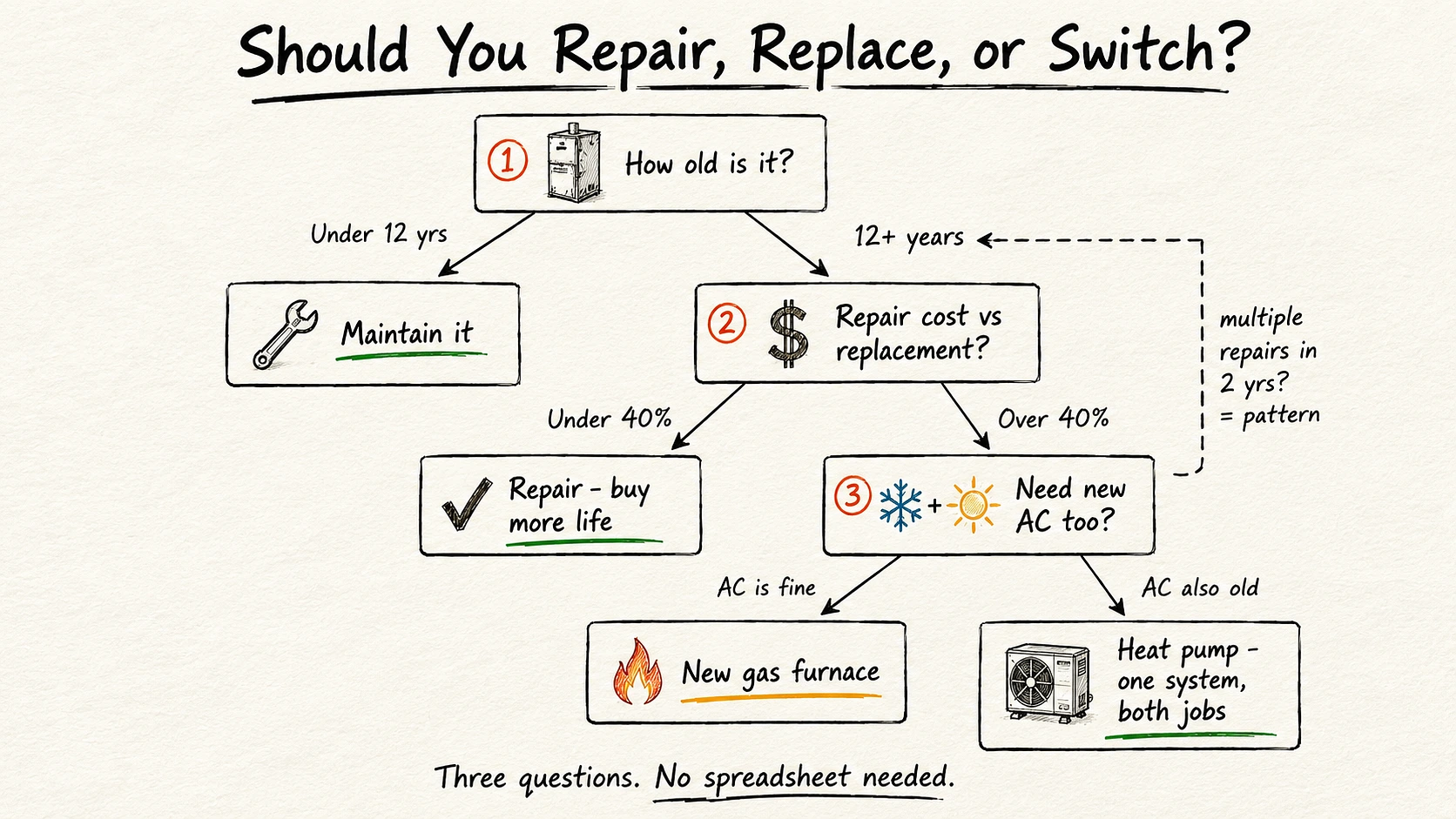
You do not need to memorize efficiency ratings or cost tables. Three questions get you most of the way there.
How old is the furnace? Under twelve and running fine, just maintain it — change the filter, get it serviced once a year, do not think about it. Twelve to fifteen, start setting money aside so you are not scrambling when something fails. Past fifteen, any repair bill over a few hundred dollars deserves a serious look at whether that money would be better spent toward a new unit.
What is the repair going to cost relative to a new system? Under forty percent, repair usually makes sense. Over it, replacement almost always wins on total cost over the next ten years. And if the furnace has had multiple repairs in the last two years on top of the current one, the pattern is telling you something even if the individual numbers look manageable.
Are you also going to need a new AC unit soon? This is the question that often tips the whole thing. If the AC is also old and on its way out, a heat pump handles both jobs in one system. Paying for a heat pump is easier to justify when it is replacing two pieces of equipment instead of one. If the AC is relatively new and working fine, swapping just the furnace for another gas furnace is simpler and cheaper and there is nothing wrong with that approach.
Beyond those three, you get into specifics — your gas rate versus your electricity rate, your climate zone, your ductwork condition, and whether your electrical panel can handle a heat pump without an upgrade. Those are real factors, but they are also things your HVAC contractor should be walking you through during the quote, and if they are not bringing them up, that tells you something about the quality of the quote.

 Decor & Improvement Accessories