

Home & Decor Blogs: DIY, Interior Design & Lifestyle Ideas
The 2 a.m. Bathroom Path: Making a Two-Storey Home Safer Before the Fall That Changes Everything

Your parent gets up at 2 a.m. to use the bathroom. No lights on, carpet to tile transition in the hallway, a threshold sitting half an inch higher than the floor. They have made this walk ten thousand times. Then one night their foot catches the edge and the fall that follows isn’t a bruise, it is a hip fracture, a hospital stay averaging 10 days longer than any other cause, and for over a third of seniors that stay ends not at home but in long term care.
Falls cause 85% of injury related hospitalizations for Canadians over 65. Half happen inside the home. Three zones cause most of them in a two storey house: the bathroom, the staircase, and the unlit path between bedroom and bathroom.
Quick cost reference for all five modifications:
| Modification | Cost Range (CAD) | Impact |
|---|---|---|
| Bathroom grab bars (3 to 4 bars, installed) | $300 to $600 | Addresses the #1 fall zone, 80% of in home fall injuries |
| Handrails both sides of staircase | $200 to $500 | Covers unassisted direction going up or down |
| Non slip stair treads (full set) | $50 to $150 | Prevents slipping in socks or soft footwear |
| Motion sensor night lights (6 to 8 units) | $40 to $80 | Eliminates the unlit 2 a.m. path |
| Stairlift (straight staircase) | $3,000 to $6,000 | Removes stair climbing entirely |
Every item on that list is installed without structural renovation.
1. Bathroom Grab Bars: Diameter, Mounting, and the Drywall Problem
Bathrooms account for roughly 80% of in home fall injuries among seniors. Wet tile, restricted space, stepping over tub edges, lowering onto a toilet seat. Highest risk room by a wide margin.
What specs matter on the bar itself:
- Diameter: 1.25 to 1.5 inches. This range fits arthritic hands that can not fully close around a wider bar.
- Clearance from wall: minimum 1.5 inches so fingers wrap around completely.
- Weight rating: 250 lb minimum. Quality bars test to 500 lb.
- Height from floor: 33 to 36 inches.
Where each bar goes:
- Toilet side wall: 42 inch horizontal bar, 33 to 36 inches from floor. This handles the hardest part, standing up from a seated position when knees don’t cooperate.
- Shower/tub entry: vertical bar near the entry point for stepping in.
- Shower back wall: horizontal bar for balance while standing. If there’s a shower seat, an L shaped bar gives support in both directions.
- Bathroom doorway (outside): short vertical bar on the wall just outside the door. This one gets overlooked constantly but it is the transition point from carpet to tile, often in socks, often at night.
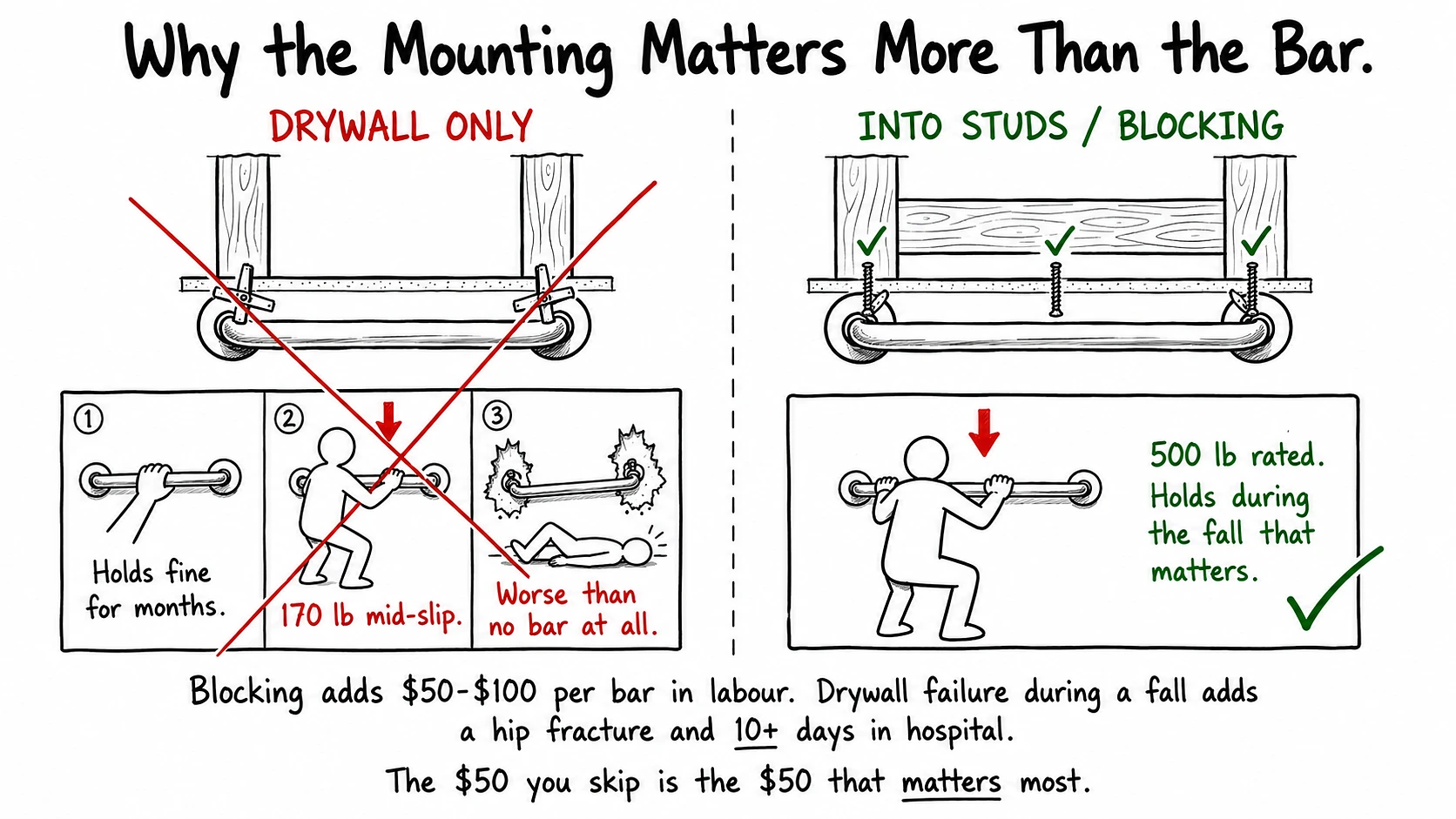
The drywall problem nobody warns you about. A grab bar anchored only into drywall will hold fine for months, maybe a year. Then a 170 pound person puts their full weight on it mid slip and the anchors rip straight out of the wall. The person goes down harder than they would have without the bar. A grab bar that fails during a fall is worse than no grab bar at all.
Bars must mount into wall studs. If studs don’t line up with where the bar needs to go, a contractor installs blocking behind the drywall, a solid piece of wood screwed between studs that gives the bar something structural to bite into. Adds $50 to $100 per bar in labour.
2. Staircase Handrails, Treads, and When You Need a Stairlift
Most two storey homes have a handrail on one side. For an aging parent, you want both sides.
Going up, most people pull with their stronger hand. Coming down, they steady with the other side. One rail means either the ascent or the descent is unassisted, and that unassisted direction is where falls happen.
Handrail specs:
- Diameter: 1.25 to 1.5 inches (same as grab bars, same reason).
- Height: 34 to 38 inches above stair nosing.
- Must be continuous top to bottom with no breaks at landings.
- Extend 12 inches past the top and bottom steps horizontally. The transition from flat floor to stairs is where a surprising number of staircase falls actually occur.
Non slip treads: rubber or abrasive grit treads covering full step width, wrapping over the nosing edge. The peel and stick foam versions from hardware stores lose adhesion in six to eight months and start curling at the edges, which creates a new tripping hazard.
When stairs themselves become the problem. Handrails help with balance. They do not help when the physical effort of climbing is the issue: severe arthritis, post surgical recovery, chronic fatigue, knee replacements. At that point, Stairlifts remove the climbing risk entirely.
Stairlift costs in Canada:
| Type | Cost (CAD, installed) | Why the difference |
|---|---|---|
| Straight staircase | $3,000 to $6,000 | Standard rail, cut to length |
| Curved staircase (turns, landings) | $10,000 to $18,000 | Custom manufactured rail for your exact staircase geometry |
Installation for straight units takes about two hours. The unit mounts to the stair treads, not the wall, so there is no structural modification. Battery powered models keep working during power outages, which matters in a Canadian winter storm when a senior is on the upper floor with no safe way down.
3. Lighting the 2 a.m. Path
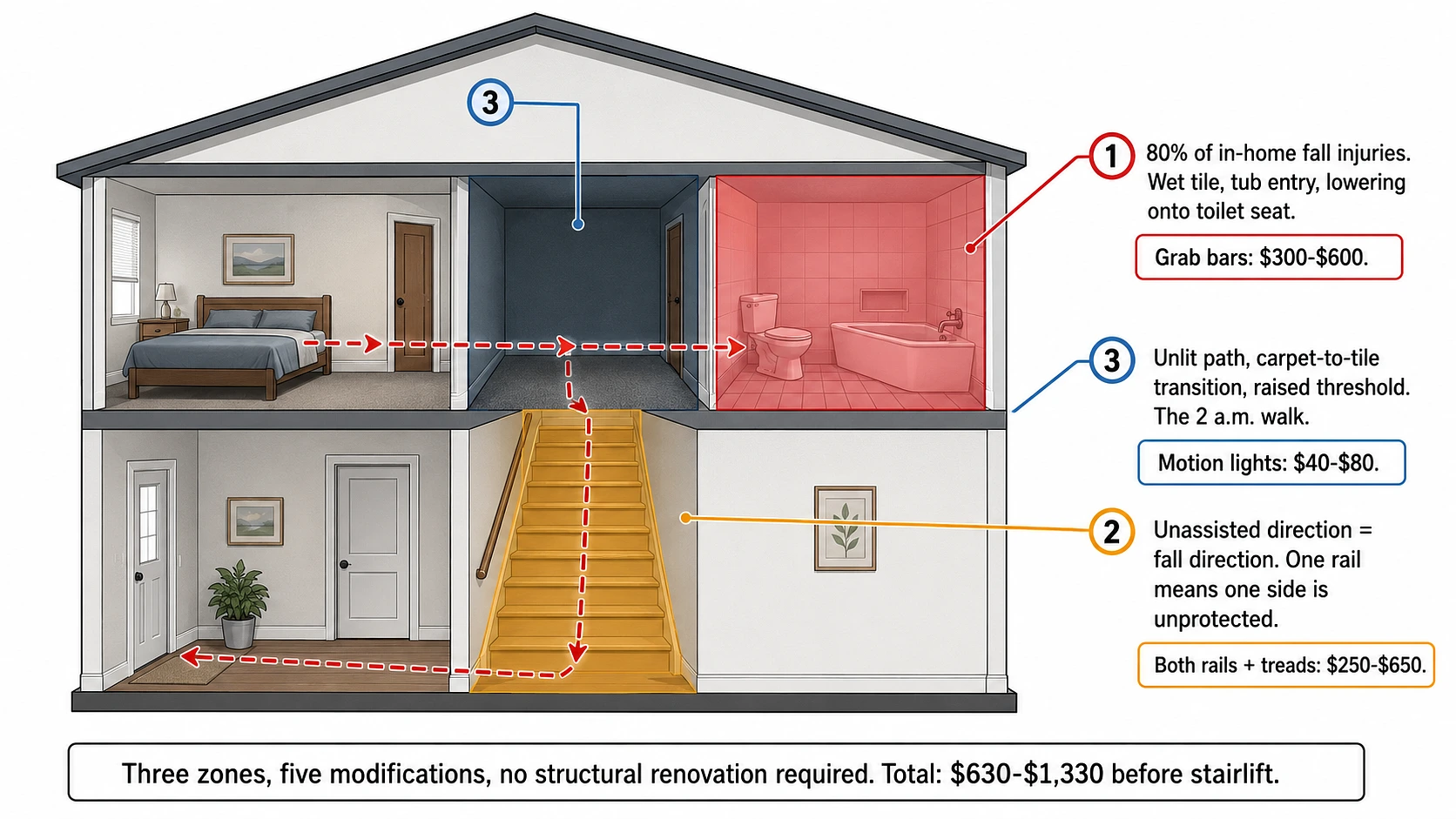
Short section because the fix is simple, cheap, and disproportionately effective.
Most nighttime falls happen because somebody got up and didn’t turn on lights. Motion sensor night lights in three spots solve this almost entirely:
- Hallway between bedroom and bathroom. Plug in units positioned 12 to 18 inches from the floor. Low placement reduces glare to sleepy eyes while illuminating the floor path.
- Top and bottom of staircase. Motion activation so anyone approaching stairs at night has visibility before the first step.
- Inside the bathroom near the toilet. No fumbling for a switch on tile in a half awake state.
Colour temperature for older eyes: stay at 2700K to 3000K (warm white). Anything above 4000K causes glare and reduces contrast perception in aging vision, making it harder to see edges and transitions.
Total cost for 6 to 8 motion sensor units: $40 to $80. The highest return modification on this list relative to what it costs.
4. The Tripping Hazards That Are Not Rugs
Loose area rugs are the obvious one. Remove them or secure them. But three others show up constantly in fall reports and almost never in prevention guides.
- Room transition strips. The metal or wood strip where tile meets hardwood creates a raised edge of 3 to 5 mm, enough to catch a shuffling foot. Bevelled transition strips or adhesive ramps cost $10 to $30 per doorway, ten minutes to install. Five or six transitions in a typical two storey home: $100 and an afternoon.
- Electrical cords crossing traffic paths. Charging cables from side tables, extension cords to far side lamps. Cord covers along baseboards or simply rearranging furniture to close the gap between outlet and device removes the risk.
- Raised door thresholds. Older homes especially have thresholds sitting half an inch above the floor. For someone with limited foot clearance, that is an obstacle on every pass. A flat or bevelled replacement threshold is a $20 part and a 30 minute job.
5. When Daily Life Should Move to the Main Floor
This is not a renovation. It is a rearrangement.
If the staircase is already difficult, moving sleeping to the main floor cuts stair use from a dozen daily trips to almost none. A dining room, home office, or family room works as a temporary bedroom. The planning that matters is relocating everything else to the same floor: medications, clothing, personal items. If your parent is still going upstairs four times a day to get things, the rearrangement hasn’t actually worked.
The limit of this approach: if the only full bathroom is upstairs, you have created a new problem because now the highest risk activity (showering on wet tile) still requires the stairs. In that case, the stairlift from section 2 becomes the bridge, making the upper floor bathroom safely accessible while daily living stays downstairs.
Fewer stair trips per day means lower fall risk. The other modifications on this list make each trip safer. Reducing the number of trips makes the math work even better.

 Decor & Improvement Accessories