

Home & Decor Blogs: DIY, Interior Design & Lifestyle Ideas
Heat Pump vs Gas Furnace: Which One Actually Costs Less to Heat Your Home

A gas furnace burns fuel to create heat. A heat pump moves heat that already exists in the outdoor air using electricity. That is the fundamental difference and it determines everything else, from the monthly bill to how warm the air feels coming out of the vents to whether the system holds up when it is fifteen degrees outside.
Which costs less to run comes down to a ratio between your electricity rate and your gas rate. If a therm of natural gas in your area costs less than roughly ten times the price of a kilowatt-hour of electricity, the furnace is cheaper to operate. If gas costs more than that, the heat pump wins. Pull your last two utility bills and do that multiplication before you listen to any contractor’s pitch because the answer is already sitting in the numbers you have.
What Each System Costs to Install
Gas furnaces run cheaper on the purchase and installation side, mostly because they do one job. An 80% AFUE unit – the base efficiency you will find in warmer regions where heating is secondary – comes in between $3,500 and $5,500 installed. Move up to a 96% AFUE condensing furnace and you are looking at $5,000 to $7,500. The top-end 98% AFUE units push $7,000 to $10,000. None of those include air conditioning, so if you also need cooling you are adding another $3,000 to $6,000 for a condenser and coil on top of the furnace price.
Heat pumps cost more on the sticker but they handle both heating and cooling in one system, which changes the comparison pretty quickly if your AC also needs replacing. A basic single-stage 14.3 SEER2 unit runs $4,000 to $7,000 installed. Mid-range two-stage systems with better humidity control and quieter operation land between $7,000 and $12,000. The premium variable-speed inverter units, the ones that modulate output continuously instead of cycling on and off, go $12,000 to $18,000.
The federal government has offered tax credits up to $2,000 for qualifying heat pump installations under the Inflation Reduction Act, and state and utility rebates often stack on top of that. These incentive programs shift around so check the DSIRE database for your ZIP code before committing to a number. But when available, a mid-range heat pump after rebates can land in roughly the same range as a furnace plus a separate AC unit. That changes the whole upfront cost argument.
The Temperature Thing
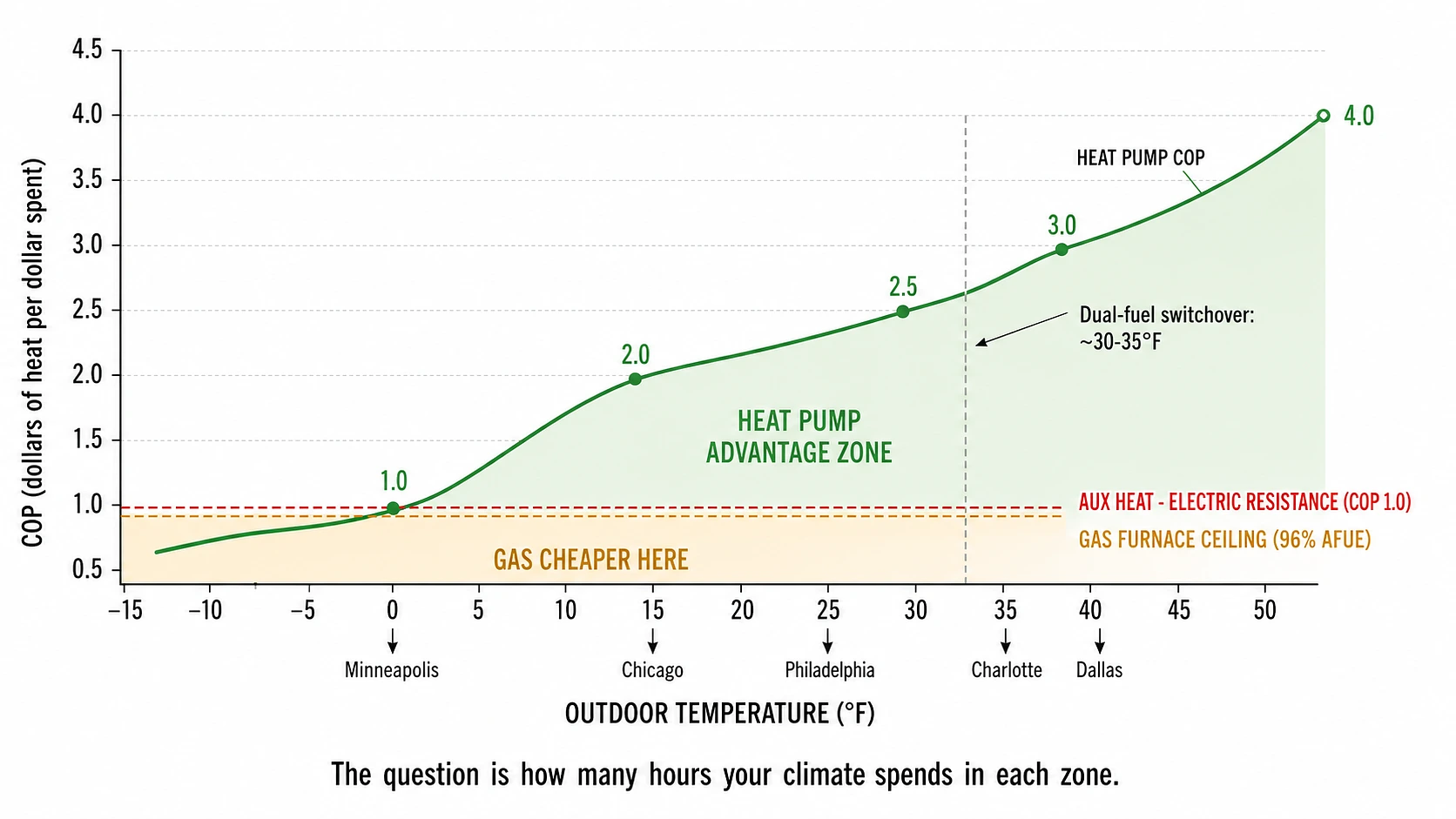
A modern heat pump can physically run down to about negative fifteen degrees Fahrenheit. Cold-climate models hold seventy to eighty percent of their rated heating capacity at five degrees outside. The old line about heat pumps not working in cold weather does not apply to current equipment the way it applied to the units from the nineties.
But there is a difference between “operates” and “operates efficiently.” A heat pump’s efficiency is measured by COP, coefficient of performance. At forty-seven degrees outside a good unit runs COP 3.5 to 4.0, meaning for every dollar of electricity you get three to four dollars worth of heat. Even the best gas furnace caps at 98 cents of heat per dollar of gas. So in mild weather the heat pump has a thermodynamic advantage that combustion cannot match.
COP drops as it gets colder outside. At thirty degrees maybe 2.5. At fifteen, closer to 2.0. Below a certain point some units kick on auxiliary electric resistance heat which is basically a giant toaster element inside the air handler, and that runs at COP 1.0. One dollar in, one dollar out, no efficiency advantage, and electricity usually costs more per unit of heat than gas does at that point.
So the question is really how many hours per year does your area spend below the point where the heat pump’s advantage disappears. In Charlotte or Atlanta or Dallas the answer is barely any, the heat pump wins almost every day of the heating season. In Minneapolis or Buffalo there are enough hours in degraded or aux-heat mode that gas may cost less across a full winter. This is why dual-fuel setups exist but more on that further down.
The Ratio, With Real Numbers
A therm of natural gas contains roughly 100,000 BTUs. A kilowatt-hour of electricity contains 3,412 BTUs. A 96% efficient gas furnace delivers about 96,000 usable BTUs per therm. A heat pump at COP 3.0 delivers about 10,236 usable BTUs per kWh.
To get the same 96,000 BTUs from the heat pump you need about 9.4 kWh. So the comparison is: cost of one therm versus cost of 9.4 kWh.
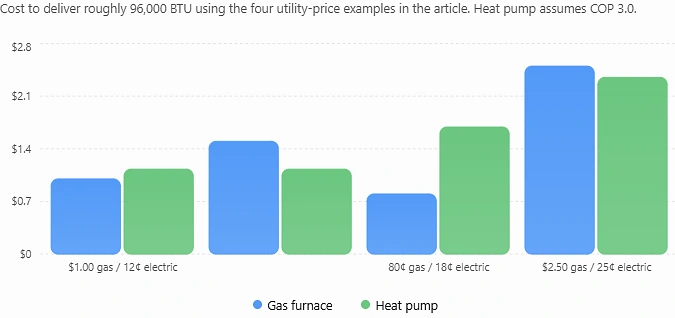
- You pay $1.00/therm for gas and $0.12/kWh for electricity. Heat pump costs $1.13 for the same heat the furnace does for $1.00. Gas wins, barely.
- You pay $1.50/therm and $0.12/kWh. Heat pump $1.13 versus gas $1.50. Heat pump wins.
- You pay $0.80/therm and $0.18/kWh. Heat pump costs $1.69 versus gas $0.80. Gas wins by a lot. This is Western New York, parts of the Midwest, areas where natural gas is cheap and electricity is not.
- You pay $2.50/therm and $0.25/kWh. This is roughly Bay Area California pricing. Heat pump costs $2.35 versus gas $2.50. Heat pump wins, though the margin is tighter than people expect given how much California pushes electrification.
If you have rooftop solar and your effective electricity cost is close to zero, the heat pump operating cost drops to almost nothing regardless of what gas costs. That is a different conversation entirely but it is worth mentioning because solar plus heat pump is the combination that fundamentally changes the math for a lot of homeowners who already have panels or are planning to add them.
How the Heat Feels Coming Out of the Vents
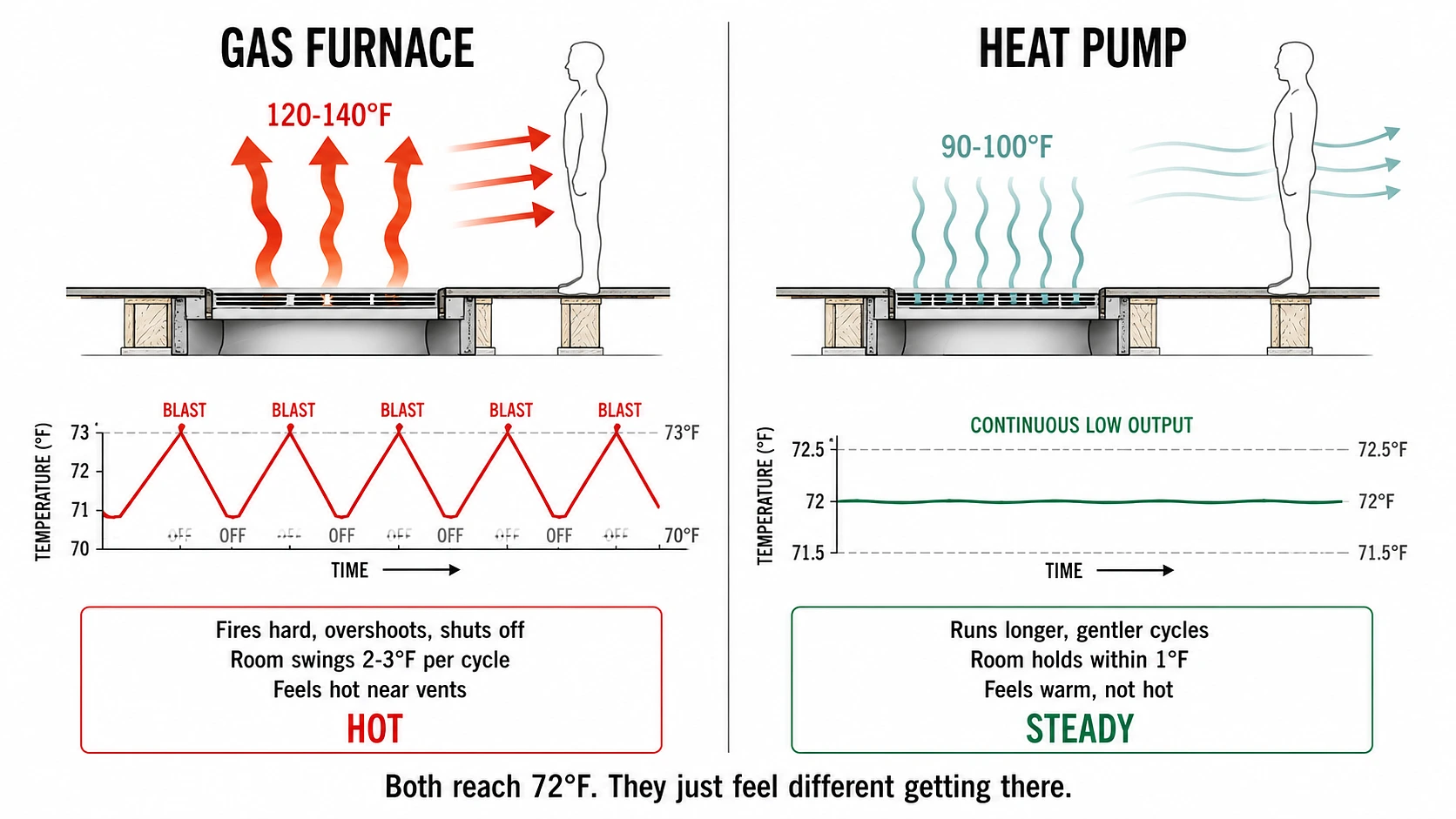
Gas furnace supply air runs 120 to 140 degrees Fahrenheit. You stand near a register and the room heats up fast. The system fires, pushes hot air, overshoots the thermostat setting by a degree or two, shuts off, the house cools a bit, fires again. You feel cycles.
Heat pump supply air runs 90 to 100 degrees. Still warmer than body temperature so it is heating the room, but it does not feel the same. People sometimes describe it as “cool air” which is not accurate, it is warm, just not hot. The heat pump runs longer gentler cycles and holds temperature steadier instead of blasting and stopping.
Some people prefer the consistency. Others genuinely miss the hot blast from the furnace and feel like the house never gets warm even though the thermostat reads the same number it always did. You can not know which camp you fall into until you have lived with it, which is a frustrating thing to say but it is true. Both systems get the house to seventy-two degrees. They just do it in ways that feel different on your skin.
Picking Equipment If You Have Decided on a Heat Pump
Goodman is a useful reference point for heat pump tiers because they make units at every level and they are one of the most widely installed residential brands in the US.
Their entry-level single-stage units sit at 14.3 SEER2 and 7.5 HSPF2, which is the federal minimum. Gets the job done in mild climates, loudest option, most cycling, cheapest to buy and most expensive to run per hour. Fine if you are in a region where the system is not working hard most of the year.
Their mid-range two-stage models with ComfortBridge technology run 15.2 to 17.2 SEER2 and 7.8 to 8.2 HSPF2. Two stages means the compressor runs at reduced output during mild weather and ramps up when needed, which gives you better humidity control and less of that on-off cycling. A goodman split system heat pump in this range carries a ten-year parts warranty when contractor-registered. This is the tier where operating savings over ten to fifteen years start to offset the higher purchase price, particularly if you are running the system five or six months a year.
Above that you get into variable-speed inverter-driven compressors at 18+ SEER2, which continuously adjust output instead of stepping between two fixed stages. Best temperature consistency, best dehumidification, quietest operation, lowest running cost. Also the highest price tag. Whether it makes financial sense depends on how many hours per year the system actually runs under load.
If you decided on a gas furnace instead, the main question is 80% AFUE versus 96%+ AFUE. The 80% unit uses a standard metal flue. The 96%+ is a condensing furnace that needs PVC venting, cheaper to vent but the unit costs more. In a cold climate where the furnace runs heavily for four or five months the fuel savings pay back the price difference in three to five years. In a mild climate where the furnace barely runs, the payback stretches past the furnace’s lifespan and the cheaper unit makes more sense.
Dual-Fuel Systems
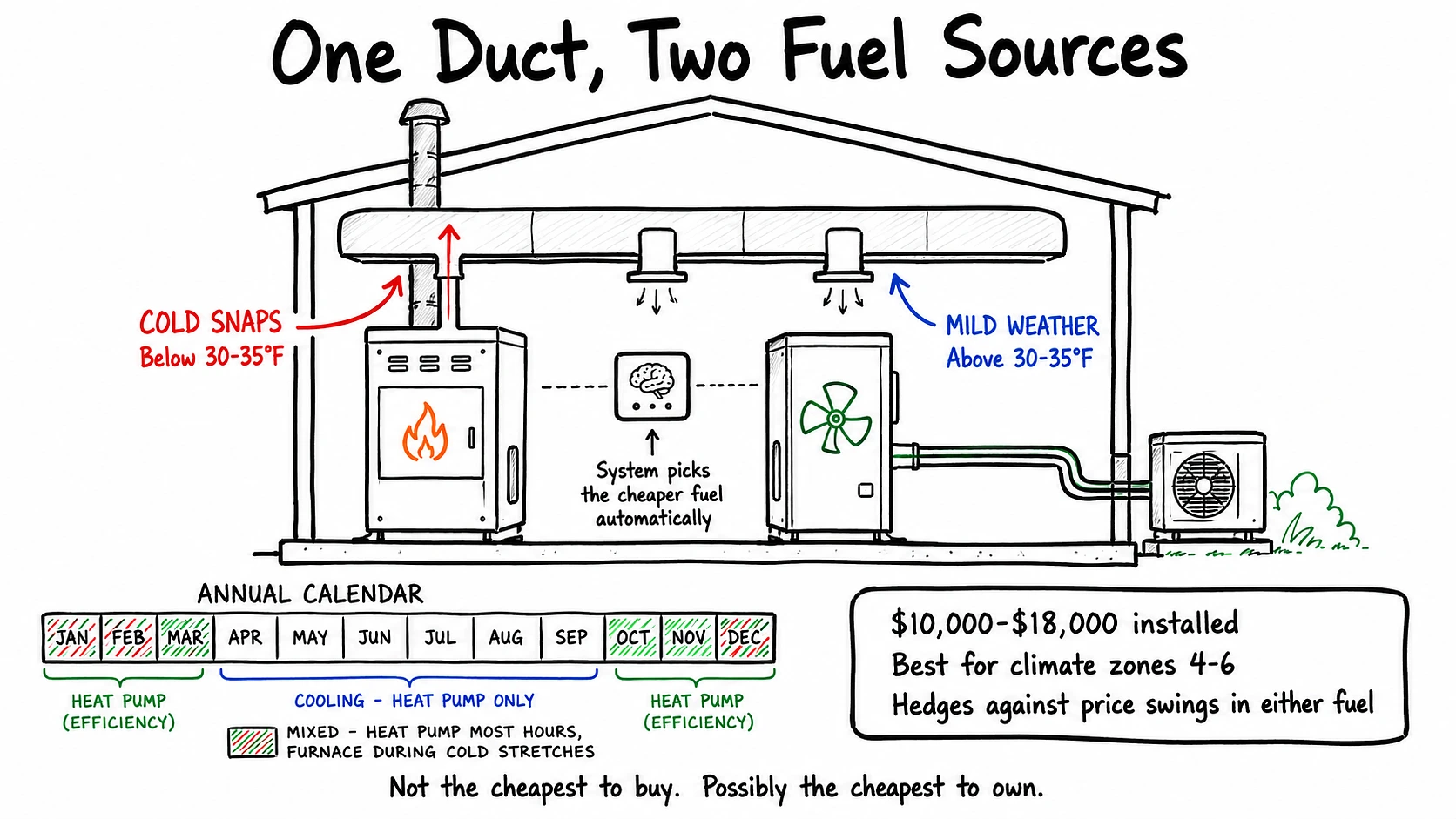
If you are in a climate that gets genuinely cold for stretches, not just a few chilly nights but weeks below twenty-five degrees, there is a third option worth pricing out.
A dual-fuel system puts an electric heat pump and a gas furnace in the same ductwork.
The heat pump handles heating whenever it is efficient to do so, which in most climates covers the majority of the heating season. When temperatures drop below a switchover point, usually around thirty to thirty-five degrees depending on local utility rates, the system automatically switches to the gas furnace.
You get the heat pump’s efficiency for most of the winter and the furnace’s raw output for the worst of it. The system picks whichever fuel source is cheaper at any given outdoor temperature.
Installed cost runs $10,000 to $18,000 depending on equipment tier and whether gas service already exists. That is more than either system alone. But in climate zones four through six, where winters run cold enough to push a heat pump into aux mode but not cold enough to justify burning gas all season, operating savings over a decade or so can close that gap.
The other thing it gives you is flexibility. Gas prices jump, and the heat pump carries more load. Electricity spikes during peak hours, the furnace takes over. You are not betting your heating costs for the next fifteen years on a single fuel source staying affordable, and given how unpredictable utility markets have been lately that is worth something even if it is hard to put a dollar figure on it.

 Decor & Improvement Accessories