

Home & Decor Blogs: DIY, Interior Design & Lifestyle Ideas
What It Actually Costs to Automate Your Driveway Gate and Which Opener Type Fits Your Setup
You have got a gate at the end of your driveway or you are thinking about putting one in and the part you are trying to figure out is whether you can motorise it so you stop getting out of the car in the rain to shove the thing open by hand. You can, and it probably costs less than you think. A single swing electric opener runs about three hundred to four hundred and fifty dollars for the unit. Dual swing is more like five to eight hundred. Solar adds roughly 20% on top because the panel and battery come included. The gate itself, if you do not already have one, is where the real cost lives, anywhere from $1,500 to $6,000 for a standard residential build or $8,000 to $15,000 if you go custom.
Those numbers are easy enough. The part that is not easy is picking the right type of opener for the gate and driveway you actually have, because you usually do not find out you picked wrong until the thing is installed and the motor is straining or the gate will not close all the way.
Swing Gate Openers: Most Homes Already Have This Type
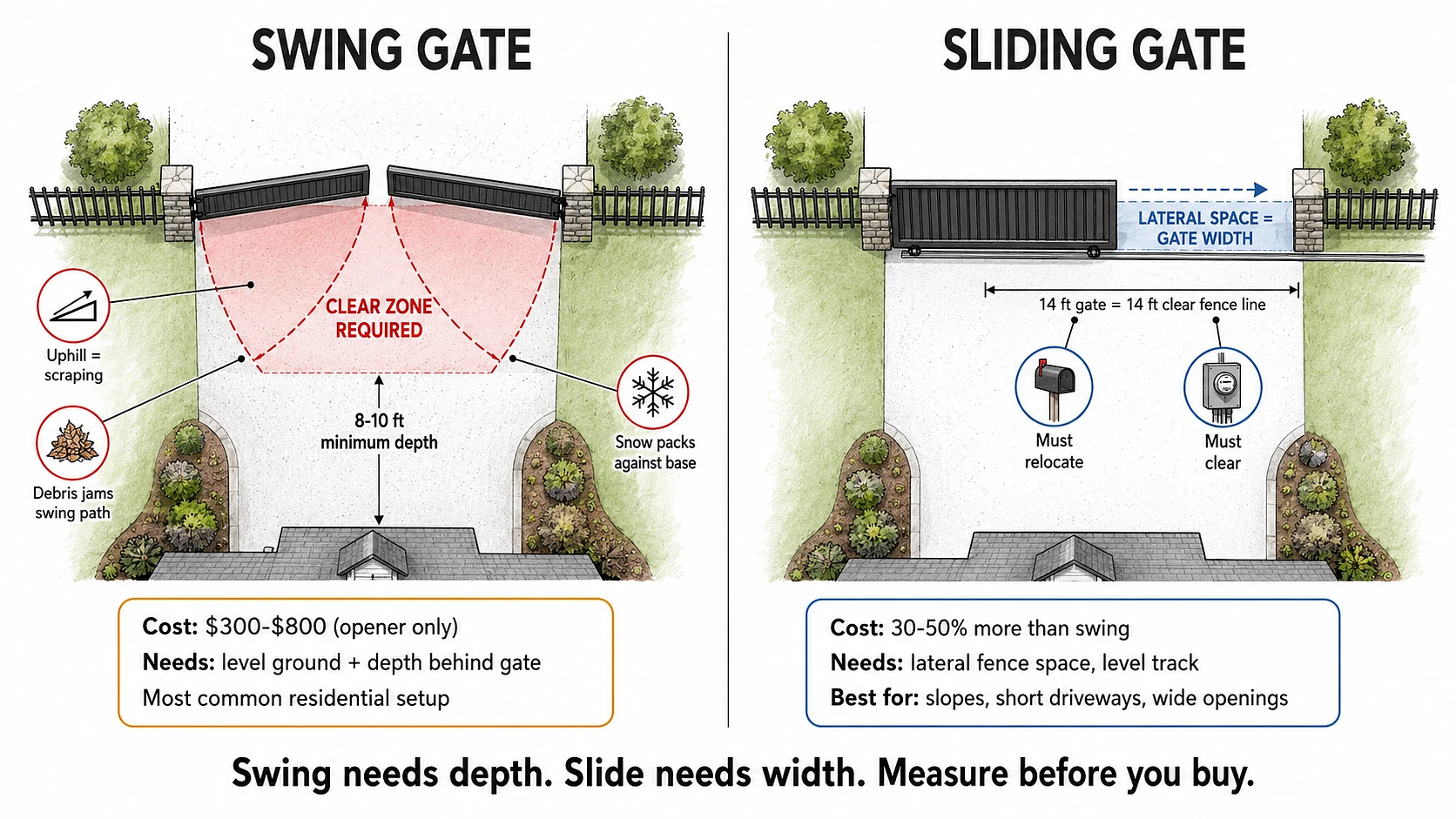
Most residential driveway gates swing open on hinges, same as a door. If yours has two panels that meet in the middle, that is a dual swing gate and it is by far the most common residential setup.
- Single swing opener: one motor arm, one gate leaf. Handles gates up to 900 lbs and 20 ft, or 1,100 lbs on heavy duty models. You see these on side gates and narrower single panel driveways.
- Dual swing opener: two arms, one per panel, both running in sync. Most driveway gates fall in the 12 to 16 ft range and split into two leaves, so this is usually what you are shopping for.
The thing nobody tells you until installation day is that swing gates eat space. The panels need room to actually swing through their full arc, and that means the driveway behind the gate or in front of it has to be level and completely clear. A driveway that slopes upward even slightly right behind the gate means the bottom edge scrapes every time. Snow packs against the base in winter and jams it. Leaves pile up and do the same thing in autumn. Even gravel can shift and build up enough to block the swing path over a few months if you are not keeping it clear.
That is a gate type problem, not a motor problem. If your driveway is steep or short, no amount of spending on a better opener changes the physics.
When Sliding Makes More Sense
Sliding gates move sideways along a track. They do not swing, so they do not need depth in front of or behind them. What they need instead is lateral space along the fence line equal to the width of the gate. Fourteen foot gate means fourteen feet of clear fence to one side. No mailbox, no meter box, no garden bed, no uneven ground in that run or the gate catches or the track warps.
People tend to discover that requirement after they have already bought the gate and the opener and the contractor is standing there pointing at their mailbox saying it has to move.
Sliding setups cost more, roughly 30 to 50% above an equivalent swing installation because of the track, the heavier motor, and extra hardware. But there are driveways where swing simply will not work:
Steep slopes where a swing gate would scrape the ground. Short driveways with only 8 to 10 ft between the gate and the garage or street where there is just no room for panels to open. Very wide openings past 16 ft where a single swing leaf would be so heavy it puts extreme stress on the motor and the hinge post every single cycle.
In those situations, sliding is not the premium option, it is the only option.
Electric or Solar: The Decision Is Really About Distance
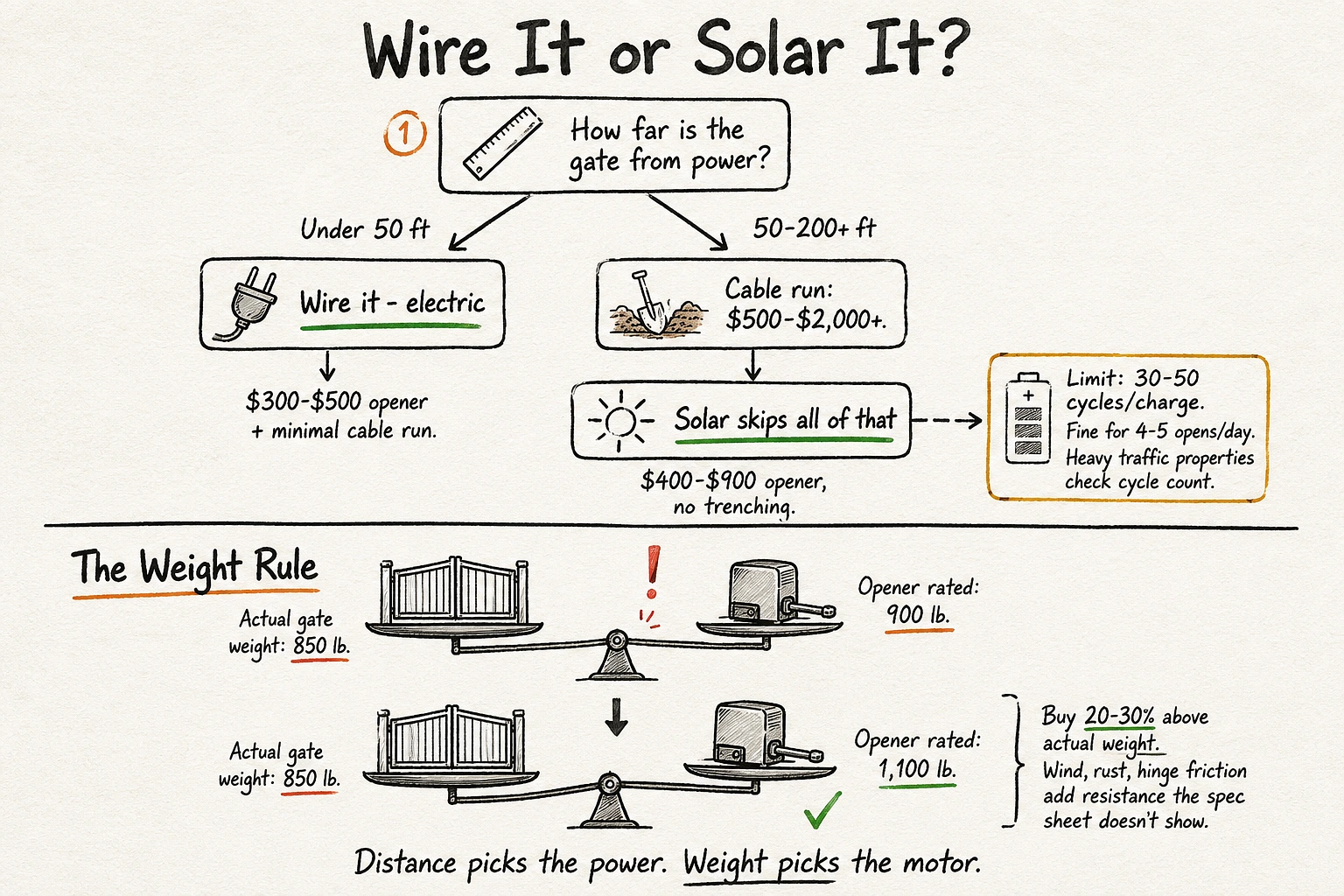
Electric openers wire into your home’s power. Cheaper at the outset, roughly $300 to $500 for a quality single swing unit, and they run reliably every time the power is on. Outage means you are using the manual release key which is fine but not convenient. Add a battery backup for about a hundred dollars if outages are a regular thing in your area.
Solar charges a battery through a panel mounted near the gate. Costs about 20% more per unit so a solar single swing runs $400 to $550 and dual swing solar systems sit around $600 to $900.
Here is where the real math happens though. If your gate sits 50 or 100 ft from the nearest outlet, running electrical cable underground to the gate means trenching, conduit, and possibly an electrician, and that alone can run $500 to over $2,000 depending on the distance and what is in the ground between here and there. Solar skips all of that. So even though the opener itself costs more, you come out ahead if the alternative is a thousand dollar cable run.
Solar has a limit though and it is cycles. Most solar openers hold enough charge for 30 to 50 open and close cycles per full charge. A residential driveway that opens four or five times a day will never come close to that ceiling. But a property with frequent deliveries, multiple family members coming and going, guests, tradespeople, you can run through that count and end up with a dead gate by evening especially during overcast stretches when the panel is not charging at full rate.
If the gate is close to power, wire it. If it is far out or you are on acreage, solar makes more sense.
Smart Features: What the App Actually Does
A basic opener comes with a remote and that is the whole setup. Modern ones connect to your phone and the features that actually matter are not the flashy ones, they are the practical ones.
You are at work and the plumber calls saying the gate is locked. You open it from your phone. Your kid gets home from school, you get a notification that the gate opened and closed. A guest is arriving and you are still fifteen minutes away, you let them in remotely. These are the use cases that make app control worth having, not the novelty of pressing a button on a screen instead of a remote.
Geofencing is probably the feature people underestimate the most. It draws a boundary around your property and when your phone crosses it on the way home, the gate opens automatically. When you leave, it closes. No button at all. After a week of using it you forget the gate is even there, it just opens when you arrive and closes when you leave.
Access sharing lets you give gate access to a housekeeper or a contractor or whoever through the app without handing over a physical remote. You grant it, they use it, you revoke it when the job is done.
The security layer underneath all of this is the signal encryption. Older gate openers, and most budget ones still on the market, use 64 bit fixed codes. Those can be cloned with hardware you can buy online for thirty dollars. Newer systems from brands like ZUMI use 128 bit rolling codes that change with every single activation, which makes the signal effectively impossible to copy. If your gate is on a property with expensive equipment sitting in the driveway or you are in a rural area where nobody is around during the day, that encryption spec is not a marketing checkbox, it is the difference between a gate that actually secures the property and one that just looks like it does.
The Weight Spec That Everyone Ignores
Every opener lists a maximum gate weight and a maximum width. Exceed either and you are looking at motor burnout, bent arms, or a gate that stalls halfway open.
Most residential steel gates at 14 ft wide and 6 ft tall weigh somewhere between 400 and 700 lbs depending on gauge and design style. Aluminium is lighter. Wrought iron is heavier. Ornamental gates with scrollwork and thick frames sit at the top of that range and sometimes over it.
If you buy an opener rated for 900 lbs and your gate weighs 850, the motor is pushing at near max on every cycle. It will burn out significantly faster than a 1,100 lb rated unit handling that same gate at about 75% capacity. Buy for at least 20 to 30% above actual gate weight. Not because the gate gains weight over time, but because wind pushing against the panels, hinge friction increasing as things age, and rust or weathering all add resistance the motor has to fight through on top of just moving the mass.
Maintenance Is Simpler Than People Assume
Gate openers sit outside year round dealing with rain and dust and temperature swings but the maintenance list is actually short and most of it you can do yourself.
Hinges affect the motor more than most people realise. Stiff or rusty hinges force the motor to work harder on every cycle which wears it out faster. Silicone spray every few months keeps them smooth. If you hear grinding or the gate hesitates mid swing, check the hinges before you assume the motor is dying.
Infrared sensors are the most common cause of a gate that randomly reverses or refuses to close. Spiders love building webs across the sensor beam especially in rural areas and all it takes is a quick wipe with a dry cloth once a month. Nine times out of ten when someone calls a technician because the gate “stopped working,” it is a dirty sensor not a motor failure.
Solar batteries lose capacity over time. About 70 to 80% after three years, roughly 50 to 60% after five. If the gate starts closing slowly or stalling mid cycle, replace the battery before assuming anything else. And check whether the battery is replaceable before you buy the opener in the first place because a lot of budget solar units seal the battery inside permanently, which means the entire opener becomes waste when the battery dies.
Motor gears on cheap openers are plastic and they strip within a couple of years under regular use. Nylon gears last much longer. This is a spec you check before buying, it is buried in the product details but it is the single biggest predictor of how long the opener will last.
Weather rating should be IP55 or better on the motor housing. That means dust and water protection rated for year round outdoor exposure. Anything below IP44 is cutting corners and you will see moisture damage inside the housing within a year or two in any climate that actually gets rain.

 Decor & Improvement Accessories