
Home & Decor Blogs: DIY, Interior Design & Lifestyle Ideas
What Raleigh Homeowners Should Know Before Hiring a Roofing Contractor

Somewhere in Wake County last fall, there was a house that existed for one reason. To catch roofers.
It looked like any other home on the street. It wasn’t. The North Carolina Department of Insurance and Farm Bureau had wired it for surveillance and brought in engineering experts who checked the roof before anyone climbed up, and again after. Then they put the word out and invited roofing companies to come take a look.
One of them stood out. Investigators say a project manager named Robert Bentley, a Charlotte man with Raleigh ties, got up on that roof and went to work. Bending shingles. Hammering at spots to fake hail dents. Trying to turn a clean roof into a storm-wrecked one. The payoff was supposed to be a $30,000 insurance claim for wind and hail damage that never happened. He was arrested in December. A second arrest is still pending.
Then in June, WRAL aired the video. And you can hear it.
They pull the shingles up hard enough that the adhesive lets go with an audible crack, the sound of glue peeling off the roof, and then they chalk-mark the spot like they just found it.
A state investigator said on camera that footage like that is very rare. Most of the time nobody’s filming. The homeowner never finds out the damage on their own roof got put there by the guy they waved up the ladder.
So that’s the backdrop for hiring a roofer in Raleigh right now. Not everyone who knocks is a criminal, plenty aren’t. But enough are that the state built a fake house to catch them, and they’ve promised more for 2026.
How the door-knock actually works
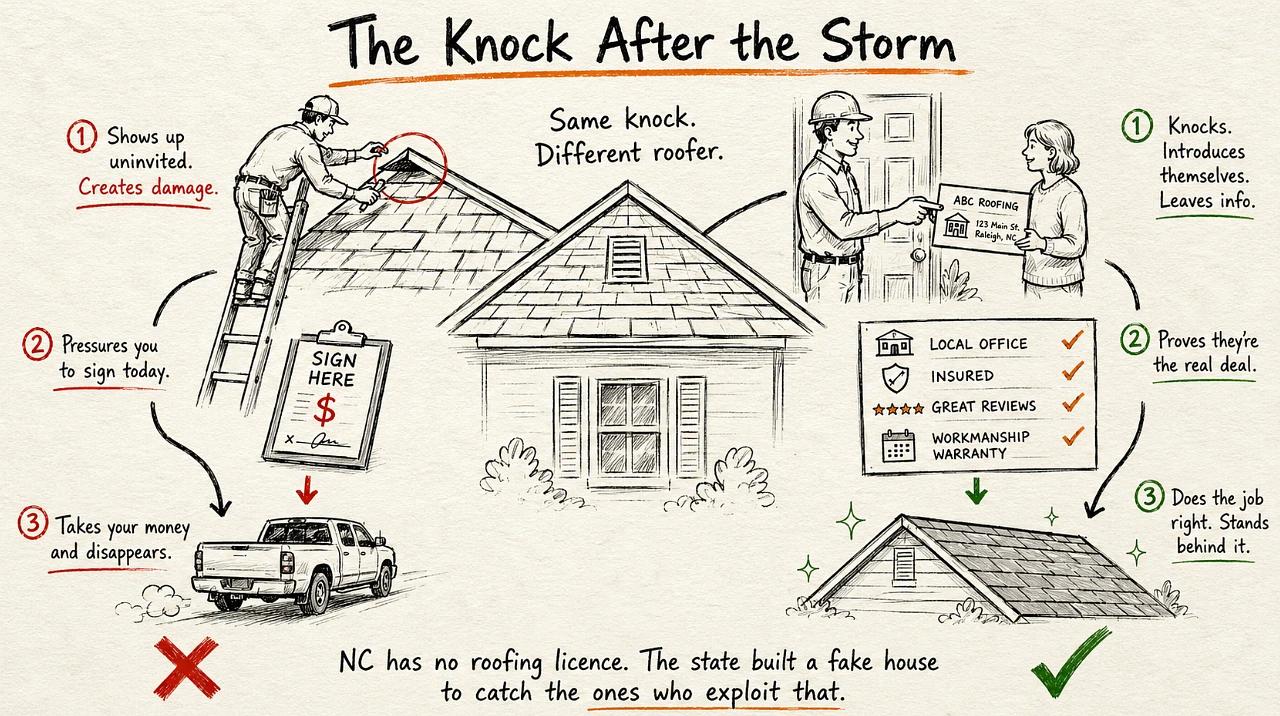
The pitch runs on a script and once you’ve seen it you can’t unsee it. A crew works a neighborhood a day or two after a storm rolls through the Triangle. Knock, friendly, “we’re already working in your area.” They offer a free inspection. Sometimes the truck has out-of-state plates. Sometimes the business card lists a P.O. box, or no address at all.
They go up. They come back down with photos. And this is where it forks. Sometimes the damage is real, storms do lift shingles, that part is true. Sometimes the damage is what they just put there, the way the bait house caught. Either way the next line is always the same, they’ll handle everything with your insurance, you just sign here.
The signing is the trap, not the inspection. A lot of these contracts are exclusive, which means the second you sign you can’t bring in another roofer who’d do it for less, you’re locked to them. Then there’s the deductible they tend to skip over. The “free roof” isn’t free, your policy still makes you pay your share. North Carolina does give you a three-day window to cancel a signed contract in some cases. Cancel after those three days though and a drive-by outfit can hit you with fees big enough that most people just don’t bother.
Why North Carolina makes this easy
North Carolina has no roofing license.
None.
That one fact explains most of the mess. There’s a dedicated state board for nursing, for dentistry, for plumbing, for heating, but not for roofers. So a person can wake up tomorrow, decide to be a roofer, and start knocking on doors without a single roofing certificate or anybody overseeing the work.
The only license that touches roofing is the general contractor license, and that one only kicks in once a job’s value clears $40,000. A lot of roof replacements come in under that. Which means for a big chunk of residential roofing around Raleigh, there is no required license, no certificate, no roofing-specific board to report anyone to. A DOI investigator put it about as bluntly as you can, there’s no oversight on these roofers, people can just go out and be one. That gap is the engine the whole door-knocker economy runs on.
Then Florida sent its roofers north
The missing license isn’t the only reason they came. After Florida tightened its insurance rules, some Florida roofing companies appear to have packed up and headed north looking for the next soft market, and a state with no roofing board and plenty of storms looked soft.
The state’s answer has been to triple its fraud investigators and bring in special prosecutors, with more bait houses promised through 2026. So enforcement is ramping up. The catch is that enforcement happens after you’ve already signed.
What a real local roofer looks like next to a chaser
So you’re standing at your door and a stranger’s offering to fix your roof with your insurance company’s money.
How do you tell which kind you’re dealing with?
It mostly comes down to one thing, whether they’re rooted here or just passing through.
A real one has an address you could drive to. Not a P.O. box, not “we’re based somewhere else but we cover your area,” an actual office or showroom in the Triangle. They’ve got years of reviews from people in your zip code, not a page that went up last week or nothing at all.
They’ll give you a license number where one applies and show proof of liability and workers’ comp without getting cagey about it, and that workers’ comp is the thing that keeps you off the hook if a crew member falls off your roof. An established Raleigh roofing contractor like Baker Home Exteriors has the one thing a chaser structurally cannot fake, a local reputation that’s still standing in six months and a workmanship warranty that actually means something, because the company will still be here to honor it.
That last bit matters more than people think.
A manufacturer warranty covers the shingles themselves. A workmanship warranty covers the install, and the install is exactly where the cheap jobs fail, reused flashing, no ice and water shield laid down, new shingles nailed straight over rotted decking, no permit ever pulled. The storm chaser will promise you a workmanship warranty too, of course. It’s just worthless the moment the truck crosses the state line. You can’t enforce a warranty against a company with no address.
If someone knocks after the next storm
The Triangle is going to keep getting storms, that part isn’t in doubt. So when the next one passes and there’s a stranger on your porch inside forty-eight hours, the move is simple.
- Call your own insurance company first and let their adjuster look before you let any contractor up there. The adjuster works for the claim, not for a commission.
- Don’t pay upfront. A small deposit can be normal, but most of the money comes after the work is done right. Full payment or a large deposit before anyone starts is the red flag.
- Get the address. Make them give you a real local one, then actually look it up.
- Don’t sign at the door. Same-day pressure is the whole tell. A genuine local roofer is fine waiting while you get two more quotes.
None of that takes any roofing knowledge. It just takes not signing the first thing shoved at you while you’re rattled about your roof.
The bait house in Wake County worked because the fraud is real, local, and ongoing, not because it’s some rare thing.
More of those houses are coming this year. The roofer who’s actually from here, the one you could find again next spring, isn’t bothered by any of it, not the adjuster, not the second quote, not the three days to think it over. The one in a hurry for your signature is the one the state had to build a fake house to catch.
 Decor & Improvement Accessories