

Home & Decor Blogs: DIY, Interior Design & Lifestyle Ideas
For Home Renovators Growing on Instagram: Why You Still Need a Website to Land Real Jobs

Say you film your own renovations. You post the demo, the middle, the reveal, and one of them takes off, and now the DMs are coming in, “do you take clients?”, “how much for something like this?”. That’s the moment a lot of people who’ve built a home-improvement or DIY page start to think the page is the whole business now. It got the attention, it’s getting the inquiries, so why bother with a website at all.
Somebody watching your reel at 9:40 at night, saving it, sending it to their partner, that person is interested. They’re not ready to book. And the gap between those two things is exactly where a website does its work, and where an Instagram page, however good, quietly runs out of road.
Do you even need a website if the page is already pulling in inquiries?
Short answer, yes, and it’s less about the inquiry and more about what happens after it.
Think about what’s actually going through someone’s head once they’ve watched your work and started imagining it in their own house. Can this person handle a job my size? Do they even work in my area? What’s it going to be like dealing with them for the eight weeks my kitchen’s torn apart? Are these reviews real or are they three mates? What happens after I fill in the form, do I hear back tomorrow or never?
Instagram can’t answer most of that in any organised way. The feed is built to show the next thing, not to hold the boring, reassuring detail somebody needs before they hand over a renovation budget. A profile buries your best case study under forty newer posts. There’s nowhere clean to put your service area, your pricing ballpark, your process, the fact that you don’t do jobs under a certain size. So the person who loved your content leaves the app anyway, googles your name, and goes looking for the proof somewhere else. The question is whether that somewhere is your website or a competitor’s.
Is this even worth it, or is renovation demand drying up?
It’s worth it, and the numbers back that up rather than just vibes.
The 2026 U.S. Houzz Renovation Plans Report surveyed just over a thousand homeowners, and 91% said they intend to go ahead with their renovation plans this year, with 67% keeping or actually expanding the scope of what they’d planned. More to the point for anyone offering a service, 93% said they plan to hire a professional to do the work, and that figure climbs for the bigger projects, the fifty-grand-and-up ones. So the people are there and they’re spending. They’re just careful about who they hand it to, which is the whole reason the trust side matters as much as the reach side.
Nobody weighing months of disruption and a five-figure bill books off a single reel. The closer they get to actually spending, the more proof they go looking for.
So should you drop Instagram and pour everything into a site? No.
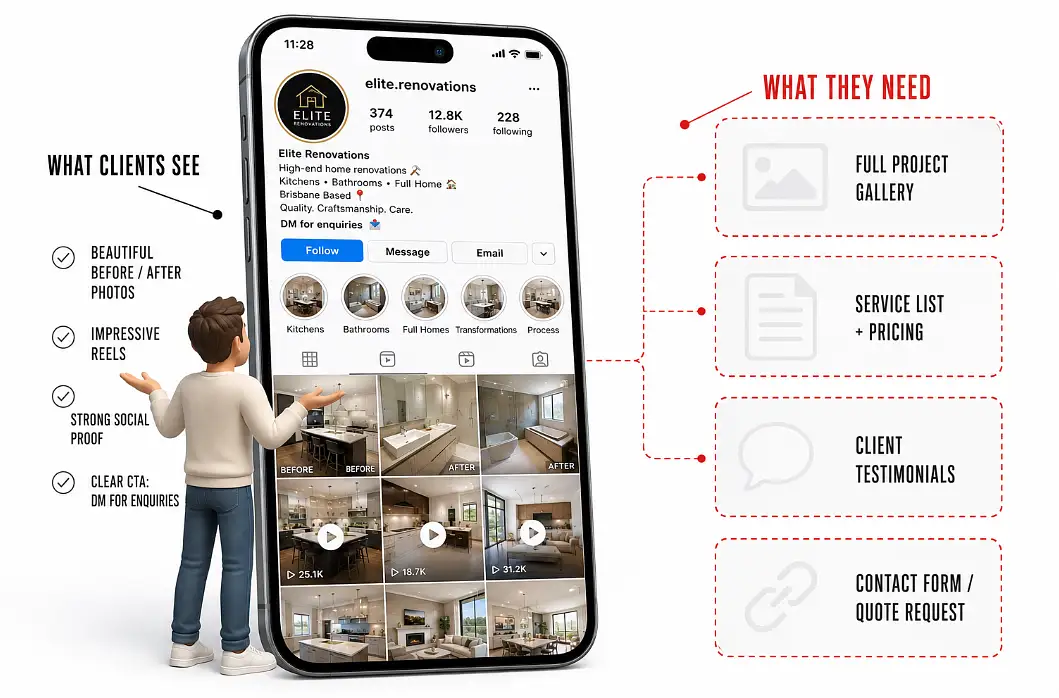
This is where people overcorrect, and it’d be a mistake. Instagram, and TikTok right alongside it, is genuinely the best tool you’ve got for the first half of this, and you shouldn’t walk away from it because someone told you websites matter.
Home improvement is almost unfairly good content for these platforms. The demolition gives a job a beginning, the finished room gives the payoff, and a thirty-second clip can show craft and personality and progress in a way a static ad never manages. That reach is real, and it’s cheap compared to everything else.
Look at how many established, genuinely well-known home brands still put serious effort into their reels and their TikTok even though they could coast, they keep showing up there because that’s where the desire gets created. You want that same top of the funnel working for you.
The point isn’t Instagram versus a website. It’s that they do two different jobs, and the mistake is asking one of them to do the other’s work. The feed creates the want. The website earns the trust. Drop either and the chain breaks.
What the homeowner is actually doing between the two
Contractors tend to measure their Instagram and their website as separate things, two dashboards, two numbers. The homeowner doesn’t experience it as two things at all. To them it’s one journey, and it goes roughly like this.
They see the reel or the paid post, that’s discovery. They tap the profile, save it, send it to whoever they share money decisions with, that’s interest. Then they open your website and start checking, do you cover my area, are these projects like mine, are the testimonials believable, that’s verification. Then they’re hunting for the practical stuff, rough budget, timing, what the first step is, that’s qualification. And only then do they fill in the form or book the call.
Which is why raw inquiry count off Instagram can flatter you and lie to you at the same time. Two businesses can pull the same number of DMs, but if one sends everyone to a bare “contact us” page and the other asks what kind of project, what postcode, rough budget, when they want to start, the second one might log fewer submissions and be running a far healthier business, because those fewer inquiries are ones they can actually act on. Fewer, better leads beats a pile of “just curious” every time.
When is it actually time to build a real site, and how far do you go?
Here’s the honest bit, because not everyone reading this needs to run off and commission something.
If you’ve just started, if it’s you, a phone, and a growing page, you do not need to sink money and weeks into a custom website yet. A tidy link-in-bio, a Google Business Profile filled in properly, real reviews on it, and a fast reply to every message will carry you a surprisingly long way, and it’ll carry you further than a half-finished site you built at midnight and never touched again. Don’t burn energy you don’t have on the wrong thing this early.
The moment it changes is when the page has outgrown what a profile can hold, when you’re turning down the wrong-sized jobs, fielding the same five questions in the DMs every week, and losing track of who asked what. That’s when it’s worth getting a proper site built rather than cobbling one together, and honestly worth paying a web design company to do it if web design isn’t your thing, because the brief for that site should start with qualification, not prettiness. The photos still matter, but the site’s real job is to route the project types, gather the useful detail up front, and make the follow-up easier for you, so you’re not doing all the sorting on a first phone call.
And whatever you build, make the exclusions clear. If you only take six-figure design-and-build jobs, don’t hide that behind a vague “get a free quote” button that wastes both your time and theirs.
Get the inquiry form right, then leave it alone
A form that asks for too much kills the momentum you spent all that content building. A form that asks for a name and email and nothing else just shoves all the work onto your first call. The right amount sits in between, and it depends on the job.
A small repair might need a postcode, a couple of photos, and a preferred time, and that’s plenty. A kitchen job reasonably wants the property type, a rough budget, a target date, and whether any design’s been done yet. A full custom build can ask more before you’ll give up a consultation slot. Set expectations while you’re at it, tell them when they’ll hear back and what the first step is, and if that first step is a paid design consultation rather than a free quote, say so before they submit, not after.
None of which matters if the reply is slow. A beautiful site and a considered form can’t rescue an inquiry that sat unanswered for four days while the homeowner booked someone else. Speed of the first response is doing more quiet work than almost anything else on this list.
The channel that inspires isn’t the one that closes
People building these home brands sometimes expect Instagram to finish a decision it was never built to finish. The feed is brilliant at showing what’s possible, at giving you a face and a style and a steady drip of proof that real work is happening. It gets people to the edge.
The website handles the questions that cost money to get wrong. It organises the proof, explains who you’re right and wrong for, takes the brief, and gives someone something solid to come back to at 9:40pm when they’ve decided they’re ready. With that many homeowners planning to spend this year and nearly all of them planning to hire, the work is out there. Whether it comes to you is mostly decided in the quiet stretch after the save, the share, or the profile tap, and that stretch is the part the page alone can’t hold.

 Decor & Improvement Accessories