

Home & Decor Blogs: DIY, Interior Design & Lifestyle Ideas
How to Navigate ADU Permits in LA: A Step-by-Step Guide for Homeowners
The homeowner had picked out finishes before the permit was even submitted. Kitchen tile from a specialty importer. A specific window brand for the western elevation. A plan set drawn up by a family friend who was an architect but had never filed anything with LADBS. Six months later, the project was still in plan check on its third round of corrections, and the finish materials were sitting in a storage unit collecting monthly fees while the design was being restructured to meet the solar mandate that everyone had missed.
This is the version of the ADU process that almost nobody warns homeowners about. Not the version where you decide on a backyard cottage and eight weeks later you’re pouring foundation. The version where the permit process itself becomes the project, and the actual construction is the easy part by comparison.
The reason it goes this way isn’t complexity. It’s that homeowners approach the permit process backwards. They start with the design and try to force it through LADBS. What works is starting with LADBS’s constraints and designing within them from day one. This article walks through the actual sequence, the actual costs, and the actual timeline in 2026, from the first zoning check through certificate of occupancy.
What the Whole Process Actually Costs and How Long It Takes
Before anything else, here are the numbers a homeowner needs to plan around. These are current 2026 LADBS figures, not estimates from older articles or ballpark ranges.
Total permit and plan check fees for an ADU in Los Angeles: $5,000 to $14,000. The exact number depends on construction valuation, square footage, and whether school fees apply.
ADUs at or under 750 square feet are exempt from impact fees and school fees. This is the single most valuable design threshold in LA. Cross above 750 square feet and the fee structure changes dramatically.
LAUSD school fees on additions 500 square feet or larger: $4.79 per square foot residential. On a 1,000 square foot ADU that’s an extra $4,790 you don’t pay if you design at 749 square feet.
Standard plan check timeline: 4 to 10 weeks first review. Each round of corrections adds 2 to 4 weeks.
Real-world total timeline from plan submission to permit issued: 4 to 6 months. State law says 60 days for a complete application. Reality is that corrections stop the 60-day clock, and almost every custom design generates 2 to 3 correction rounds.
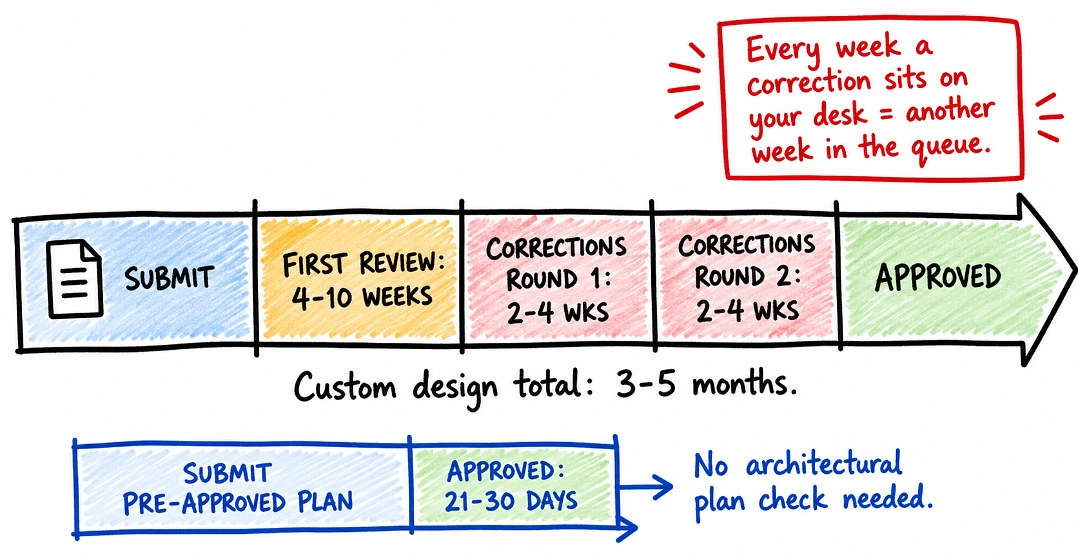
Pre-approved standard plans: approved in 21 to 30 days. This is where most homeowners save the most time and money if the plan fits their lot.
The rest of this article explains where each of these numbers actually shows up in the process and what triggers the worst cost overruns.
Zoning and Site Verification
Before designing anything, verify that the property qualifies. This costs nothing and takes an afternoon. Skipping it costs months.
Check the zone on ZIMAS. Los Angeles publishes zoning at zimas.lacity.org. Enter the address and confirm residential zoning. If the lot sits in a Coastal Zone, Hillside Area, Historic Preservation Overlay Zone (HPOZ), or Very High Fire Hazard Severity Zone, additional review is required and the fee structure changes.
State setback requirements:
- Four foot side and rear setbacks for detached ADUs
- Front setback matches the primary home’s zoning
- No setback required from an existing structure being converted
Size limits under current state law:
- Detached new construction ADU: up to 1,200 square feet
- Attached ADU: up to 50 percent of the primary home’s floor area
- Junior ADU (JADU): up to 500 square feet, must be within the primary home
- Standard height limit: 16 feet, with some exceptions allowing 18 to 25 feet
Overlay zones that add cost and time:
- Coastal Development Permit filing fee: approximately $13,753 on top of standard permits
- Hillside or Geo-Hazard Area: adds $5,000 to $15,000 in soils and geological reports
- Very High Fire Hazard Severity Zone: requires non-combustible exterior materials and interior sprinklers
If any of these apply, factor the additional cost and 2 to 4 months of extra timeline before designing anything.
The Solar Mandate Decision That Changes Everything
This is the decision point that determines whether the project will be simple or expensive, and most homeowners don’t know it exists until it’s already too late.
New construction detached ADUs require solar panels under California Title 24. The system must be sized to offset the ADU’s annual electricity consumption. For a typical 400 to 1,200 square foot ADU, that’s a 1.5 to 4.0 kW system requiring 100 to 300 square feet of roof area.
Solar system cost: $4,000 to $19,000 before the federal tax credit. After the 30 percent tax credit, $2,800 to $13,300.
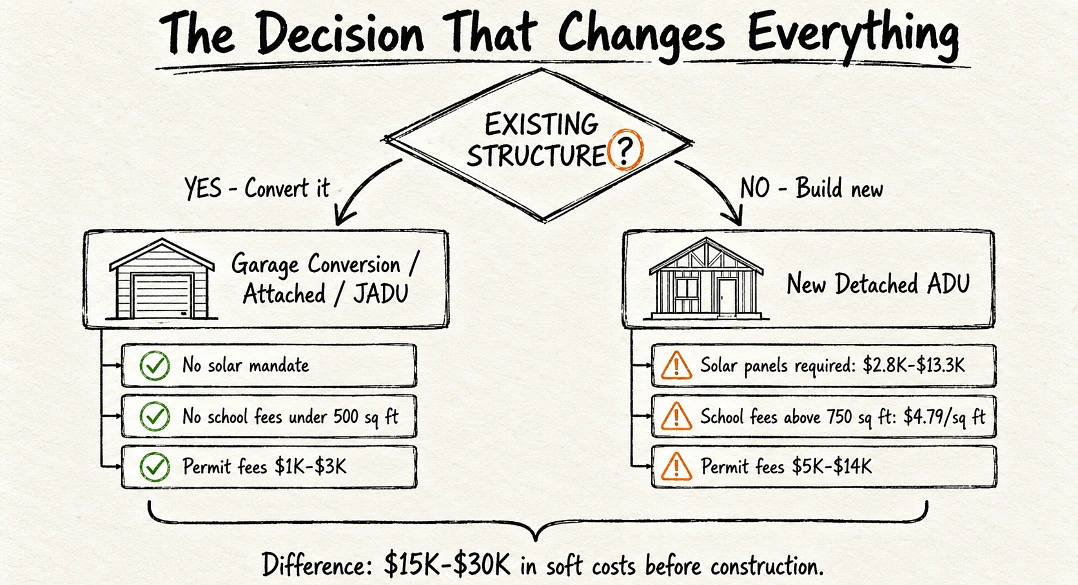
But here’s what changes the entire economics: garage conversions, attached ADUs, and JADUs are exempt from the solar mandate. Title 24 treats these as alterations rather than new construction. The California Department of Housing and Community Development has confirmed this position.
The practical implication for homeowners with an existing garage:
Converting an existing 400 to 500 square foot garage into an ADU skips the solar requirement entirely. It also skips school fees if the unit stays under 500 square feet. And LADBS fees for a garage conversion typically run $1,000 to $3,000 compared to $5,000 to $14,000 for new detached construction.
That’s a difference of roughly $15,000 to $30,000 in soft costs alone, before any construction. On a project where the finished ADU will look nearly identical either way, that’s a significant decision.
The trap: If the garage gets demolished and rebuilt from scratch, even in the same footprint, LADBS treats it as new construction and the solar mandate applies. Preserving the existing foundation and framing is what maintains the exemption. This is where working with someone who has actually filed these applications matters, because the classification decision happens at permit intake and it’s not always obvious.
Design and Plan Preparation
Once the zoning is confirmed and the ADU type is chosen, design and plan preparation begins. This phase costs the most and takes the longest for custom designs.
Custom design fees: $4,000 to $12,000 for a full plan set with structural calculations and Title 24 energy compliance documentation.
Pre-approved standard plans: often free from LADBS. The city offers more than 80 pre-approved designs from roughly 30 firms, plus one city-owned plan (YOU-ADU, a 455 square foot one-bedroom). These plans have already been reviewed for Building, Residential, and Green Code compliance, which means they skip architectural plan check entirely and get approved in 21 to 30 days.
The tradeoff is layout flexibility. If a pre-approved plan fits the lot and matches the homeowner’s needs, using one saves 4 to 8 weeks of time and $4,000 to $8,000 in design fees.
Required documents for a complete plan set:
- Architectural plans showing existing house footprint, ADU footprint, and property lines
- Structural engineering notes with foundation depths and framing specifications
- Title 24 energy compliance documentation (CF1R, CF2R, CF3R under the 2025 code cycle)
- Site plan showing utility connections, setback compliance, and drainage
- Solar photovoltaic plan if solar is required
The single most common reason for plan check rejection: missing or incomplete Title 24 documentation. The 2025 code cycle took effect January 1, 2026, and any permit submitted after that date must comply with the new standards. Heat pump water heaters are now the prescriptive baseline for new detached ADUs. Updated compliance forms are required. Working with a designer or contractor who has filed ADU plans under the new code matters more than it has in the past.
For homeowners going the design-build route, hiring an experienced luxury home remodeling company that handles the plan preparation, engineering coordination, and LADBS submission end-to-end typically reduces the correction rounds and shortens the permit timeline compared to piecing it together yourself.
Submission and Plan Check
Plans get submitted through LADBS’s online ePlanLA system or in person at one of four district offices: Figueroa Plaza (downtown), Van Nuys, West LA, or San Pedro. The office is determined by the property location.
Plan check fees at submission: approximately 90 percent of the building permit fee. For a typical detached ADU with $250,000 construction valuation, the plan check fee runs roughly $3,500 to $4,500.
What happens during plan check:
- A plan checker reviews the submission for completeness. Incomplete packages get returned before technical review even begins.
- Complete packages move into technical review by structural, electrical, plumbing, mechanical, and fire/life-safety reviewers.
- Correction sheets get issued for any issues. Typical residential ADU projects generate 2 to 3 correction rounds.
- Each correction round: 2 to 4 weeks to receive, plus however long the design team takes to respond.
The critical timing factor: response speed. Correction responses that come back within a week keep the project on the reviewer’s active desk. Responses that take a month push the project into the queue behind newer submissions and can add 4 to 6 weeks to the timeline. This is the single biggest thing homeowners can control during plan check.
Standard plan check timeline breakdown:
- Complete initial review: 4 to 10 weeks
- Each correction cycle: 2 to 4 weeks
- Typical total plan check for custom designs: 3 to 5 months
- Pre-approved plans: 21 to 30 days total
Department Approvals Beyond Building and Safety
Getting past plan check isn’t the final step. Multiple city agencies verify separate compliance areas before the building permit issues.
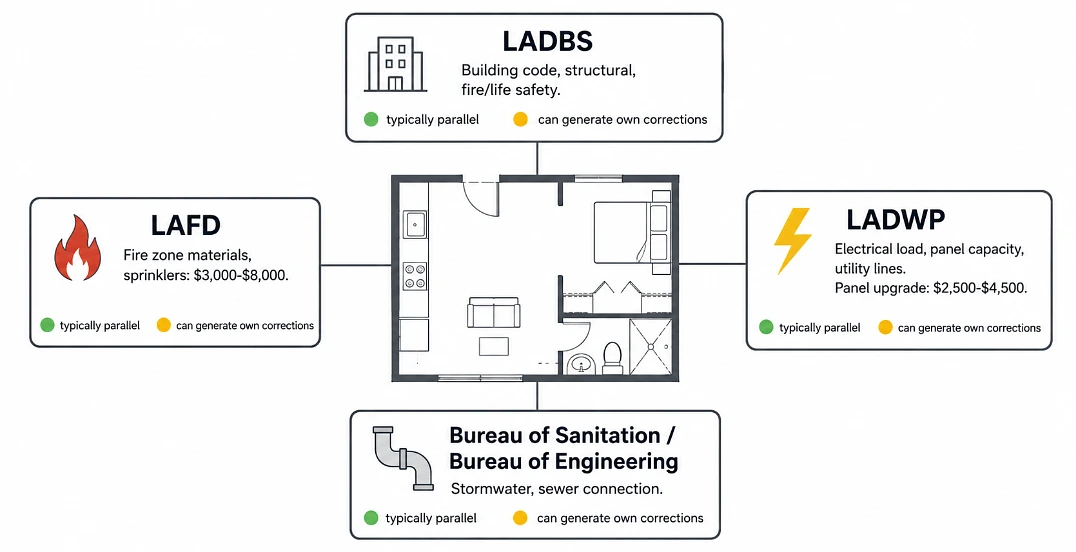
LADWP (water and power): Reviews electrical load capacity. If the existing panel can’t handle the additional load, a 200-amp panel upgrade costs $2,500 to $4,500. Also assesses distance from the new structure to overhead utility lines.
Bureau of Sanitation and Bureau of Engineering: Reviews stormwater compliance and sewer connections. New detached ADUs typically need either an independent sewer connection to the main line or a dedicated branch off the main house lateral.
LAFD (Fire Department): Enforces fire zone requirements. Homes in Very High Fire Hazard Severity Zones require non-combustible exterior materials (fiber cement, stucco, metal) and interior fire sprinklers. Sprinkler installation adds $3,000 to $8,000 to the project cost.
Coordination timing matters. These reviews often happen in parallel with LADBS plan check, but they can also generate their own correction requirements. A response that clears LADBS but fails LADWP restarts a piece of the process.
Utility Connections
New detached ADUs generally require independent utility connections. Garage conversions, attached ADUs, and JADUs can typically share the primary home’s utilities.
Sewer connection to main line: New detached ADUs need either a direct sewer connection or a dedicated branch line. Cost depends on trenching distance and site conditions.
Electrical: The service panel review determines whether an upgrade is required. Detached ADUs often benefit from separate meters for future rental income tracking, but shared metering is allowed under current LADWP rules.
Water: Attached to the main line either through a shared connection or a new tap.
The panel upgrade calculation people miss: Even if the current 100-amp or 150-amp panel technically has capacity, adding an ADU with electric heat pump water heater (now the Title 24 baseline for new construction) plus an EV charger typically pushes the load beyond what the existing panel can handle. Budget for the 200-amp upgrade rather than assuming it can be avoided.
Permit Issuance, Construction, Inspections
Once all reviews clear, the building permit issues. This is when construction can legally begin.
Building permit fee at issuance: separate from plan check fee. For a typical ADU, this runs $1,500 to $6,000 based on construction valuation.
Required inspections during construction:
- Foundation (before pour)
- Underground plumbing and electrical (before backfill)
- Framing (after rough framing complete)
- Rough electrical, plumbing, mechanical (before insulation)
- Insulation and drywall (before finish)
- Final inspection (before occupancy)
Certificate of Occupancy: Issued after final inspection clears. The ADU cannot be legally occupied or rented until this document is in hand.
Real construction timeline once permits issue:
- Garage conversion: 2 to 4 months
- Attached ADU: 4 to 6 months
- New detached ADU: 6 to 9 months
What Actually Slows Projects Down
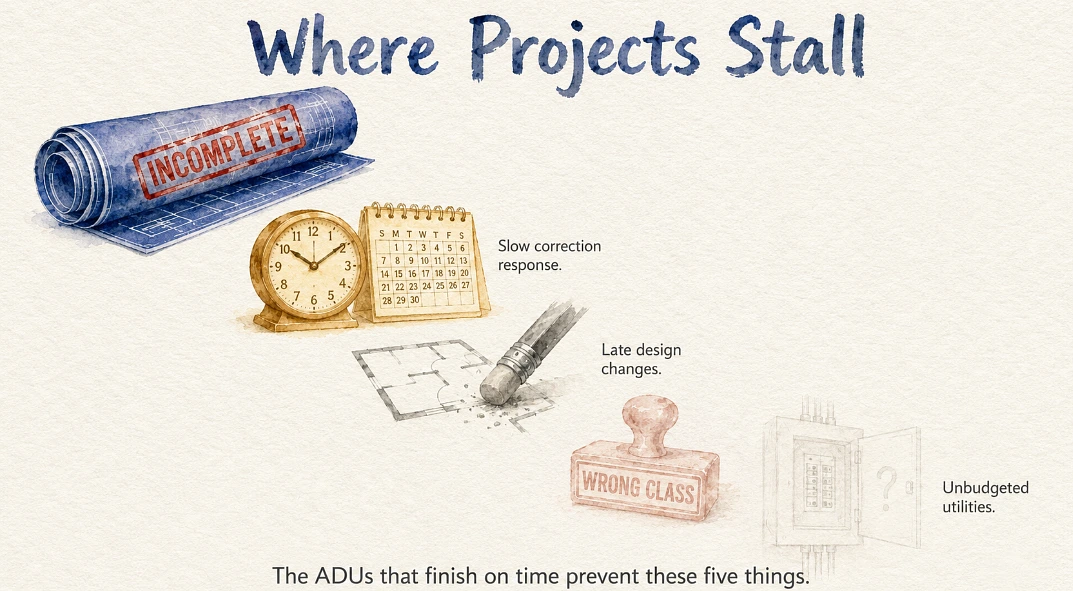
After watching enough ADU projects go through LADBS, patterns emerge in what causes the worst overruns.
- Incomplete plans on first submission. The most common rejection reason. Missing structural calculations, missing Title 24 documentation, missing site plan details. Filing a complete package on day one saves 4 to 8 weeks compared to filing what’s ready and adding the rest later.
- Slow correction responses. Every week a correction sheet sits on the design team’s desk is a week the project loses momentum in the reviewer’s queue.
- Late-stage design changes. Every design modification after plan check begins restarts a portion of the review. Lock the design before submitting.
- Wrong classification decisions. Filing a garage conversion as new construction (or vice versa) triggers the wrong fee structure and the wrong compliance requirements. This gets caught at intake but only if the intake staff notices, and if they don’t, the entire plan check runs under the wrong framework.
- Not budgeting for utility upgrades. The 200-amp panel upgrade, the sewer connection, the separate meter installation. These are often treated as afterthoughts and end up as surprise line items late in the process.
Getting through LADBS successfully is less about knowing every rule and more about understanding where the process breaks down and preventing those specific failure points. The ADUs that finish on time and on budget are the ones designed with the permit process in mind from day one, not the ones that treat the permit as an obstacle to work around after the design is set.

 Decor & Improvement Accessories