

Home & Decor Blogs: DIY, Interior Design & Lifestyle Ideas
Revamp Your Bathroom Without A Full Renovation

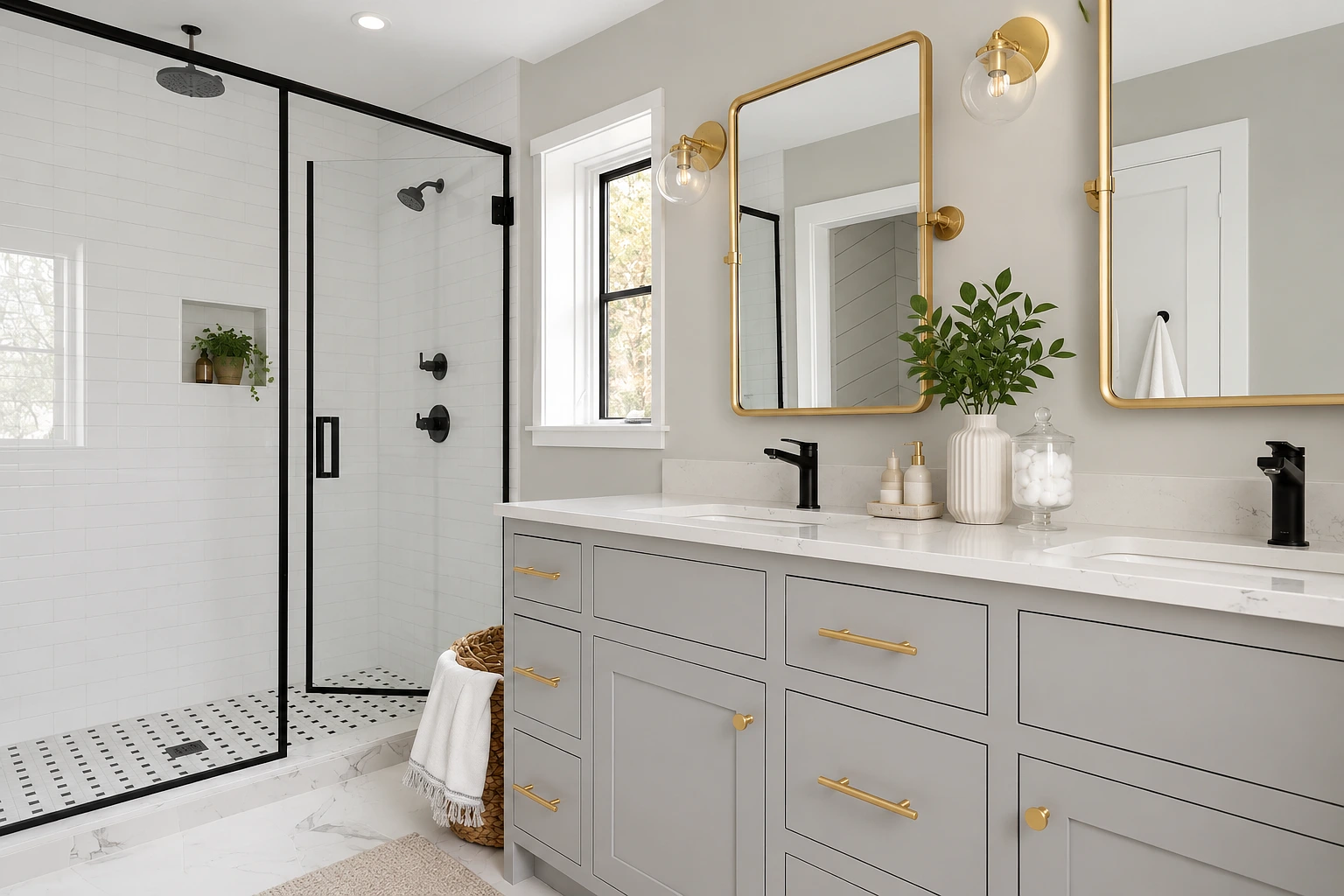
Most bathroom refresh advice is wrong in the same way. It tells you to add color, swap the vanity, and think about finishing touches, in that order, as if the three moves are roughly equal in impact. They aren’t. Doing them in that order is how partial refreshes end up looking exactly like partial refreshes: a nicely painted room with old fittings, a new vanity that fights the tile it’s sitting on, and a light fixture that dates the whole thing back to 2013.
A refresh that actually reads as “done” costs between $3,000 and $7,000 and takes 3 to 7 working days. What separates it from the version that costs the same and still looks tired is which items get replaced, in what order, and where the money goes. The information the original advice skips is the ordering logic, and that’s most of what determines whether the finished bathroom looks like a renovation or looks like someone spent money without a plan.
What Actually Delivers Visual Impact In A Partial Refresh
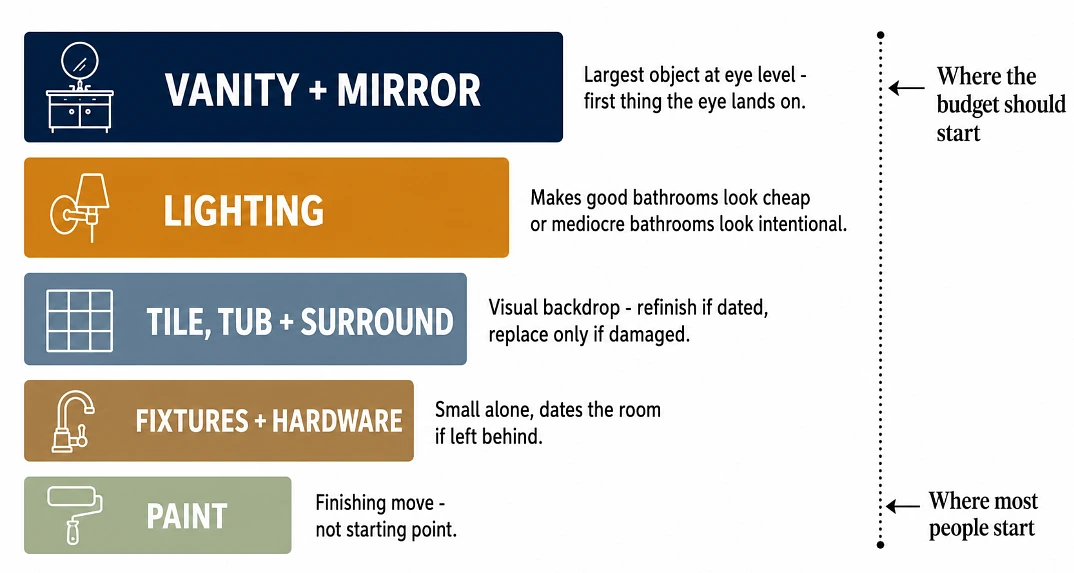
There’s a hierarchy of visual weight in a bathroom. Not everything a person sees when they walk in gets equal attention. The eye lands on specific things first, and those things determine the perception of the whole room. Refresh advice that treats every element as equally worth updating misses this entirely.
The hierarchy, in the order the eye actually processes a bathroom:
The vanity and mirror combination carries the most visual weight. This is the largest single object in most bathrooms, sits at eye level, and is the first thing a person sees when the door opens. Replace this and the room reads as updated even if nothing else changes.
Lighting is second, and it’s the item most homeowners underspend on. Bad bathroom lighting makes a good bathroom look cheap. Good bathroom lighting makes a mediocre bathroom look intentional.
The tile, tub, and shower surround collectively form the visual backdrop. If these are dated but intact, refinishing beats replacing at roughly one tenth the cost. If they’re damaged, the refresh math changes and this becomes the first priority.
Fixtures (faucet, showerhead, hardware) are fourth. Small in isolation, meaningful when everything else has been updated because they’re the item that dates the room if left alone.
Paint is fifth. This is the opposite of most refresh advice. Paint gets treated as the starting point when it’s actually the finishing move.
Spending $2,000 on paint and mirrors and hardware while leaving the original vanity and lighting in place produces the recognizable “someone tried” look. Spending the same $2,000 on the vanity and lighting alone produces a room that reads as genuinely refreshed even before the walls get touched.
The Vanity Decision Sets Everything Else
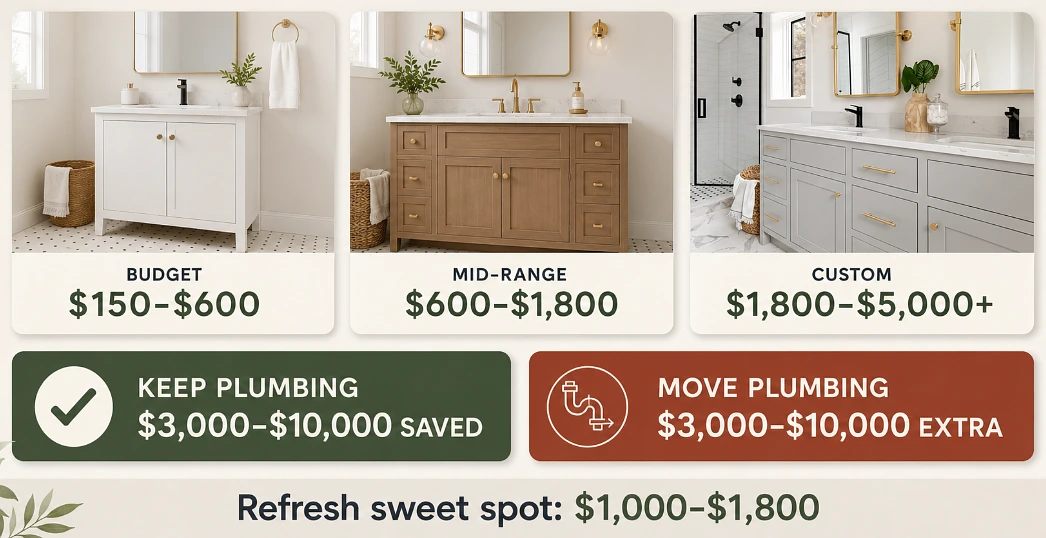
The vanity replacement is where most of the refresh budget should land. It’s also the item that offers the widest cost range depending on how the decision is approached.
Prefabricated vanity cost ranges in 2026:
- Basic MDF or particleboard construction with laminate top: $150 to $600
- Mid-range solid wood components with quartz or stone top: $600 to $1,800
- High-end custom cabinetry with premium materials: $1,800 to $5,000+
Installation labor: $400 to $2,200 for vanity installation, depending on whether plumbing needs modification. Straight replacement in the same location with no plumbing changes runs at the lower end.
Removal of the old vanity: $150 to $500, sometimes bundled into the new installation.
The gap between what a $600 vanity looks like and what a $1,800 vanity looks like is disproportionate to the price difference. Solid wood versus particleboard, quartz versus laminate top, real hardware versus injection-molded plastic. The visual delta between mid-range and budget is more pronounced than between mid-range and premium, which is why the sweet spot for a refresh sits in the $1,000 to $1,800 range for the vanity unit itself.
One decision that saves the most money: Keep the existing plumbing layout. Moving the sink even 12 inches to a different wall adds $3,000 to $10,000 to the project because it triggers real plumbing work, potential permit requirements, and re-tiling. A refresh that stays in place is a refresh. A refresh that relocates plumbing is a partial renovation dressed as a refresh, with the corresponding cost jump.
Lighting Is Where Most Refreshes Go Wrong
Most homeowners underspend on bathroom lighting because it feels like a small item next to the vanity. That’s the mistake. A $200 vanity light on a $1,500 vanity underdelivers on the entire room. A $400 to $800 fixture with the same vanity delivers a room that reads several tiers higher than what was actually spent.
Bathroom lighting cost ranges:
- Basic vanity light bar: $40 to $150
- Mid-range wall sconces or pendant fixtures: $150 to $450 per fixture
- Premium designer fixtures: $400 to $1,200 per fixture
- Electrician labor for fixture swap (same circuit): $150 to $400
The right fixture depends on the aesthetic direction of the vanity. Modern slab-front vanity paired with an ornate traditional fixture creates the “someone furnished this from three different stores” look that undoes the rest of the refresh. Traditional Shaker vanity paired with an industrial black fixture creates the same disconnect.
For refreshes going in a European or traditional direction, European style bathroom wall lights in antique brass or brushed nickel pair naturally with wood or painted vanity finishes and read as intentional rather than mismatched.
Color temperature matters more than fixture style. For bathroom lighting, aim for 3000K to 3500K. This is warm enough to look flattering in the mirror but cool enough to read makeup labels and shave properly. Above 4000K starts feeling clinical. Below 2700K feels dim and yellow. This is a spec on the bulb, not the fixture, and it’s the free upgrade that gets overlooked because nobody talks about it.
Where Paint Actually Belongs In The Sequence
Paint is the finishing move, not the starting point. Doing it first means either painting around a vanity that’s about to be replaced or scheduling paint touch-ups after the new vanity install, both of which waste time and paint.
The correct sequence:
- Vanity and mirror install
- Lighting swap
- Fixture and hardware replacement (faucet, showerhead, towel bars, hooks)
- Any tile or tub refinishing if needed
- Paint
- Recaulk
Paint cost for a typical bathroom refresh:
- Two gallons of quality bathroom-specific paint: $80 to $150
- Painting supplies (rollers, tape, drop cloths, brushes): $40 to $80
- Total DIY paint cost: $120 to $230
- Hired painter for a small bathroom: $300 to $800
Bathroom-specific paint matters here. Standard interior paint fails in bathrooms because it doesn’t handle the moisture cycle. Look for paint labeled for bathrooms, kitchens, or high-humidity spaces. Zinsser Perma-White and Sherwin-Williams Emerald Interior Acrylic both handle bathroom conditions without mildew growth in the paint film itself.
On color: The “under the sea theme” or “just choose your favorite color” advice ignores what actually works in bathrooms. Small bathrooms with dark colors read as smaller. Bathrooms with warm colors (cream, warm white, soft beige) read as bigger and more expensive. Bathrooms with cool colors (gray, blue, sage) can work but need more light to avoid feeling cold.
For a refresh where the goal is making the bathroom look like it was updated, neutral warm tones with a single accent element (a colored vanity, patterned tile, brass fixtures) outperform bold color schemes. The bold color choice is a stronger design statement but a weaker refresh strategy because it makes the room feel like a color choice rather than an updated space.
The Fixtures And Hardware That Get Skipped
After the vanity, lighting, and paint are done, the fixtures and hardware become the items that either finish the refresh or leave it looking incomplete.
What to replace, with 2026 cost ranges:
- Bathroom faucet (single hole or widespread): $80 to $400 for mid-range, $50 to $150 installation
- Showerhead: $40 to $250 for mid-range, DIY install is realistic
- Towel bars and hooks: $20 to $80 each
- Toilet paper holder: $20 to $60
- Cabinet hardware (knobs and pulls): $5 to $25 per piece
- Toilet seat replacement: $30 to $150
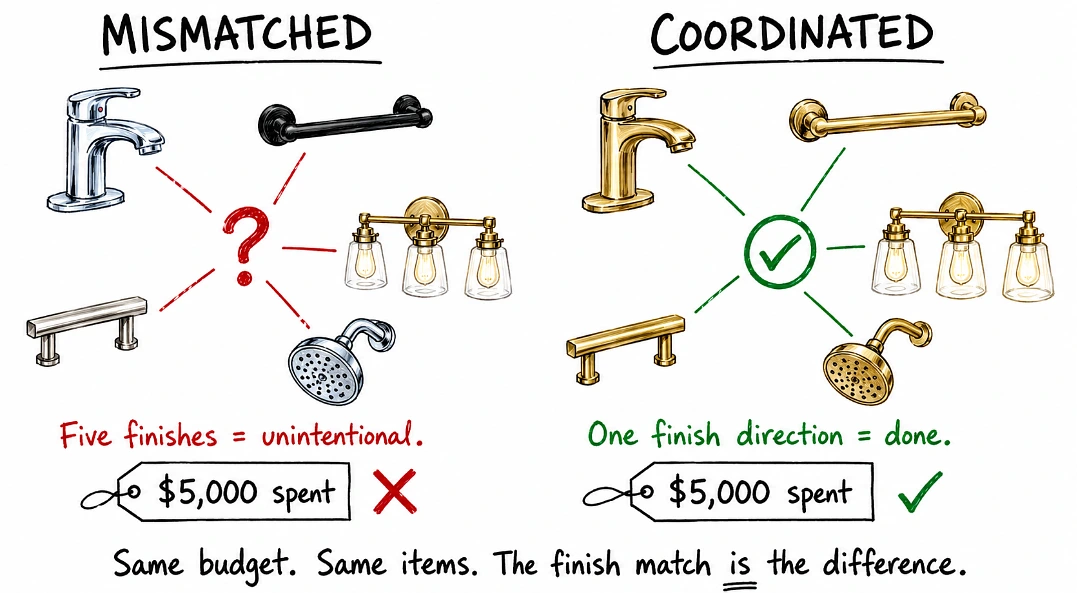
The whole fixtures-and-hardware package for a typical bathroom lands at $300 to $900 if the finishes match across all items. Mixing chrome, brass, and matte black in the same bathroom is the fastest way to make a $5,000 refresh look like a $500 one.
Finish coordination is the rule everyone breaks. Pick one finish direction (brushed nickel, matte black, antique brass, polished chrome) and stay with it across every visible metal in the room. The shower valve trim, the faucet, the towel bars, the door handle, the light fixture hardware, the cabinet pulls. If any one of these doesn’t match, the whole room reads as unintentional.
Refinishing Versus Replacing Tub And Tile
If the tub and tile are structurally sound but dated, refinishing costs a fraction of replacement.
Bathtub refinishing: $300 to $600 for a professional reglaze. Lasts 5 to 10 years with reasonable care.
Tub replacement: $2,000 to $9,400 for a standard replacement. $7,875+ for a custom walk-in shower conversion.
Tile refinishing (paint-based systems): $250 to $500 for materials, DIY-realistic if surfaces are prepped properly. Lifespan varies with product quality.
Tile replacement: $2,500 to $6,000 for professional installation on a small bathroom, plus tile material costs.
Refinishing is the correct choice when the surface is aesthetically dated but structurally sound. Cracked tile, broken grout, or a tub with rust-through gets replacement. Yellowed but intact enamel, or beige tile from a previous era, gets refinishing. The judgment call is whether the surface is worth another 5 to 10 years of use.
What The Refresh Actually Costs In Total
Adding it up for a typical small to mid-size bathroom refresh:
DIY-heavy refresh (paint, recaulk, hardware, mirror by homeowner; vanity, lighting, faucet install by trades): $2,500 to $4,500 total.
Fully hired refresh (all labor contracted): $4,000 to $7,000 total.
Refresh with tub refinishing added: Add $300 to $600.
Refresh with tile refinishing added: Add $250 to $500 DIY or $800 to $2,000 hired.
Compared to a full bathroom renovation at $15,000 to $42,000+, a well-sequenced refresh delivers roughly 70 to 85 percent of the visual impact for 20 to 30 percent of the cost. That’s why the refresh option exists as a category, and it’s why doing it in the right order matters more than any single design decision inside it.
What Separates The Refreshes That Look Done From The Ones That Don’t
After the vanity is in, the lighting is swapped, the fixtures match, the paint is finished, and the caulk is fresh, the bathroom either reads as done or it doesn’t. The difference usually comes down to two things.
The mirror. A refreshed vanity with the old builder-grade frameless mirror above it undoes half the work. Replacing the mirror (framed, backlit, or a proper vanity mirror that matches the fixture finish) costs $80 to $400 and closes the gap between “updated vanity” and “updated space.”
The details nobody looks at directly. The switch plate covers, the outlet covers, the door hardware, the caulk lines. When these are old, mismatched, or visibly worn, they signal “unfinished” even if every major element is new. Swapping all the plate covers for matching finish costs $30 to $60 and is the item most homeowners skip.
A bathroom refresh done right doesn’t look like a refresh. It looks like a small renovation. The version that looks like a refresh, the version everyone can identify as “they painted and put in a new vanity,” is the version where the sequence and the coordination got skipped in favor of picking a wall color first.
 Decor & Improvement Accessories