

Home & Decor Blogs: DIY, Interior Design & Lifestyle Ideas
Buying Furniture and Decor Straight from Chinese Factories: A Homeowner’s Practical Guide


A Practical Guide for US Homeowners
Flip the price tag on a nice sectional in a US showroom and you are usually staring at four to six times what the thing cost to make. That is not a markup on craftsmanship, because most of the world’s furniture, the budget flat-pack and the upholstered pieces sold under premium American and European labels alike, rolls off the same production lines in the same handful of Chinese industrial towns. The difference is just where the money gets added, and nearly all of it gets added after the container lands here.
So of course people furnishing a whole house start asking the obvious thing. Why am I paying the middleman if the factory is right there?
You do not have to, and this guide is for the US buyer who wants to go direct. But I will be honest with you up front, because the people who lose money on this are almost always the ones who were told it is easy. It is not easy. It is a bargain in the right situation and an expensive lesson in the wrong one, and the whole point of what follows is knowing which one you are walking into.
When Going Direct Is Worth It, and When It Really Isn’t
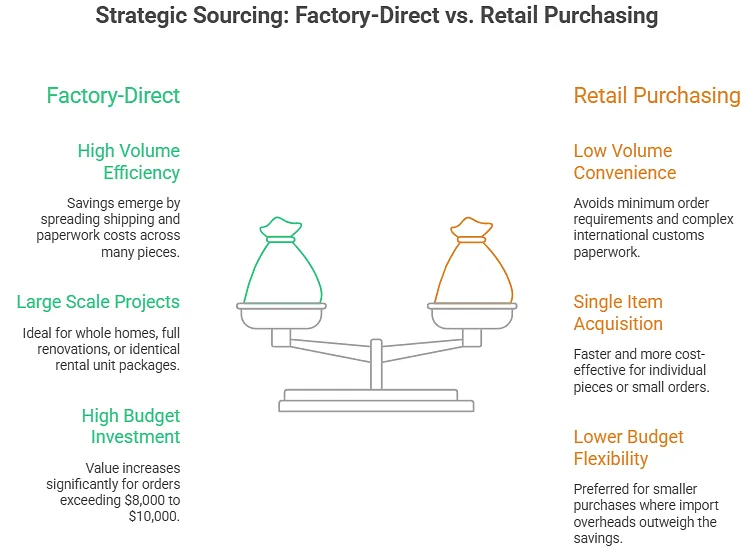
The thing that makes this work is volume, plain and simple. The savings only show up when you are buying enough at once to spread the cost of shipping and paperwork across a lot of pieces, so factory-direct rewards the big job and punishes the small one.
It genuinely works when you are doing:
- A whole home, or several rooms in one go, living room, bedrooms, dining, outdoor, all on one order.
- A full renovation package, where the vanities, tiles, lighting, sanitaryware, doors and furniture travel together.
- A rental or a small guesthouse, because a stack of identical units is exactly what a factory is built to churn out.
- A designer’s client project, custom sizes and finishes and fabrics for a fraction of what bespoke retail asks.
Here is where people get burned, though. It does not work for a single sofa. Between the minimum order a factory will accept, the sea freight, and the customs paperwork, one-off pieces are almost always cheaper and far quicker to just buy at home, or from a retailer who already did all this importing and is charging you a little extra for the privilege of not having to. As a rough line in the sand, this starts making sense somewhere past $8,000 to $10,000 in furniture, and it only gets better the bigger you go.
Where Your Furniture Actually Comes From
China’s furniture trade is carved up into regional clusters, and once you know which town makes what, the pricing suddenly makes a lot more sense.
Foshan, down in Guangdong, is the giant of the whole thing, thousands of factories and the vast furniture malls of Shunde turning out sofas, beds, marble dining tables, the lot. Just nearby, Zhongshan does the lighting and Chaozhou does the sanitaryware. Head north and Anji owns the office and recliner-chair business while Nankang works in solid wood. Two things fall out of that, and both matter to you. Almost anything you have admired in a Western showroom has a factory-direct twin, quite often off the very same line. And a mixed order, furniture plus lighting plus a bathroom, means dealing with several factories in several different cities, which is why consolidation, getting all of it combined into one container, is the skill that quietly decides whether the whole project holds together or falls apart.

The Number That Matters Is Landed Cost, Not the Factory Price
The price a factory quotes you, usually FOB, meaning the goods dropped at the port and cleared to export, is not what your furniture costs. What it costs is the landed price, the number for that furniture standing in your own hallway, and the space between those two figures is where the nasty surprises live.
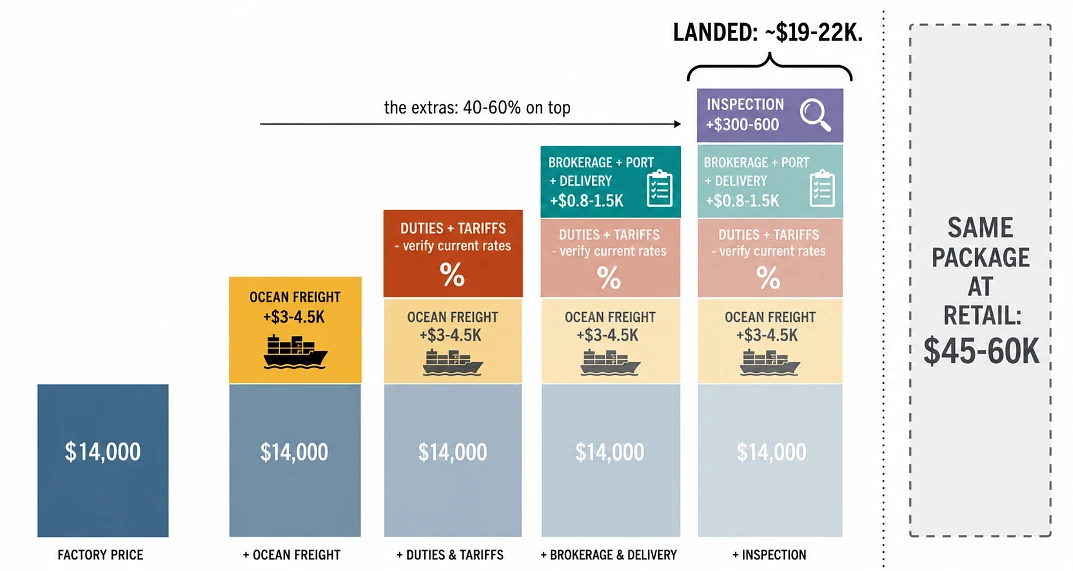
Say you are furnishing a three-bedroom home and the furniture at factory prices comes to $14,000. Here is what piles on top:
- Ocean freight for a 40ft container, somewhere around $3,000 to $4,500.
- Duties and tariffs, and these are the wild card that can make or break the whole thing, which I will get to in a second because it deserves its own space.
- Customs brokerage, port fees and the final delivery, another $800 to $1,500.
- A pre-shipment inspection, about $250 to $400 for a single inspector-day, more if the order needs a few days of checking.
On a low-duty category, all of that lands you somewhere near $19,000 to $22,000, against the $45,000 to $60,000 the same haul would cost you at US retail. The saving is real and it is large. But look at what the extras did, they added forty to sixty percent on top of the factory quote, so if you budget off the FOB number and nothing else, you are budgeting for a shock.
To put a real face on the good side of this, someone furnishing a living room shared that they got an exact custom replica of a Restoration Hardware set made in China for about $3,500 including tariffs and shipping, when the same five pieces from RH would have run them north of $21,000. That is the dream version, and it does happen. Just keep reading before you assume it will happen to you.
The Tariff Trap That Can Swallow the Whole Saving
This is the part most guides gloss over, and for an American buyer it is the most important thing on this entire page, so slow down here.
Furniture from China does not carry one clean duty rate, it carries a stack of them. Plenty of categories that look duty-free at the base rate still pick up a Section 301 surcharge of twenty-five percent, and by the time everything is layered on, China sits around thirty-five percent combined on a lot of covered goods. That alone bends the math. But the thing that actually ruins people is antidumping and countervailing duty, and it lands hardest on the exact stuff you would think of first for a renovation.
Chinese wooden bedroom furniture, cabinets, vanities and mattresses can carry antidumping rates running into the hundreds of percent.
Read that again, because it is not a typo. On the wrong classification, the duty can cost you more than the furniture did. Those are the very items, the bedroom set, the bathroom vanity, that people assume are the slam-dunk savings, and they can be the thing that turns the whole order upside down.
So do not take a single number here, or anywhere else, on faith. Before you commit a dollar, go and check your own category. The official rates live on the US International Trade Commission’s Harmonized Tariff Schedule at hts.usitc.gov, and you can screen your specific supplier and its rate over at access.trade.gov. Ten minutes there, ideally with a licensed customs broker confirming exactly how your pieces get classified, is what tells you whether you are looking at a bargain or a trap for the specific things sitting in your cart. Your category decides your bill, nobody else’s example does.
Getting Around Minimum Order Quantities
Here is a wall you will hit early. Factories set minimum orders because stopping a production line and retooling it for three chairs is a waste of their day, so you will run into MOQs like twenty to fifty pieces on a chair model, or five to ten on a sofa.
There are ways through it. Some factories will sell you showroom or stock pieces one at a time, and honestly the Foshan furniture malls are basically wholesale retail if you can get yourself there in person. A lot of them will also drop the per-model minimum if your total order value is big enough, so mixing across their catalogue does the trick.
And the route most people actually take is going through a sourcing agent, who either bundles your order in with other buyers’ or simply knows which factories are happy to take a smaller custom run. That help usually costs three to ten percent of the order value. If you are doing a whole-home package anyway, most of these minimums stop being a problem, you clear them without trying.
Quality Control Is the Step Nobody Skips Twice
Now the uncomfortable truth, and it is the one that catches first-timers hardest. When you buy direct, the quality risk is yours, all of it. There is no returns desk, no customer service line to shout at. Once that container sails, a cracked marble top or a sofa in the wrong fabric is your problem, sitting ten thousand kilometers away with your money already spent.
And this is not a rare thing that happens to careless people.
Over on Reddit, a designer ordered fifty dining chairs for a high-end restaurant client and spelled it out clearly, a specific warm-grey performance fabric, brushed brass legs. What turned up was a chair with roughly the right shape, wrapped in a synthetic velvet of a totally different texture, in whatever shade the factory’s own dye library decided “warm grey” meant, sitting on chrome legs instead of brass. The kicker? The factory did not think they had done anything wrong. That is what you are up against, and it is exactly why the inspection step exists.
The fix the whole industry runs on is a pre-shipment inspection. An independent inspector, not the factory’s own people, walks into the plant once production is mostly finished but before anything is boxed up, pulls a statistical sample against your written spec using AQL sampling, which for furniture means AQL 2.5 on major defects and 4.0 on minor, photographs everything, and hands you a pass or fail. You release the final payment only after it passes. Given that failure rates on China shipments hover around thirty percent, that few hundred dollars is the cheapest insurance in the entire process.
You can line this up through one of the big independent names like SGS or Bureau Veritas, or through a China sourcing and quality-control company that folds the inspection in alongside wrangling the factories and consolidating your container, which tends to be a lot simpler when you are juggling five suppliers across three cities at once. Whichever way you go, one rule does not bend. Keep the inspector independent of the factory, because a plant’s own internal QC report is a record of what its own staff decided to look at, and that is not the same thing as someone checking on your behalf.
Five Mistakes That Cost Real Money
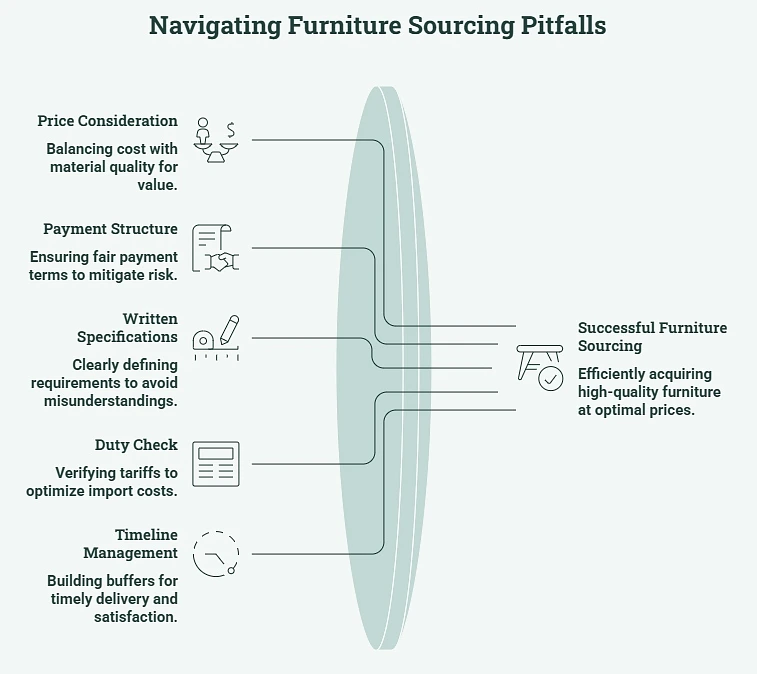
- Picking a supplier on price alone. The cheapest quote nearly always means someone quietly traded away quality where you cannot see it, the foam density, the moisture in the wood, the hardware.
- Paying the whole thing upfront. The normal structure is thirty percent down and seventy percent once the goods pass inspection. A factory demanding all of it in advance is waving a red flag at you.
- Skipping written specs. “Like the photo” is not a specification, as those fifty chrome-legged chairs will tell you. Dimensions, materials, finishes, fabric codes, packaging, all of it goes on the order sheet in writing.
- Forgetting to check the duty. Ten minutes on your actual category rate can change the entire calculation, and on an AD/CVD category it can end the project before it starts.
- Treating the timeline as the most it will take. It is the least. Custom production alone eats thirty to forty-five days, and door-to-door you are realistically looking at ten to fourteen weeks, so if you are mid-renovation, order when the build starts, not when it finishes.
So, Should You Do It?
Buying your furniture and decor straight from a Chinese factory is neither the scam some people warn you about nor the free money others promise. It is a logistics project, and at the right scale it hands you a real forty to sixty percent saving at the end of it. If you are kitting out a whole house, a rental, or a client’s place, do the three things that actually matter.
Run the landed-cost math with your own category’s real duty rate, not a tidy example. Insist on an independent inspection before anything ships. And give the thing the three months it honestly takes instead of the three weeks you were hoping for. Do that, and the hallway full of factory-priced furniture is worth every hour of the spreadsheet it took to get there.
 Decor & Improvement Accessories