

Home & Decor Blogs: DIY, Interior Design & Lifestyle Ideas
Mattress Firmness for Lower Back Pain: What Back, Side, and Stomach Sleepers Need


Lower back pain has a cruel schedule. For a lot of people it is mildest during the day, worse lying in bed, and worst of all in the first minutes after waking, which is exactly backwards from what rest is supposed to do. Somewhere around six hundred million people are living with it at any given time, and the World Health Organization ranks it as the leading cause of disability anywhere. A mattress will not cure any of that. What it can do is stop re-straining your back a little every night, and choosing a mattress for lower back pain comes down to one variable most buyers skip past: the position you actually sleep in.
Why Sleep Position Decides the Right Firmness
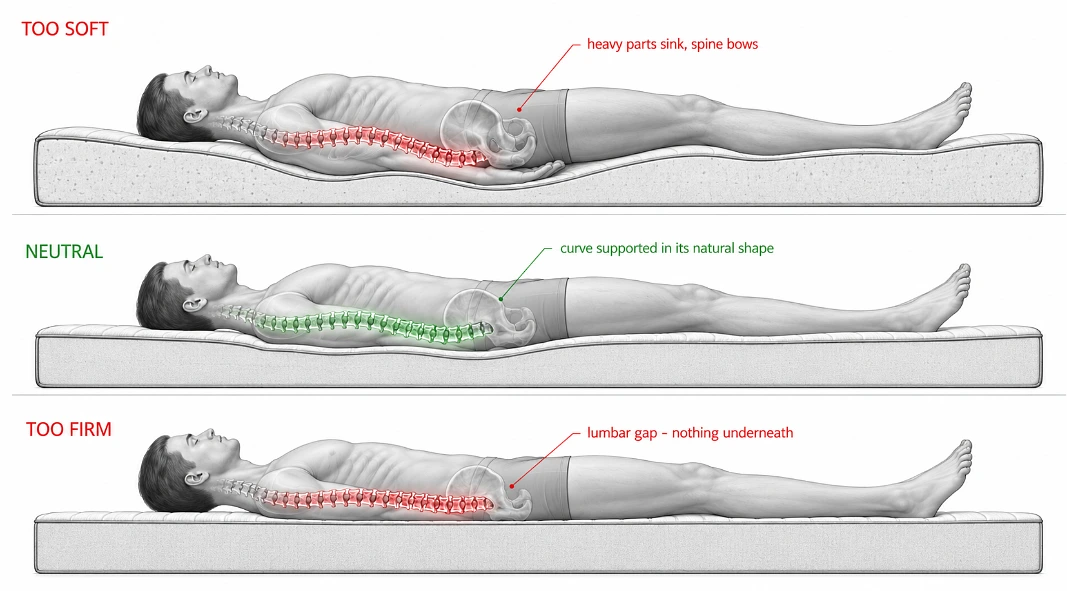
Your spine holds an S curve, and the mattress’s whole job is to let that curve rest in its natural shape for eight hours. Too soft, and the heavy parts of you, hips and shoulders, sink in deep enough to bow the spine out of neutral. Too firm, and the surface cannot follow your contours, leaving a gap under the lower back with nothing supporting it. Each sleeping position loads the lumbar spine differently, so the same mattress that protects one sleeper’s back quietly bends another’s.
The Lancet Study on Mattress Firmness
For decades the standard advice was firm, full stop. A survey around the time found about three quarters of orthopaedic surgeons recommending firm mattresses for back pain, with basically no evidence behind the advice. Then in 2003, Francisco Kovacs and colleagues ran a randomized, double blind trial on 313 adults with chronic low back pain, published in The Lancet, comparing firm against medium firm. Both groups improved, but the medium firm group improved their pain related disability by 50 percent against 30 percent for the firm group. The blinding worked partly by accident, since 43 percent of the medium firm sleepers believed they were on firm mattresses anyway. One caveat travels with the study: it used spring mattresses, and the authors noted results might differ with other constructions. It remains one of the only controlled trials ever run on this question, and it retired “firmer is better” as a universal rule.
Back Sleepers: Medium to Medium Firm
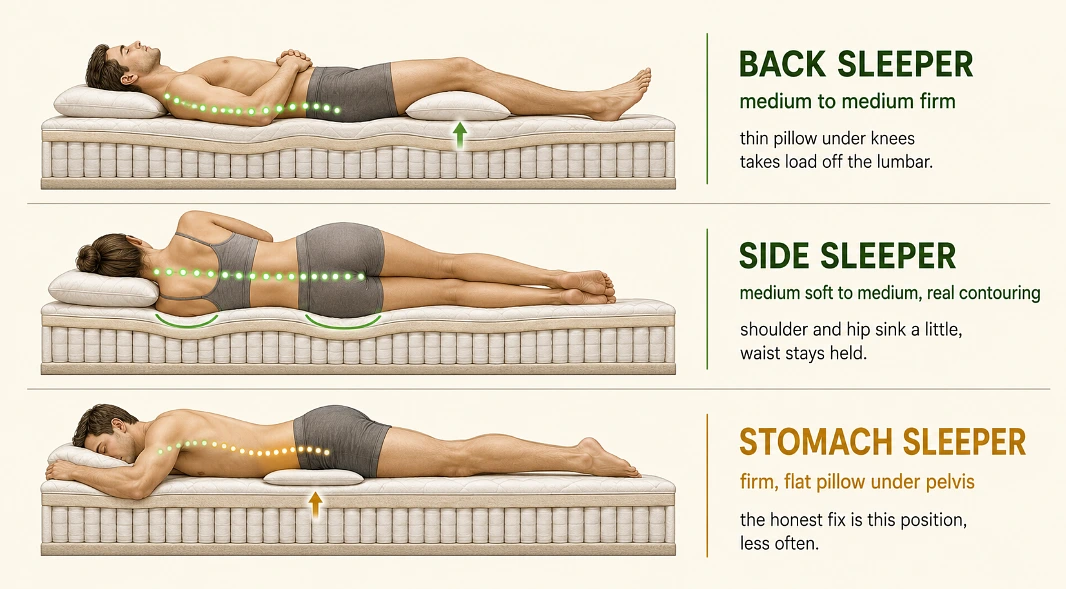
Back sleeping distributes weight the most evenly of the three positions, which is why it gets called spine friendly. The mattress still has one specific job here, keeping the hips from sinking lower than the shoulders. Medium to medium firm handles it because:
- The pelvis and shoulders stay roughly level, so the lower back is not arching all night.
- There is enough give to fill in under the lumbar curve instead of leaving it hanging.
- The hips get support without the deep sink that shows up as morning stiffness.
A thin pillow under the knees helps more than people expect. It tilts the pelvis flat and takes load straight off the lumbar spine, and it costs nothing to try tonight.
Side Sleepers: Softer, With Real Contouring
Side sleeping is how most adults sleep, and it concentrates weight on two points, the shoulder and the hip. A mattress that is too firm turns those into pressure points. Too soft, and the whole midsection hammocks toward the centre of the bed, dragging the spine into a curve. The working range is medium soft to medium with genuine contouring on top, memory foam or a hybrid with proper foam layers, so the shoulder and hip sink slightly while the waist stays held. On foam, density is the spec that matters and the one the sticker never mentions: daily use wants comfort layers around 3 pounds per cubic foot or better, and the very cheap foam beds are cheap because they are under 2, which is fine for a guest room and not for a spine you are trying to protect.
Stomach Sleepers: Firm Support, Flat Pillow, and an Honest Word
Sleep specialists like this position least for a reason. Lying face down pushes the lumbar spine into an exaggerated arch, and keeping your head cranked to one side all night compounds it from the top. If it is your position and it is not changing, go firm, so your midsection cannot sink and deepen the arch, and put a flat pillow under the pelvis to pull the spine back toward neutral. The firmer truth is that the best mattress adjustment for stomach sleeping is sleeping on your stomach less, and a body pillow that nudges you toward your side does more than any firmness rating.
An Old Mattress Undoes the Right Choice
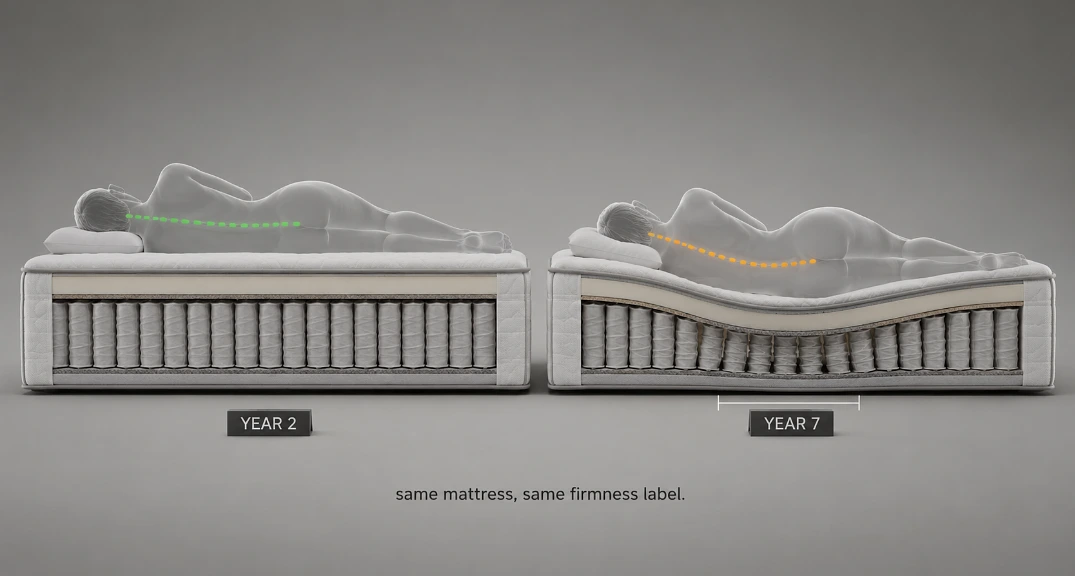
Support degrades no matter what firmness you bought. A mattress that held the right shape in year two can be sagging by year seven, and a sag recreates the too soft problem on a bed that is nominally medium firm. Sleep researchers generally suggest re evaluating support every six to eight years, sooner for anyone already managing a bad back. Lifespan tracks construction, traditional innersprings can start sagging inside 6 years while good latex and hybrid builds run 12 to 15, which changes the real cost math more than the sticker does.
What a Good Mattress Costs by Type
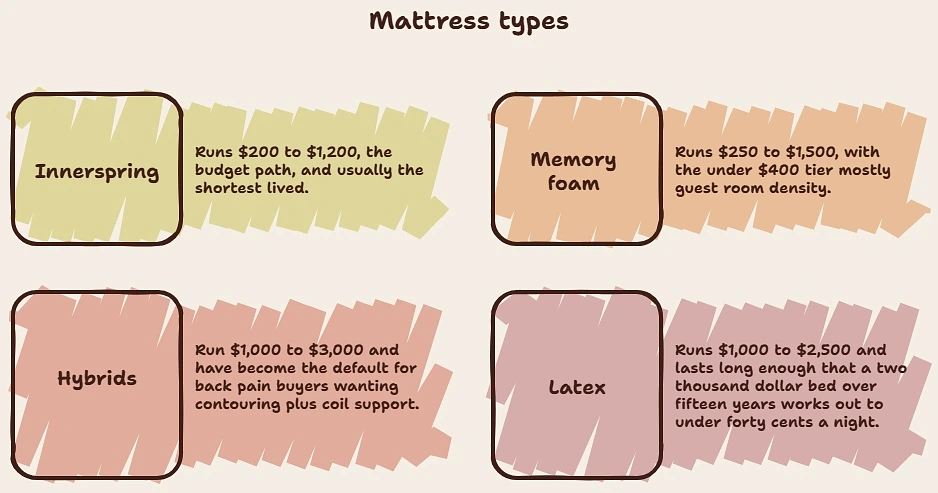
Queen size, which is what most price guides measure:
- Innerspring runs $200 to $1,200, the budget path, and usually the shortest lived.
- Memory foam runs $250 to $1,500, with the under $400 tier mostly guest room density.
- Hybrids run $1,000 to $3,000 and have become the default for back pain buyers wanting contouring plus coil support.
- Latex runs $1,000 to $2,500 and lasts long enough that a $2000 bed over fifteen years works out to under forty cents a night.
Most people find what they need between $1,000 and $1,800, and nearly every online brand now offers a trial window of around a hundred nights, which matters more for back pain than any spec sheet, because the only test that counts is your own spine across a few weeks of mornings. And if the pain stays constant no matter what you sleep on, the mattress was never the whole story, that one belongs to a doctor or a physio.
 Decor & Improvement Accessories