

Home & Decor Blogs: DIY, Interior Design & Lifestyle Ideas
Your Thermostat Says 72 – Your House Feels Like A Locker Room. Why?

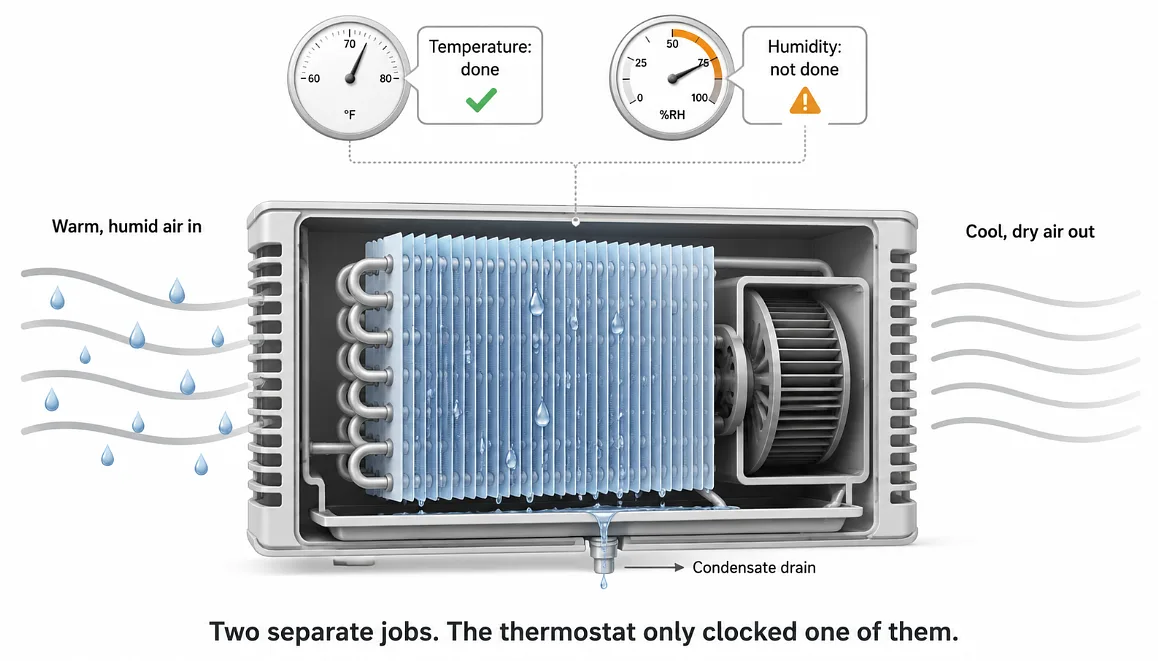
Set it to 70. Still sticky. Set it to 68, same thing, and now the room is cold and sticky at once, which should not even be a real combination of feelings a person can have standing in their own living room in socks.
This happens to more people than you would think, and almost nobody diagnoses it correctly. You blame the thermostat first, because that is the dial right there in front of you. Then you start blaming the AC unit itself, assuming it is dying somewhere inside the walls, and you start pricing a replacement online before bed one night without really meaning to. Rarely is that the actual problem. The actual problem is humidity, and your thermostat has no idea it even exists.
Your AC Has Two Jobs And You Only Asked It To Do One
Cooling and dehumidifying are not the same task, even though one machine does both, sort of accidentally, as a side effect of how the physics works.
Warm humid air moves across a cold coil inside the unit. Moisture condenses on that coil the same way it beads up on a glass of iced tea, and it drips away down a drain line while the air, now drier, blows back into your room. That is the whole trick. Cool the air enough and the water falls out of it on its own.
The problem shows up when the system gets good enough at the temperature part that it stops running before the humidity part is finished. A too large AC unit cools a room in six minutes and shuts off, mission accomplished as far as the thermostat is concerned. Except the coil barely had time to warm up, let alone pull real moisture out of the air. So you get a fast, cold, damp room. Undersized units have the opposite problem, running constantly and still never quite catching up.
Bigger is not better here. Bigger is often worse.
30% To 50% Matters More Than Your Temperature Setting:
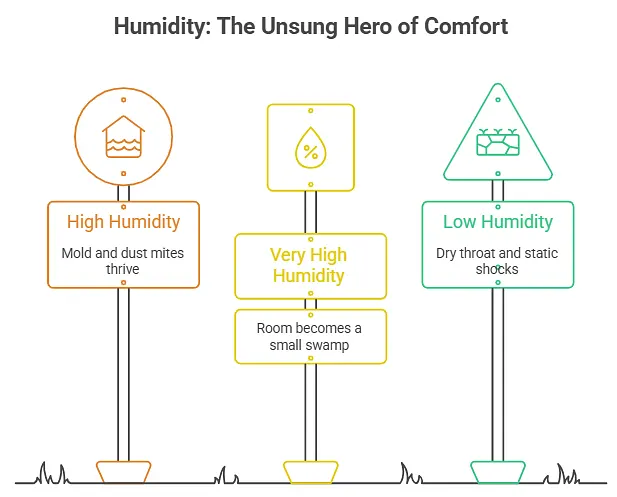
Thirty to fifty percent. That is the range, according to the Department of Energy and the standards ASHRAE sets for indoor comfort, and it decides how a room feels more than the number on your thermostat does, which is a strange thing to accept when you have spent your whole life staring at the temperature dial like it was the only knob in the room.
What each range actually does to you:
- Above 50 percent, mold starts finding its footing and dust mites move in like they own the place.
- Above 60 percent, according to more than one HVAC outfit that deals with this constantly, you are basically running a small swamp with furniture in it.
- Below 30 percent you get the other version entirely, dry throat, static shocks off every doorknob, wood floors starting to gap at the seams.
A cheap hygrometer costs less than a dinner out and it will tell you the real number sitting in your living room right now, today, and most people going about their lives have never once checked it.
What Is Actually Sabotaging Your System
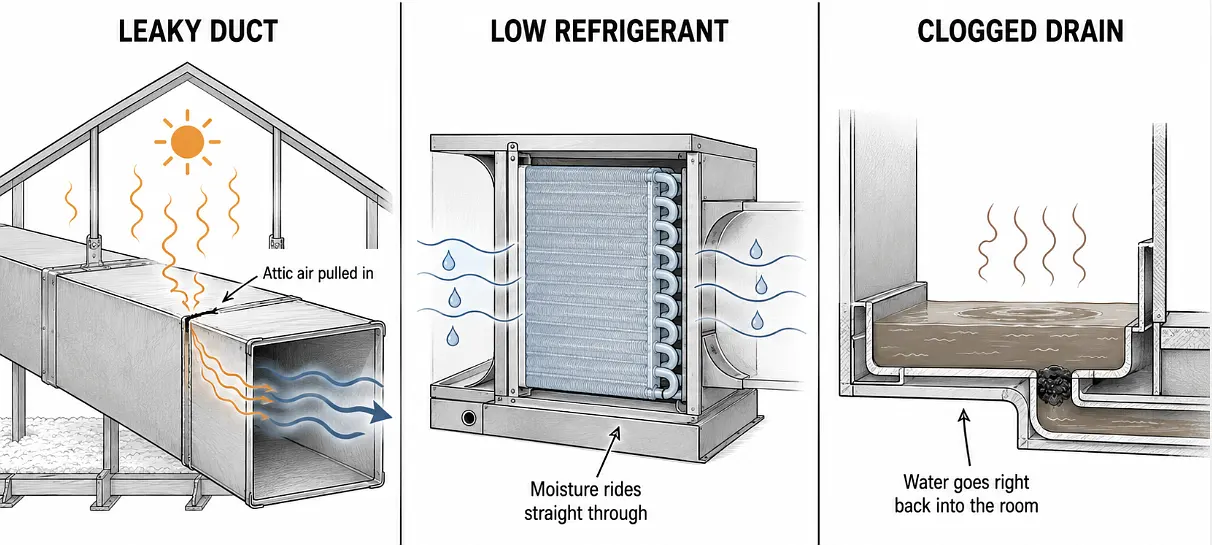
You already turned the thermostat down twice this week and the room still feels the same, and that alone should tell you the problem was never really about the temperature setting, because a few very specific things quietly wreck the dehumidifying half of the job while leaving the cooling half looking perfectly fine on the display.
- Leaky ductwork is the sneaky one, because a duct running through a hot attic with even a small gap in the seam ends up pulling in attic air instead of staying sealed, and that attic air is hot and humid and dusty and it is absolutely not the air you just paid your electric bill to cool, so it gets mixed straight back into your supply and your system spends its whole life fighting air it never should have had to deal with in the first place.
- Low refrigerant does something similar but from the inside, because the coil needs to run properly cold to actually condense water out of the air, and a system running low on refrigerant cools weakly enough that the coil never gets cold enough, which means the moisture just rides along with the air the whole way through instead of dripping down into the drain like it is supposed to.
- A clogged condensate line means the water that did get successfully pulled out of the air has nowhere left to go, so instead of draining away outside like it should, it sits there, and sometimes it backs up, and sometimes it just evaporates straight back into the same room it was pulled out of five minutes earlier, so the system technically did its job and the house quietly undid it anyway.
None of these three things show up as an error message on anything. They show up as sticky.
The Part That Actually Needs A Professional
I will be honest about where the DIY advice runs out, because most of this article you can act on with a hygrometer and common sense, and this part you genuinely cannot.
Refrigerant level, coil condition, duct integrity, whether your unit is actually the right size for your square footage, none of that is a homeowner project. You are not going to correctly diagnose a slow refrigerant leak from the internet, and cracking open a sealed system yourself is the kind of thing that turns a comfort problem into an expensive one fast. This is squarely a job for a certified HVAC technician, someone who brings a gauge and actually measures the refrigerant charge instead of guessing from a website checklist, someone who can pressure test the ducts instead of poking around with a flashlight and a hunch.
Here is the honest filter for whether it is worth the call. If your house still feels damp with the AC running and the thermostat reading the temperature you set, that gap between what the thermostat says and what your skin says is the entire symptom. It means something between the coil and your living room is not doing its job, and no amount of turning the temperature down two more degrees fixes a mechanical problem by accident.
The Fifteen Minute Version
Buy the hygrometer. Thirty to fifty is the target, not the temperature dial. If you are living above fifty for more than a few weeks running, especially through a wet summer, that is not a personality trait of your house, that is a system with a real fault somewhere between the coil and the vents, and it is worth having someone with a gauge actually go find it instead of quietly turning the thermostat down another degree and hoping.
 Decor & Improvement Accessories