

Home & Decor Blogs: DIY, Interior Design & Lifestyle Ideas
How to Keep Your Home Cool and Comfortable During Extreme Summer Heat

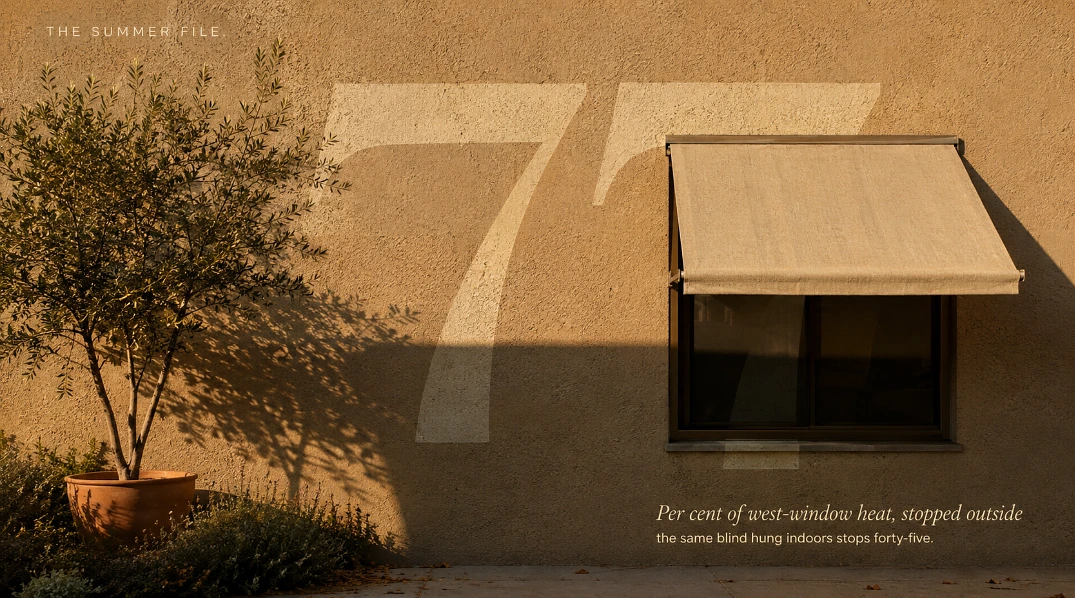
Sunny windows make an air conditioner work two to three times harder. Everything else on this page is small change next to that
Summer heat can turn your home into an oven before you even think about cranking up the AC. You want relief without turning your living room into an icebox or your wallet into tissue paper.
The heat is not building up because of what is sitting in your rooms. It is pouring in through the windows as sunlight, and your AC then has to haul all of it back out again while more keeps arriving.
This is about the house you already live in. Not new windows, not a remodel, just what you can change this week.
And one more thing before we start. Most summer decor advice repeats the same five swaps, and about three of them do nothing you can measure. Those are at the bottom of this page, because the reason they keep getting repeated is worth knowing.
What Each Cooling Fix Costs and How Much Heat It Blocks
Work down this list in order. The first few cost you nothing but an afternoon and a little bit of habit.
| The fix | What it does | Cost | Effort |
|---|---|---|---|
| Awnings or exterior screens | Blocks up to 77 percent on west windows | Real money | Installer |
| Reflective blinds or shades | Up to 45 percent of heat gain gone | Moderate | An afternoon |
| Cellular shades, fitted tight | 20 percent in summer, 10 percent off winter heating | Moderate | An afternoon |
| Closing them at the right hour | Beats picking fancier fabric | Nothing | A habit |
| Fan counterclockwise, off when you leave | Lets you raise the thermostat 4°F | Nothing | Two minutes |
| Oven and dryer off in the afternoon | Stops you making heat indoors | Nothing | A habit |
| Clear vents, fresh filter | Lets the cool air reach you | Under $30 | An hour |
| Duct sealing | Recovers up to 25 percent of your cooling | Real money | Contractor |
Those numbers come from Department of Energy guidance. Look at where they sit. Everything at the top happens outside or right at the glass, and nothing in the room itself made the list at all.
Awnings and Exterior Screens Block More Heat Than Any Indoor Blind
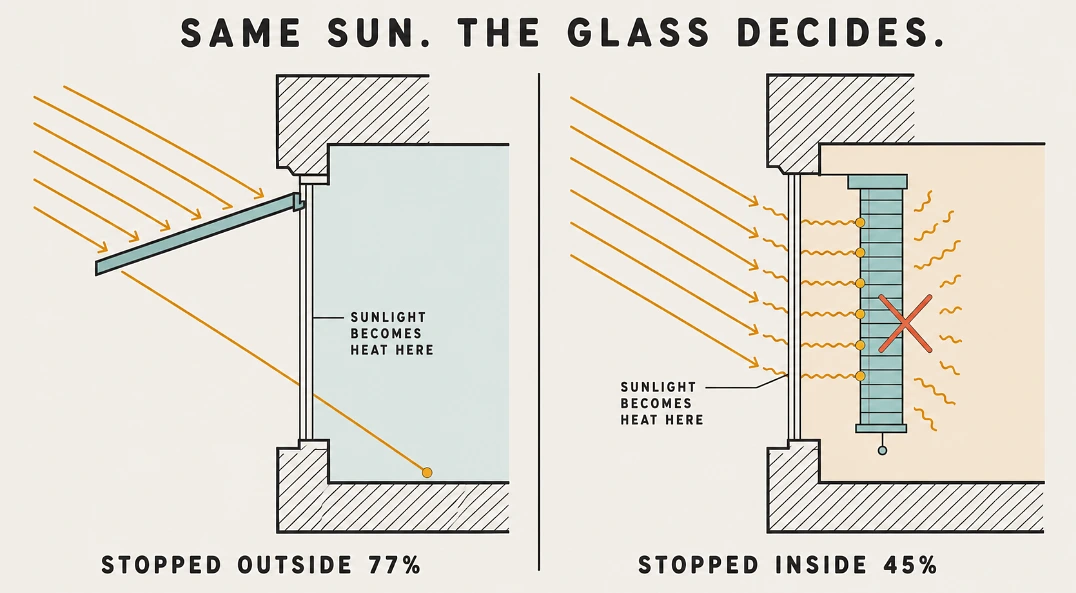
Outside beats inside, and it is not close.
Once sunlight comes through a window it has already turned into heat in your room. Anything you hang behind the glass is cleaning up a mess instead of stopping one.
Awnings cut solar heat gain by up to 65 percent on south facing windows and 77 percent on west facing ones. Exterior solar screens take out around a quarter and still let you see out, which is the version most people can live with.
Cannot do exterior? That is fine, inside options still help. Reflective blinds and shades manage up to 45 percent. Cellular shades fitted snugly inside the recess block about 20 percent in summer and save around 10 percent on heating in winter, which makes them the smart year round pick. Even curtains work if they have a white backing, roughly a third of the heat gone, and that backing is doing nearly all the work rather than the pretty side facing your room.
Hang them close to the glass and let them reach the sill. Gaps at the top or the sides let warm air slide right past whatever you just paid for.
Close East Blinds by 8am and West Blinds by Noon
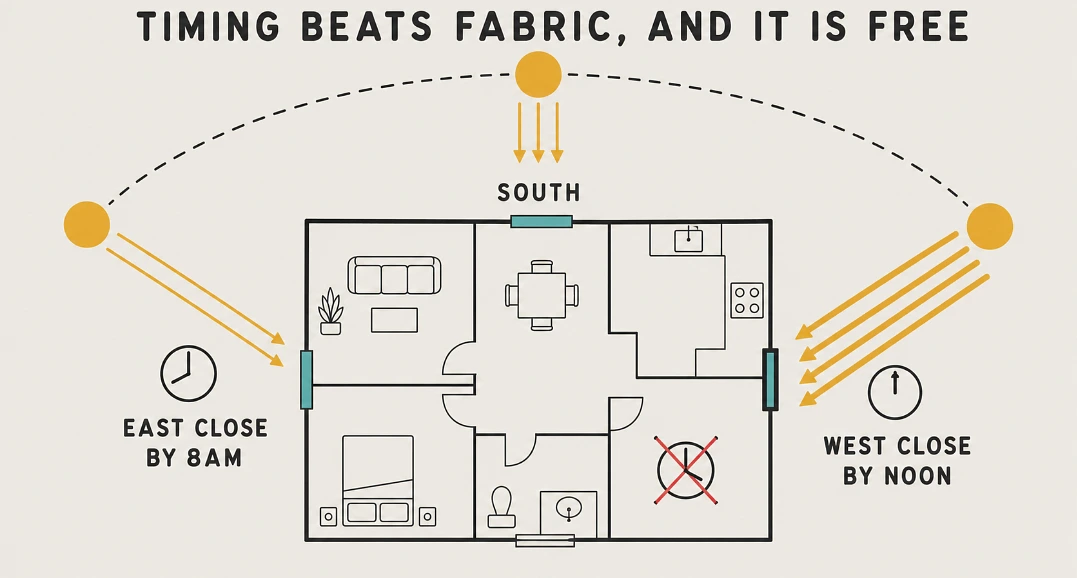
Timing beats fabric. Every time, and it is free.
Shut the east side blinds by eight in the morning. Shut the west side by noon. Blinds you close at four in the afternoon are just trapping heat that already made it inside, and now you are cooling a room with a warm curtain hanging in it.
If you only fix one set of windows this summer, make it the west facing ones. They take the sun at the exact hour your house is already struggling.
Ceiling Fans Cool People, So Turn Them Off in Empty Rooms
This one changes how you use them. A fan does not lower the temperature of anything.
It moves air across your skin, sweat evaporates faster, and you feel cooler. That is the whole trick. So a fan spinning in an empty room is adding a little motor heat and doing nothing else for you.
Two rules come out of that. Set it counterclockwise in summer so it pushes air down at you. Then flip the switch on your way out of the room.
Do both and you can raise the thermostat by about four degrees and feel exactly the same. That is where the savings show up.
Running the Oven, Dryer and Dishwasher in the Afternoon Heats Your House
Every appliance you run turns electricity into heat, and your AC has to remove that too.
The oven is the worst offender by a mile. Summer is grill season, slow cooker season, air fryer season, sandwich season if it comes to that. Save the roasting for October.
Run the dishwasher and the dryer late in the evening instead of mid afternoon. Swap out any old incandescent bulbs still hanging around, since they throw off far more heat than light. And use your kitchen and bathroom fans, because they pull hot damp air straight out of the house rather than letting it drift into your other rooms.
Furniture Blocking Vents Stops Cool Air Reaching Your Rooms
Cool air cannot help you if it cannot get to you.
Walk through the house and look at every vent. A sofa pushed against a supply vent, a laundry basket parked in front of a return, a closed door on a room that has a vent inside it, all of that makes the system work harder for a worse result.
Furniture matters here for practical reasons rather than pretty ones. A room packed wall to wall leaves fewer paths for air to travel, so the cool air hangs around the vent while the far corner stays warm.
If your evenings cool off, open the house up at night and shut it again first thing in the morning. Free cooling while you sleep, which is the one nice thing about a desert August.
Leaking Ducts and Dirty Filters Waste Up to 25 Percent of Your Cooling
Some of this needs a professional, and that is worth knowing before you blame your thermostat.
Ducts running through an attic or crawl space can lose about 25 percent of your cooling before it ever gets to a room. That is a quarter of your bill vanishing into a space no one sits in.
Change your filter every one to three months during a hot summer. A clogged filter chokes airflow and makes everything downstream struggle.
If one room has always run hot, or the system runs and runs without ever hitting your setting, that is not something you fix with decor. That is a sizing or duct issue, and it takes someone with gauges to find it. Around the Coachella Valley, KC’s 23 1⁄2 HVAC Indio is one of the outfits that will test airflow and duct pressure properly rather than just quoting you a bigger unit, which is the answer a lot of homeowners get talked into. Desert summers find a weak system fast.
Dark Art, Mirrors and Houseplants Do Not Cool a Room
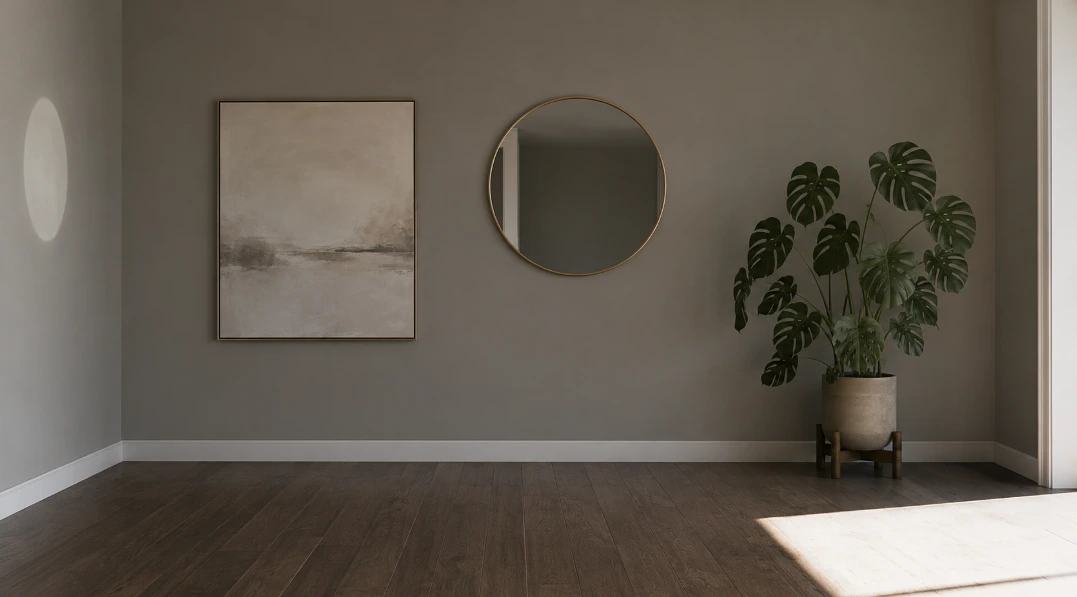
Now for the part that gets repeated everywhere and falls apart the moment you think about it.
Swapping dark artwork for pale artwork will not cool your room. A canvas on an interior wall is nowhere near the sunlight coming through your window. Same story with trading a dark vase for a metallic one.
Mirrors will not do it either. A mirror bounces light around your room, and that light is still energy sitting inside your house.
Plants do release moisture into the air, which is a real thing, and the temperature change in a normal room is far too small to feel. Keep them because you like them, not because you think they are doing your AC’s job.
What does help is what you touch. Lighter bedding, cotton or linen instead of anything heavy. A thinner throw on the sofa. Bare floors instead of a thick rug underfoot. That is comfort rather than cooling, and comfort is what you notice at eleven at night.
Start With the West Facing Windows in Your Hottest Room
You do not have to do all of this at once. Pick your worst room and work down the list from the top.
West windows covered, blinds closed before noon, fan turned the right way and switched off behind you, oven cold until the sun goes down. Free or close to it, all of it, and it is the part most people skip while they shop for a new thermostat.
Then, if the house still will not hold its temperature, get someone out with gauges. That order matters, because the expensive fix is the one everybody reaches for first and it fixes the least while your windows are still letting the sun in.
 Decor & Improvement Accessories