

Home & Decor Blogs: DIY, Interior Design & Lifestyle Ideas
What Holds Your Storage Up: Wall Weights, Bed Gaps and Shed Bases

The Shelf Was Never the Problem. The Wall Was.
It happens in the same way every time.
Somebody buys a nice shelf on a Saturday. They hold it up, they get the spirit level out, they drill four holes, they push the little plastic plugs in with a thumb. They load it with books. It looks wonderful for about eleven days.
Then there is a noise from the living room that is not quite a crash, and the shelf is on the floor, and there are two ragged craters in the plasterboard where the plugs used to be, and the whole thing has taken a lump of wall with it on the way down.
Nobody did anything wrong here except one thing, which is that nobody checked a number.
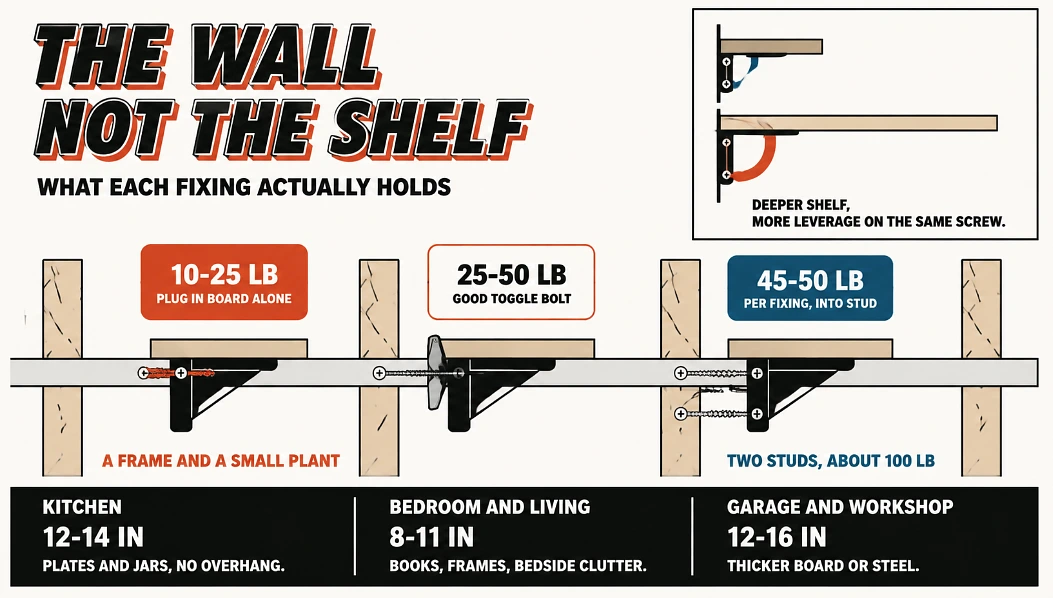
A plug in plasterboard alone holds somewhere around 10 to 25 pounds. Find the timber stud behind that plasterboard and the same fixing takes 45 to 50, so a three foot shelf catching two studs will hold about 100 pounds and not think about it again.
Same shelf. Same books. Same wall, even. Entirely different eleven days.
Storage Is An Arithmetic Problem Wearing A Decorating Costume
That is really the whole thing, and it is why so much storage advice is useless.
The articles all start with what to buy. Baskets, matching bins, a nice trolley. But every one of those is an answer, and you cannot pick an answer before you know the question, which in this case is how much stuff, going where, held up by what.
Weight, volume, and the thing behind the wall. Get those three right and almost any storage plan works. Get them wrong and you own a lot of empty boxes and a hole in your living room.
Do The Sorting First, And I Mean Actually First
Here is the mistake, and it is such a common one that most houses have physical evidence of it sitting in a cupboard.
People buy the storage before they sort the stuff. So the containers arrive, and there is nothing to put in them yet, and eventually the containers themselves become the clutter. Storage holding storage. A cupboard full of empty boxes that were meant to solve a cupboard being full.
Sort first. One room at a time, four piles, so keep, donate, store and throw.
And for anything that makes you hesitate, the question is not whether you might use it. Everybody thinks they might use it. The question is whether you did use it, once, in the last twelve months.
When the piles are finished you know your real volume, and now you can go shopping, because now you know what you are shopping for.
The Best Storage In A Small House Is Furniture That Does Two Jobs
An ottoman that opens. A bed with drawers. A bench by the front door that you sit on to take your shoes off and that swallows the shoes afterwards.
None of that is a new idea. What is worth knowing is the two details that decide whether you keep using them after the first month.
Gas struts on any lifting lid. This sounds like a small thing. It is not. A loose top that you have to hold up with one hand while rummaging with the other stops getting opened after about a fortnight, and then it is a table with a secret nobody visits.
And on beds, ask which way the drawers pull before it arrives, not after. A drawer bed shoved against a wall has lost half its storage on delivery day, and this gets discovered roughly three weeks later by somebody kneeling on the floor swearing quietly.
If the bed is staying, measure underneath it first. Most frames leave six to twelve inches, and every under bed box on the market is built to that gap rather than to whatever you were planning to slide under there.
What Is Behind The Plasterboard Decides Everything On The Wall
Back to the shelf from the top, because this is the section that saves you a wall.
Roughly 45 to 50 pounds per stud the bracket is fixed into. Two studs, about a hundred pounds, which is a proper run of hardbacks and a lamp.
No stud, and you are relying on the anchor alone, so 10 to 25 pounds for a standard plug, maybe 25 to 50 for a good toggle bolt. That is a framed photo and a small trailing plant. It is not books, whatever the packaging says.
Depth quietly works against you too, and this one surprises people. The further the shelf sticks out from the wall, the more leverage it puts on the fixings. So a shallow shelf carries more per inch than a deep one, and anything long or deep wants a continuous rail behind it instead of two lonely brackets.
Depths that work in real rooms:
Kitchen, 12 to 14 inches, which takes dinner plates and jars without them hanging over the edge. Bedroom and living room, 8 to 11 inches, fine for books, frames and the things that accumulate beside a bed. Garage or workshop, 12 to 16 inches, in thicker board or steel, because that is where the heavy nonsense lives.
Studs sit at 16 inch centres in most houses. That is not a coincidence and it is exactly why three foot shelves are everywhere. Find the studs, then design the shelf around where they happen to be, rather than deciding where the shelf goes and hoping.
Oh, and in a garage or a utility room, skip shelves entirely and put up pegboard or a stud mounted rail. Storage needs change constantly in those rooms and a hook moves in four seconds where a shelf means drilling the wall again.
Floor Space Is The Expensive Kind, So Stop Using It
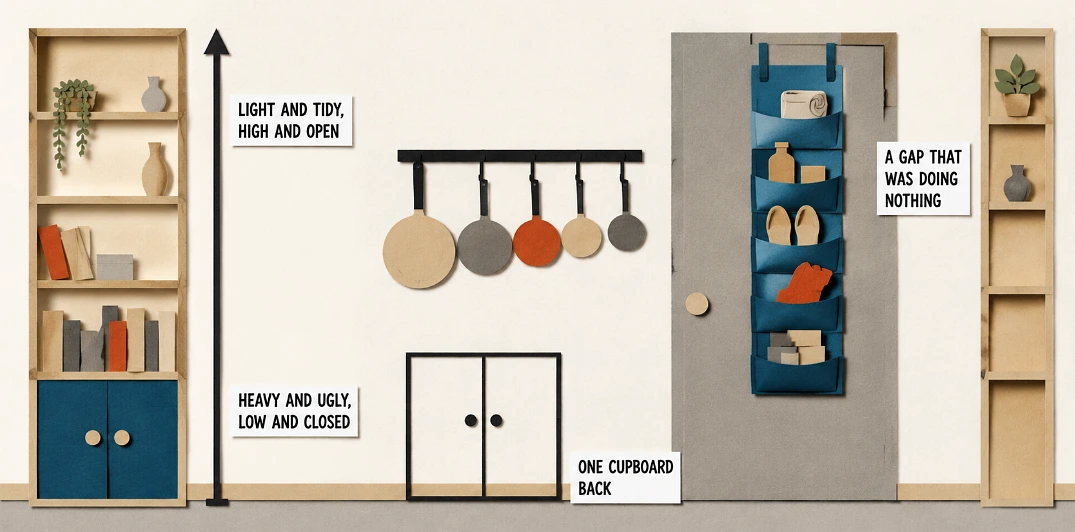
Tall and narrow beats short and wide, every time, in any room that is short of floor.
A slim bookcase takes a corner that nothing else wanted and pulls your eye upward, which makes the ceiling feel higher than it is. A wall mounted pot rack hands you back an entire kitchen cupboard for the price of four screws. An over door organiser uses a gap that was doing absolutely nothing for anybody.
One rule keeps all of that from looking like a stockroom. Heavy and ugly goes low and closed. Light and tidy goes high and open.
Do it the other way round and you have a warehouse with a sofa in it, and you will not be able to work out why the room feels wrong.
Half The Clutter Indoors Belongs Outdoors
The mower. The bikes. The tools. Six crates of Christmas decorations. The paddling pool somebody was very enthusiastic about in June.
None of it needs to be inside the house and all of it is usually what has quietly eaten the garage.
A shed fixes that, and the part everybody rushes is what the shed is standing on.
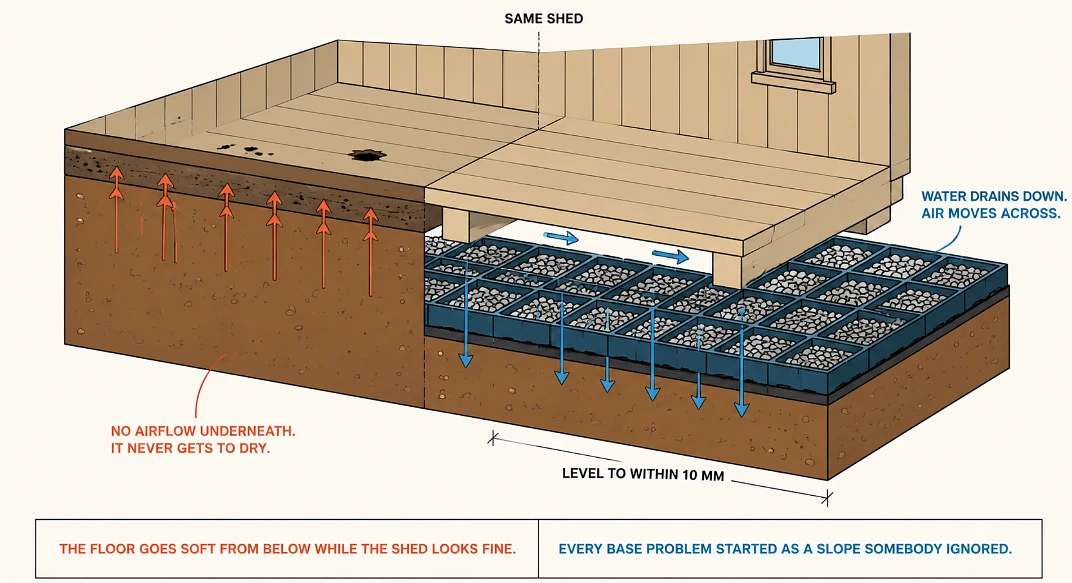
A shed with no proper base is a shed with a rotting floor. Ground moisture wicks straight up into the timber, and because it never gets airflow underneath it never dries out, so the floor goes soft from below while everything above it still looks perfectly fine. You find out when a leg of the mower goes through it.
Concrete slabs do work. They are also a mixer, a weekend, a cure time, and then living forever with whatever level you managed on the day.
Plastic shed bases are the other route. An interlocking grid, filled with gravel, so water drains down through it instead of pooling underneath the shed and waiting for the timber to get thirsty.
Whichever you pick, level the ground properly first. Every single base problem anybody ever complains about started as a slope that somebody decided was near enough.
Staying Tidy Is The Actual Project
The clear out is the easy part. What nobody tells you is that it comes back, quietly, over about eight months.
One in, one out. New thing arrives, similar thing leaves. This one habit stops most of the creep on its own. Fifteen minutes a day of putting things back rather than putting them down. A seasonal look through the shed and the loft, because those are where forgotten things go to be forgotten properly. Label the boxes on the side, not the top. The top is the bit you cannot see once they are stacked.
That last one sounds trivial and it is the difference between storage and burial. An unlabelled box gets opened once, gets shut again, and then sits there for four more years because nobody fancies finding out what is in it.
The Way To Think About All Of This
Sort before you shop. Check what is behind the wall before you drill. Get the shed off the wet ground.
None of that is exciting and none of it costs much, and it is the difference between a house that feels bigger by Christmas and a house with a shelf on the floor.

 Decor & Improvement Accessories