

Home & Decor Blogs: DIY, Interior Design & Lifestyle Ideas
The Gas Hot Water Tank In Your Canberra Garage Is Now A Timing Decision


There is a phrase this country reaches for in exactly this situation, and you already know what it is. She’ll be right.
The tank is fifteen years old. It sits in the garage or against the side wall, it has never given you trouble, and it still makes hot water every morning. She’ll be right.
And she is right, for now. That is the majority position around Canberra, since roughly seven in ten homes here are still connected to gas and a good share of those tanks went in somewhere around 2010 or 2011. The trouble is that the rules changed underneath your tank while it was quietly doing its job, and she’ll be right stops being a strategy the moment the thing stops working.
Canberra Stopped Connecting New Gas In December 2023
Something happened that month that you had no particular reason to notice. Why would you? Your hot water was fine, the heater was fine, and policy announcements are not what anyone is reading over breakfast.
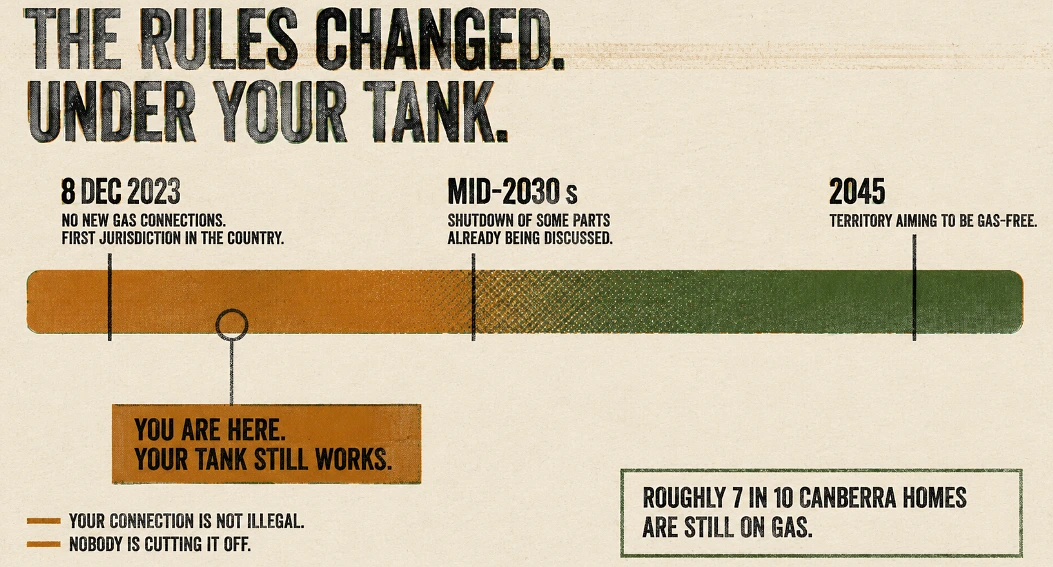
On 8 December 2023 the ACT stopped allowing new fossil fuel gas network connections to buildings, making it the first jurisdiction in the country to legislate it. Every home built in Canberra since is all-electric by design.
What that actually means for the house you are living in, though, is narrower than it sounds:
- It does not touch your existing connection. Your gas is not illegal, and nobody from the government is coming down your driveway to cut it off.
- It does mean the network you are attached to has a finish line now. The Territory is aiming to be gas-free by 2045, and shutdown of some parts is already being discussed for the mid-2030s.
So the gas keeps flowing, your tank keeps working, and the decision stays theoretical right up until the morning it is not. Which is the whole problem, because that morning is going to be a Sunday.
A Gas Tank Bought Today Still Has A Gas Line To Remove Later
You can put another gas tank in. It is legal, the units are available, and a plumber will have it swapped inside an afternoon. Plenty of Canberra households will do exactly that this winter.
It is also the version where you pay twice without noticing you agreed to it. Tradies have a saying about this that fits better than anything I could write, buy once, cry once, and a straight gas swap is the opposite arrangement.
- Today: a new gas tank, fitted quickly, cheapest number on the day.
- Later: a bit north of a thousand dollars to disconnect the gas line and pull the meter, plus another decade of daily supply charges sitting on your bill in between.
The straight swap is not the wrong answer, it is the answer where the cheap part happens in front of you and the expensive part happens somewhere out of sight.
Is there still a case for it? There is, and pretending otherwise would be silly. If you are selling inside a couple of years, or the budget genuinely will not stretch past the cheapest immediate fix, a gas replacement puts hot water back on today. What matters is that you chose it, rather than discovering it later.
The Booster Element Fires Below Minus Five, And Canberra Gets There
Now the part that belongs to this city rather than to a national brochure.
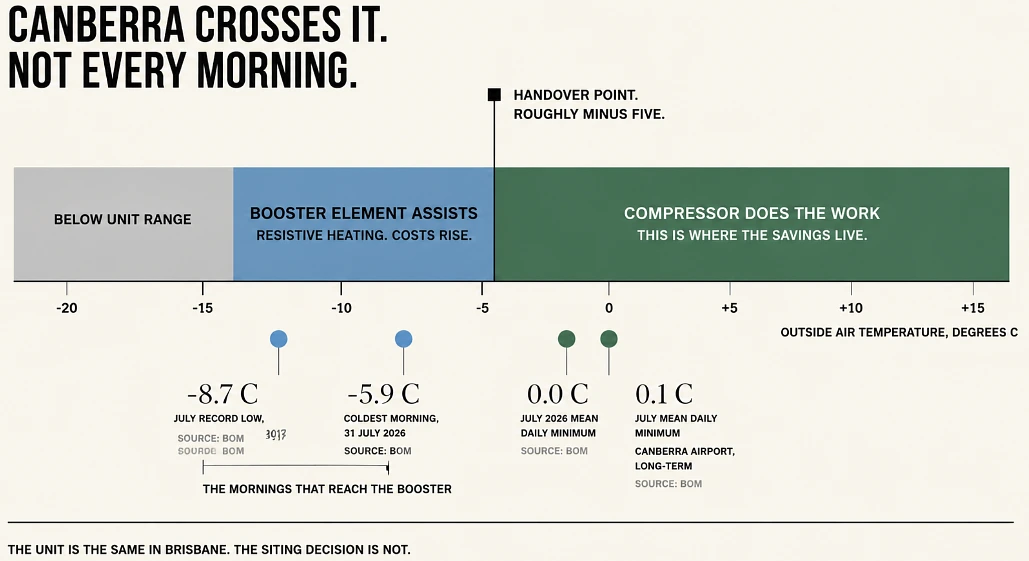
A hot water heat pump takes warmth out of the outside air, and modern units keep doing that down to somewhere around minus fifteen. Below roughly minus five though, most of them hand over to an electric booster element, and the ACT Government’s own factsheet does not soften what that costs you, warning the booster can significantly increase your water heating costs if it is running often.
You have scraped ice off a windscreen in Weston Creek in July. You know Canberra gets there.
Not every morning and not for long, but often enough that the same unit behaves differently here than it does in Brisbane, and that difference is decided at installation rather than afterwards.
Where The Unit Sits, And When It Runs
Two things separate a heat pump that sips power through a Canberra winter from one that leans on the booster.
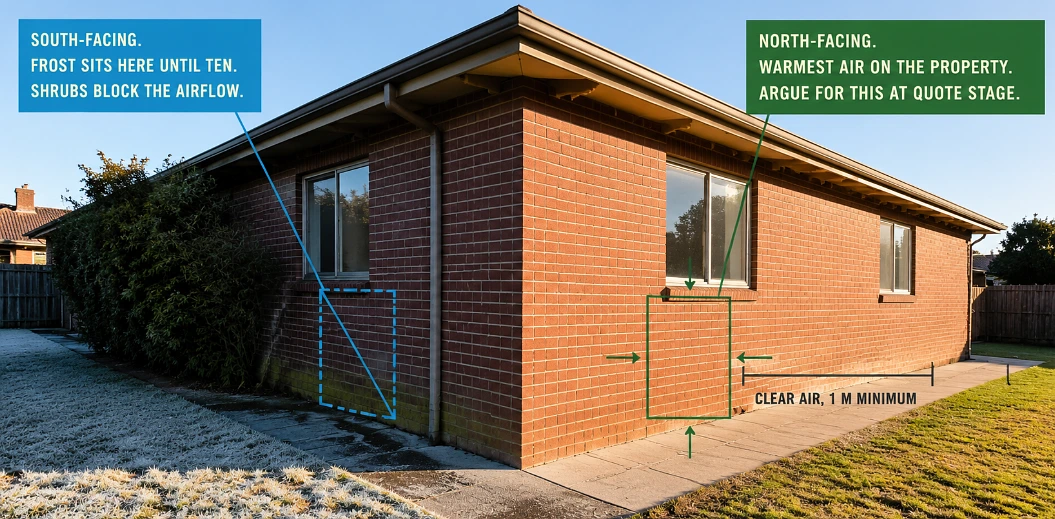
First is where you put it. It wants clear airflow and it wants the least brutal spot on the property, which usually rules out that shaded southern corner where the frost sits until ten in the morning. A north-facing wall with open air around it is worth arguing for while somebody is still quoting rather than after they have drilled.
Second is a timer. These tanks are well insulated and lose heat slowly, so running the cycle through the warm part of the afternoon instead of before dawn keeps the compressor working in the easiest air of the day, and if you have panels on the roof, that same afternoon run is spending your own electricity rather than buying it back. Ask whether a timer is included, because the answer varies between installers and it changes what you pay every year afterwards.
Rebates Cover Half The Install, But Only Before You Buy
Here is where the Sunday emergency gets genuinely expensive, and it has nothing to do with after-hours rates.
The ACT’s Home Energy Support scheme covers 50% of supply and installation on a hot water heat pump, up to $2,500, and it pairs with a zero-interest loan of up to $10,000. Sitting alongside it, the Sustainable Household Scheme runs low-interest loans from $2,000 to $15,000 over as long as ten years.
Set that against a Canberra heat pump install of roughly $2,300 to $4,800 and you can see the shape of it. That is not a discount at the edges. That is potentially half the job.
And you cannot claim any of it while standing in a cold bathroom at seven on a Sunday evening. There are eligibility checks, quotes to gather, and an application built on the assumption that you have not bought anything yet. The household that sorts this out early buys the same system as the household that panics, for something close to half the money.
Which is the argument for arranging hot water installation while the old tank is still limping rather than after it has stopped, because a planned job leaves room for the paperwork, the siting conversation and the timer, and an emergency job leaves room for none of the three.
The Yearly Gap Is Six Hundred To Fourteen Hundred Dollars
Back to your house. Three or four of you, showers stacked up between seven and eight in the morning.
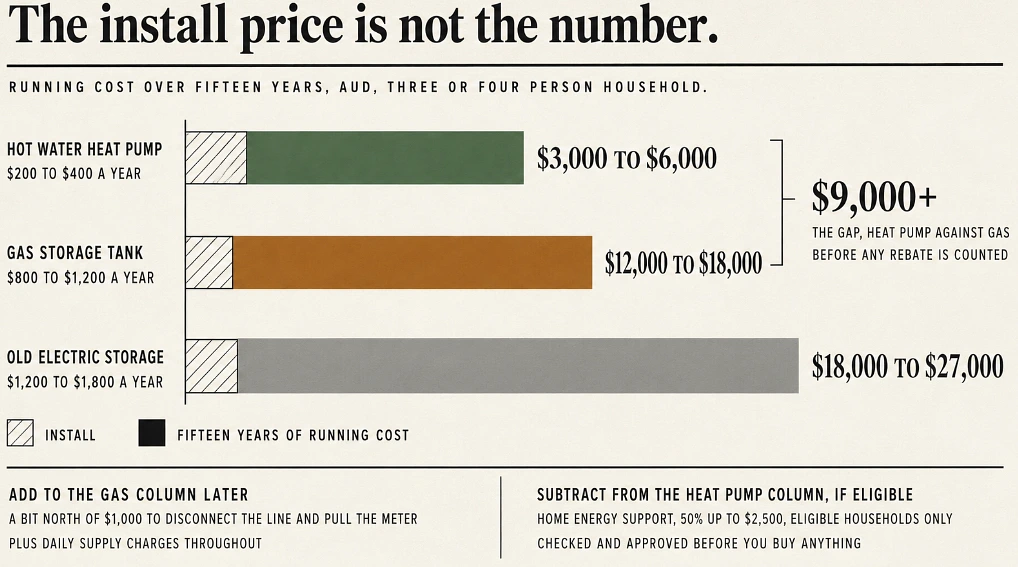
Run that on a heat pump and you are looking at roughly $200 to $400 a year. On gas it is somewhere around $800 to $1,200. On old electric storage it is worse again, $1,200 to $1,800.
Hot water is the second largest energy use in an average Canberra home, sitting behind heating and cooling, so none of this is a rounding error on the bill. Across the ten or fifteen years the next tank is going to spend in your garage, the distance between the gas figure and the heat pump figure runs well into five figures.
That number decides this more than the install price does.
The Cheapest Version Of This Decision Happens In October
Not because October is special. Because it is not winter and your tank has not died yet.
Before it does, a few things are worth having settled:
- The age of the current unit, which is usually stamped on the compliance plate.
- Whether your switchboard has capacity for an electric system, since that is the surprise that turns a simple job into an expensive one.
- Which rebate your household actually qualifies for, checked before you buy anything.
- Where a heat pump would physically go, and whether that spot gets morning sun or morning frost.
- Whether the quote includes removal and disposal of the old tank, because some do and some quietly do not.
That tank is going to make this decision for you eventually, on a day of its own choosing. Fifteen minutes on the list above is the difference between picking a system and taking whichever one can be fitted before dinner.
 Decor & Improvement Accessories