

Home & Decor Blogs: DIY, Interior Design & Lifestyle Ideas
How to Judge a Phoenix Neighbourhood Before You Buy There
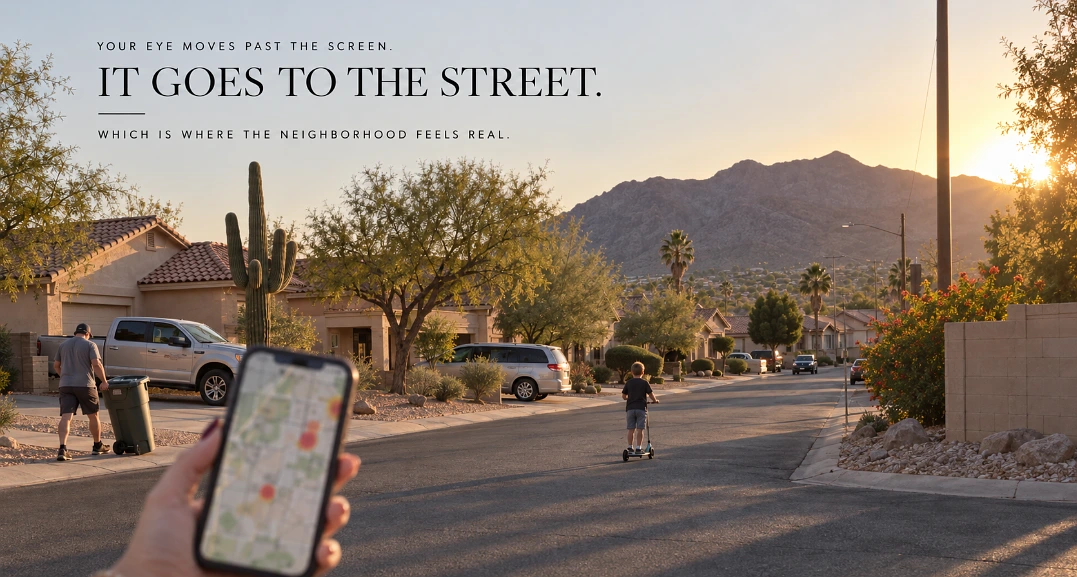
Most buyers start with a crime map, and it is probably the least reliable thing they will look at during the whole search.
What a map reports is incidents inside a boundary, and what it cannot report is anything about what sits inside that boundary. In a city the size of Phoenix that gap gets wide, because the districts inside the city line have very little in common with each other.
The 2024 figures give a sense of the shape of it. There were somewhere around 13,300 violent crimes and 38,700 property crimes across the city, so the bulk of it is property crime, and the category that stands out is vehicle theft at roughly 7,000 a year, which runs well above the national rate. That is not the problem most people have in mind when they see a red patch on a screen.
City wide averages are close to meaningless on their own. Phoenix works out at about 7 violent crimes per 1,000 residents, and Ahwatukee Foothills sits nearer 2 to 3, which means the citywide number is describing almost no one’s actual street. Published lists of the safest neighborhoods are a better place to start than a heat map, if only because they break the city into pieces somebody could walk across.
Why a District’s Population Changes What the Numbers Mean
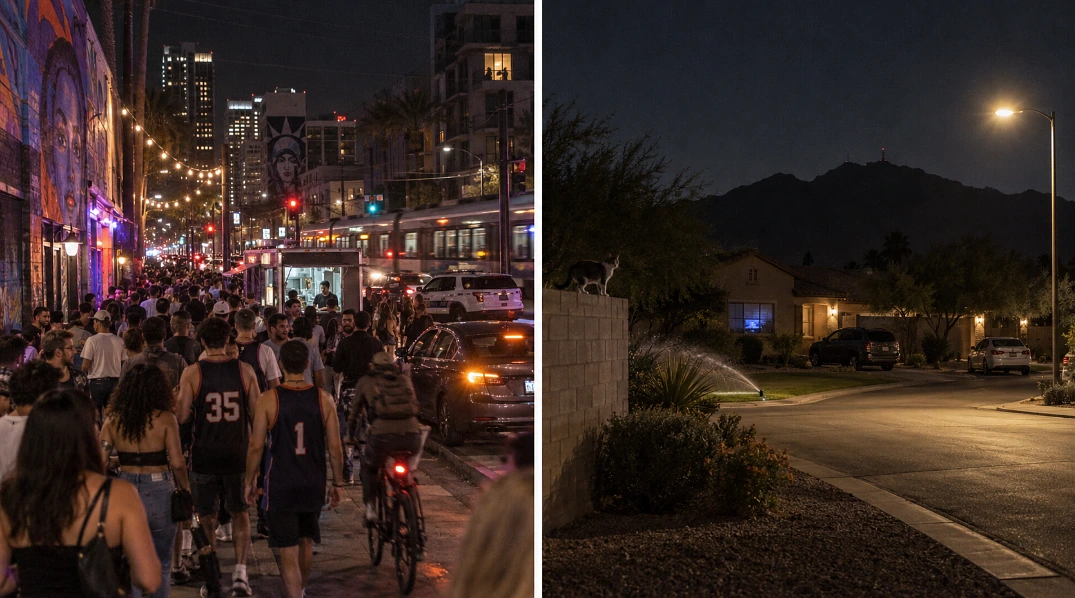
Two neighbourhoods can report the same number of incidents and be nothing like each other, because the count moves with how many people are around rather than how many live there.
Downtown Phoenix and the Roosevelt Row area take in commuters, bar traffic, crowds coming out of the stadiums and the arena, and a daytime working population. The number of residents is small next to the number of people standing in it on a Friday night.
Ahwatukee works the other way. It sits behind South Mountain, it is mostly residential, and the people in it are largely the people who live there.
An identical incident count in those two places is describing two different risks to a resident. One is spread across a population that fills and empties every day, and the other lands among the people who sleep there.
It is worth asking what fills an area at different hours before reading anything into a total.
Phoenix Road Design Is a Safety Issue On Its Own
This is the part buyers skip, and in Phoenix it carries more weight than it does almost anywhere else.
The city runs on a grid of wide arterial roads with long blocks, high speed limits and not many crossings. Those roads move traffic efficiently, which is the same thing as saying they are difficult to cross on foot, and Arizona ends up near the bottom of the national rankings for pedestrian deaths year after year.
Worth looking at on a street visit:
- How far apart the crossings are on the nearest arterial, because half a mile between signals means people cross wherever they happen to be
- Whether footpaths run continuously or just stop at a wall
- Traffic speed at 5pm rather than at midday
- Whether a child can get to school without crossing six lanes
A quiet subdivision sitting against a fifty mile an hour arterial is a different proposition for a family with a ten year old than the map suggests it is.
Heat Changes What Walkable Means Here
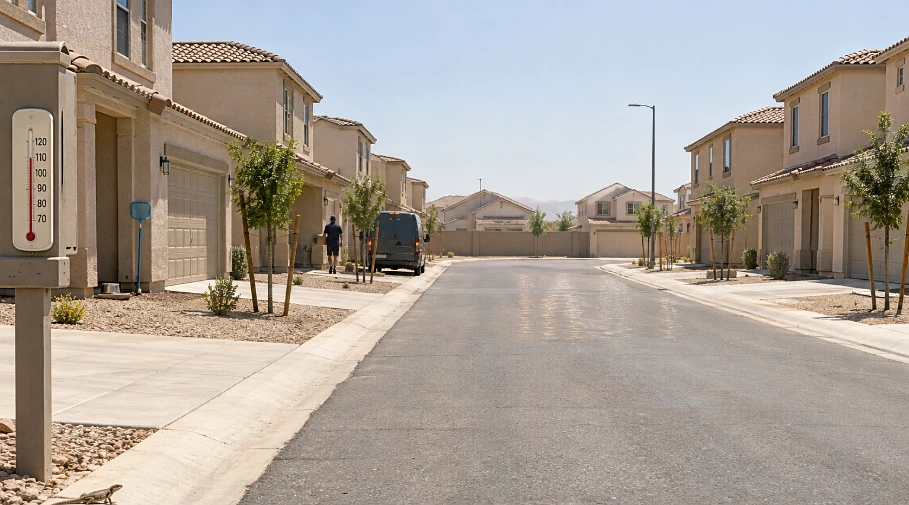
No crime map carries this one, and it separates Phoenix from nearly every other market in the country.
Between June and September, a walk of any length only really works early or late in the day. That reshapes the whole calculation, because shade and distance and timing end up doing more to decide whether people are outside than street layout ever does.
Streets with mature trees, covered paths and short distances to shops keep people out on them. Streets with none of that empty out for four months, and an empty street loses the eyes that make a place feel watched.
Visiting in July is the honest test. A neighbourhood that looks alive in February can be deserted in August, and that is the version somebody lives in for a third of the year.
The Things Worth Checking Before You Commit
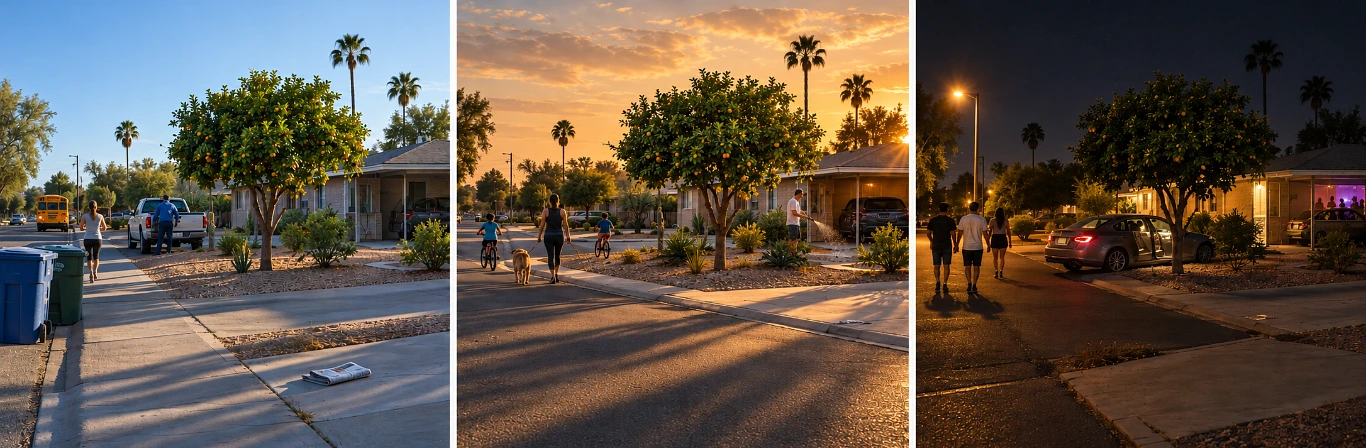
Data narrows a shortlist. These are what settle it.
- Visit three times, so a weekday morning, a weekday evening around six, and a Friday or Saturday night. The same street can be three different places.
- Look at maintenance, so whether the lighting works, the bins get collected, graffiti gets removed, verges get cut. Those say whether anybody is paying attention.
- Check the HOA situation, since a lot of the north Phoenix and Ahwatukee housing sits inside master planned communities with private patrols and active management, and that changes the day to day feel.
- Ask about vehicle theft specifically, because it is the standout crime here. Garage parking and a gated entry matter more in this city than in most.
- Talk to two neighbours, not the agent. Somebody who already lives on the street will explain what it is like after dark in about four minutes.
What the Safest Areas Have in Common
The names that keep coming up are Ahwatukee Foothills, Desert Ridge, North Gateway, Desert View, Deer Valley and Arcadia.
What they share is a set of features rather than a location. Master planned layouts, active HOA oversight, newer construction, low through traffic, and a resident population that does not swell with visitors.
That last one is the pattern worth carrying into any neighbourhood, including the ones that never appear on a list. Low through traffic and a settled population do more for how a street feels than a good score on a map does.
The map is somewhere to start. In a city this size it is not the answer and it is not close to being one.

 Decor & Improvement Accessories