

Home & Decor Blogs: DIY, Interior Design & Lifestyle Ideas
1 Dead Outlet Is Usually A Circuit Problem, And Here Is The Order To Check It In
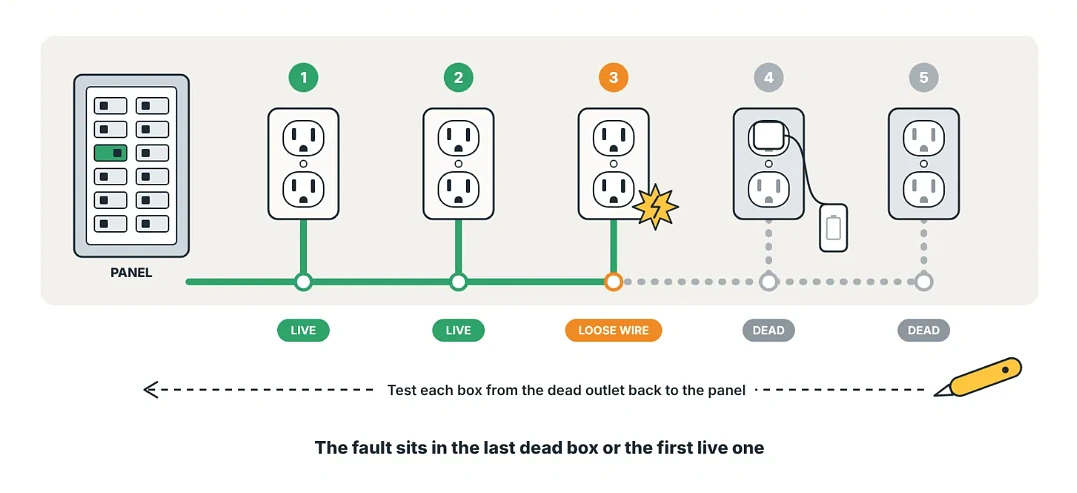
So the phone charger stops charging on the bedroom wall one morning, and what most people do is move the plug to the next socket along, see the phone charging again, and forget about the dead one for a month or so. Which is fair, because a dead outlet looks like a small thing. Now, the thing about that socket is that it is not on its own back there. In a normal house it would be 1 of maybe 8 to 12 outlets and lights hanging off 1 breaker, all wired in a chain from the panel outward, and when 1 of them goes dead the question is not really what is wrong with that socket. It is where along that chain the power stopped getting through.
A dead outlet is a clue about a circuit, not a broken part. There are 4 things that usually cause it, and 3 of the 4 you could check yourself in about 10 minutes without touching anything you should not. The 4th is the one you call someone for.
The 4 Things That Kill An Outlet, Cheapest First
Going by how often they turn up: the thing plugged in, a tripped GFCI somewhere upstream, a tripped breaker, and a loose connection in a box further along the same circuit.
1. The thing plugged in. It comes first because checking it costs nothing. A cracked cord, a worn adapter, a power strip that died without telling anyone, any of those would make a perfectly good outlet look dead. Plug in a lamp you know works. If the lamp lights, the outlet was never the problem and you have just saved yourself a call.
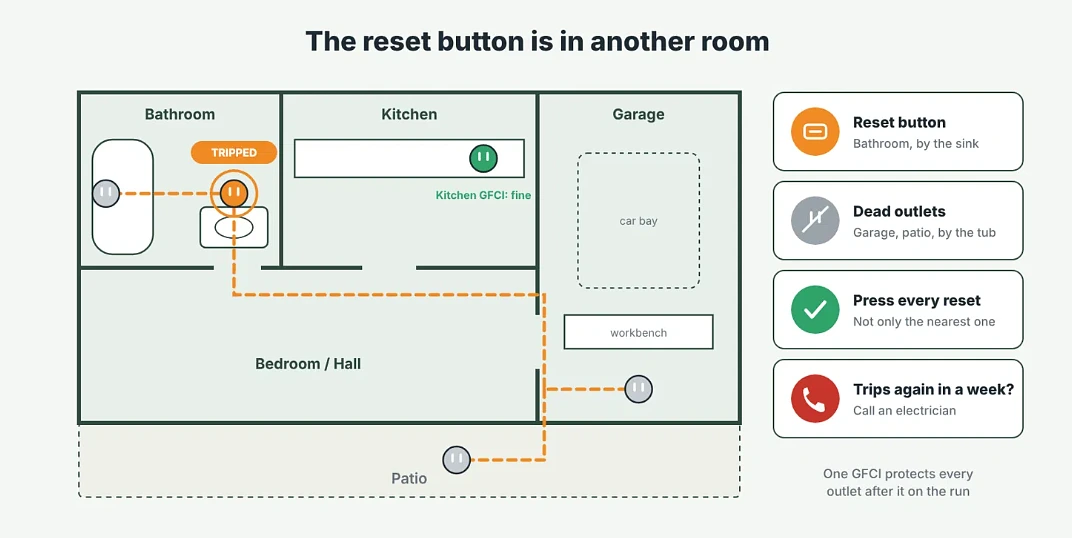
2. A tripped GFCI upstream. This is the one that catches the most people out. The electrical code has wanted ground fault protection in wet rooms since the 1970s, bathrooms first and then kitchens, garages and outdoor sockets, and the cheap way a builder would meet that rule was to put 1 GFCI outlet at the start of a run and let it protect every outlet after it. So the reset button for a dead socket in the garage might be in the bathroom. Or on the kitchen counter. Or behind the washing machine. It trips, everything downstream goes quiet, and the GFCI itself sits in another room looking like nothing happened. Hmm, and people spend an afternoon on the garage socket without ever going near the bathroom.
3. A tripped breaker. It would cut the whole circuit, so if the outlet is dead there are usually other things dead with it, and that is your giveaway. Walk the house and note what else stopped at the same time.
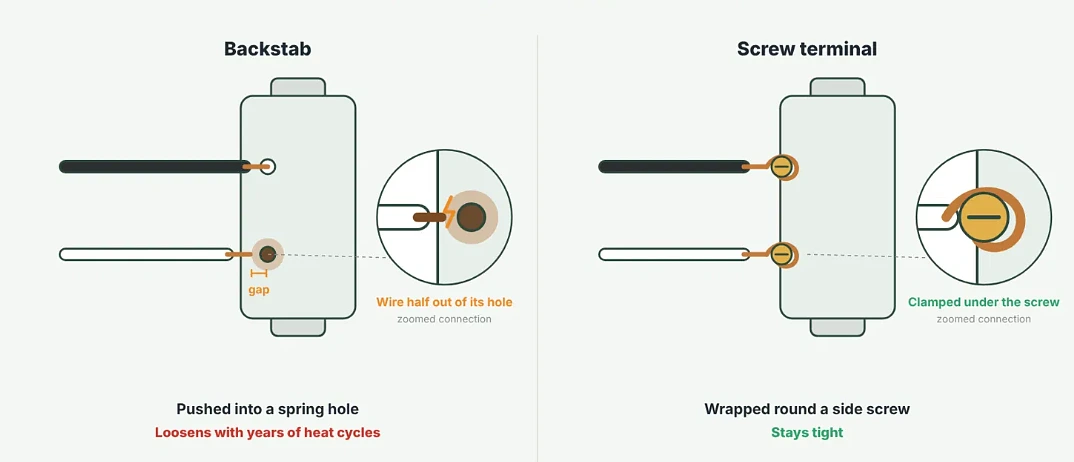
4. A loose connection in a box along the run. This is the real one. Outlets get wired 2 ways. Either the wire wraps round a screw on the side, or it pushes straight into a spring hole on the back, which is called backstab. Backstab was the standard in tract housing for about 30 years because it is quicker, and backstab connections loosen over decades of warming up and cooling down. A wire that has crept half out of its hole 3 boxes upstream would kill every outlet after it and leave no mark at all on the one you are staring at. That is the fault that makes people replace 3 outlets and still have a dead wall.
What A Homeowner Can Check In 10 Minutes
Everything here gets done with the panel cover on and nothing opened up.
- Plug a working lamp into the dead outlet, then into the sockets either side of it, and note which ones are dead
- Press the reset button on every GFCI in the house. Bathrooms, kitchen, garage, outside, laundry, all of them and not only the nearest one
- Open the panel door, which is not the cover, and look for a breaker handle sitting halfway between on and off. A tripped breaker does not always flip fully off. Push it off, then back on
- Write down what else stopped working and when. A dead outlet plus a dead porch light plus a dead garage door opener is a map of the circuit, and it would save a technician the first 20 minutes
If the outlet comes back after a GFCI reset or the breaker, you are done for now. If the same GFCI or breaker trips again inside a week, something on that circuit is pulling too much or leaking to ground, and that is where you stop and call.
The 4 Signs That Mean Stop Using It Today
A warm cover plate, a buzz or a crackle, a burning smell, or brown or black marks on the plastic. Any 1 of those means heat is building at a loose connection, and heat at a loose connection is how a fire gets started inside a wall.
The thing to understand is that those 4 are the same fault at 4 different stages. A loose connection has a tiny gap in it. Current jumps the gap. The jump makes heat. The heat loosens the connection a little more. A warm plate is early. A buzz is the arc you can hear. A smell is the plastic starting to cook. The brown marks are the stage after that, and you would not want to find out what comes next.
An outlet that only works when you wiggle the cord is the same fault before it has got hot enough to notice. So is a lamp that flickers when someone walks past. Unplug it, leave it alone, and do not put a space heater on that circuit while you wait for someone.
Why Tracing The Circuit Beats Swapping The Outlet
A new outlet is $3 and 20 minutes. A new breaker is about $15. Neither one would fix a loose wire 3 boxes upstream, which is why swapping parts turns out to be the expensive way to find a cheap fault.
We put this to Firefly Electrical Services, who have been doing residential repair out of Lakewood since 2014 and cover Golden and Arvada and that whole west side of Denver, and asked what the first thing is that they check on a dead outlet call. GFCIs and the panel, they said, before anything gets opened, because a decent share of these calls end right there with a reset button. After that it is a voltage tester at each box along the run, starting at the dead outlet and working back toward the panel until power shows up, and the loose connection would be in the last dead box or the first live one. Not complicated, but you do need the tester and you need to know which boxes are on the run. So the local electricians Golden CO homeowners ring for this will usually find it in 1 visit, where a homeowner swapping parts could go through 3 outlets and a breaker and still be sitting with the same dead wall.
The trace also catches the thing a swap never would. Open the boxes along a run in a 1980s house and there is usually more than 1 backstab connection on its way out, and fixing all of them while the circuit is already open is a Tuesday morning. Finding them 1 at a time as each one fails over the next few years is 5 separate calls, which is the bit people do not think about when they are weighing the $3 outlet against the call-out.
| What you see | Most likely cause | You can check | Electrician job |
|---|---|---|---|
| 1 outlet dead, everything else fine | The device, or a GFCI upstream | A different lamp, then reset every GFCI | If both come up empty |
| Several outlets and a light dead together | Tripped breaker | Panel door, handle sitting between on and off | If it trips again inside a week |
| Outlet works when the plug is wiggled | Loose connection in that box | Stop using it | Yes, soon |
| Warm plate, buzz, smell, brown marks | Loose connection heating up | Unplug and leave it | Yes, today |
| Dead outlet in the garage or outside | GFCI in the bathroom or kitchen | Reset buttons in every wet room | If the reset does not hold |
That socket on the bedroom wall is probably still dead a month later. Before anyone replaces it, go and press every reset button in the house, because that fixes more dead outlets than a screwdriver ever has.

 Decor & Improvement Accessories