

Home & Decor Blogs: DIY, Interior Design & Lifestyle Ideas
How To Choose A Standby Generator Location On A Pittsburgh Lot

The storm came through on a Tuesday afternoon. By Wednesday half the city was on candles and the hardware stores had run out of extension cords. If you were here on April 29 you do not need the figures, but here they are anyway, more than 300,000 Duquesne Light customers out, nearly half the company’s base, 2 people killed in Allegheny County, 95% back inside 5 days and the last of it 9 days later, and in September the company sat in front of city council and said “we do acknowledge that things did not go well”.
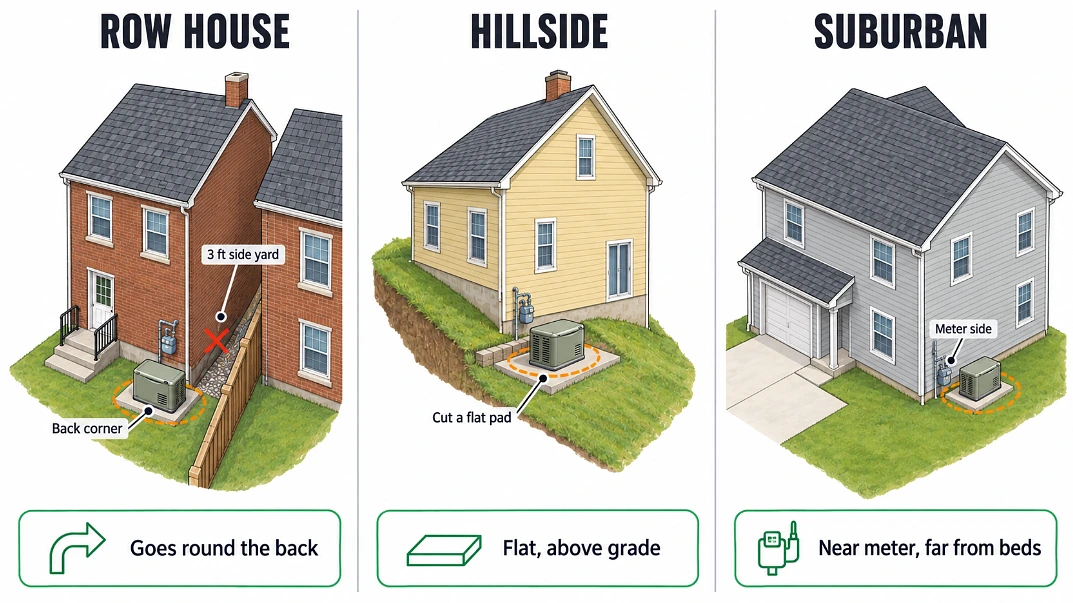
So the generator is being priced, and the quote is the easy part. The hard part on a Pittsburgh lot is where it sits, because this city has 3 kinds of lot and each one fights the machine in its own way, the row house with a side yard of 3 or 4 feet, the hillside where the back yard is a slope, and the suburban lot in the North Hills or the South Hills with room to spare and a long way from the meter. One rule, the manufacturer’s, settles most of it on all 3, and the gas meter and the bedrooms settle the rest.
The 5 Foot Rule Decides Most Pittsburgh Side Yards
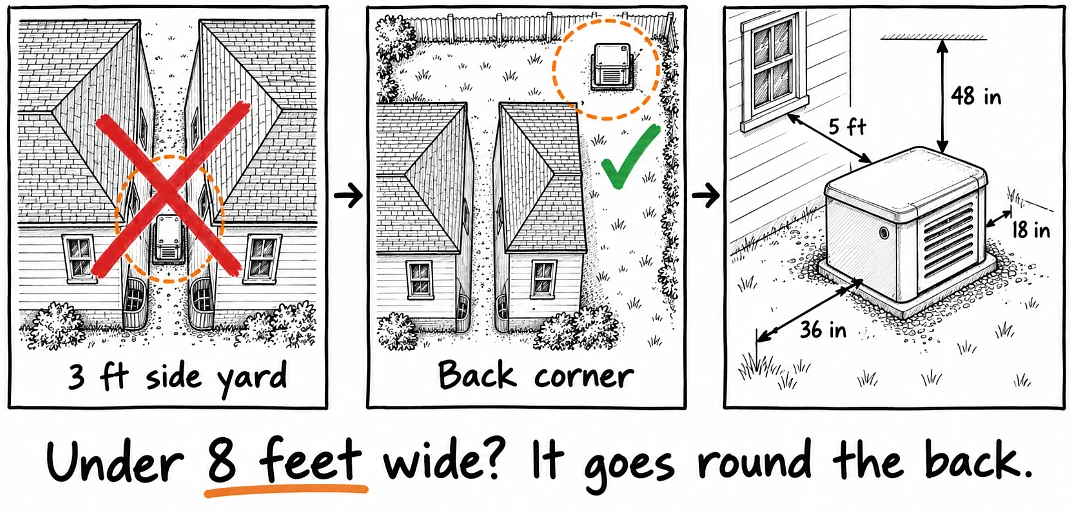
Briggs & Stratton’s own placement page gives the distances, and they come from NFPA 37, the fire standard every installer in the county works to:
- 5 feet from any window, door, vent or other opening in the wall, measured from every part of the unit.
- 18 inches from the house wall, and only for the fire tested units, an untested unit may need 5 feet from anything that burns.
- 36 inches clear at the front and both ends, and shrubs count as a wall.
- 48 inches clear above, so no deck, no overhang, no soffit over the top of it.
The exhaust carries carbon monoxide, and a basement window well is a bowl that holds it, so the 5 feet is measured to the well and to the dryer vent and to the furnace intake, and only then to the glass. A Pittsburgh side yard is 3 feet wide because 1890 did not plan for a Briggs & Stratton, and once the unit has taken its 18 inches off the wall there is no 5 feet left to any window on either house. The rule has no opinion about your lattice either, it counts the shrubs as a wall and leaves fallen against the intake louvers as a fire.
On a side yard under 8 feet the generator goes to the back of the house, the rule does not bend.
I asked Pittsburgh’s generator dealer, Power Pros out in Springdale, about this and they said the same, the side yard loses to the 5 foot rule more often than not, and the back corner on the utility side is where most of their city installs have ended up. The longer conduit sweep that comes with it costs a few hundred dollars more in copper and trench, and that is the end of it.
The Gas Meter Pulls It One Way And The Bedrooms Pull It The Other
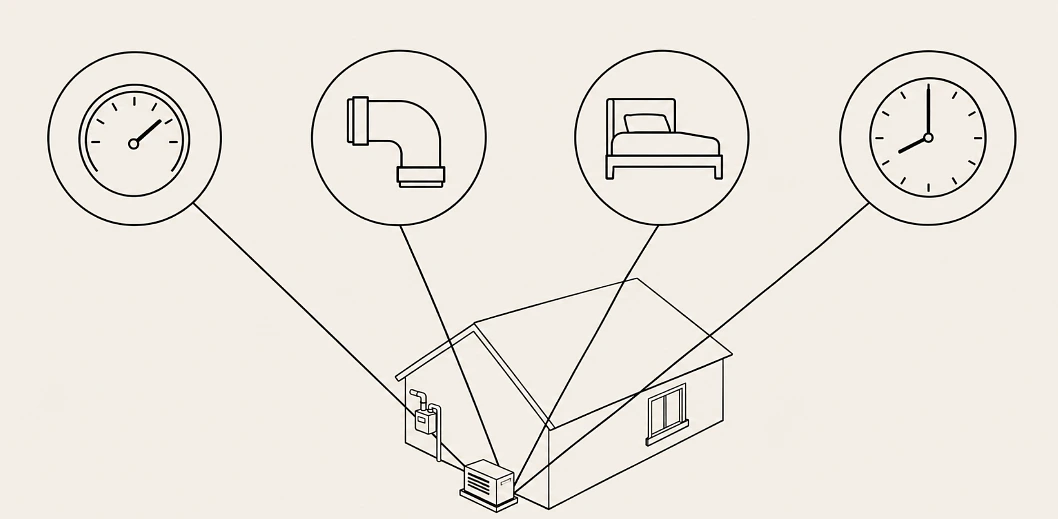
Almost every Pittsburgh house runs on Peoples natural gas and the meter sits at the front or on the side, so the generator wants to be near it. A standby unit draws gas by the cubic foot an hour and the line has to carry that on top of the furnace and the water heater on the coldest night of the year, when all 3 are running, and every foot of pipe and every elbow between the meter and the unit drops the pressure a little, until the unit could start, stumble and shut down under load. Close to the meter means a smaller pipe and fewer elbows.
An 11 kW unit on an old city meter will usually need the meter or the regulator upgraded by the utility before the installer runs a line, so ask Peoples before you ask the installer, because the meter answer changes the spot. Near the meter is also near the front of the house, which on a row house is near the street and on a suburban lot is near the bedrooms, and a generator exercising at 8 on a Sunday under the bedroom window is the complaint the installers hear most.
Near the meter wins on pressure, far from the bedrooms wins on sleep, and on most Pittsburgh lots the back corner on the meter side gives you both.
A propane tank changes the sums, the tank has its own setbacks from the house and the property line, a long run wants 2 stage regulation, and the buried line gets a tracer wire so the next person with a shovel can find it. The generator then sits on the tank’s side of the yard, and the electrical run gets longer instead.
The Hillside Lot And Where The Pad Goes
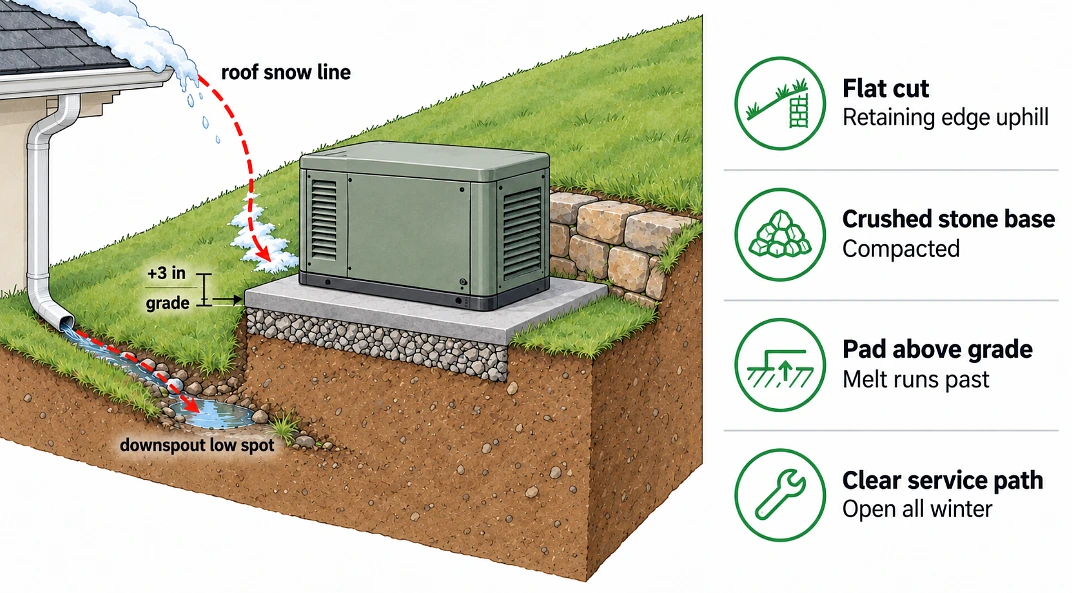
My back yard is a hill, where does the pad even go? Where a picnic table would go, flat, and if there is no flat the installer makes 1, a cut into the slope with a small retaining edge on the uphill side so the ground does not wash into the unit. The pad is a compacted crushed stone base with a poured or composite pad on top, sat a few inches above the finished grade so the spring melt runs past it, and it stays out of the line where the roof sheds snow and out of the low spot where the downspout empties.
On an exposed hill the enclosure gets the anchors the manual specifies, and a clear path to the service side stays open all winter, because the annual oil change is due whatever month it falls in.
The Weekly Exercise And The Neighbor 12 Feet Away
It runs every Sunday at 8 and my neighbor has started leaving notes. Every standby unit runs itself for a few minutes once a week to keep the battery and the engine ready, and the controller lets you pick the day and the hour, so pick Tuesday at 10 in the morning, when the only person home is the dog. The published rating is a decibel figure at about 23 feet, and what the neighbor hears depends on what stands between, so the house itself is the best noise wall you own, the unit goes on the side away from both sets of bedrooms, and the exhaust does not point at a brick wall that will bounce it back onto a porch.
Rubber isolation pads under the enclosure take the hum out of the pad, and a detached garage, where there is 1, makes a better neighbor to the unit than the kitchen wall does.
The Trench To The Transfer Switch
The automatic transfer switch usually sits by the meter base, and the trench from the generator to it is where a bad spot costs money, because every obstacle on the way, a stoop, a patio, a retaining wall, the AC condenser, adds either length or an elbow. What the electrician will be planning:
- The conduit at the depth the code asks, with warning tape above it, and a route that crosses as few other utilities as possible.
- Long radius sweeps in place of stacked 90 degree elbows, so the conductors pull through without tearing the insulation.
- A heavier conductor on a long run to a 200 amp switch, to keep the voltage drop down.
- The low voltage harness between the controller and the switch, kept away from sharp bends and sealed where it enters the foundation.
- A weatherproof disconnect at the unit, in sight of it and at working height, where the mower and the car tires cannot reach it.
The grounding follows the switch design, and that is the electrician’s call, but the spot is yours, and a spot that keeps the disconnect and the conduit out of the driveway will have saved a repair before the first winter.
Permits In The City And In The Boroughs
The city and the boroughs are 2 different desks, and the line between them runs down the middle of some streets. Inside Pittsburgh the electrical and mechanical permits go through PLI, outside it they go through the borough or the township, and either way the steps are the same:
- The 811 call before anyone digs, which is free and takes 3 business days.
- The gas review with Peoples if the meter or regulator cannot carry the new load.
- Zoning confirmation on the setback to the property line, which on a row house lot is the question that moves the unit again.
- A site plan if there is a homeowners association, showing the enclosure, the finish and the pad.
- 2 inspections, 1 after the pad and the rough in, 1 at the end when the switch is tested under load.
If the trench crosses a sidewalk or the public right of way there will be restoration conditions on top. Draw the lot to scale before the pad is ordered, with the meter, every window and well, the bedrooms and the property line on it, and lay the 5 feet out with a tape on the ground on a Saturday, because a pad poured in the wrong corner gets broken out and poured again.
 Decor & Improvement Accessories