

Home & Decor Blogs: DIY, Interior Design & Lifestyle Ideas
Stylish Bedroom Benches Bench for Every Space

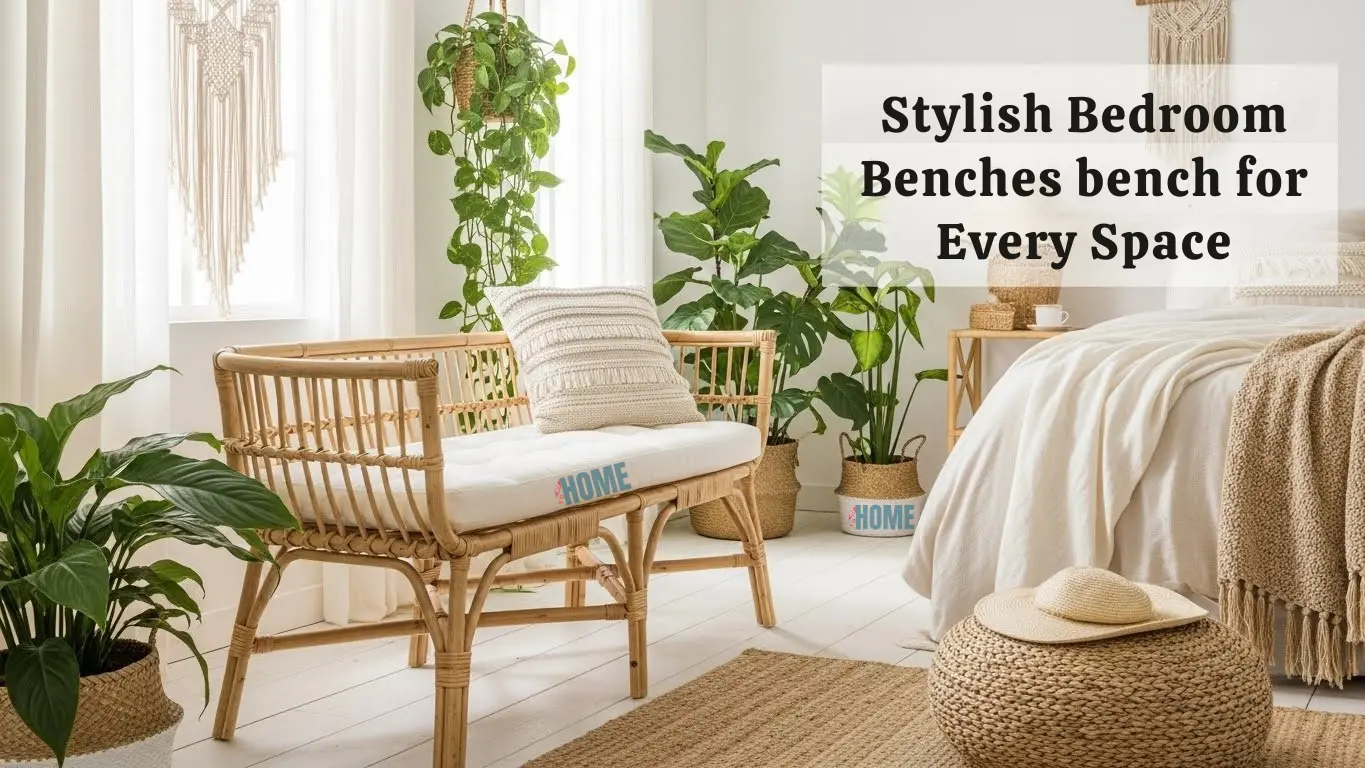
If you have ever walked into a beautifully designed bedroom benches bench and wondered why does this room feel so complete, the answer is often simpler than you’d expect: the bedroom bench. A stylish bedroom bench adds comfort, elegance, storage and personality and it works in almost any design style or room size.
Getting the Size Right, Most People Don’t
A designer we spoke with last year said something that stuck: “I can walk into any bedroom and tell you within five seconds if the bench is the wrong size. It’s always either eating the room or looking like it wandered in from somewhere else.”
She’s not wrong. We’ve seen it constantly. Bench too wide, it juts past the bed frame, catches your shin in the dark. Too narrow and it sits there looking like a forgotten footstool somebody meant to return.
The rule that actually works: 3–6 inches shorter than your bed’s width. That slight inset keeps things proportional. Go flush with the frame and the foot of the bed starts looking like a barricade. Go too short and honestly, why bother.
Height is the thing people skip. 17–19 inches, that puts the bench roughly level with your mattress top. We tested this in a showroom once, sat on benches at 15, 17 and 20 inches. The 15-inch one? Getting back up felt like a workout. The 20-inch one felt like perching on a bar stool someone cut in half. That 17–19 range just works. Your body knows it even if you can’t explain why.
Seat depth, 15–16 inches minimum if anyone’s actually sitting on this thing and not just using it as a clothes rack. Which, fair enough, happens too.
| Bed Size | Bench Length |
| Twin / Single | 36″–40″ |
| Full / Double | 42″–48″ |
| Queen | 44″–52″ |
| King / Cal King | 54″–62″ |
Now here’s where people with small bedrooms make the wrong call. They skip the bench entirely. “No room,” they say. But a 36-inch bench in a tight space does something weird, it actually makes the room feel more complete. Without anything anchoring the foot of the bed, the bed just floats there. Dominates everything. The room reads as “not enough furniture” rather than “thoughtfully minimal.” TheHomeTrotters has recommended this fix dozens of times. It works every time.
Matching the Bench to Your Bedroom’s Style
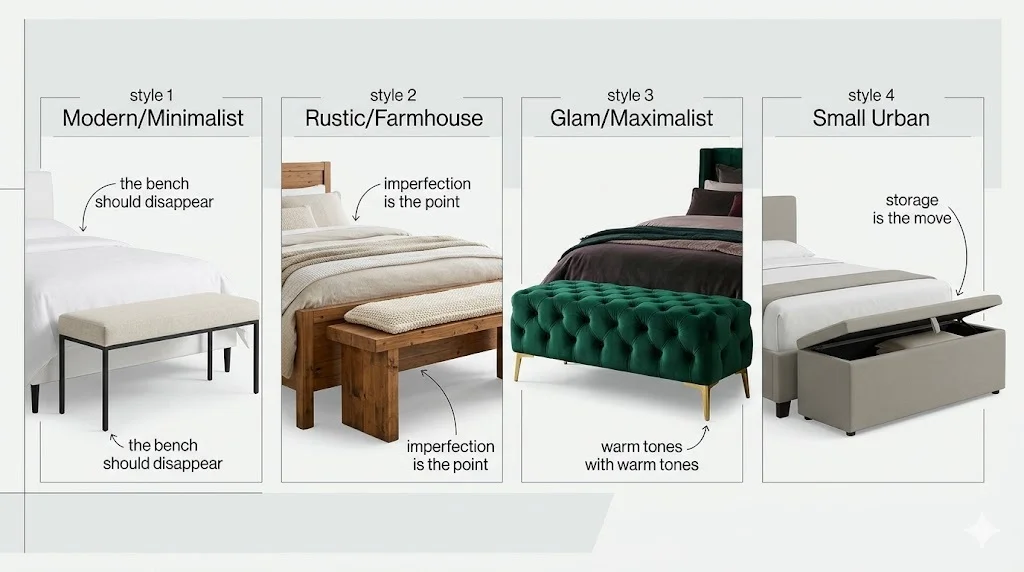
Biggest mistake we see? People color-matching the bench to the bed frame like they’re picking paint swatches. That’s not how this works.
The bench doesn’t need to match. It needs to not fight. Same room, same general mood, that’s it. Architectural Digest has covered this at length. Mixing materials is fine. Mixing tones is where things go wrong. Warm wood bed frame with a cold chrome bench? That’s a fight. Warm wood with warm-toned linen upholstery on different legs? That’s a room.
- Modern / minimalist, metal legs, structured fabric, nothing tufted. Linen or faux leather, neutral palette. The bench should almost disappear. If someone walks in and notices the bench before the bed, you overdid it.
- Rustic / farmhouse, wood grain you can feel, maybe a woven seat or a loose cushion that looks like it’s been there a while. A slatted bench with an uneven stain works because it’s imperfect. We saw a gorgeous one at an estate sale last spring, old pine, slightly warped top, somebody had carved their initials underneath. Looked better than anything in a catalog. That’s the energy.
- Glam / maximalist, velvet. Tufting. Brass legs. This is the one room style where the bench gets to be loud. That deep emerald velvet piece you’re second-guessing? It’s probably exactly right. Glam rooms eat bold choices for breakfast. TheHomeTrotters have pushed people past their comfort zone on this one more than once. Nobody’s regretted it yet.
- Small urban bedrooms, slim, storage underneath, quiet colors. Do not bring ornaments into a small room. It doesn’t read as elegant. It reads as “I bought this for a different apartment.” A storage bench in this context isn’t a compromise. It’s the move.
Placement Beyond the Foot of the Bed
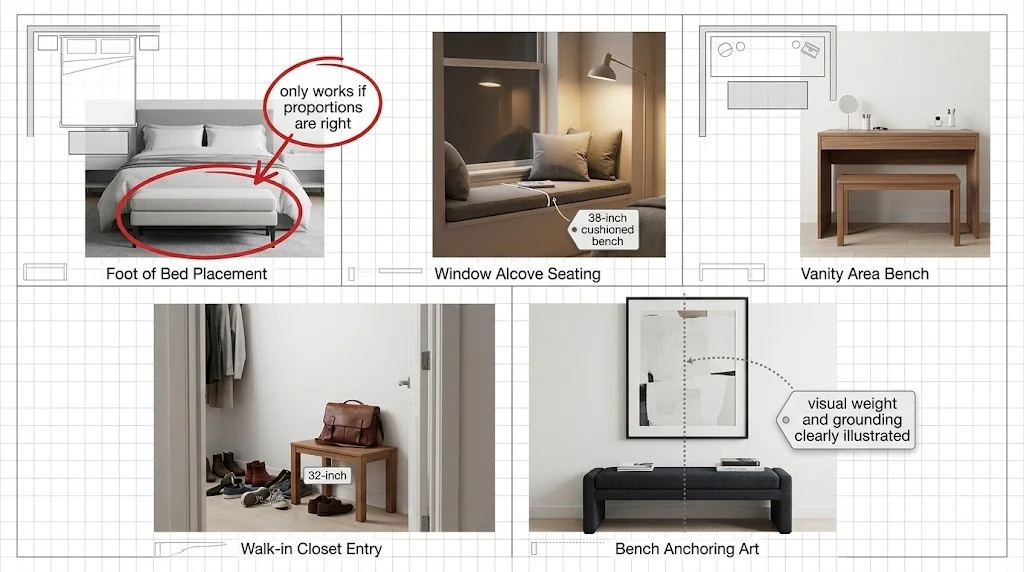
The foot of the bed is where everyone puts it. Default position. And yeah, it works, when the room layout supports it. But maybe half the bedrooms we’ve seen at TheHomeTrotters actually have the right proportions for that centered-at-the-foot placement. The other half? The bench either blocks a closet door, crowds a walkway or sits there looking like it’s waiting for instructions.
So where else does a bench work?
- Window alcoves. Criminally underused. Almost every bedroom with a window bump-out has dead square footage sitting there doing nothing. We visited a reader’s apartment in Chicago last year, tiny bedroom, maybe 11×12, but this deep window nook on the far wall. She’d shoved a laundry basket in it. We suggested a 38-inch bench with a cushion. Went back three months later and she said it was the only spot in the apartment where she actually sat down to read. Dead space turned into the best corner in the room.
- Vanity areas. A chair at a makeup vanity always feels slightly too big. Slightly in the way. You’re constantly pushing it back, pulling it forward, bumping the desk. A slim bench tucks under. Slides out when you need it. Doesn’t announce itself when you don’t. Small difference on paper. Noticeable within a week.
- Walk-in closets or dressing areas. This one surprised us honestly. A compact bench just inside a walk-in closet, 30 to 36 inches, nothing bigger, changes the morning routine in a way that’s hard to quantify until you experience it. Sit down to put shoes on. Set a bag down while you’re deciding between two jackets. It sounds minor. Everyone who tries it says the same thing: “Why didn’t I do this years ago?”
- Under wall art. Gets skipped constantly and it shouldn’t. A gallery wall or a single large piece hung above bare floor looks disconnected. Like it’s floating up there with no relationship to the rest of the room. Put a bench underneath and suddenly the whole arrangement has weight. Visual gravity. The art stops being decoration and starts being part of a composition.
One thing worth mentioning, not every spot needs a bench. If you’re forcing it into a corner just to have it somewhere, that’s worse than not having one. The bench should solve something. A seating gap, a visual gap, a storage gap. If it’s not solving anything, the room is telling you it doesn’t need one there.
Storage Benches, Same Footprint, Different Payoff
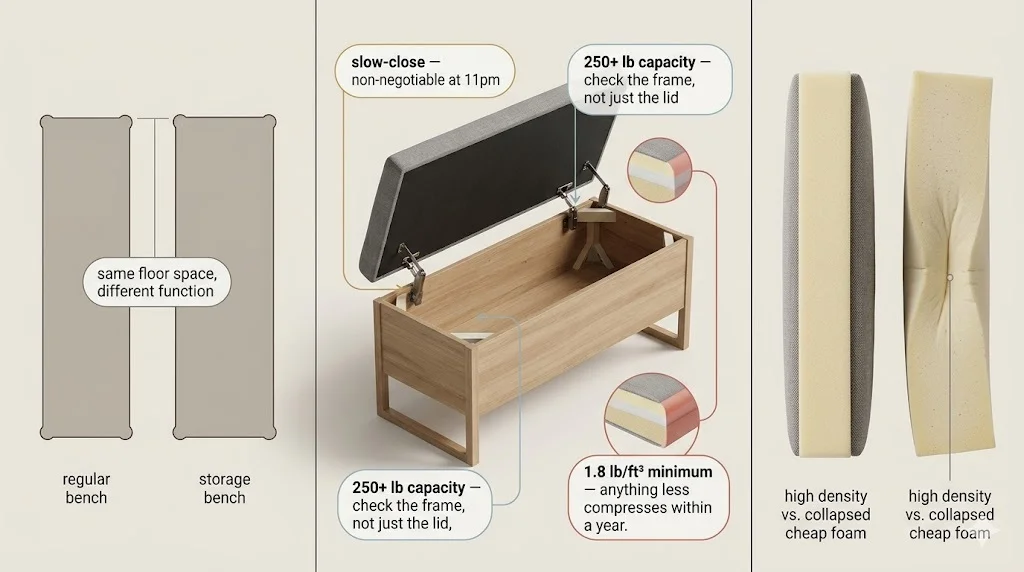
Regular bench and storage bench take up identical floor space. Identical. The room can’t tell the difference. You will, every single night when you pull six decorative pillows off the bed and need somewhere to put them that isn’t the floor.
Lift-top storage benches handle extra bedding, off-season clothes, shoes, the throw blankets that multiply somehow. TheHomeTrotters has recommended them for small apartments so many times we’ve lost count. It’s the easiest functional upgrade in any bedroom.
But there’s a quality gap here that catches people.
- Slow-close hinges. Basic hinges slam. Not a big deal when you’re shopping and the showroom is loud. Very big deal at 11pm when your partner’s asleep and you need a blanket from inside the bench. Slow-close adds maybe $15–20 to the price. Worth it from day one.
- Weight capacity. Every listing includes the number. Almost nobody checks it. Then the lid starts warping four months in and they leave a one-star review blaming the manufacturer. If you’re storing heavy blankets or hardcover books, look for 250+ pounds capacity on the frame. Not just the lid, the frame.
- Foam density on upholstered tops. This is the one that gets people. Cheap foam compresses. Not eventually, within a year. The bench top starts caving in and the whole piece looks tired. Industry specs on seating foam put 1.8 lb/ft³ as the floor for anything people actually sit on regularly. We’ve opened benches at the 6-month mark that were already shot because the foam was 1.2. You can literally push your thumb into it and it doesn’t bounce back. That’s what you’re avoiding.
A reader emailed us about this exact issue, bought a storage bench from a mid-range retailer, looked great for about eight months, then the seat developed this permanent dip right in the center. Replaced the foam herself with high-density stuff from a local upholstery shop for $40. Said it felt better than new. So even if you buy cheap, there’s a fix. But buying right the first time saves the hassle.
Making the Bench Look Like It Belongs
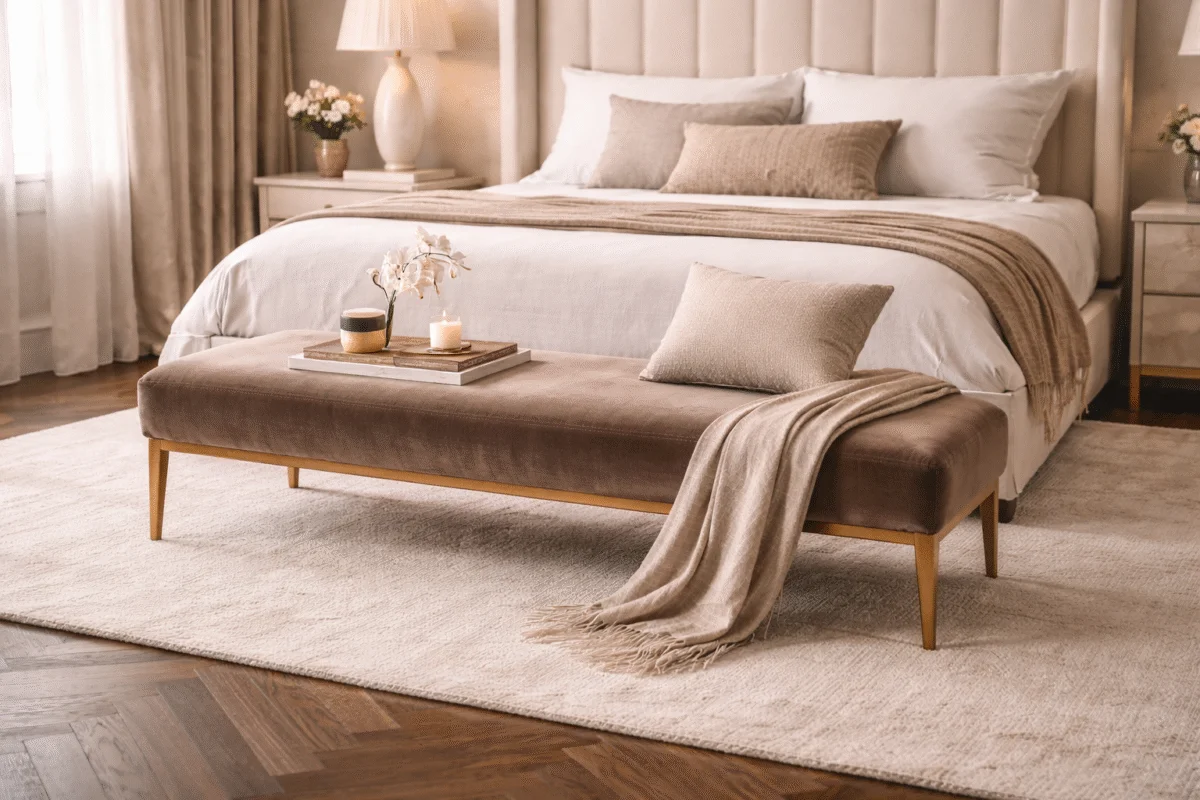
A bare bench at the foot of the bed looks like it just got delivered and nobody’s unpacked the rest yet. Styling it takes three minutes. Maybe less.
Here’s what works. A throw draped across one end, draped, not folded. Folded looks like a hotel. Draped looks like someone was sitting there an hour ago and left it. A narrow tray in the center, candle, small plant, a book you’re actually reading. Not a stack of coffee table books arranged by color. That’s staging, not living.
One or two small accent pillows. Not the big ones from the bed, grab something with a different texture. Linen pillow on a velvet bench. Chunky knit on a smooth leather surface. That contrast is what makes the eye stop.
The mistake we see most at TheHomeTrotters? Everything on the bench matching the bedding. Same fabric, same color, same pattern. It flattens the entire setup. The bench visually melts into the bed and you lose the whole point of having a separate piece there. Different texture. Slightly different tone. That’s the line between “designed” and “bought the matching set.”
And here’s the thing nobody says out loud but should, the bench should still look like someone uses it. A little imperfect. A throw that’s not perfectly centered. A pillow slightly off to one side. Lived-in beats staged every time. The goal isn’t a magazine photo. The goal is a room that feels like yours.
The Sizing Mistake Almost Everyone Makes
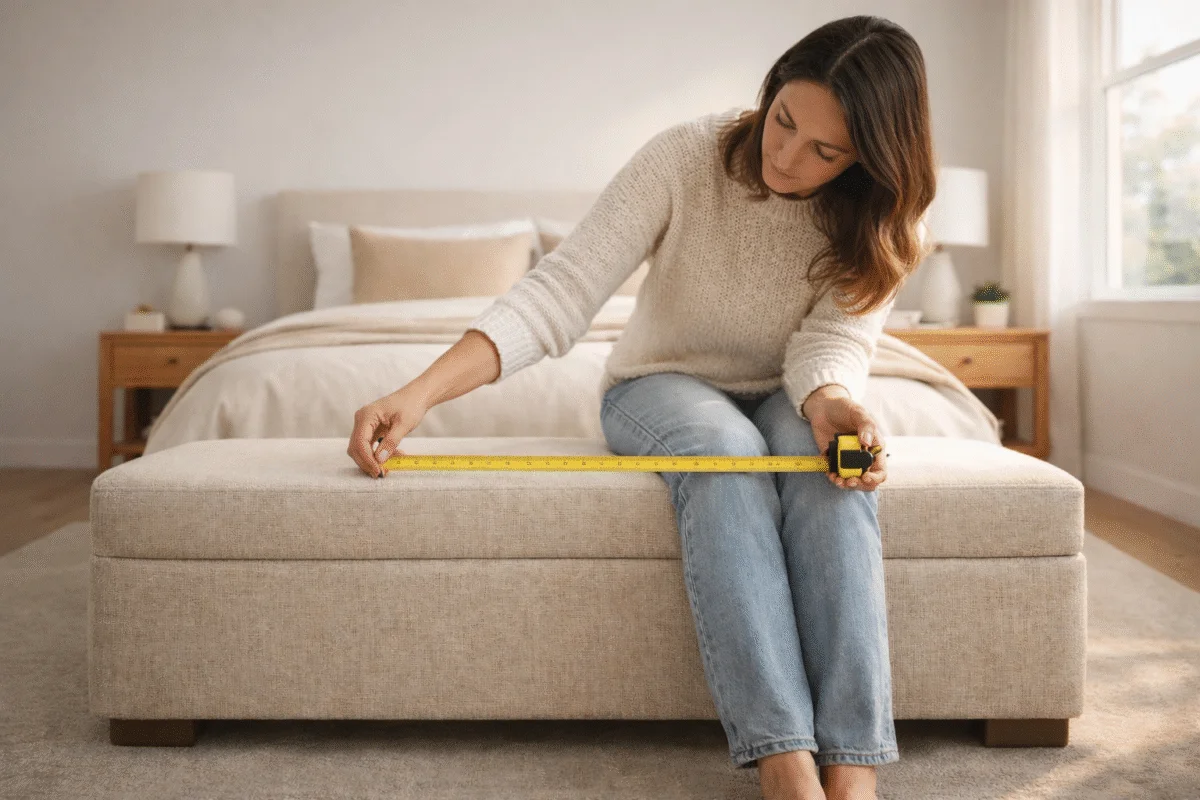
Most bedroom benches look wrong — and the owner can’t figure out why. The style’s fine, the color works, but something feels off. Nine times out of ten, it’s the size. The bench is either too wide for the bed frame or too narrow to look intentional. We’ve seen this in hundreds of bedrooms at TheHomeTrotters. It’s the single most common furniture mistake in any bedroom and almost nobody realizes they’re making it.
The fix is surprisingly specific. Your bench should run 3–6 inches shorter than your bed’s width. Not flush. Not half the width. That exact window. Go outside it and the whole foot of the bed looks either cramped or incomplete — there’s really no in-between.
But sizing isn’t just width. A bench that’s too tall feels like you’re perching. Too low and getting back up at 6am becomes it’s own cardio. The height, the depth, how it relates to your mattress line — all of it matters and most buying guides either skip these details or bury them under generic style advice.
TheHomeTrotters put this guide together after years of watching the same mistakes repeat. We’ll cover the specific measurements that work for every bed size, how to match a bench to your room’s style without overthinking it, placement ideas beyond the obvious foot-of-bed spot and the quality details — like foam density and hinge type — that separate a bench you’ll keep for a decade from one that caves in within a year
FAQs
44–52 inches for most queens. Tight room, stay closer to 44. Got some breathing room? Push toward 50–52. Measure the bed frame width first though, the bench should always sit slightly narrower, not flush and definitely not wider.
Opposite, actually. A 36–42 inch bench in a tight bedroom anchors the space. Without something at the foot of the bed, the bed just floats there and the room feels unfinished. People confuse “less furniture” with “more space.” Sometimes the right piece makes a room read bigger, not smaller.
Depends on the room. Upholstered adds warmth and softness, great when everything else is hard edges and clean lines. Wooden handles spills better, lasts longer with less maintenance and fits rustic or minimal setups without trying too hard. No universal winner. Look at what your room is missing, not what Pinterest says.
That’s just the default. Window nooks, vanity corners, inside walk-in closets, under a piece of wall art, all fair game. Foot-of-bed works when the layout supports it. But if there’s an awkward empty corner that bugs you every morning, that’s probably where the bench should go.
 Decor & Improvement Accessories