

Home & Decor Blogs: DIY, Interior Design & Lifestyle Ideas
Do You Know What The Most Common Carpets In Households Are Actually Cleaning Nightmares?

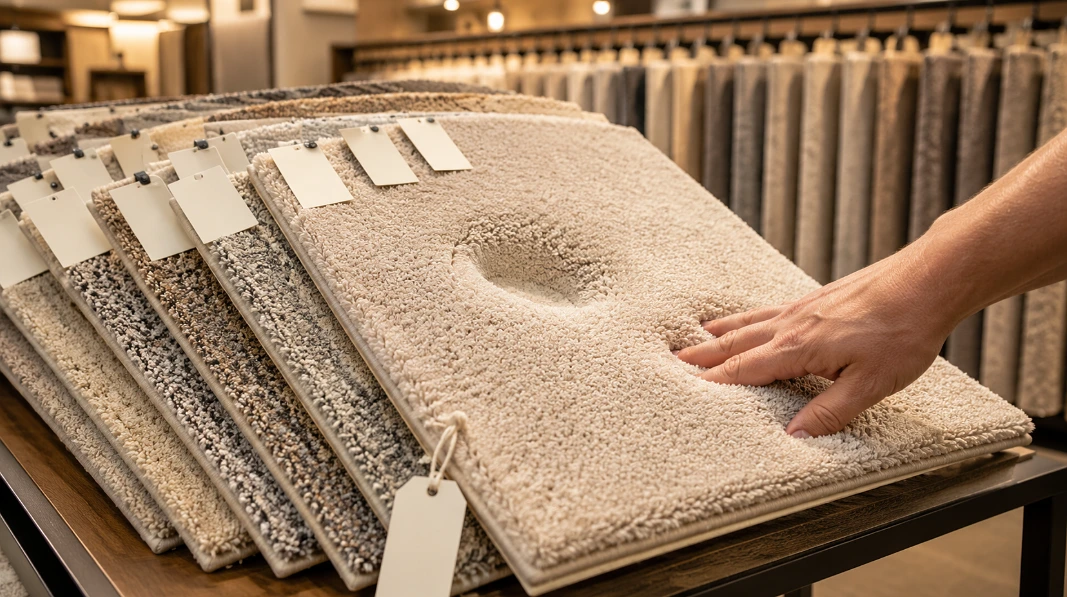
Most people walk into a showroom, run a hand across something soft, like the colour, and buy it, and nobody standing there in that moment is thinking about a spilled juice box eight months from now, which is honestly the whole problem in a sentence. That’s exactly how three specific types of carpet end up in more houses than they should, quietly setting their owners up for a fight against dirt they haven’t even met yet.
I’m going to name them, not hint at them, not soften it into something vague about how some carpets may present challenges depending on your household, actually name the three, because if I was buying carpet for my own house tomorrow I would walk straight past all three of these, and I want to lay out the actual reasons rather than just leave it as a warning you’re supposed to trust.
Olefin Is Sold As The Safe Choice And It Is The Trap
Olefin, also called polypropylene, gets marketed as the sensible budget pick, moisture resistant, stain resistant, cheap, and every one of those claims is technically true, which is exactly what makes it sneaky, because it passes the test everyone checks for in the shop and quietly fails the one nobody thinks to ask about until they’re living with it.
Olefin has an almost magnetic pull toward oil, and oil is in basically everything that ever touches a carpet, cooking grease tracked in on socks, skin oil, the residue off a dog’s paws after a walk. Once that oil binds into the fibre, dirt sticks to the oil and you end up with a stain that started out as nothing at all. On top of that olefin has a low melting point, so something as ordinary as furniture friction, a chair dragged instead of lifted, can actually damage the fibre itself rather than just mark the surface. And it crushes, because under real foot traffic in a real hallway olefin flattens faster than almost anything else on the market, so a carpet that was sold to you as the durable practical option ends up looking tired and matted while a pricier nylon carpet three doors down is still standing tall years later.
So olefin isn’t lying about being stain resistant and moisture resistant, it’s just never mentioning the other exam, the one about surviving actual daily footsteps, and that happens to be the exam it fails.
Long Loose Pile Is A Dust Trap Wearing A Nice Outfit
Shag, plush, anything with fibres long enough to sink your toes into, feels genuinely luxurious the day it goes down, and I get the appeal completely, there’s nothing pretend about how good that feels underfoot in a showroom.
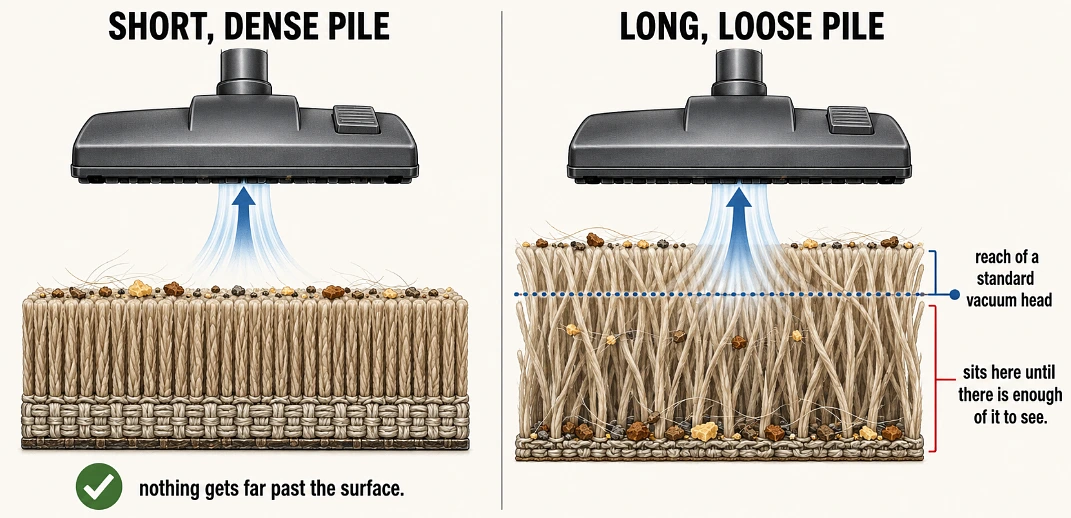
But think about what that extra length is actually doing underneath the surface. Every extra millimetre of fibre is another millimetre of hiding space, somewhere a crumb or a strand of pet hair or a bit of dust can settle down and sit out of reach of a standard vacuum head.
A low, dense pile behaves like a closed door, nothing gets far past the surface before it’s picked up. A long loose pile behaves like an open door with a welcome mat laid out in front of it, and the dirt just walks straight in and keeps going deeper than you’d think. Commercial spaces worked this out decades ago, which is exactly why you’ll never see plush deep pile carpet running through an airport corridor or an office hallway, you see short tight loops instead, because that’s the construction a vacuum can actually finish the job on.
So the trade here is at least an honest one, comfort now, paid back later in vacuum sessions that never quite feel like they got everything.
Loop Pile Looks Tough Right Up Until One Loop Catches
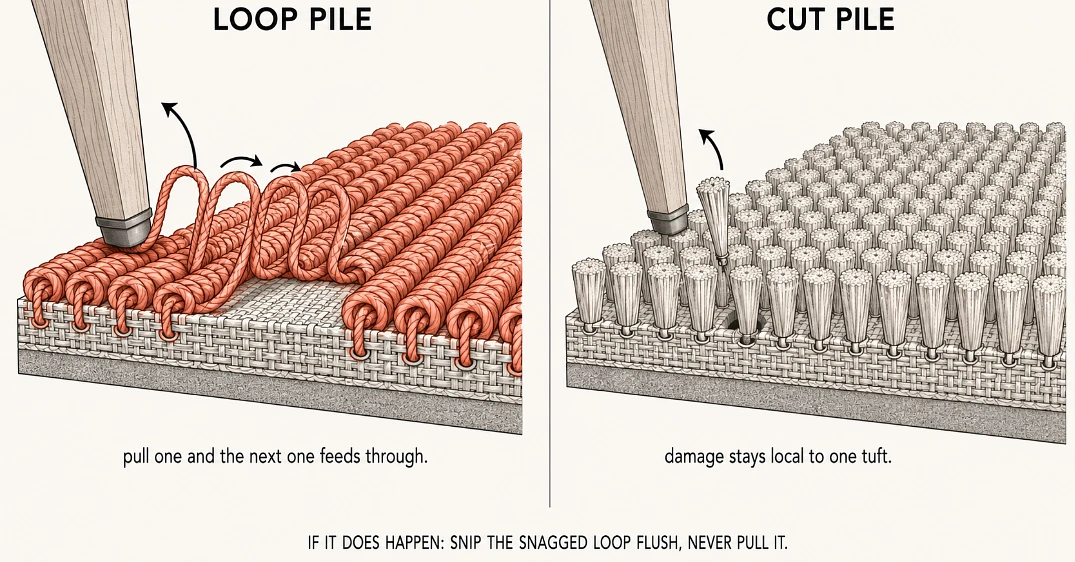
Berber and other loop constructions get sold on toughness, tight loops of yarn woven into the backing, dense, low profile, marketed as the carpet that laughs off heavy traffic and hides stains inside its own texture, and all of that is genuinely true right up until the day something catches on a single loop.
A chair leg gets dragged across the floor instead of lifted properly. A dog’s claw snags on the way past. A dropped fork lands tine first and gets kicked before anyone even notices it happened. Any one of those can catch a single loop, and because the whole surface is built from one continuous strand of yarn looping over and over across the backing, a snag almost never stays a single snag. Pull on it even slightly and the loop sitting next to it starts feeding through too, and now there’s a visible pulled thread running across the floor, sometimes just one row, sometimes an entire section unravelling the way a jumper does when a thread catches on a nail on the way out the door. Cut pile carpet simply doesn’t do this, because each fibre in cut pile is its own short independent strand, so any damage stays local to that one tuft rather than spreading.
So loop pile isn’t lying about being tough against dirt and daily traffic, it’s just one bad afternoon with a piece of furniture away from a repair job that a cut pile carpet in the same spot would never have needed in the first place.
Why These Three Keep Winning The Showroom And Losing The Living Room
The pattern is the same once you line all three up next to each other. Olefin wins the showroom on price and a stain resistant label sitting on the sample card. Long pile wins the showroom on how it feels the second you step onto it barefoot. Loop pile wins the showroom on how tough and low maintenance it sounds coming out of a salesperson’s mouth. All three win the five minutes you actually spend deciding, and all three start quietly losing the moment real life starts happening on top of them at home.
According to Cleaner Cleaner, a UK carpet and upholstery cleaning company, wool, synthetic and blended carpets are generally suitable for hot water extraction, while more delicate fibres such as viscose, Tencel, seagrass and jute often need a dry compound clean instead, which is worth knowing because it means the fibre you pick at the showroom doesn’t just decide how the carpet wears, it decides how it can even be cleaned years down the line. Out of curiosity for this issue I reached out to Vladimir Todorov, founder of Cleaner Cleaner, I asked him about loop pile, is it actually being tough against traffic or what, and according to him, “Commercial spaces figured this out decades ago, which is exactly why you never see plush deep pile carpet in an airport corridor or an office hallway, you see short tight loops that a vacuum can actually finish the job on.”
Real fibres like nylon cost a little more up front and don’t feel quite as plush and don’t promise quite as much toughness on the sample card, and none of that ends up mattering six months in, because a nylon carpet built as a tight cut pile is still going to look like itself long after these three have started showing their age. If a fibre resists stains but folds under normal foot traffic, that’s not actually a win, that’s a carpet failing one test loudly enough that you never notice it failing the other one quietly in the background. A carpet built to stay whole under an accidental snag saves you more real weekend hours than one that only looks tough while it’s sitting still in a showroom under good lighting.
What I’d Actually Tell You To Do
Skip all three if the room sees kids, pets, or a front door that gets used every single day, and that’s not really a maybe. Go with nylon or wool, cut pile rather than loop, something short and dense enough that pressing a finger into it at the shop makes it spring straight back up rather than staying dented where you touched it. A mid tone or lightly flecked colour helps as well, since it hides everyday marks no matter which fibre you end up choosing, but that part is the bonus round, not the actual decision.
And if a carpet is already down in your house and it happens to be one of these three, that’s not a disaster, it just means the cleaning routine has to work harder than the material itself is willing to. Vacuum long pile more often than feels necessary, because the debris sitting an inch below the surface isn’t visible until there’s already a lot of it built up down there. Treat any oil based mark on olefin the second it happens rather than letting it sit overnight, because that oil bond only gets stronger with time, never weaker. And on loop pile, snip a snagged loop flush with a pair of scissors the moment you spot it instead of pulling at it with your fingers, since a clean cut stops the chain reaction that pulling starts running down the row.
Choosing well at the start beats fighting the wrong material for the next ten years, every single time.
 Decor & Improvement Accessories