

Home & Decor Blogs: DIY, Interior Design & Lifestyle Ideas
Best Home Hacks DecoRadTech Guide to Smarter DIY Living
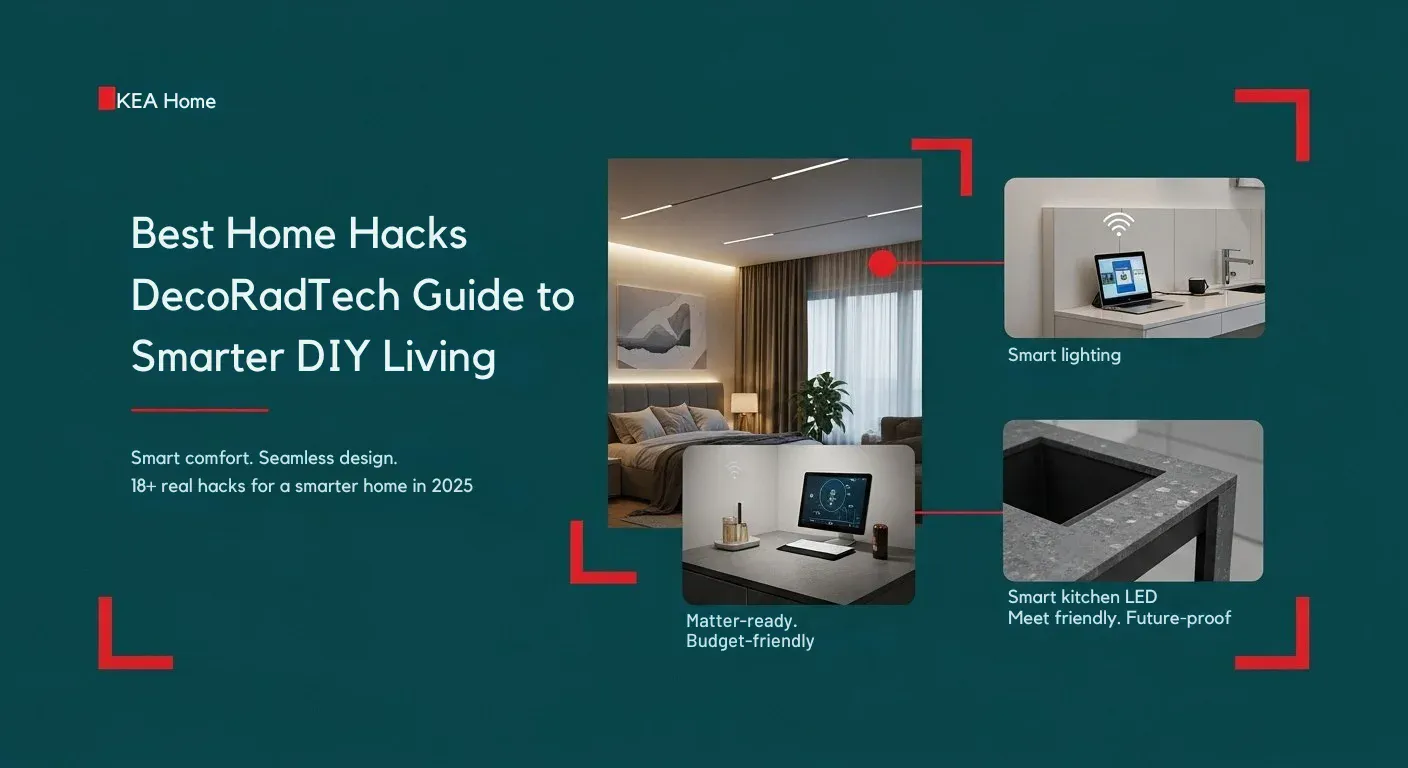
The fastest way to spot a beginner smart home is that you can see all of it. Bulky white plastic sensors stuck on door frames, a fat speaker puck sitting out on the shelf, RGB strips glaring out in dotty little points, cables snaking down the wall behind the TV. The tech works fine. The room just looks like an electronics aisle.
The decor-first approach, which is what I’m calling DecoRadTech here, flips that. The house gets smarter and you genuinely can’t tell. And the surprising part is it’s barely about money, it’s about a handful of small craft decisions most people never hear about.
So this isn’t another sweep of forty gadgets you’ll never buy. It’s the part nobody explains, how to hide the tech so your home still looks like a home, and where to let one piece show on purpose.
Before the room-by-room stuff, one decision sits above all of it, which ecosystem you build on, because that choice quietly dictates what plays nice with what for years.
| Ecosystem | Best for | Privacy | Hub needed | Worth knowing |
|---|---|---|---|---|
| Amazon Alexa | Most devices, cheapest add-ons | Medium | Speaker, ~$25–100 | Best routines and multi-room audio |
| Google Home | Natural voice, casting | High | Speaker, ~$49–99 | Strong with displays and photo frames |
| Apple HomeKit | iPhone homes, tight privacy | Highest | None extra | Locks down data hardest, smaller device range |
| Matter / Thread | Mixing brands without fights | Depends | Any of the above | Future-proof, ends the “works with” headaches |
If you take nothing else from the table: lean toward Matter or Thread devices where you can. It’s the thing that lets gear from different brands actually talk to each other instead of trapping you in one app, and a lot of it keeps working locally even when your wifi drops.
Lighting is where every smart home gives itself away
Strip lighting is the first thing people get wrong, and it’s the easiest tell. They stick a bare LED strip under a cabinet or behind the TV and you get that cheap row of dots instead of a smooth glow.
The fix is a thing most guides skip entirely: aluminium channels, also called diffusers. The strip sits down inside the channel, a frosted cover snaps over it, and those individual dots blur into one soft continuous line. It’s the whole difference between “looks built-in” and “looks stuck on,” and it runs a few quid per strip. Cheapest upgrade in this entire guide, easily.
Two more things separate a designed glow from a gadget:
- Paint the channel your wall colour. Once the housing disappears into the wall, the light reads like it’s coming from nowhere, which is the effect you’re after. People literally cannot find the source.
- Match the colour temperature to the room. Warm white, around 2700K, in bedrooms and the living room where you actually wind down. Save the colour-changing RGB for one feature wall or behind the TV. A whole house of colour-shifting light doesn’t read as luxe, it reads as a gaming bedroom.
If you want the upgrade nobody asks about, look at circadian bulbs that warm their tone as the evening goes, something like the warmer end of a Philips Hue or Wiz set on a schedule. They drift toward amber late at night, which is a lot kinder on your sleep than a room full of cold blue light at 11pm. Quiet one, but you notice it after a week.
And here’s a near-free trick I’d fight to keep: a “good night” routine that kills every light except one hallway light dropped to 1% red on a motion sensor. Red at that level barely counts as light, so you can cross the house at 3am without blinding yourself or finding the corner of the bed with your shin. Tiny thing. You’ll use it every single night.
Where to let the tech show on purpose
Hiding everything isn’t quite the goal. The trick is choosing the one thing you let be visible, and making it a deliberate design piece rather than an accident.
This is where neon signs earns its place. Most smart lighting is meant to vanish, but a single custom neon piece is the opposite, it’s the intentional focal point the soft hidden lighting frames. Because you can have one made to your own word, shape, or colour, it reads as decor you chose, not a gadget you bought, and it gives a room a personality that a strip of white LEDs never will. One bold visible piece against a backdrop of invisible light is the whole DecoRadTech look in a sentence.
The mistake is the reverse, letting the boring tech show and hiding the characterful stuff. Flip it. Hide the sensors and speakers, show the one thing worth showing.
Hiding the boxes nobody wants to look at
The speaker is the worst offender. A smart speaker sitting out in the open is the most obvious “I bought a smart home” signal there is.
Drop it inside a ceramic vase or a wide-mouthed pot with the top open, and the microphone still hears you fine through the gap. From across the room it’s just pottery. You keep the voice control and lose the plastic puck, and people honestly cannot work out how you’re talking to your house.
The same thinking covers the rest of the hidden layer:
- Wires are the real giveaway, so plan them before you mount a single thing. Run them in cable raceways painted to the wall, or fish them inside the wall where the run allows. That one trailing cable dropping from a wall-mounted TV is what makes an entire setup look amateur. Fix that and everything around it looks more finished.
- Door and window sensors hide behind a picture frame or on the top edge of one, where nobody’s eye travels. The little Aqara ones are made for exactly this. You still get the ping when a door opens, you just don’t get a white plastic rectangle wrecking your door frame.
- Smart plugs belong out of sight by definition. Behind furniture, inside lamp bases, tucked anywhere the eye doesn’t land. You’re buying the control, not the object.
The TV, the one screen you can’t hide
You can’t make a television vanish, so the move here is making it pretend to be something else when it’s off.
A frame-style TV (Samsung’s The Frame is the one everyone knows, and there are cheaper lookalikes from the likes of Sylvox and Atmosfire now) shows artwork when it’s off, so that dead black rectangle becomes a picture on the wall instead. Pair it with strip lighting behind the panel, tucked in a diffuser channel like the rest of your lighting, and you get two wins at once. It softens the harsh contrast between a bright screen and a dark wall that quietly tires your eyes, and during films it bleeds colour onto the wall so the picture feels bigger than the panel actually is. A sync box like a Govee Immersion or a Philips Hue Play setup does the colour-matching automatically for not much money.
Kitchen Hacks That Save Time and Sanity
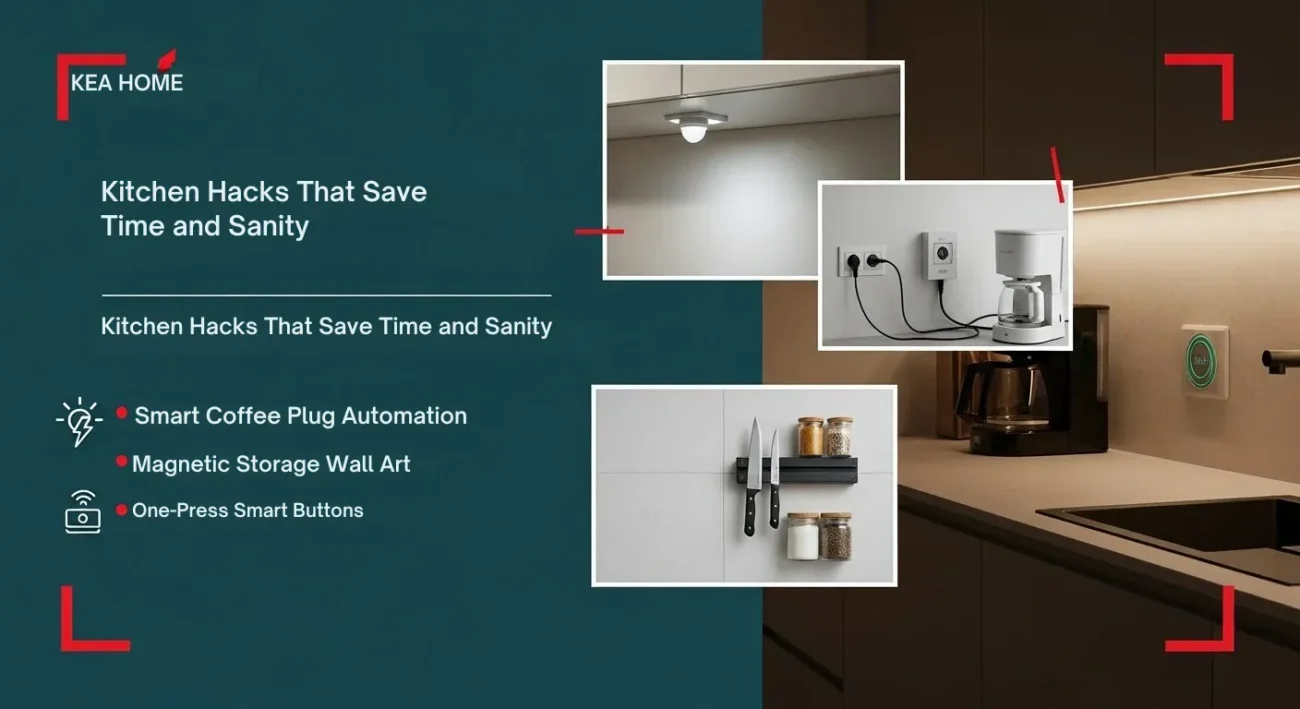
The kitchen is where DecoRadTech pays for itself fastest, because here the hacks are about hands-full convenience, not looks, and you notice them every single day.
- Under-cabinet LED strips on a motion sensor mean you never chop vegetables in your own shadow again, the light comes on the second you reach the counter.
- A smart plug on the coffee maker lets you wake up to fresh coffee without getting out of bed to start it.
- Magnetic knife strips and magnetic spice jars on the side of the fridge double as wall art that actually does a job, clearing your counter while looking deliberate.
- Plug-in smart buttons like Flic or Shelly stuck on the backsplash give you one-press control, hit it and your playlist starts or the kettle goes on, no phone, no voice command.
One last thing before you buy anything
A quick word on privacy, because it’s the bit people skip until it bothers them. Devices that process locally rather than firing everything off to a cloud are the safer pick, and HomeKit and Matter gear tend to be better on this front. If you want to be properly careful, most routers let you drop your smart devices onto a separate network in about five minutes, so a $15 sensor that turns out to be sketchy can’t reach the laptop with your real life on it.
None of this needs a big budget or an electrician. Start with the lighting, because that’s where the biggest visible jump happens for the least money, get the diffuser channels on and hide the strips properly, and the room already looks twice as considered. Add the hidden speaker, sort the one trailing wire that’s bugging you, and put up the one neon piece you actually love. That’s a home that’s quietly smarter and still looks like somewhere a person lives, instead of a showroom floor.

 Decor & Improvement Accessories