

Home & Decor Blogs: DIY, Interior Design & Lifestyle Ideas
How to Make a Small Living Room Feel Finished When It Already Has Furniture in It


Most small living room advice starts with “buy a smaller sofa” or “use light colours,” which is not helpful when you already own the sofa and the walls are already painted. The room has furniture. It has a rug, probably. A lamp somewhere. Maybe a coffee table. And it still feels like nothing in there is talking to each other.
That’s the actual problem in most compact living rooms – not that there’s too much stuff, and not that the room is too small. It’s that the pieces landed where they landed, and nobody thought about what each one is doing for the room as a whole. A lamp fills a corner but doesn’t light where you actually sit. A bookcase stores things but drags the eye downward. A mirror hangs on a wall, but reflects the back of the TV and a tangle of cables.
The fix for that is not buying more things. It’s making the things you already have do clearer work.
Stand in the Doorway and Find Where Your Eye Goes First
This is the test that tells you whether a room has an anchor or just has stuff in it.
Walk to the doorway of your living room, stand there, and notice where your eye lands in the first two seconds. Does it hit the sofa? The TV? The window? A bookcase? A blank wall? The floor? Whatever it lands on is what the room is currently organized around, whether you planned it that way or not.
A room where the eye jumps around – rug to lamp to basket to blank wall to TV – feels restless even when it’s tidy. A room where two or three things sit together and form a clear zone feels settled even when it’s messy.
Here’s a quick version of the check. Name four things from the doorway: the strongest shape, the darkest object, the tallest piece, and the brightest point. If all four are scattered in different corners, the room is fighting itself. If two or three of them cluster in one area, you have a focal zone, whether you meant to build one or not – and you can work with that.
What counts as an anchor zone:
- A sofa wall with one piece of art and a lamp beside it.
- A reading corner where a tall shelf, a chair, and a light source sit together.
- A low console with a mirror above it and something warm on top – a candle, a ceramic, a small plant.
Pick one zone. Let it carry the room. Everything else supports it quietly.
For studying how this works in moodier, darker interiors where texture and contrast do the heavy lifting instead of colour, AURA Modern Home’s “The Modern” Blog is worth browsing – they consistently show rooms where a few confident pieces create atmosphere without filling every surface.
The Actual Measurements That Decide Whether Furniture Fits or Fights
People eyeball this and get it wrong constantly, and in a room under fifteen square metres, the margin is thin.
Coffee table depth. If your room is narrower than 3.5 metres wall to wall, a coffee table deeper than 45cm starts blocking the path between the sofa and whatever is opposite it. You need roughly 40-45cm of clear space between the sofa edge and the table edge for someone to sit comfortably and stand up without bumping their shins, plus a minimum of 60cm on the other side for a walkway. Do the math on your room, and you’ll see how fast a 60cm-deep table eats the whole thing.
Round tables help here because the depth isn’t uniform – you get clearance at the corners where the walkway bends.
Rug size. A rug that’s too small is one of the fastest ways to make a seating area feel temporary and disconnected. The front legs of the sofa should sit on the rug at a minimum. If the rug stops short of the sofa entirely and floats in the middle of the floor, it looks like a bathmat that wandered into the wrong room. For most compact living rooms, a 160 x 230cm rug is the starting point, not a 120 x 170.
Side table height. This sounds minor, but it changes comfort noticeably. The top of the side table should sit within 5cm of the sofa arm height – above or below. If the table is significantly lower than the arm, you’re leaning down and reaching sideways every time you pick up a drink. If it’s higher, it feels like an obstacle beside you instead of a surface that’s working with the seat.
One Tall Piece Does More Than Three Short Ones
When a small living room needs more storage or more visual weight, the instinct is to add things at floor level – another basket, a second side table, a low cabinet. That works until you have so much stuff below waist height that the room feels heavy at the bottom and empty at the top.
A single tall piece changes the proportions. A bookcase that goes up to 180 or 200cm, a floor lamp that reaches above head height, a tall mirror leaned against a wall, a piece of vertical artwork – any of these pulls the eye upward and makes the ceiling feel further away than it actually is.
The bookcase is the most useful of these because it solves storage and visual height at the same time. But it only works if it’s styled with some restraint. Heavy objects low, lighter things higher, a few gaps of empty space between items, so the whole thing doesn’t read as a storage locker with the door removed. Mix books with a couple of ceramics, one framed photo, maybe a small plant, and leave the top shelf at least partially empty. The piece should feel like it’s floating upward, not pressing down.
If there is already a low console or TV unit dominating one wall, adding height next to it – a tall lamp on one side, or a narrow shelf unit – balances the visual weight without adding anything at floor level where the room can’t spare it.
Lighting at Night Is Where Most Small Rooms Actually Fail
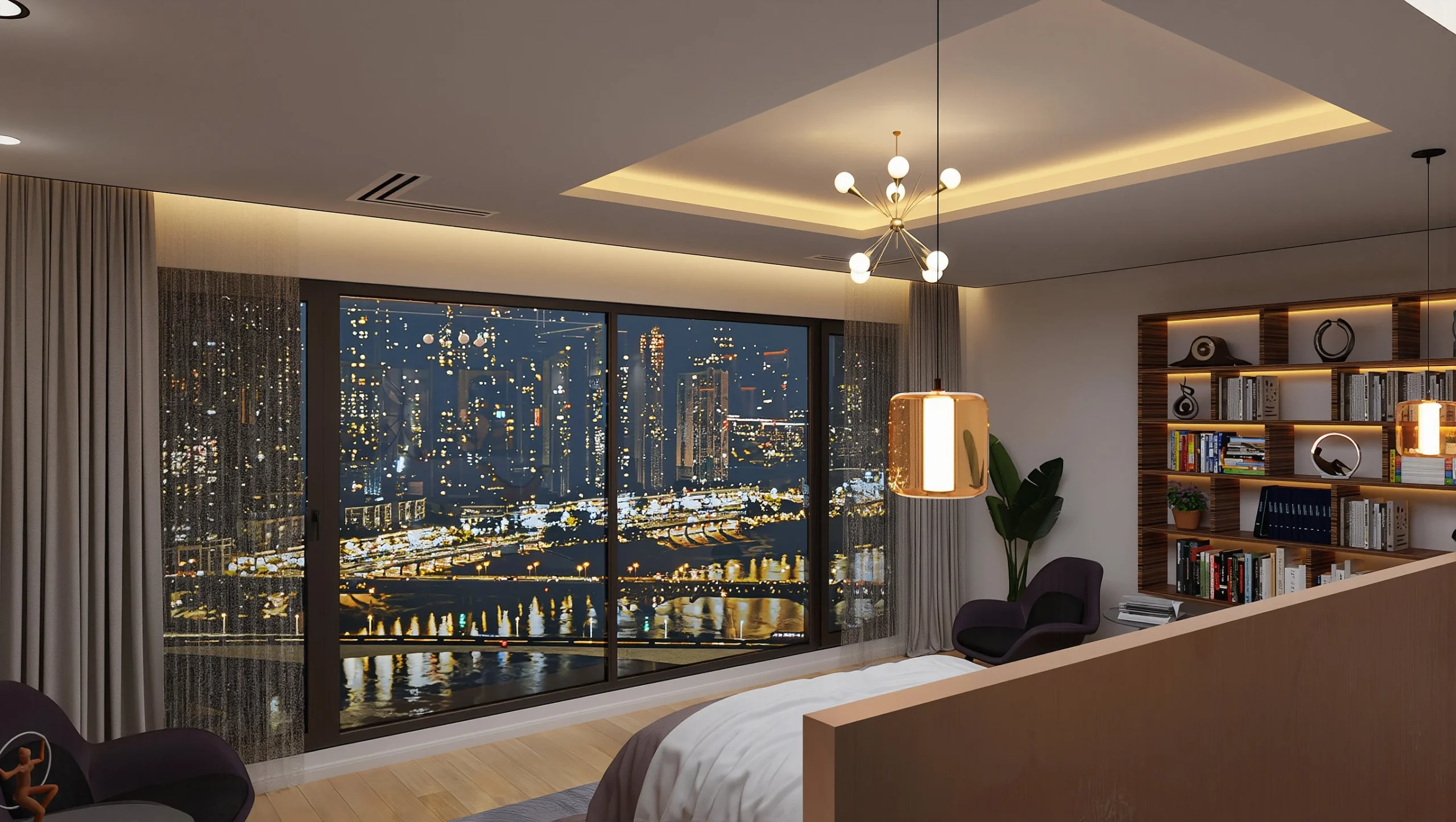
A room that looks fine during the day and feels flat, cold, or harsh at night has a lighting problem, not a furniture problem.
The issue is almost always the same: one overhead light doing all the work. A ceiling fixture lights the room evenly, which sounds good except that “evenly” means no shadows, no depth, no warm spots, and no cool spots. Everything looks the same. The room feels like a waiting room.
What you actually need is three separate light sources doing three different things:
- One general light for overall visibility – this can be the ceiling fixture, dimmed if possible.
- One lamp near where you sit – beside the sofa or the reading chair, at a height where it lights your lap and your book without glaring into your eyes or casting a shadow across the TV.
- One smaller accent light somewhere else – on a console, inside a bookcase, on a shelf. This one creates the depth. It’s the light that makes the room feel like it has corners and layers instead of one flat wash.
Try this tonight. Turn off the overhead light. Turn on just the lamp and whatever accent light you have. Sit down the way you normally would. If the room feels warmer and more settled, your problem was never furniture.
Scale matters with lamps in small rooms. A floor lamp with a wide shade in a room where the sofa is only 30cm from the wall creates a cramped feeling right at the spot where you’re supposed to relax. A slim-profile floor lamp or a table lamp on the side table does the same lighting job without eating up the space you do not have.
Repeat One Material and the Room Starts Looking Intentional
This is possibly the simplest fix that most people never think about.
If the coffee table is dark wood, and nothing else in the room is dark wood, the table looks like it belongs to a different room. It might be a beautiful table on its own but it’s floating visually. Add one more dark wood element – a picture frame, a small tray on the console, a bowl on the bookshelf – and suddenly the table looks like it was chosen on purpose.
Same principle with any material. Brass lamp base? Echo it with a brass frame or a brass drawer pull on the side table. Black metal legs on the coffee table? Get a mirror with a black metal frame. Woven texture on a cushion? Repeat it with a woven basket or a rattan tray.
You don’t need matching sets. You need two or three quiet echoes of the same material scattered across the room so the eye connects them without consciously noticing. That’s what makes a room feel “collected” instead of “decorated” – it looks like the pieces accumulated over time from someone with consistent taste, not like they were bought in one shopping cart.
Five Mistakes That Make a Small Room Feel Worse
Buying small versions of everything. A tiny rug, a tiny lamp, a tiny table, and tiny art on the wall make the room feel nervous, like it’s apologizing for its own size. Compact rooms usually look better with fewer pieces at normal or generous scale than with many pieces all scaled down.
Pushing every piece flat against the wall. Sometimes you have to. But even pulling the sofa forward by 10cm creates a shadow line behind it that adds depth. A side table angled slightly off the wall, a bookcase with 5cm of breathing room behind it – small gaps make furniture look placed rather than shoved.
Decorating every flat surface. A coffee table does not need five objects on it. A side table does not need a stack of books, a candle, a plant, and a coaster display. Leave room for the glass of water, the phone, the thing you’re actually using right now. The empty space is part of the design.
Hanging art too high. The centre of the piece should sit roughly at eye level, which for most people is around 145 to 150cm from the floor. In a room with a sofa below the art, the bottom edge of the frame should be 15 to 25cm above the sofa back – close enough to feel connected. A 60cm gap between the sofa and the art makes them look like they’re ignoring each other.
Ignoring what the mirror reflects. A mirror that reflects a window or a lamp doubles the light and the sense of space. A mirror that reflects the TV power strip and a pile of remotes doubles the mess. Before you mount it, hold it up and check what’s actually in the reflection from where people will be sitting.
The rooms that feel best at this size are never the ones with the most stuff in them. They’re the ones where someone looked at what was already there, figured out what each piece was supposed to be doing, and gave it a clearer job. That usually means moving three things, removing one, and adding maybe one more that was chosen because it solved a specific problem the room actually had – not because it looked good in someone else’s photo.
 Decor & Improvement Accessories