

Home & Decor Blogs: DIY, Interior Design & Lifestyle Ideas
Latex Vs Memory Foam, Checked Before You Buy: Which Mattress Claims You Can Verify Before Paying

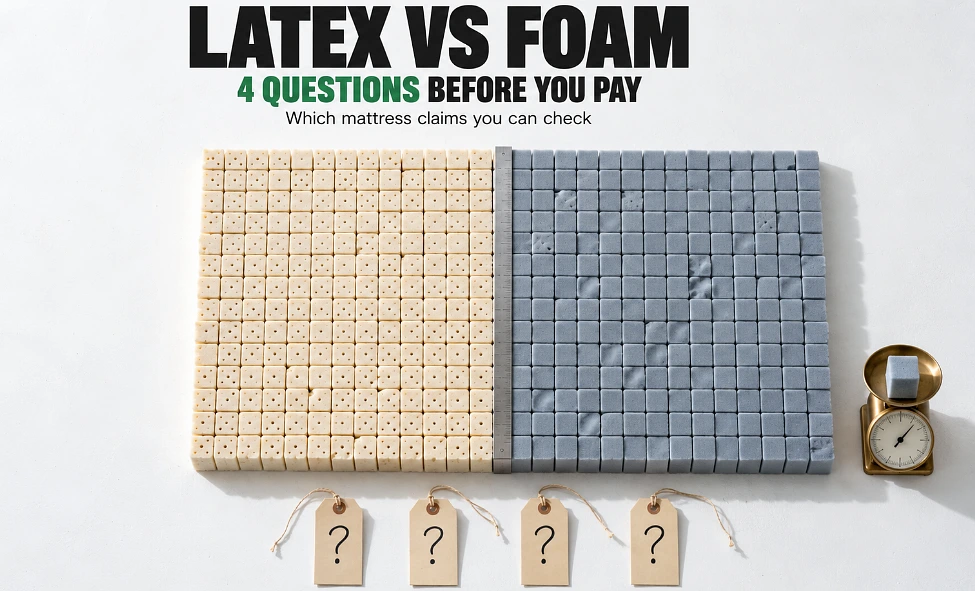
When CHOICE in Australia put 18 mattresses through its 2026 test, 13 of them earned a cool rating, whereas a year earlier only 8 of 21 had, and Peter Zaluzny, who runs the mattress testing there, said that for a long time very few mattresses had lived up to their cooling claims at all. One of the lowest scoring beds in that round carried a recommended price above $7,500. So the question for anyone choosing between latex and memory foam is less which material wins than which claim about either one can be checked before the money leaves the account.
What Lisa Galliers Found In 8 Weeks Of Watching Mattress Prices
Which? ran a price check on 11 mattress brands between August and October 2023 and published it on 20 February 2024. Dreams, Emma, Eve, Hypnos, Nectar, Simba and Tempur were among the names, and the finding was that several of them ran one sale straight into the next, with countdown timers that reset, so that a Nectar memory foam bed advertised at 60 percent off had never once been sold at its full price during the whole period. Lisa Galliers, who manages product testing at Which?, said tactics like these can have a real influence on shoppers’ behaviour and that when a company promotes a deal it must be a genuine offer.
Scaled down to one bedroom, a $900 bed marked “was $2,250” is only a bargain provided a customer paid $2,250 for it at some point, and the shop ought to be able to say when. Ask for the date of the last full price sale before you let the percentage do any work on you.
What The FTC Made Moonlight Slumber Take Back In September 2017
The clearest record of a mattress claim failing a check sits in the Federal Trade Commission’s files. On 28 September 2017 the commission barred Moonlight Slumber of Elgin, Illinois, from making misleading claims about its baby mattresses, and the order, made final on 12 December that year, lists what had gone wrong. The beds had been sold as organic though they held little organic material, as having a “Natural Latex Core” that was in fact synthetic, as made from plant based foam, and as having passed a VOC emissions test that had not been run as described. The company had even awarded itself a “Green Safety Shield” of its own design.
Four years earlier, on 26 July 2013, the commission had settled with Relief-Mart, Essentia Natural Memory Foam and Ecobaby Organics over “VOC free” and “chemical free” claims on memory foam, and in Ecobaby’s case the certifier that vouched for the foam turned out to be the company itself under another name.
Because “natural” and “latex” sit next to each other on so many labels, the Moonlight case is the one to remember. A latex core may be natural, blended or synthetic, and Sleep Like The Dead, which gathered owner reviews for a decade before AI content existed, warned in 2019 that some makers say “natural latex” when they mean a blend, and that something is not better merely because it is natural any more than it is better merely because it is synthetic. Unless the label gives a percentage of natural rubber, ask for one before the word natural counts for anything.
How Radium Foam Has Made Talalay Blocks In Maastricht Since 1961
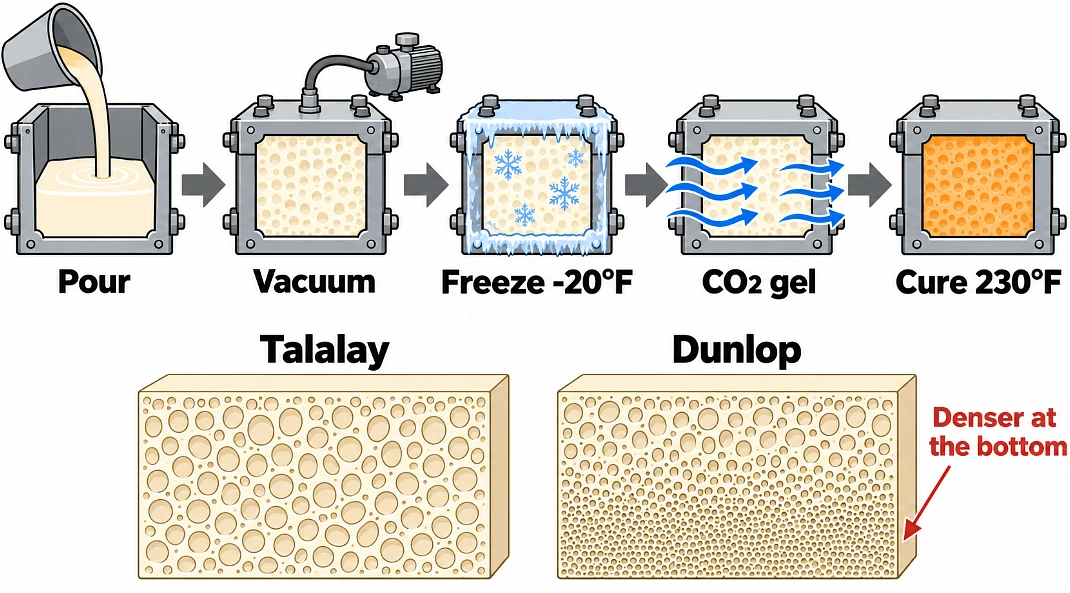
Latex is the easier side to check, provided the maker says who made the foam, because the two ways of making it are named processes with named steps. DeRUCCI’s latex comes from Vita Talalay, the brand of Radium Foam in Maastricht, which has been in that city since 1932 and bought the freeze foam patent in 1961. The Talalay method, developed by the Talalay brothers and in commercial use since the late 1940s, pours liquid latex into a closed mould, draws a vacuum so the foam expands to fill it, freezes the mould to about minus 20°F to hold the bubble structure, pushes carbon dioxide through to gel the latex, and then heats it to around 230°F to cure before the block is washed and dried. The Dunlop method skips the freeze and uses a chemical gelling agent, which is why the heavier particles settle and a Dunlop block comes out denser at the bottom.
Victor Garcia Hoogendonk, Radium’s sales director, told BedTimes in August 2024 that the factory had added a ninth step in which every block is tested for firmness and weight at 10 points before it leaves, and that the company had become the first Talalay producer to hold GOLS organic certification that year. Whether or not a buyer cares about organic status, a block that is weighed and pressed at 10 points is a block whose firmness number can be trusted. The trade measures that firmness as ILD, indentation load deflection, and Sleep Like The Dead’s 2019 guide put 14 to 22 as soft, 23 to 29 as medium, 30 to 37 as firm, with most people preferring 25 to 35. If a latex bed is sold without an ILD figure, you may as well ask the shop how it decided the bed was soft, because the tag will not say.
What Charles Yost Built For NASA In 1966 And What Density Tells You Now

Memory foam began as a government contract. In 1966 NASA hired Charles Yost, an aeronautical engineer at Stencel Aero Engineering in North Carolina, to make airline seats safer in a crash, and the Ames Research Center fitted his slow spring back foam into a seat design before Yost formed Dynamic Systems in 1969 to sell it as temper foam. The Polyurethane Foam Association’s technical bulletin still describes the material that way, as an open cell polyurethane typified by its slow recovery after compression, and it adds the line that matters at the shop, that the physical properties of viscoelastic foam can be greatly influenced by temperature.
That temperature line is why memory foam has fewer checkable claims than latex. There is no five step process to walk through, since each maker’s recipe is its own, and the foam that feels soft in a warm showroom may feel firm in a cold bedroom in January. DeRUCCI keeps a mattress materials evidence map that sets the two materials side by side, with the tested figures in one column and the gaps in the other, and the memory foam column is the shorter one on that page too. What the material does carry is density, the weight of one cubic foot in pounds, and the PFA bulletin puts the usual range at 2 to 6. Daniel Noyed’s Sleep Foundation guide, updated in July 2025, calls anything under 3 low, 3 to 5 medium and over 5 high, and Lauren Fountain’s lifespan guide on the Sleep Foundation site, also updated in July 2025, gives foam beds 6 to 7 years on average against 7.5 to 8.5 for latex, with low density polyfoam named as the kind that wears out much faster. Sleep Like The Dead’s owner data from 2018 adds the other side of the ledger, that owners of high density foam usually report sinking in significantly, and that about 9 percent of memory foam owners say the bed sleeps hot.
So the one question that turns a memory foam pitch into a checkable claim is the density in pounds per cubic foot, layer by layer, and a shop that cannot produce that figure should be asked where its soft, medium and firm labels came from.
What Miriam Diamond’s Team Measured In Toronto In April 2025
Chemistry is the other claim worth checking on foam, and the newest evidence came from the University of Toronto in April 2025. Sara Vaezafshar, Miriam Diamond and colleagues bought 16 new children’s mattresses from North American retailers at between 50 and 105 Canadian dollars, two of them certified, and measured what came off them at room temperature and then under the heat and weight of a simulated sleeping child, 37.5°C and 7.5 kilograms. Emissions of phthalates, flame retardants and UV filters rose several times under the warm weight, and the flame retardant TBOEP, found in 3 mattresses cold, was found in all 16 warm. TCEP, which is banned in Canada, turned up as well. Diamond called the result a wake up call for manufacturers and policymakers, and Arlene Blum of the Green Science Policy Institute, who also wrote the paper, said it was concerning that these chemicals were still being found in children’s mattresses.
For an adult bed the practical check is the CertiPUR-US seal, which Mike Crowell’s programme extended to moulded foam in November 2016 and which tests the foam at accredited laboratories for ozone depleters, PBDE and TCEP type flame retardants, heavy metals, formaldehyde, regulated phthalates and VOC emissions under 0.5 parts per million. The seal does not say the foam is natural or that it sleeps cool, only that those particular things were looked for and not found above the limits, and a narrow, dated statement of that kind is one a buyer can rely on.
What BekaertDeslee Reported From A Guangzhou Laboratory In June 2020
The tidiest example of a number arriving with its paperwork is a fabric. On 26 June 2020 BekaertDeslee, the Belgian ticking maker that has been weaving mattress covers since 1892, announced from Waregem that the Guangdong Detection Center of Microbiology had tested its VIRASE fabric under ISO 18184:2014 and found a reduction in viral activity of more than 99 percent within 2 hours. A trade report later added a second test at a European laboratory against SARS-CoV-2 showing 99.97 percent after 2 hours, with the caveat that results may vary by fabric construction. The company’s own product page today says only that the fabric reduces the spread of viruses with 99 percent effectiveness, and the standard and the window have dropped off the sentence, which shows how a checkable number can turn back into a slogan once the conditions get left off.
DeRUCCI uses that fabric, and its own materials record shows the other sort of figure next to it. Its 3D Plus spacer fabric is rated at more than 1.4 million support points and 4.4 times the breathability, and those are stated as the brand’s own ratings, not as laboratory results. A spec sheet that marks which numbers were tested and which were declared is being straight with the reader, and both kinds have a place so long as the two are kept apart. The pocket springs in those beds come from AGRO in Bad Essen, whose managing director Dominik Meyer told BedTimes in July 2021 that all AGRO innersprings were already recyclable and that the family firm thinks in generations. AGRO’s titanium copper alloy spring is described by retailers as patented, though the only published description of it that could be found is a retailer’s page, so that particular claim stays in the “ask for the patent number” column.
The 4 Things To Ask Before Lying Down
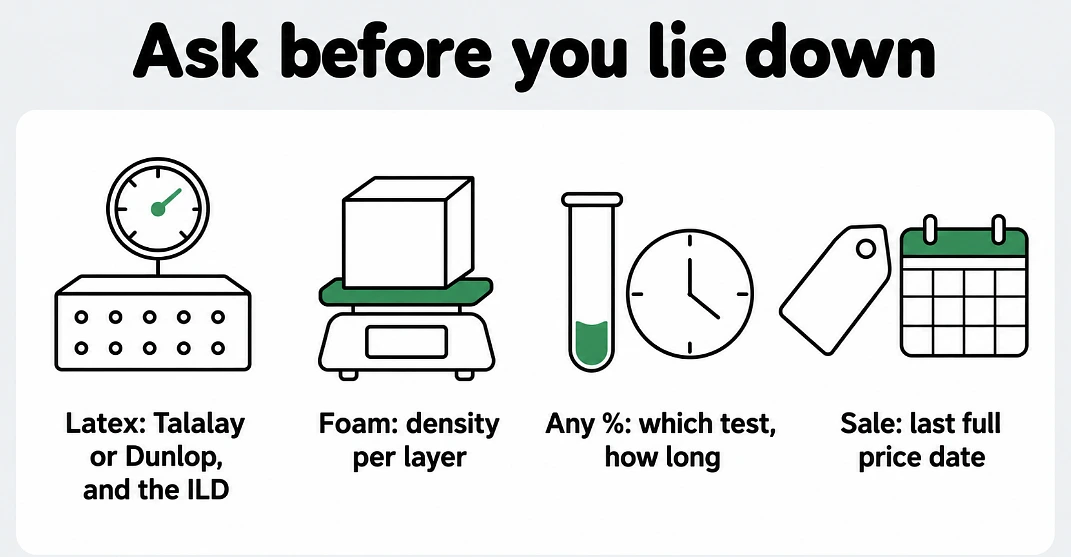
John Ryan by Design, a Yorkshire bed maker whose advice pages date back to 2013, puts the rule in one line: if a retailer or manufacturer cannot or will not tell you, that absence of information should itself tell you something. Sleep Like The Dead said it another way in 2019, that any claim not backed with proof should be dismissed as hype. Ask the four questions that follow and the two materials will sort themselves out on paper before you take your shoes off.
For latex, ask whether it is Dunlop or Talalay, who made the block and what the ILD is. For memory foam, ask for the density of each layer in pounds per cubic foot and whether the foam carries a CertiPUR-US certificate you can see. For any figure with a percentage in it, ask which test standard produced it and over what time. For any sale price, ask when the bed last sold at the full one.
DeRUCCI’s sleep problems to mattress guide walks the longer route from a complaint about sleep to a choice of bed, and the materials named here are the ones used in the beds in its shop. Read the method first, then go and lie down for the 10 minutes the National Bed Federation has always recommended, because there is still no substitute for that.
 Decor & Improvement Accessories