

Home & Decor Blogs: DIY, Interior Design & Lifestyle Ideas
Luxury Backyard Transformations: 7 Ideas That Turn a Yard Into a Living Space

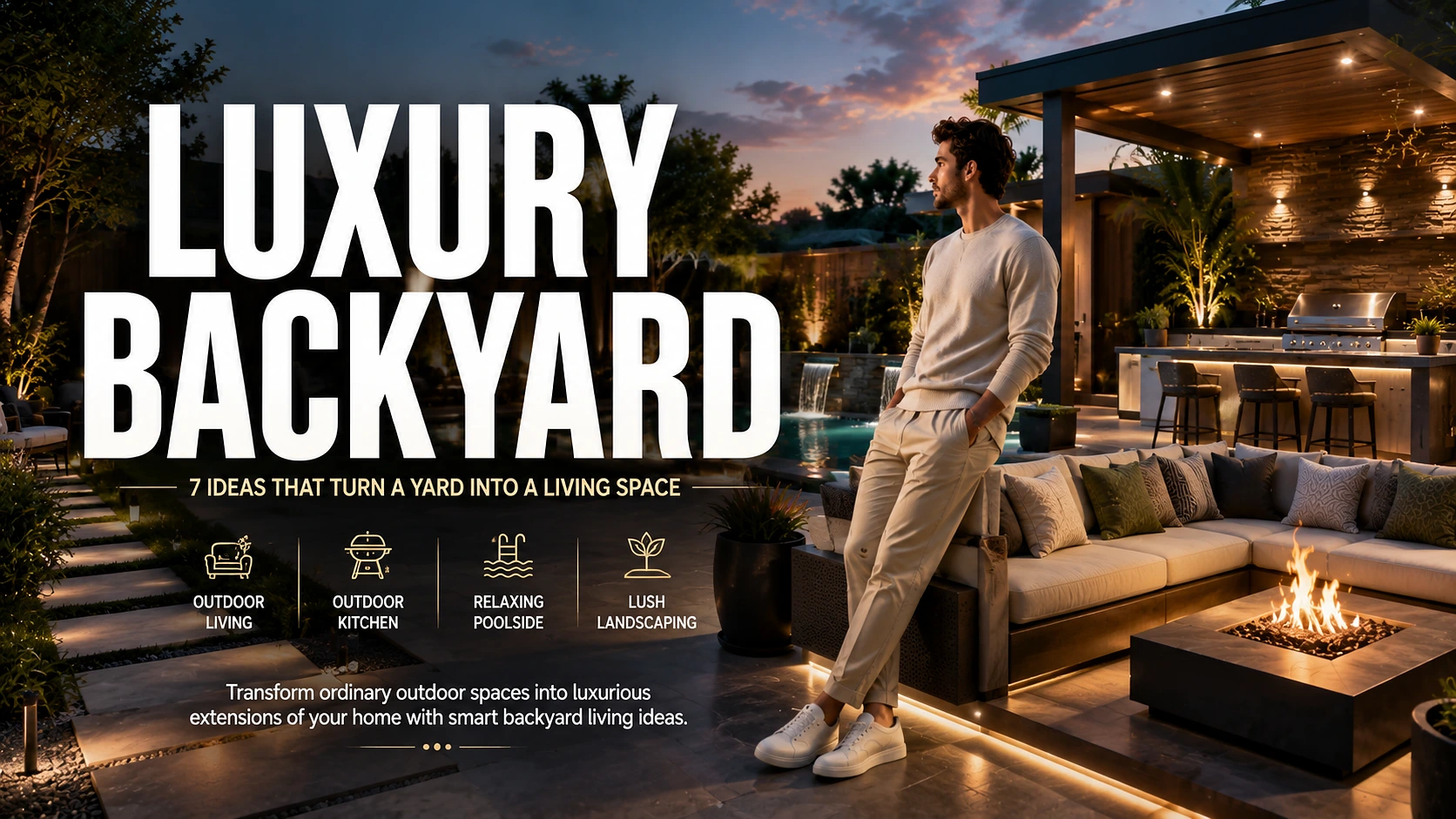
Spend enough time around finished pool projects and you start to notice something. The yards that feel genuinely high-end aren’t always the ones that cost the most. Plenty of six-figure backyards still feel like a pool dropped into a lawn with some furniture scattered around it. The ones that work — the ones people actually live in — got a handful of decisions right early, and most of those decisions happened before anyone broke ground.
Here’s what those decisions actually are, with the specifics that generic advice tends to skip.
1. Start With a Layout That Supports Real Life
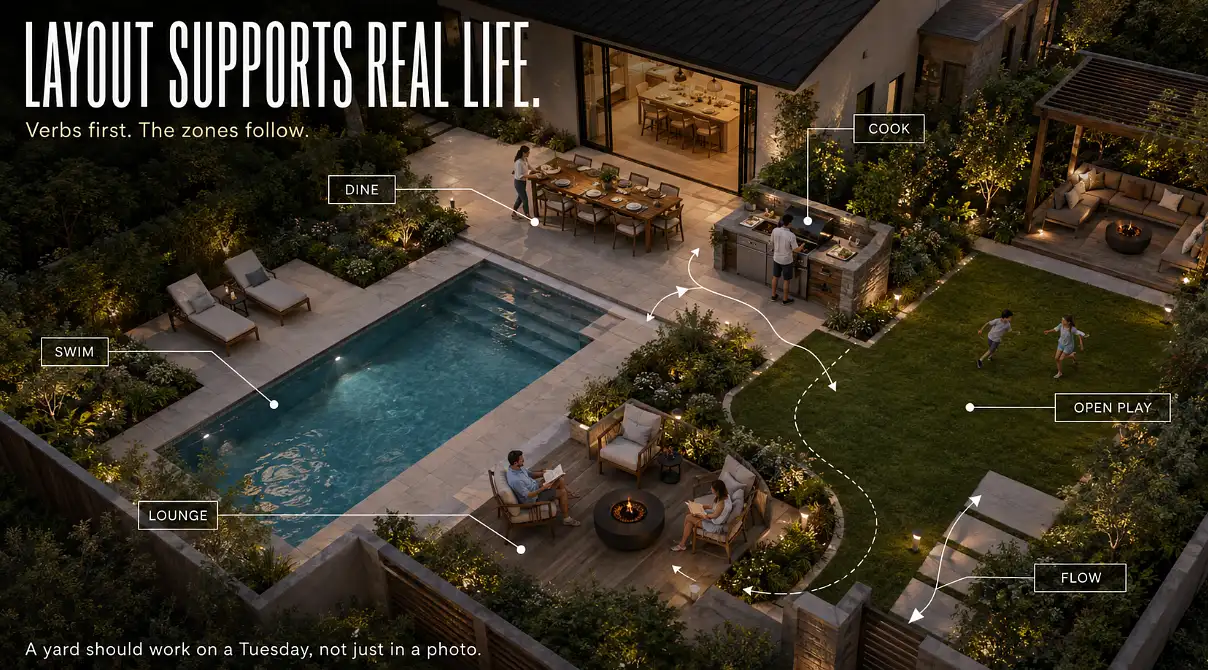
The single most expensive mistake is designing for a photo instead of a Tuesday.
A yard built for weekend entertaining — twelve people, drinks, music — needs a completely different bones than one built for two adults who want to read by the water and eat dinner outside three nights a week. The first one needs circulation space, a bar-height surface, and seating that pulls apart and regroups. The second wants a tighter footprint, a dining zone close to the kitchen door, and not much else competing for attention.
Most people skip this step and let the pool dictate everything, then wonder why the finished yard feels awkward to move through.
Figure out the verbs first. Swim, host, cook, lounge, let the kids run. The verbs decide the zones, and the zones decide nearly everything downstream.
This is also the point where it pays to bring in someone who builds these for a living rather than just sketches them. Homeowners who search for pool contractors near me usually want more than a hole in the ground that holds water — they want a team that can look at the house, the lot, and the way the family actually lives, and design backward from that. That sequencing is where the money either works hard or gets wasted.
2. The Pool Should Look Like It Was Always There
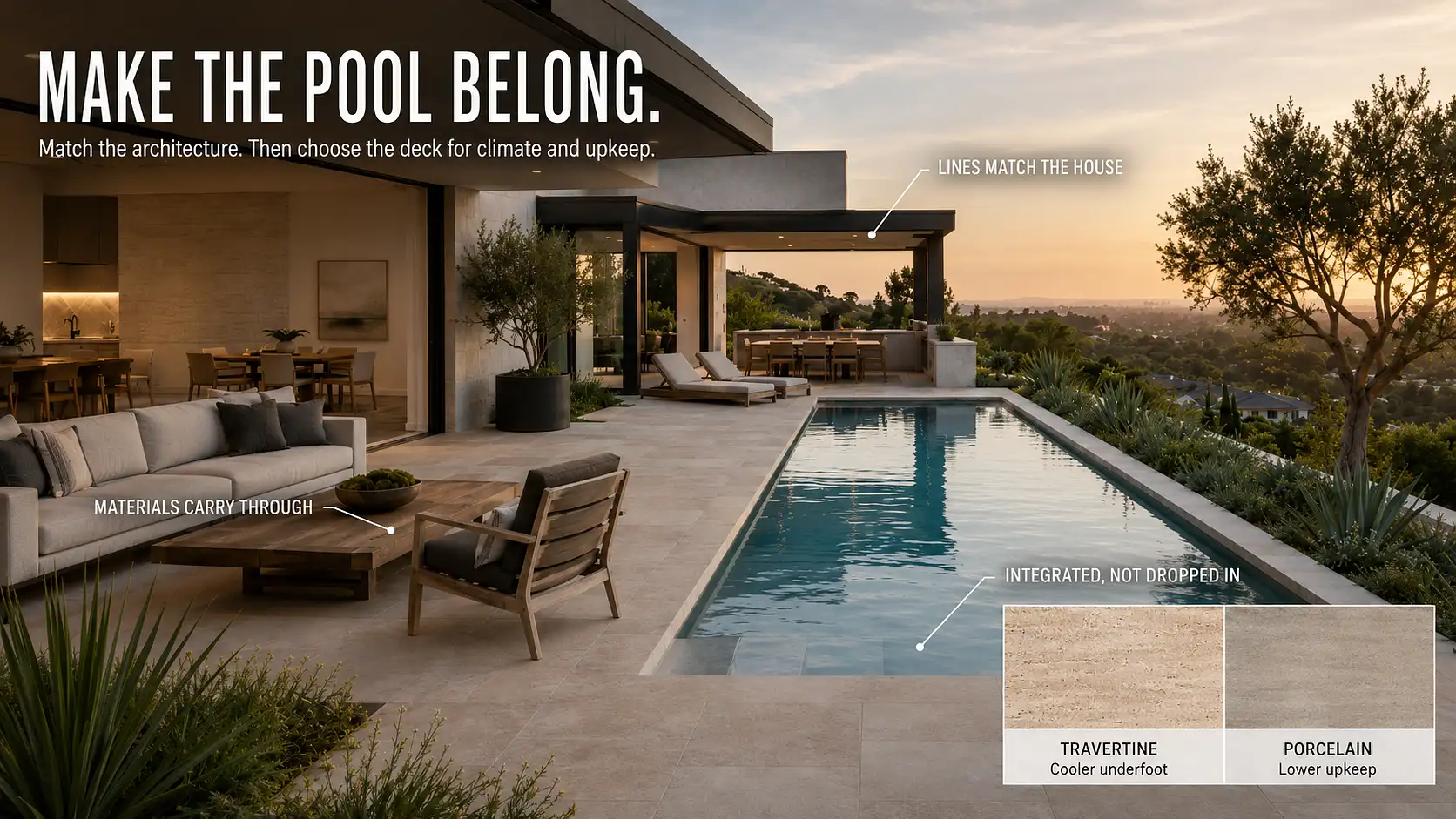
A pool reads as luxury when it looks like part of the house, not an afterthought parked in the middle of the yard. That mostly comes down to lines and materials matching the architecture. A clean rectilinear pool next to a modern flat-roofed house works.
The same pool next to a Spanish-style home with arches and terracotta fights it. Match the geometry, carry the home’s exterior materials or colors into the coping and deck, and the pool stops looking like a separate object.
The deck material is where a lot of this gets decided, and it’s worth being specific because the two common premium choices behave very differently. In direct California summer sun, a light travertine surface can be 20–30°F cooler underfoot than a comparable porcelain tile — which matters enormously if your deck bakes from May through October. Travertine’s natural porous structure and light coloring reflect solar radiation rather than absorbing it, while dense porcelain absorbs and retains heat, and even lighter colors often don’t match travertine for barefoot comfort.
The tradeoff runs the other way on upkeep. Porcelain is close to maintenance-free, while travertine needs professional sealing and periodic resealing to hold up against pool water, salt, and chlorine — though done right, a travertine deck can last 30 to 50 years. Neither one is the “correct” answer. Hot dry climate and barefoot kids point to travertine; a homeowner who never wants to think about sealing points to porcelain. The point is that this is a real decision with real consequences, not a coin flip on what looks nice in the showroom.
3. Use Hardscaping To Give The Yard Structure
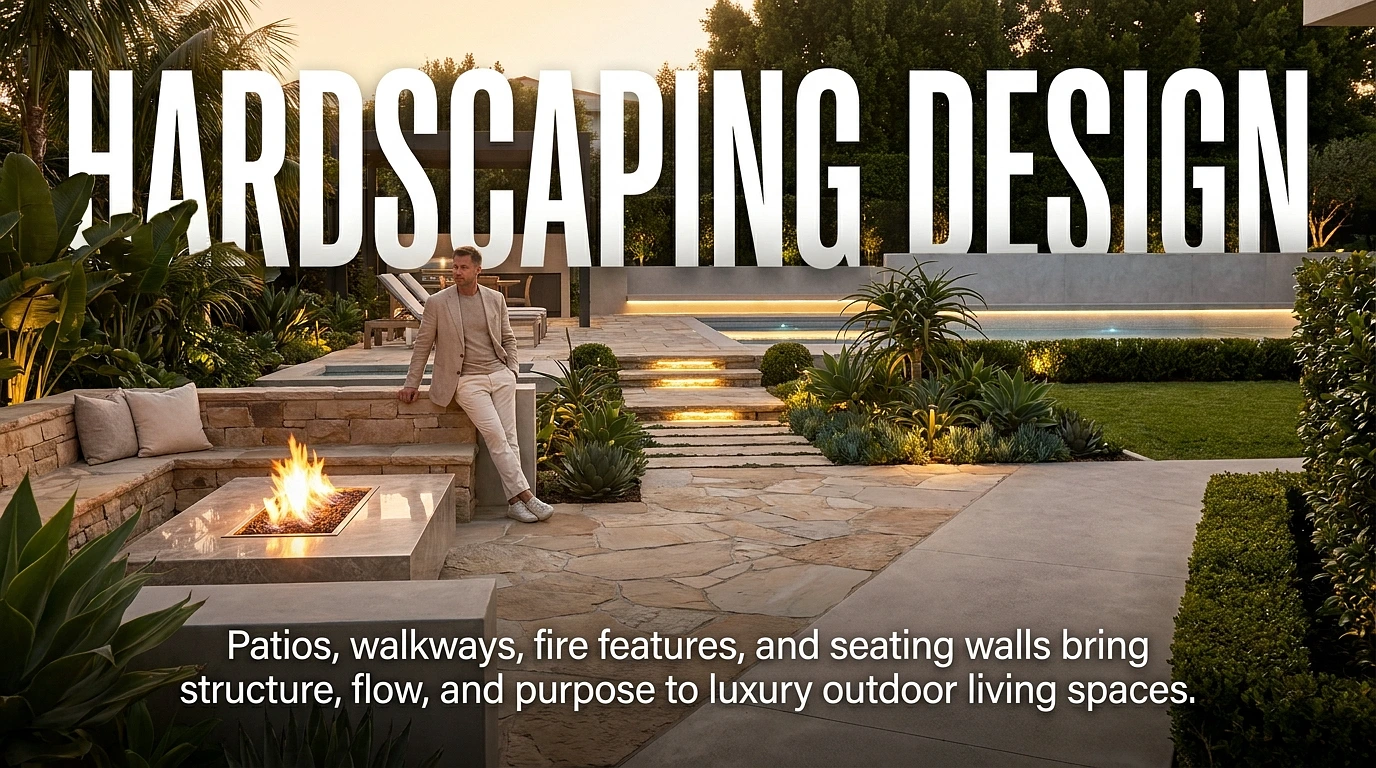
Plants and water get the attention. Hardscaping is what actually holds a yard together. Patios, walkways, retaining walls, seat walls, fire features — these define where you walk, where you sit, and where one zone ends and the next begins. A yard without enough of it feels like furniture floating on grass. A few specific additions tend to earn their cost more than others:
- An oversized patio. People consistently under-size these. A dining set plus circulation room needs more square footage than the showroom photo suggests — usually a good bit more than homeowners first plan for.
- A seat wall around the fire feature. It does double duty: structural edge and built-in seating, so you’re not hauling chairs out every time.
- A continuous material path from the back door to the water. Breaking the walk into mismatched surfaces chops the yard into pieces. One material, carried through, makes the whole space read as bigger.
Stick to two hardscape materials at most. The fastest way to make an expensive yard look cluttered is to use a different stone for the patio, the path, the wall, and the coping. Restraint reads as luxury. Variety reads as a yard that got renovated in four phases without a plan.
4. Add Shade And Comfort Where People Gather
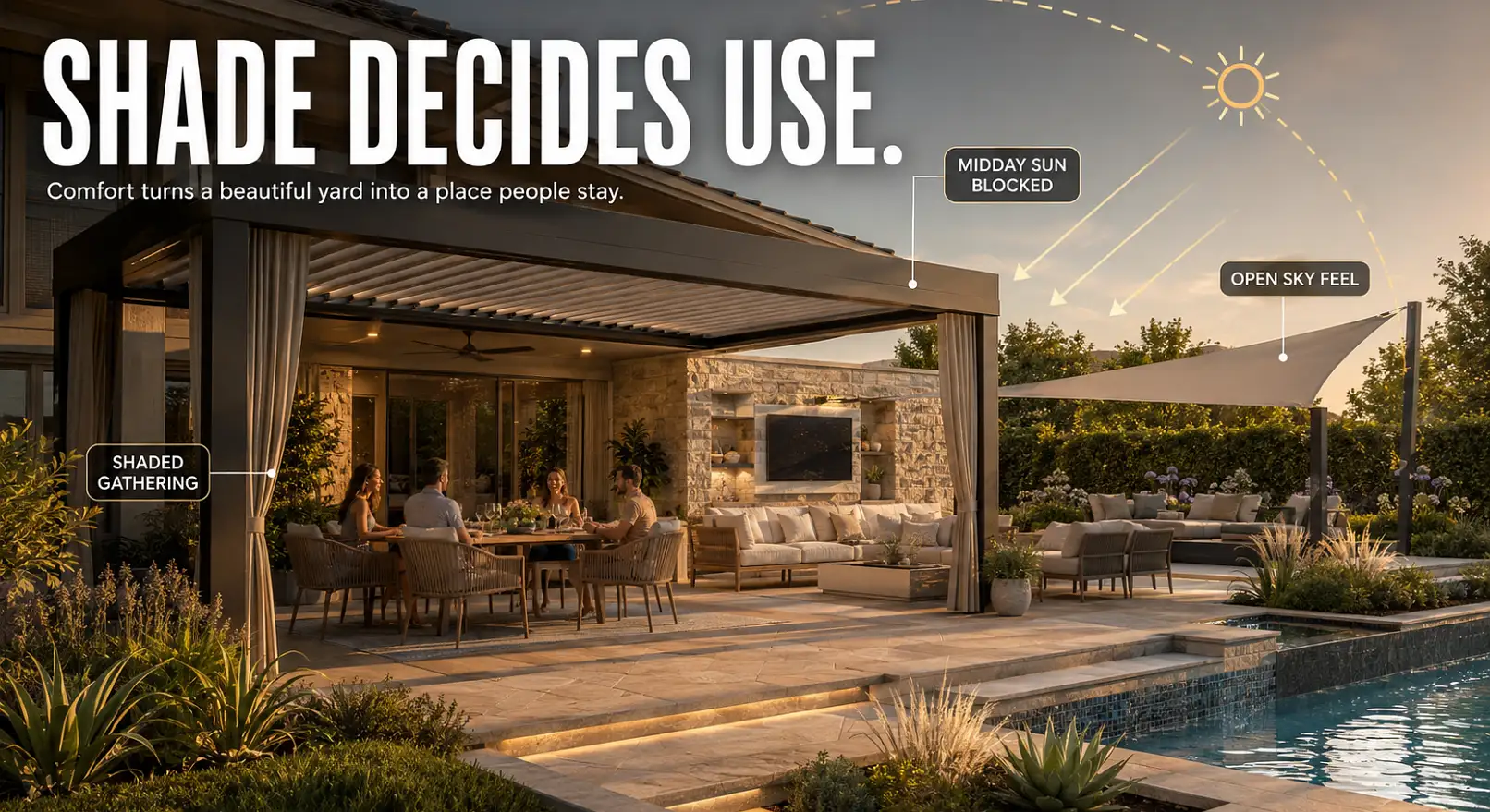
A gorgeous yard that’s unbearable from noon to four is a gorgeous yard you use at 7pm only.
This is the part that looks optional on a rendering and turns out to be the thing that decides how many hours a week the space actually gets used. A pergola, a covered loggia off the house, a stretch of sail shade over the dining zone — any of them can pull the usable window from a couple of evening hours to most of the day. In hot climates it’s not a luxury add-on, it’s the difference between a deck people sit on and a deck they cross quickly on the way to the water.
The trick is blocking the high midday sun without walling the yard in. A solid-roof structure on the west side, or an adjustable louvered pergola you can open and close, handles the worst of the heat while keeping the openness that made the yard feel good in the first place.
5. Choose Lighting That Works After Sunset
The ambiance of the backyard is influenced by outdoor lights after sunset. It also improves safety, highlights architectural details, and gives the property a more polished appearance at night. A effective lighting design involves more than just one brilliant bulb. By stacking various types of light, it produces depth.
Not one bright floodlight — that flattens everything and kills the mood. Good outdoor lighting is layered. Uplights grazing the trunks of mature trees, a soft wash inside the pool, downlights tucked under cap stones on the seat walls, low path lights at ankle height. Each one does a different job, and stacked together they build depth instead of glare.
For residential work this almost always means a low-voltage system. Low-voltage landscape lighting runs on 12 volts through a transformer, lowers the risk of shock, is easier to install since the cable doesn’t need deep burial, and comes in far more fixture and bulb options than line voltage. It also operates safely in wet locations, so you can run it right up to the pool or a water feature without worrying about it. Line voltage at 120V exists, but it’s labor-intensive, usually needs an electrician, and is really meant for lighting large areas with a few very bright fixtures — the wrong tool for the subtle, layered look you actually want around a pool.
The bonus: lighting is forgiving. It highlights the parts of the yard worth showing off and quietly drops the parts that aren’t into shadow.
6. Use Plants To Soften The Edges
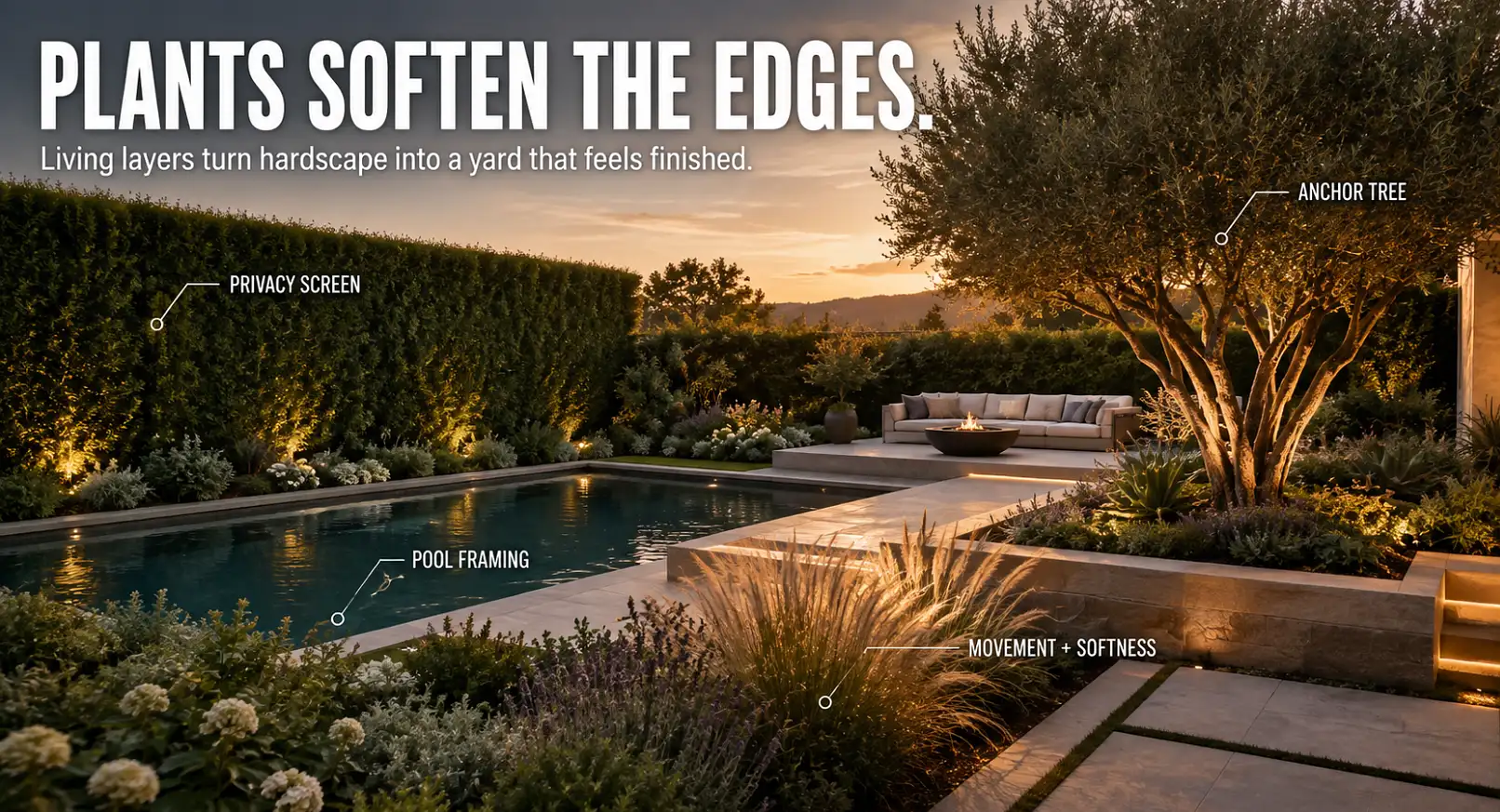
All that stone, tile, and concrete needs something living to push against, or the whole yard feels hard. Greenery softens the edges and ties the built elements back into the landscape, but vague advice like “add some plants” is exactly what produces forgettable yards. Be specific about what each planting is doing.
Tall, dense hedging — think podocarpus or clumping bamboo in the right climate — builds privacy screens along a fence line. Layered shrubs frame a pool without crowding it. A specimen tree like a multi-trunk olive or a Japanese maple gives a corner an anchor. Ornamental grasses bring movement when the wind picks up, which is the thing photos never capture but you notice constantly in person.
Match the palette to your climate and your water budget honestly. A lush tropical look in a drought region means a water bill you’ll resent and plants that struggle. The yards that age well usually lean into what actually thrives where they are, rather than fighting the region for a look borrowed from a magazine shot in a different one.
7. Focus On Details That Make The Space Feel Finished
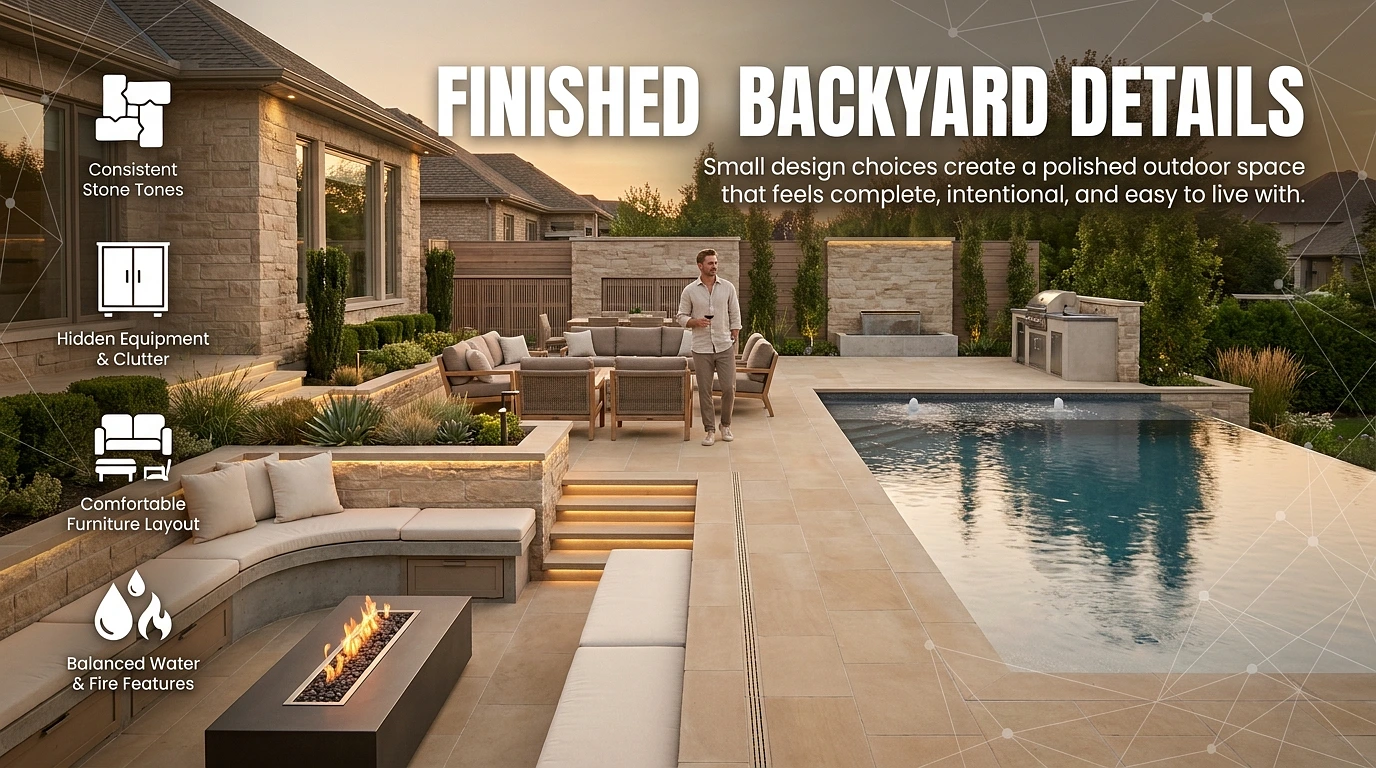
You can usually tell a carefully designed yard from a merely expensive one in the parts nobody points at directly.
Coordinated material tones across the whole space. Sightlines arranged so the pool equipment, the pump, and the hose bib are tucked out of view rather than staring back at you from a lounge chair. Drainage that actually moves water off the deck instead of pooling it. Furniture placed around the natural gathering points instead of pushed to the perimeter like a waiting room. None of it announces itself. All of it is the reason one yard feels resolved and another feels almost-right.
A finished backyard tends to share a few of these:
- Consistent stone and paver tones that read as one decision, not several.
- Equipment and clutter hidden behind planting or screens, off the main sightlines.
- Comfortable, conversational furniture spacing — close enough to talk, not shouting across a void.
- Water and fire elements that add a little motion and sound without taking over.
These finishing touches do not usually dominate the design, but they shape how people experience it every day.
What Homeowners Notice First
The majority of homeowners choose comfort above technical design. When the pool suits the yard, the layout makes sense, and the area encourages them to spend more time outdoors, they sense it. For this reason, flow is just as important to the greatest outdoor projects as beauty.
They also take note of how simple it is to maintain the yard. A luxurious area should seem kind rather than demanding. That objective is aided by sensible placement, sturdy materials, and clean surfaces. In this way, luxury is not about going overboard. It’s about having a well-functioning but polished yard.
 Decor & Improvement Accessories