

Home & Decor Blogs: DIY, Interior Design & Lifestyle Ideas
Property Management in Atlanta: How to Choose, What It Costs, and What Georgia Law Now Expects
Quick answer: full service management in metro Atlanta runs 8 to 10 percent of collected rent, which works out to roughly $150 to $190 a month on a typical home, plus a leasing fee of 50 to 100 percent of the first month when a new tenant gets placed. Whether that money is worth it mostly comes down to three things, how close you live to the property, whether you know Georgia’s rules since the 2024 Safe at Home Act rewrote them, and what one bad month costs you compared to twelve average ones. The sections below walk through the neighborhoods, the law, the fee math on a real rental, and how to interview a company before you sign anything.
Atlanta Rents Are a Street by Street Business

The first thing to understand about this market is that there is honestly no such thing as an Atlanta rental strategy, because Decatur is its own little world with a courthouse square and tenants who ask about school districts before they ask about the kitchen, Kirkwood and Grant Park fill bungalows with people who want a porch and a MARTA stop, Buckhead towers rent on amenities and commute time, and out in Roswell or Sandy Springs the family renter wants space and a yard and will trade fifteen minutes of drive for it. Rent that a place fifty dollars wrong for its street and it either sits empty or fills with the wrong applicant pool, and both of those outcomes cost more than any management fee does. Which is why single market depth matters more here than brand size, and it is a whole business model at this point, Atlanta specialized property management firms staff people who can tell you from memory what a Grant Park bungalow pulls against a Smyrna townhome, and that kind of memory shows up directly in your vacancy numbers.
Georgia Law Got Teeth in 2024, and Most Self Managers Have Not Caught Up

For most of its history Georgia was about as landlord friendly as states get, and then the Safe at Home Act passed in 2024 and changed the ground rules in ways that still surprise owners. The state wrote a duty of habitability into law for the first time, capped security deposits at two months’ rent under the statute, and gave tenants a short cure window to pay before a landlord can file for eviction. The deposit rules were already a trap and now they are a bigger one, you have thirty days after move out to return the money or send a written itemized statement, the law expects proper move in and move out inspection records behind any deduction, and getting it wrong exposes you to triple damages plus attorney fees, which on a two month deposit from an $1,800 rental means a mistake that can cost more than five years of management fees. Eviction here runs through the county dispossessory process, and the practical reality is that Fulton, DeKalb, Cobb and Gwinnett each move at their own speed with their own paperwork habits, so the owner who has never filed one learns the process during the worst month of their ownership. And after the Atlanta squatting cases made national news, Georgia tightened its removal process too, which helps, but only if whoever is managing the property documents things properly from day one.
The Fee Math, Worked Out on a Real Rental
Take an ordinary $1,800 a month single family rental, which is a very normal Atlanta number. Full service management at ten percent costs $180 a month, so $2,160 a year, and the Georgia surveyed average is actually a touch lower at 8.03 percent of collected rent. Add a leasing fee somewhere between half and all of the first month when a tenant turns over, inspections at $50 to $150 each if they bill separately, and you are looking at roughly $3,000 in a year that includes one tenant placement. Some companies offer flat fees instead, the Georgia average is around $101 a month, which looks tempting on higher rent homes but can dull the company’s incentive to push your rent up. And one detail that separates the good contracts from the bad ones: ask whether the fee is charged on rent collected or rent due, because rent collected means the manager only earns when you do, and that is the owner friendly standard worth insisting on.
Now the other column, which is the one people skip. One extra week of vacancy costs about $450 on that same rental, and self managed properties tend to sit longer because the listing goes up slower, the photos are worse, and showings wait for your work schedule. Repairs run at retail without a vendor network, and managed portfolios typically get 10 to 25 percent off common jobs just through volume. Then there is the legal column from the section above, where one deposit mistake can outcost years of fees. So is it worth it for a single rental, which is the question every owner with one property eventually types into Google at midnight. The honest answer is that it depends on whether you are nearby, whether you enjoy the work, and whether you know the dispossessory process in your county, because when all three of those are true, self managing one local rental genuinely works, and when any of them slips, the fee starts looking like cheap insurance.
How to Interview a Management Company Before You Sign
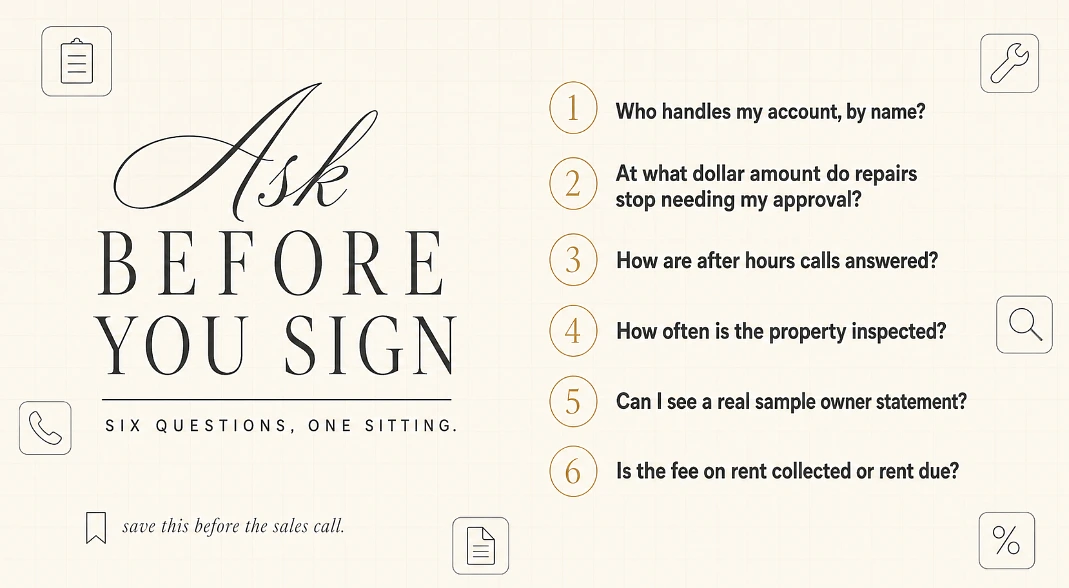
The sales call always sounds good, so make the questions specific. Ask who handles your account day to day and by name, how home maintenance approvals work and at what dollar amount they stop asking you, how after hours calls get answered, how often the property gets inspected, and what a monthly owner statement looks like, ask them to send you a real sample. Ask how screening runs step by step, income verification, rental history, credit, eviction search, because careful screening is the single strongest protection you have, and companies that do it properly keep their eviction rates under one percent. Red flags worth walking away from:
- Fee schedules they cannot explain in one sitting, or that scatter charges across setup fees, markup fees, and renewal fees without a total.
- Vague answers about screening standards, since vague standards fill units fast and empty them expensively.
- Slow replies during the sales process, because that is them at their most motivated.
- Contracts charging on rent due rather than rent collected.
And when you compare two companies side by side, the difference usually shows up in the same four places:
| The situation | The weak company | The strong company |
|---|---|---|
| A vacancy | Waits for leads | Adjusts price and marketing inside the first two weeks |
| A repair | Sends whoever answers | Sends a vetted vendor at a negotiated rate |
| Your statement | A total with no story | Line items you can hand to your accountant |
| A tenant issue | Reacts after it escalates | Documents early and communicates before it grows |
One last note for anyone holding commercial property here, the mechanics differ, leases run years instead of twelve months, maintenance costs often pass through to tenants, and the compliance load shifts from habitability law to lease enforcement, so hire someone who does commercial as a practice and never as a favor.
The position this article takes, plainly: if you live within half an hour of your rental, know the Safe at Home Act, and have three good vendors saved in your phone, manage it yourself and keep the fee. Everyone else in Atlanta should pay the 8 to 10 percent, because the math above stops being close the first time a deposit dispute, a July air conditioner, and a vacancy land in the same season, and in this market they eventually do.

 Decor & Improvement Accessories