

Home & Decor Blogs: DIY, Interior Design & Lifestyle Ideas
Sewer Problems Homeowners in Raleigh Should Never Ignore
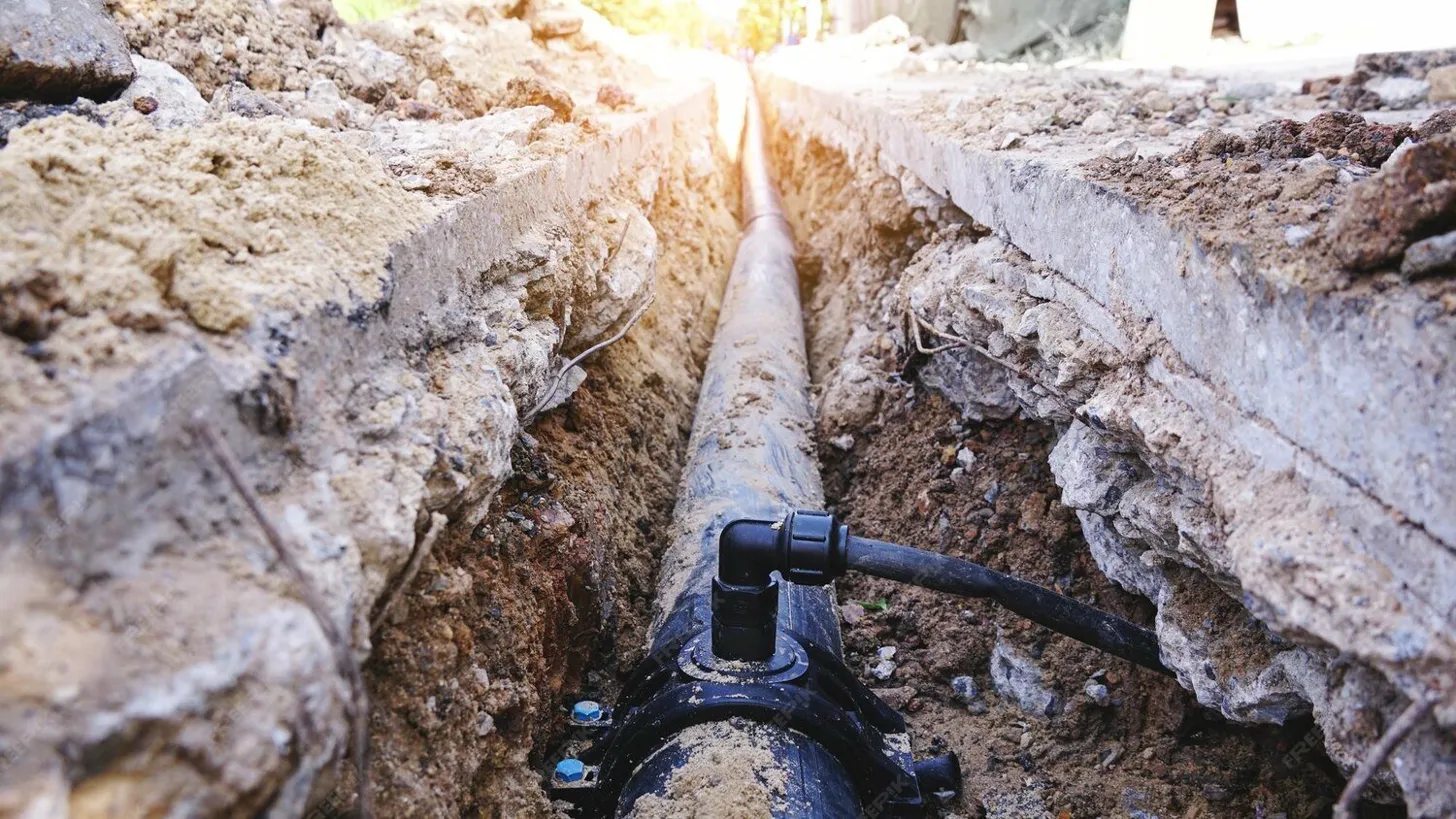
A sewer line doesn’t fail like a lightbulb — on one second, dead the next. It deteriorates over months and years, a hairline crack letting in a root tendril. The root grows. Grease catches on the root. The paper catches on the grease. Six months later your shower drain gurgles every time you flush and you keep telling yourself it’s probably nothing, because the alternative is a phone call you do not want to make.
It’s worse in Raleigh because the clay soil beneath much of the metro area boils and cracks when it rains and contracts when it dries, year after year, stressing buried pipes. There are still houses in older neighborhoods such as Cameron Park and Oakwood with 40, 50 and sometimes 60 year old original clay or cast iron lines. Those materials crack. Joints separate. And all those gorgeous oaks and maples lining the streets? Their roots are underground doing exactly what roots do — chasing moisture straight into your compromised pipe.
Multiple Drains Going Slow at the Same Time
If one of the sinks is slow, that’s a local clog — hair, soap deposits, food particles, which can be remedied with a $15 hand snake at the hardware store or a plunger.
If several fixtures go slow at once, however, it’s no longer a local issue. The kitchen sink is backed up, and the water in the bathtub is also backed up and the water level in the toilet bowl is fluctuating, that’s a sign of a partial clog in the main sewer line that is connecting your home to the city sewer system. All the house’s structure is based on that one pipe. Partial blockages won’t clear on their own, they will accumulate more debris, the flow will become even more clogged, and eventually you will have a full blockage with raw sewage pouring up through the lowest drain in the house.
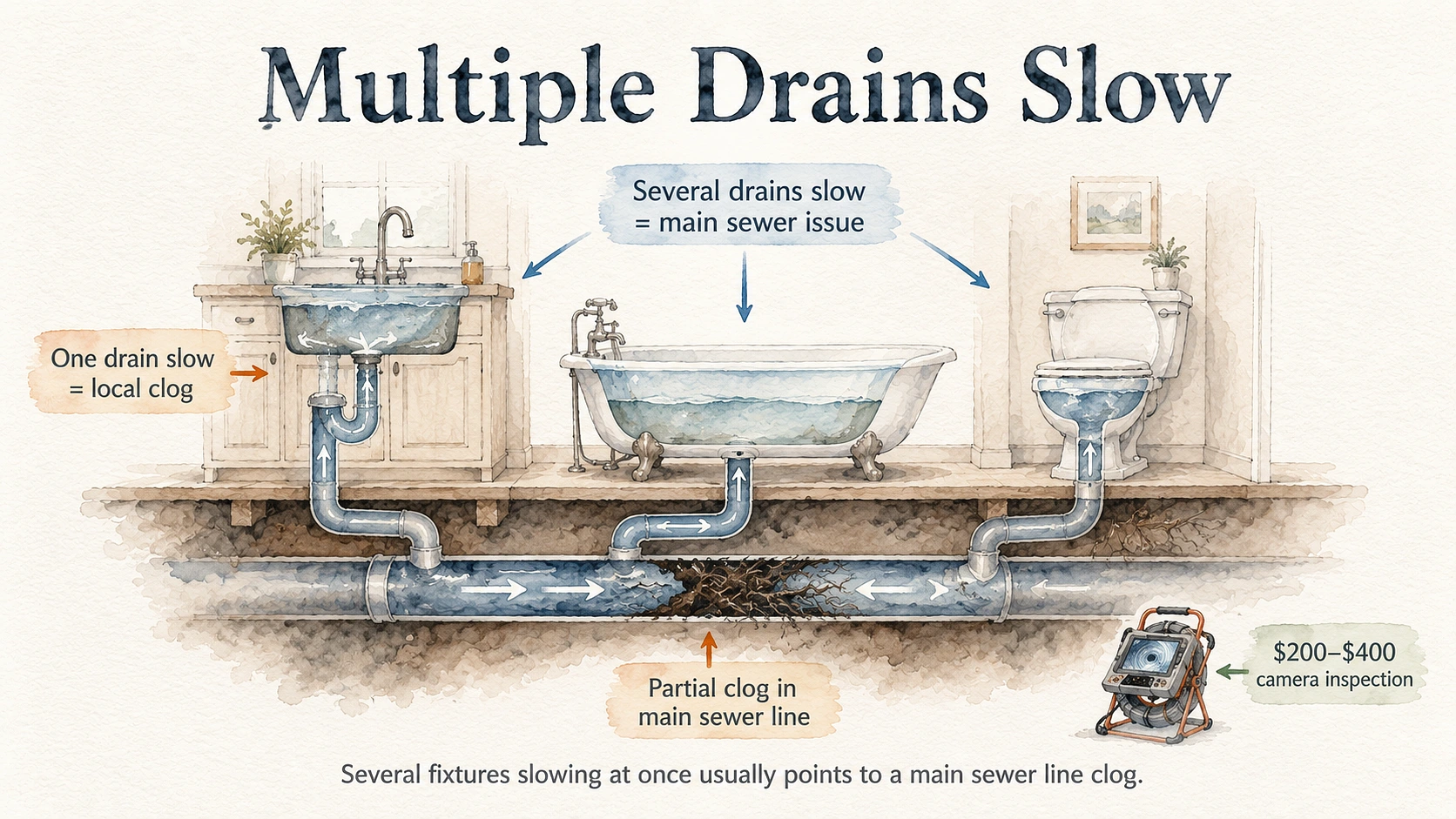
Most Raleigh plumbers charge between $200 and $400 for a camera inspection, and it will reveal to you what is clogging the line and where. Affordable Flood Insurance for basements.
That Rotten Egg Smell Near the Drains
The water traps under all drains, vent pipes that run up through the roof and wax seals under toilets are built into your plumbing as protection against sewer gas entering the home. If you notice a foul odor in the vicinity of a drain or near the basement, one of those barriers has failed.
It can be a leaky underground pipe, a dry bathroom trap or a leaky vent stack on the roof — and sometimes it’s just a leaky vent stack that’s so hard to see you never look up there. The gas is a mixture of hydrogen sulfide and methane, and low concentrations are nothing but a nuisance, while higher levels cause headaches, dizziness and nausea.
If you have sewage odors outside your home, around the yard or near the foundation, then most likely the sanitary line has broken, and sewage is leaking into the ground. That crack won’t go away on its own, it will only get bigger, the leak will only get bigger, and the soil around the crack will become contaminated.
The Yard Is Telling You Something
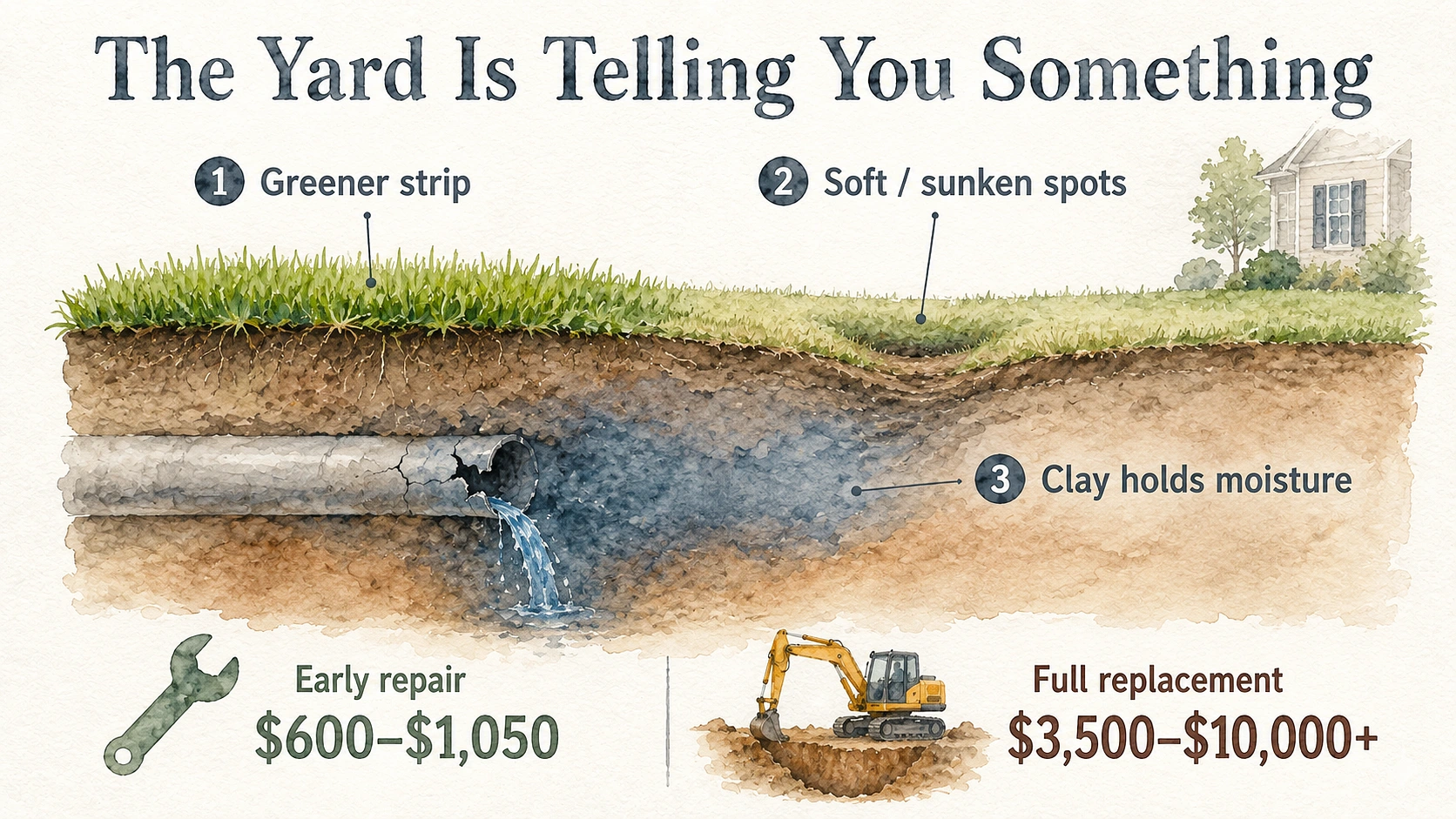
Your grass will tell you before anything else does. A strip of lawn that’s noticeably greener and thicker than the rest of the yard — especially when it has not rained — is getting fed by something underground. If there is no irrigation line running through that spot, it is getting fed by a leaking sewer pipe (the wastewater basically acts as fertilizer, so the grass loves it even though your pipe is falling apart).
Soft or sunken spots are further along the damage timeline. A pipe that has been leaking long enough saturates the surrounding clay, the soil shifts, the surface sinks. More commonly you get uneven settling and soft patches — actual sinkholes from residential sewer leaks are rare, though at least one has been documented in Raleigh’s Oakwood neighborhood.
Why does Raleigh clay make this worse? Because clay holds moisture instead of draining it away. A leak that might not cause visible surface problems in sandy coastal soil creates obvious damage faster in the Triangle — the water just sits there eroding the ground around the pipe from the inside out.
Cost-wise, the gap between early and late intervention is brutal. A spot repair on a cracked section runs $600 to about $1,050. Full line replacement when the whole thing has deteriorated can run $3,500 on the low end and push well past $10,000 when you factor in depth, length, access complications, and restoring whatever the dig tore up.
Backups That Keep Coming Back After You Snake Them
You snake it. It clears. Three weeks later, same problem. Snake it again. Clears again. Six weeks this time. Then four. Then two.
That shrinking interval is the pipe telling you the snake is not solving anything — it is just temporarily pushing past a problem that is getting worse. In Raleigh, recurring backups almost always trace to one of two things, and both of them need more than a snake.
The first and more common one is tree roots. They find sewer lines through cracks no bigger than a hair, and once inside they expand and create a net that catches everything flowing through the pipe. Snaking cuts through the root mass temporarily but the roots grow back, and they grow back faster each time because the crack that let them in keeps widening. Those oaks in Oakwood and the maples in Five Points are beautiful from the street — underground they are relentless.
The other culprit is bellying, which is what happens when Raleigh’s shifting clay causes a section of pipe to sag and create a low spot. Wastewater pools there instead of flowing through. Debris settles in the belly. Snaking clears the debris but does nothing about the sag, so the belly fills up again — same spot, same problem, over and over.
Camera inspection tells you which one you are dealing with. Costs $200 to $400 and saves you from guessing wrong.
What actually fixes it once you know? Hydro jetting is the first step up from snaking — high-pressure water that clears root masses and heavy buildup far more thoroughly. Runs $350 to $600 in the Raleigh area and works well for roots that have not cracked the pipe wide open yet.
If the pipe itself is damaged, you are looking at trenchless. Two main options here. Lining means a resin-coated liner gets pulled into the old pipe, inflated, and cured in place — basically a new pipe formed inside the old one. Runs $60 to $250 per foot depending on diameter and access, lasts 50 years, no digging required. Pipe bursting is for when the old pipe is too far gone for lining — a bursting head pulls new pipe through while fracturing the old one outward into the surrounding soil. Similar price range, sometimes higher depending on depth and what is above the pipe.
Trenchless is the go-to in Raleigh for a practical reason — digging through that Piedmont clay is slow and expensive and tears up yards. Excavation in this soil can double the labor time compared to sandier ground, which is why most contractors around here have moved toward trenchless. Rooter & Sons is one of the local companies that handles sewer line repair in Raleigh using these methods, and they default to lining or bursting over excavation unless the pipe is too collapsed for trenchless to work.
Cracks Showing Up Inside the House
Wall cracks near door frames, floors that feel slightly uneven, doors that used to close fine and now stick — most people do not connect these to plumbing, and honestly a lot of the time they are just normal settling. Houses move, especially older ones. A sewer leak is hardly a common cause of foundation movement, as it can be caused by poor grading around the house, bad gutter drainage, or large trees growing close to the foundation. However, if interior cracking occurs in conjunction with any other symptom from this list (slow drains, yard problems, odors) this is something to consider since a leaky pipe can be exacerbating existing soil movement.
When a sewer pipe leaks close to a foundation, it causes additional water to be added to the clay below and around the foundation. The clay expands more than it would alone and when dry shrinks even harder. It’s a push-pull that builds up the pressure on the foundation over the course of a year or two, and over time they pressure the masonry enough to crack drywall, lean a door frame, etc.
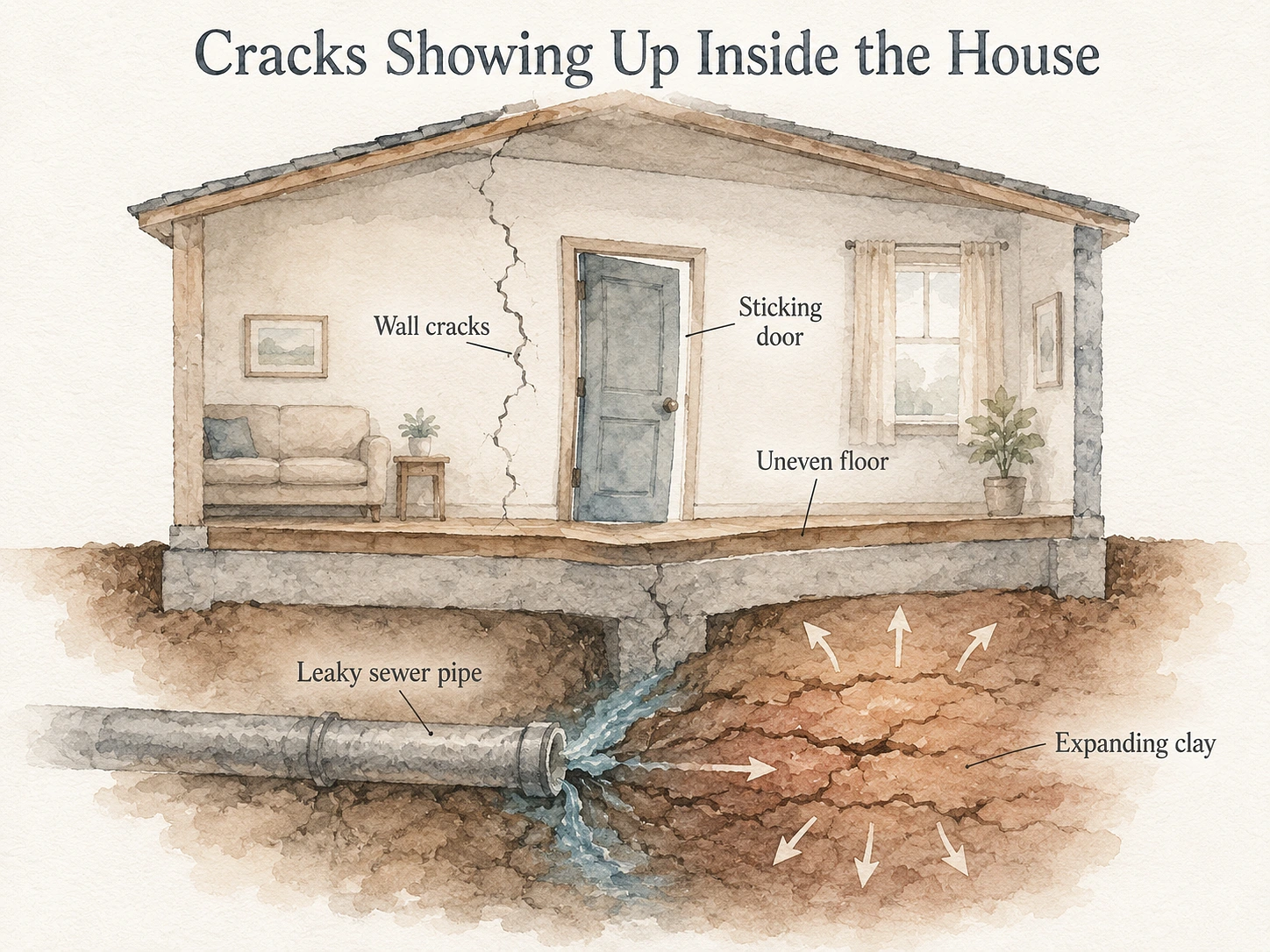
The cost of repairing the foundations is much more than repairing sewers. A $2000 expenditure at this time for the pipe will save you a $15,000 expenditure later when the structure under your home needs to be fixed.
Damp Basement With No Obvious Water Source
If there is mold in the basement or crawl space, if there is no leaking water heater, etc., etc., where is the moisture coming from? A cracked sewer pipe under or near the foundation may slowly leak water into the ground around it, not a massive leak, but just enough moisture to cause the soil to stay moist, and the concrete to be moist enough, for mold to grow. The moisture from sewer lines will show in the bottom of the house first as they run at or below foundation level.
The treatment of the mold without addressing the moisture source is an endless cycle.
What the Numbers Look Like
| Repair Type | Rough Cost |
|---|---|
| Camera inspection | $200–$400 |
| Snaking a line | $150–$600 (Raleigh avg ~$460) |
| Hydro jetting | $350–$600 |
| Spot repair on a cracked section | $600–$1,050 |
| Trenchless lining or bursting | $60–$250/ft |
| Full line replacement | $3,500–$16,000+ locally |
| Yard/driveway restoration after dig | $1–$25/sq ft on top |
Raleigh pricing tends to run higher than national averages — the red clay makes digging slower and more expensive especially in wet conditions, mature landscaping complicates access, and pre-1980 homes with clay pipes are harder to work with because the material is brittle and the pipes are often deeper than modern PVC installations. Trenchless stays competitive once you factor in the yard and driveway restoration costs that excavation adds on top.
Get three quotes. Not generic advice — it actually matters here because the right repair method depends on your specific pipe condition, depth, soil type, and property layout. A company that primarily does trenchless work will see your problem differently than one that primarily excavates — different diagnosis, different scope, different number on the invoice.
Raleigh’s clay, its old pipes, its massive trees — all of it means sewer issues are baked into homeownership here. The only real question is whether you deal with a problem on your terms or on the problem’s terms. One of those involves a phone call and a scheduled appointment. The other involves sewage on the bathroom floor.
 Decor & Improvement Accessories