

Home & Decor Blogs: DIY, Interior Design & Lifestyle Ideas
Smarter Garden Watering: How To Measure And Manage Outdoor Water Use

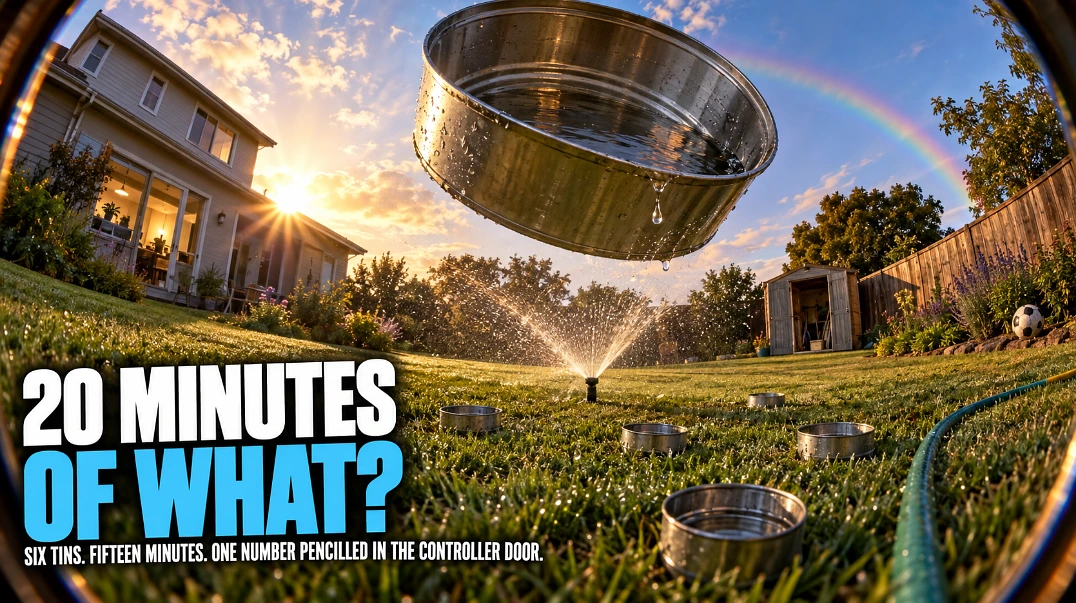
The sprinkler comes on at 7 in the evening and goes off at 7:20. It has been 20 minutes for 3 years. Somebody set it that way the first summer, nothing obviously died, and so 20 minutes became the rule of the house. What none of them can tell you is what 20 minutes actually puts on the grass. Could be a quarter of an inch. Could be an inch and a half. That gap can strongly influence whether the grass sends roots 6 inches down or keeps the lot of them in the top couple of inches, sitting there waiting to fry in August. The garden is not being watered on a schedule. It is being watered on a guess that got repeated until it started to look like one.
Which means the useful question was never how long to run the thing. It is how much comes out of it while it runs, and a handful of empty tuna tins will tell you inside 15 minutes.
How Much Water A Lawn Needs In A Week

Many established lawns need roughly 1 to 1.5 inches a week during active growth, including rainfall, though actual demand shifts with grass type, soil and weather. Colorado State reckons a lawn in a hot, dry spell can climb to 2 or 2.25 inches. Drought tolerant grasses sit well under it. And 2 days of decent rain in a week usually means the timer should have been left alone that week.
Usually one to three deeper irrigations are preferable to daily light watering, provided the soil can take the water without runoff. Water that soaks in properly gives roots a reason to chase it further down. That said, watering alone does not dictate root depth, oxygen does, so does compaction, so does the species you are standing on. Deeper rooted turf copes better between waterings. Shallow rooted turf wilts sooner, the owner reaches for the timer, and the whole thing stays shallow.
An inch across 1,000 square feet is about 623 gallons. Worth committing to memory, because it drags a woolly target into something a hose can be held against.
How To Measure Your Sprinkler Or Hose Output
Two methods, neither one eats half an hour. For a sprinkler, scatter at least 6 identical straight sided tins over the watering pattern, a few close to the heads, a few stranded midway between them. Run the zone 15 minutes. Measure each tin with a ruler, average the readings. Multiply that average by 4 and you have the output in inches per hour. Quarter of an inch in 15 minutes means the zone throws an inch an hour, so your inch a week is one 30 minute soak twice a week, not 20 minutes every night since March.
The hose is easier. Using a 1 gallon bucket, divide 60 by the number of seconds it takes to fill. Fills in 20 seconds, you are running 3 gallons a minute. A flow meter does that same sum all day instead of once, and a water flow meter sat between tap and hose counts the gallons or liters going past. It pays off on a drip or soaker line more than a sprinkler, since emitters dribble so slowly that a tin test on them is an afternoon gone.
The tins moonlight while they sit there. They show you how evenly the zone covers. Half an inch in one and an eighth in the next is not the clock playing up. The distribution is wrong, and no amount of adjusting the controller will fix that.
Why Two Zones On One Timer Deliver Different Amounts
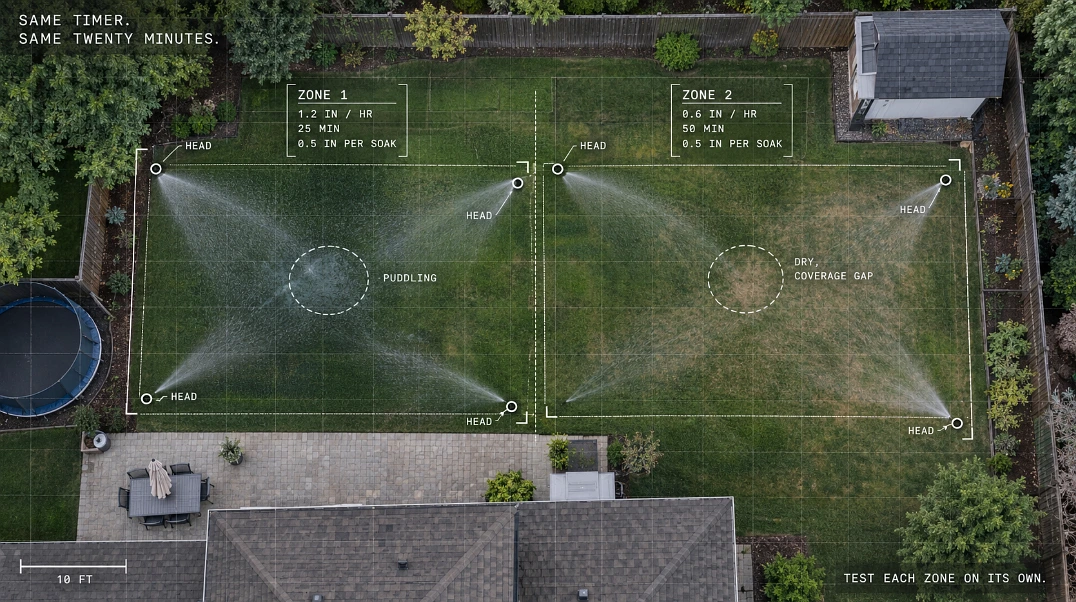
Two zones on one controller, same 20 minutes each, routinely hand out wildly different amounts. Pressure bleeds off along the line. Heads sit at whatever spacing the installer fancied. Spray overlap changes from one corner of a garden to another. One zone might throw 1.2 inches an hour while its neighbour scrapes 0.6, so a single runtime drowns the first and shortchanges the second, every cycle, right through the season. That is the argument for testing each zone on its own rather than testing one and assuming the rest behave like it.
Does it want repeating? Not every few weeks. Redo it when coverage changes, and fold it into maintenance now and then. Numbers slide without anybody touching a spanner. Nozzles silt up, a head settles an inch into soft ground, pressure shifts, a shrub fattens up and starts blocking half the arc.
How To Spot A Broken Head Or A Slow Leak
One cracked head drowns its own patch and abandons another 4 feet away. The instinct is to give the dry bit more minutes, which just floods the wet bit harder. A head clipped by a mower will cheerfully water the driveway all summer, and no driveway has ever wanted 623 gallons a week. Walking the zone while it runs, once in spring and once in midsummer, catches all of this. Ten minutes, and nothing else here pays back faster.
Leaks are sneakier, which is what makes them costly. A split hose, or a valve that no longer seats, can run for weeks without anyone twigging, because the garden still looks watered. You find out on a bill 6 weeks later. A meter reading taken with the whole system off settles it. If the number is moving while nothing is running, water is going somewhere it should not be going.
When To Water, And What Mulch Changes
Water put down in the early morning goes onto cool ground with little wind about. Less burns off before it reaches soil, and the blades dry out over the day. Colorado State marks the efficient stretch as roughly 9 at night to 9 in the morning, evaporation being low through the dark hours, and early morning sits at the good end of that because the canopy then gets the daylight to dry. Leaves left wet a long time can encourage some diseases, which is the standard case against late watering, though an evening soak is not automatically a mistake. Midday is generally the least efficient time for overhead watering, between evaporation and wind.
Mulch pins moisture in the soil rather than letting it lift off the surface. Group plants with similar thirst and you stop drowning half a bed to satisfy the other half. Drip lines feed roots instead of leaves. None of it is new, all of it works, and all of it works harder once you know your flow number, because mulching is meant to buy you fewer waterings and without measuring you never find out whether it did.
What you are left with is a lawn on 2 or 3 soaks a week instead of 7, a stack of tins on a shelf in the shed, a figure pencilled inside the controller door for every zone, and a sprinkler that starts at 5 in the morning while the house is still asleep.
 Decor & Improvement Accessories